Featured Post

Thursday, November 30, 2023

Annals of Design: Why So Many SUVs & Pickups, and Why So Dumb-Looking?


Remember modern cars?  You know, in that brief period when everything was getting sleeker and closer to the road, when American manufacturers were finally abandoning pushrods for overhead cams, and live rear axles for independent suspension. A time when Ford outsold the competition from Japan, and all other cars too, with the Taurus. And those other cars were getting more aerodynamic and weight-conscious as well, reflecting a seemingly universal concern for fuel efficiency... 
  
In 1993, Ford celebrated its success with their 2nd generation Taurus.  Wonder what the top selling vehicle was that year?  It was Ford's F150 pickup.  The not-so-aero styling was a holdover from the 80s, but popularity of pickups was on the rise, spurred by the success of the compact Japanese imported pickups and also by advertising...
By 1997, when Ford went for the aero look for their new F Series, advertising of pickups and SUVs was in the midst of a boom. Car manufacturers claimed they were just giving customers what they wanted, but between 1990 and 2000, SUV advertising jumped ninefold.  When you spend 1.5 billion bucks telling people what they should want, it's not surprising that hordes of them decide they want that very thing...  
Pickups ads and commercials were mostly aimed at men, but SUV ads aimed appeals to women based on the faulty notion that bigger, heavier vehicles were Inevitably safer. In fact, because of their high center of gravity and slower transitional response, SUVs were involved in more single car accidents during this period than any other types of car. Those ads worked anyway; by 1999 about 40% of SUV sales were to women.  Recent data indicates that pedestrians experience more fatalities in accidents involving SUVs. Then there's the fact that SUVs average 20% higher fuel consumption than cars.  Early in the boom, Nissan advertised its SUVs with the tagline "You may run out of planet."  Well, yeah...
It all seemed to start with the move of urbanites to the suburbs, a trend that was evident when Chevrolet offered its first Carryall Suburban in 1934; the one below is a '37 all-steel model. You may also recall a Plymouth Suburban, a conventional wagon based on a car. The "Suburban" name was trademarked by U.S. Body & Forging of Indiana, a company that built wagon bodies for GM, Chrysler, Nash and Studebaker, all of whom used the name at one time or another.  After the end of World War 2, the steady flow of city dwellers to suburbia became a flood, and truck-based wagons began to sell to customers who didn't own farms, hotels or inns.  (By the way, that's what Chevy called a "diamond crown speedline grille" on that '37.  My dad had a '37 sedan for awhile.)
Well, late in 1962 the Kaiser Jeep people did something original; they combined a new body designed by Brooks Stevens with their new single overhead cam inline six and added four-wheel drive, with options like independent front suspension and even automatic transmission.  We didn't know it then, but we were looking at the first SUV, and by the late 70s this long-serving replacement for the humble Willys Jeep wagon was the car to have among country club types in Denver suburbs.  
Readers of a certain age may remember the comic exaggerations of 60s car ad illustrations, where Wide Track Pontiacs looked a whole lane wide, and front seats looked as wide and flat as Nebraska wheat fields.  Well, have you looked at a Suburban lately?  No wonder it needs a 42 gallon fuel tank and only gets 16 mpg.  Not all SUVs and pickups are huge, but in the first 4 months of 2022 they took almost 73% of the US car market.  Why are they so popular?  Well, the profit incentive behind those commercials is one answer.  According to Automotive News*,  SUVs and crossovers averaged around 50% higher in price than standard cars.  And owing to the way the fuel economy standards are written, vehicles classed as SUVs (including crossovers with unitized bodies like cars, rather than separate truck frames) also get a break on their mileage standards.  And the more SUVs a car maker sells, the lower the bar is for their corporate average mileage.    
The EV tax credits that are part of the Inflation Reduction act also favor SUVs.  If you buy an electric car, you're eligible for a tax credit on purchases up to $55,000. For SUVs, though, you can get a tax credit on vehicles costing up to $80,000.  And of course, a big electric SUV will be using around 20% more energy than an electric car, which may be of concern if that electricity is coming from a coal or gas-fired power plant.  And most big SUVs, like the gas-powered Yukon XL below, seem designed to flaunt the whole idea of consumption, with no recognition that every vehicle, no matter how it's powered, needs to slice through the air...
Stellantis now offers the bloated Jeep Grand Wagoneer L below as competition for the Suburban and Yukon XL. With a 6,700 lb. curb weight (50% more than the original) and on a 130" wheelbase (20" longer than the original), it probably wouldn't exist without those SUV-friendly fuel economy standards.  Fuel consumption is the same as the Suburban, here owing to the use of a 510 hp twin-turbo inline six.
Rivian, which began with an exclusive contract to make electric vans for Amazon, first offered the R1T 4-door electric pickup, and now offers the R1S SUV below in various configurations ranging in price from $78k to $90k.  Styling is not as adventurous as the all-electric premise, except for those cartoonish headlights.  Unlike driving a Grand Wagoneer though, you'll never need to stop at a gas station except to use the bathroom...
In 2015 Ford moved to bodying all its F150s in aluminum to save weight.  Starting in spring of 2022 they offered their all-electric Lightning pickup, and that has an aluminum chassis in addition to the alloy body panels.  Base price was about $23k less than the Rivian truck, and sales were good.  The concern for weight-saving didn't carry across to aerodynamics; the style is standard-issue truck, outlined with some zappy lighting.  Judged against other pickups, though, the Lightning looks like progress.


*Footnote:  
For facts and perspectives, we consulted David Goewey's 1999 article "Careful, You May Run Out of Planet", then "The Real Reason Americans Keep Buying SUVs", by Arian Horbovetz at Streetsblog USA (usa.streetsblog.org) from Nov. 15, 2022, and Elizabeth Kolbert's essay, "Why SUVs Are Still a Huge Environmental Problem", from the March 3, 2023 issue of the New Yorker.  Kolbert points out that France has introduced a purchase tax of ten Euros per kilogram for every vehicle over 4,000 pounds, and Washington, D.C. now has escalating purchase taxes for vehicles over 3,500 pounds.

Photo Credits:  
Top thru 3rd from top:  Ford Motor Company
4th & 5th:  Wikimedia
6th:  Kaiser Jeep Corporation
7th & 8th:  General Motors
9th:  Stellantis N.V.
11th:  Wikimedia
12th:  Ford Motor Company


Thursday, November 23, 2023

Forgotten Classics: Cars Named After Dogs, and the Goodwoof Festival


A car culture website that should know better recently posted an article about how there are no cars named after dogs, and then invented some funny names as suggestions for future products. Of course, they'd missed Rover somehow, and cruised right past the AC Greyhound and the Aston Martin Bulldog.  We'll get to those, but first we're going to start with the Willys-Overland Whippet, introduced late in 1926 as a 1927 model and produced into 1931. The examples above and below (righthand drive for Australia) are from 1929. Until the Great Depression prompted by the stock market crash of that year, the Toledo firm founded by John Willys in 1908 (the year Henry Ford introduced the Model T) had been doing pretty well producing cars using Knight's patented sleeve-valve system; Daimler and Minerva were other users.  At their peak popularity, Willys was selling around a quarter million Whippets a year...
The Whippet competed in price with Ford and Chevy, but the arrival of Ford's Model A in 1929, along with that economic slide, created problems for Willys.  The 4 and 6 cylinder sleeve-valve Whippet engines were more expensive to build than Ford's or GM's, and this meant that profits were slim even in good times.  A couple years after the demise of the Whippet in 1931, Lincoln offered this graceful cantilevered leaping greyhound radiator cap ornament.  But the V12-powered car was just named the KB.  "Greyhound", the bigger and more famous relative of the agile whippet, would've been a more inspired moniker, perhaps, but there was already a bus company named that...
When Lincoln introduced its landmark Continental, based on the Zephyr V12, in 1940, they associated the sleek new car with the greyhound's grace and speed.  The ad below is from 1941... 
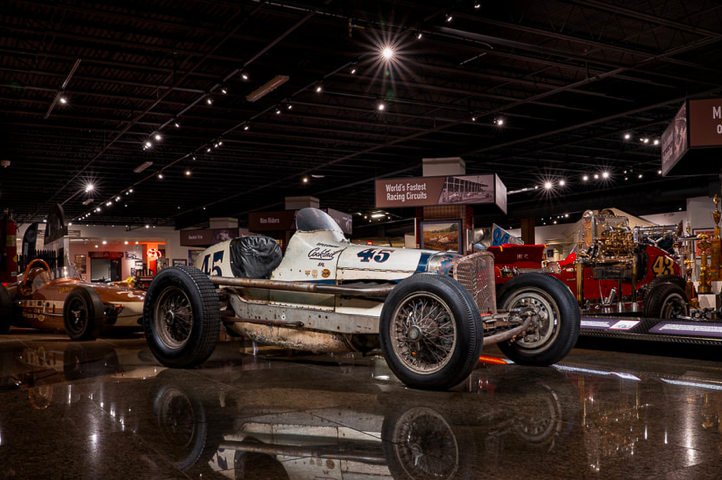
In the same era, though, John Lencki built what became a successful race car, and called it The Pup.  Under new regulations issued for 1938 by the AAA for their Championship racing series that included the Indy 500, cars would no longer need to allow room for a rider mechanic next to the driver.  Taking advantage of this, Lencki built a slimmer car, and when comparing it with his previous design, reflected that it looked like a pup.  Driver Jimmy Snyder won the 100-mile race at Syracuse, NY in fall of '38 driving The Pup, and the car competed in the Indy 500 twice.  The best finish was 14th in 1941, when it became one of the first race cars to feature a seat belt, because driver J. Chitwood noticed how the suspension bounced him away from the pedals on Indy's brick paving.   Despite the new-fangled seat belt, The Pup stayed with the twin-cam four-cylinder engine design pioneered by Harry Miller…
Of course, by that time, Rover had been building cars under that doggie-flavored name for over 3 decades, having started with a tricycle in 1883, a Rover Safety Bicycle in 1885, and before that first car in 1904, the Rover Imperial motorcycle in 1902. It is, however, the P4, known affectionately as Auntie Rover, that sticks in the mind for its pooch-like virtues of sturdiness and loyal service.  Auntie was launched in 1949 after Rover brass bought two 1947 Loewy Studebakers and used them as models for their new postwar car. The 1951 version below has special Tickford drophead bodywork; most Auntie Rovers were saloons.  They were so solidly built that Road & Track magazine cited them in 1952 as the best cars in the world, save for Rolls-Royce.  That year, Rover changed the grille to delete the "cyclops eye" fog light.
One feature the P4 shared with Rolls Royce was the "F-head" (also called IOE) engine design, with inlet valves located over the exhausts.  Initially, Rover offered only the 6-cylinder, 2.1 liter 75 model, but later expanded the line to include the 4-cylinder 60 as well as 2.6 liter 90. Gordon Bashford's Loewy-influenced body design, with its notchback and prominent "ducktail" rear deck seemed startling to the conservative British, but it turned out to be popular, and Auntie Rover overlapped the more square-rigged P5 series until 1964, selling over 130,000 cars.
That wasn't the end of innovation at Rover, either.  The more compact P6, with its Citroen DS-influenced body (horizontal crease on flanks, roof line), debuted in 1963 with an overhead-cam, 4 cylinder 2 liter engine and De Dion rear suspension. This Rover 2000 became the Rover 3500 in '68 with the addition of the aluminum V8 based on GM's design for Buick.  Both cars increased Rover's popularity...or is that pupularity?
Meanwhile, over at the Rootes Group, which made Hillmans and Sunbeams, a compact station wagon called the Husky was introduced in 1954.  Initially, the Husky came with a side-valve 1.26 liter four, unlike the OHV unit offered in Hillman Minx sedans.  But this Mark 1 Husky was cute...
The new-styled Husky introduced for 1958 (confusingly called the Series 1, but also the Audax version) expanded the 7 foot wheelbase of the previous Mark 1 to 86 inches, which it would share with the new Sunbeam Alpine when that car appeared in 1960.  Engine was an OHV inline 4 of 1.4 liters.  The side-opening rear door was a Husky feature...

Also in 1958, Polish manufacturer WFM Fafik produced the Puppy prototype, in the then-growing microcar class, powered by a 148cc engine. The wraparound windshield and backlight fit the period perfectly.  The door hinges seem to have come from a much larger car.  It seems odd that nobody in the industry has since picked Puppy or Pup as names for minicars or city runabouts...
But AC Cars, better known for their Ace and Cobra products, called their new 2+2 fastback coupe Greyhound when they introduced it at the Earls Court show in fall of '59, the same show where the BMC Mini first appeared.  The alloy-bodied Greyhounds, on a wheelbase 10 inches longer than the sleeker 90-inch Ace roadster and Aceca coupe, were offered with Bristol engines in 2 and 2.2 liter versions.  Eleven of the 83 Greyhounds built from '59 to '63 were fitted with Ford Zephyr 2.6 liter sixes.  Discontinuing the Greyhound and Aceca perhaps allowed AC to better keep up with demand for the then-new Cobra...
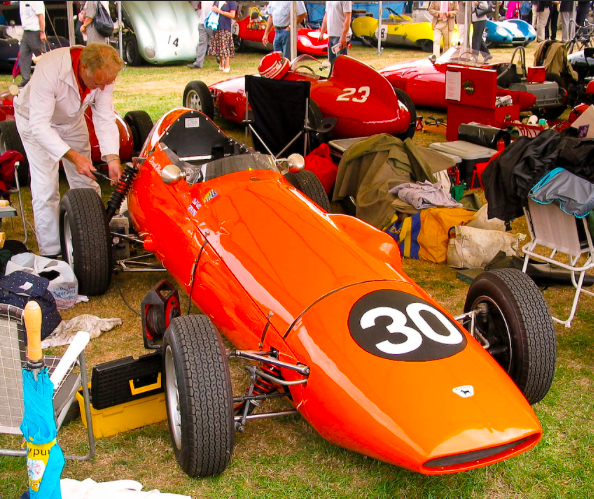
Chassis designer Len Terry, later famous for mid-engined Formula 1 cars such as the Lotus 33 and 38, and the Eagle Mk. 1, produced some front-engined Formula Junior cars under the Terrier name starting in 1960.  These were Ford Anglia powered, meeting the requirements for production engines of under 1,100 cc, and were briefly competitve until eclipsed by mid-engined cars.  The Terrier name was clever though, especially as applied to a racer.  There have since been Terrier military vehicles, and there was a Ford Greyhound armored vehicle, but these weren't cars, so we're ignoring them.

In 1979 Aston Martin Lagonda showed the prototype Bulldog, a mid-engined, very wedge-shaped supercar designed by William Towns, who had done the wedge on the Lagonda saloon three years earlier.  The ruler-straight parallel window lines are at odds with the tapering wedge idea, but may have made hinging easier for the gullwing doors.  That curved indent at the door sill may indicate that Towns had second thoughts, though.  AML management had second thoughts when they considered production costs for the twin-turbocharged Bulldog, and then cancelled the project, meaning that this is the only one.  Why, however, current Aston Martin management decided not to use the Bulldog name for their new SUV (forgettably named the DBX 707) is a mystery.  
The motor sports enthusiasts at Goodwood, though, have not lost their enthusiasm for dogs, and in 2022 they instituted Goodwoof, a weekend-long doggie festival held in May in front of the Kennels.  It was such a success (the English do love their dogs) that it was held again on May 18 and 19 of this year, and was expanded to include an architects' design competition for something called Barkitecture...
It has not been reported, however, whether the pooch below was dissuaded by the shape of the topiary sculpture from doing what male dogs usually do on shrubbery...
Watson Sherman, the Activities Manager at the Bone Lounge where all these posts are written, seems a little miffed that he was never notified of, let alone invited to, these Goodwoof events. Well, I tell him; there's always next year...

*Footnote:  
Gary Axon, on Axon's Automotive Anorak at the excellent goodwood.com website, came up with 8 cars named after dogs, admitted he cheated a bit by including the Ferrari Boxer (named for its engine configuration, not a pooch), and identified those Terriers as well as a Whippet made by designer Luigi Colani, but he never found the Pup or the Puppy.  But we'd be cheating if we didn't admit he got us onto this trail, and that we're envious that he lives so close to the Goodwoof Festival...

Photo Credits:  
Top:  Bonhams Auctions
2nd:  BGS Classic Cars
3rd:  Steve Brown on flickr.com
4th:  Ford Motor Company
5th:  Museum of American Speed
6th thru 9th:  Wikipedia
10th:  Rootes Group
11th:  Wikipedia
12th:  reddit.com
13th:  Amberley's Museum
14th:  racecarsdirect.com
15th:  flickr.com
16th:  La Escuderia
17th & 18th:  goodwood.com
Bottom:  the author

Tuesday, October 31, 2023

The Italian Line: Piero Drogo and Carrozzeria Sports Cars

The Iso Grifo* A3C road racer appeared in bare, burnished aluminum along with its sister car, the A3L grand touring coupe (which wore paint) in October 1963 at the Turin Show.  It was a product of Giotto Bizzarrini's chassis design (like Ferrari's GTO) and Giorgetto Giugiaro's body design, like the Grifo A3L (luxe) coupe.  While the A3L bodies were built by Bertone, the A3C featured bodies in riveted alloy by ex-GP pilot Piero Drogo's Carrozzeria Sports Cars, founded in 1960 with coachbuilders Lino Marchesini and Celso Cavalieri.  The shorter A3C shared its chassis with the A3L, but the 5.3 liter Chevy V8 was set back farther for a kind of "front mid-engine" effect. The apparently worked pretty well, as the Iso A3C (for Corsa) won its class at Le Mans in 1964 and '65. Around 20 A3C coupes were bodied by Piero Drogo's workshops before Iso cancelled their Le Mans program, and Bizzarrini went off to build his own similar-looking Strada and 5300 GT coupes, bodied in fiberglass instead of alloy. 
Bizzarrini*, unlike Iso,  remained interested in racing, and created the mid-engined P538* late in 1965 for Le Mans 1966.  A Chevy-powered version went far enough at Le Mans '66 to attract an order for a Lamborghini-powered V12 variant, and this ironically became the first Bizzarrini to be powered by an engine of Bizzarrini's design.  Production numbers are foggy, but most sources claim that 4 were built, and that the chassis became the basis for Giugiaro's Bizzarrini Manta show car, and also influenced the Bizzarrini chassis under the stillborn AMX3 road car...
Piero Drogo and Giotto Bizzarrini had gotten to know each other earlier, when Bizzarrini designed a competition coupe to attract attention to the line of GT cars built by ASA, with SOHC engines that were essentially 4 inline cylinders from Ferrari's Colombo V12.  Drogo's firm supplied bodies in alloy.  The car below, with Drogo standing on the left and Bizzarrini on the right, is a 1000 GTC from 1962, with displacement just below the 1 liter class limit; there was also an 1100 GTC and a 1300 GTC.  Few cars were produced, but at least one was delivered to the Silver Helmet racing team; posing with the team in the 2nd photo below, Bizzarrini is 3rd from right.
Chassis #2472 was the last of the Tipo 61, 2.9 liter, 4-cylinder Birdcage Maseratis built, in 1961. It won the Nurburgring 1000 km that year, piloted by Masten Gregory and Lloyd Casner. The original body was damaged in the Rouen 6-hour race, and was replaced by the Drogo body below in 1962, and the car was raced by Casner's Camoradi Team into '63. The designer is not known, as Drogo himself managed and lined up clients, and relied on others at Carrozzeria Sports Cars for design, or on outsiders, as in the case of the Iso A3C.
That Birdcage rebody may have attracted the attention of chief engineer Giulio Alfieri at Maserati, as his team was preparing a Le Mans racer powered by a front-mounted, 4-cam (gear-driven) V8, basically a  450S reduced to 3943cc for the 4 liter prototype class.  No more than 5 of the aerodynamic Tipo 151 coupes were built from 1962 to '65, some bodied by Allegretti, but 151/3, shown below, featured a Kamm-tailed Drogo body. When fitted with a fuel-injected 5-liter, dry-sump engine, it recorded 191 mph on the Mulsanne Straight.  Cars were supplied to Briggs Cunningham and Lloyd Casner, and the latter died testing one.  

The design of the Ferrari P3, which appeared in 1966, was closely related to that of the Dino 166P and 206SP that appeared the previous year.  All were bodied by Drogo's Carrozzeria Sports Cars, as was the Dino 206S below from 1966.  These featured the 65 degree V6, longintudinally-mounted behind the driver and in front of the transmission.  Only 18 of these cars were built, one of which was converted from a 166P.  Though these designs appeared about the same time as Pininfarina's 1965 Dino 206 Berlinetta Speciale, designed by Aldo Brovarone and refined by Leonardo Fioravante, Pininfarina has not claimed credit for the design of the race cars, which look quite different than the Speciale, which carried many features that later appeared on the 206 production car. 
Drogo built even fewer bodies for the 1966 4-liter prototype P3, shown below: a total of 3 cars, one of which crashed and two of which were converted by Ferrari to P4 specification...
While we are looking at Drogo's work on Ferraris, we would be missing one of the best examples by ignoring a re-body of a Series 1 250 GTO.  Swedish driver Ulf Norinder raced his example until the body began to fall apart, and commissioned a new body by Carrozzeria Sports Cars, which was finished in 1966.  The nose and the steeply curved windshield follow the profile of the Series 2 GTO64...
…while the tail avoids that car's notchback and recessed backlight, instead substituting a gracefully-sloped rear window with hinged hatch, in a long tail with subtly-upturned spoiler.  The converging lines of the C-pillar seem to frame the rear wheel.  Overall, one of the prettiest re-bodies ever, and it happens to be on a GTO.
The year after that GTO rebody, Drogo produced the body for the Serenissima* Agena below.  The mid-engined coupe, powered by Serenissima's own 3.5 liter 4-cam V8, was one of a handful of road cars produced by Count Volpi's firm, which also built sports racers and supplied 3 liter V8s for McLaren's early F1 efforts, gaining them their first GP point. The Agena, intended as a prototype of a potential production car, shows signs of the previous year's De Tomaso Mangusta in its creased, flush sides, and a bit like the first Ford GT40 in the treatment of the nose design.  Like Renzo Rivolta and Bizzarrini, Count Volpi eventually decided that making exotic cars was a great way to have money vanish into a dark tunnel, and stopped a couple years before Drogo's Carrozzeria Sports Cars closed its doors.  That was in 1971; sadly, Piero Drogo died in 1973 at age 46, when his Ferrari California was involved in an accident with a truck inside a dark tunnel...


*Footnote:  
We've featured posts on car makers who got into the business because they had bones to pick with Enzo Ferrari, and these include a trifecta of makes with Drogo bodies.  If you're curious about how this happened, you might visit "Born from Refrigerators: Iso Rivolta", posted  Sept. 20, 2018, "The Etceterini Files Part 18: Bizzarrini P538", posted Feb. 27, 2019,  and "Forgotten Classic:  Serenissima—The Winged Lion is the Rarest Beast of All", posted March 20, 2019. 

Photo Credits:  
Top:  Bob Jecmen 
2nd:  the author
3rd:  Carrozzeria Sports Cars, on Wikimedia
4th & 5th:  Wikimedia
6th:  carrozzieri-italiani.com
7th:  historicmotorsportcentral.com
8th:  youtube.com
9th & 10th:  ferrari.com
11th & 12th: The Klementaski Collection
13th:  artcurial.com


Saturday, October 28, 2023

Roadside Attraction + Forgotten Classic: The Moto Guzzi Museum and the Moto Guzzi V8


Lucky visitors to the Moto Guzzi Museum in Mandello del Lario (on Lake Como, in case you need another enticement) are greeted by a marble sculpture and side elevation of a motorcycle headed for the checkered flag in Plaza Leonardo da Vinci. Engineer Carlo Guzzi had built a motorcycle shortly after World War I, and founded the oldest surviving European motorcycle maker in continuous production, Moto Guzzi, with partners Giorgio and Angelo Parodi early in 1921. Racing was important from the beginning; Moto Guzzi won its first European title at Monza in 1924. Back to that racer headed for the checkered flag up there; that looks like an engine with four overhead cams, doesn't it?
Well, it's a water-cooled 500cc V8 designed for GP racing by Giulio Carcano, and it was raced by the Moto Guzzi team from 1955 to 1957.  One way to think about this engine with its 4 overhead cams is that it resembles the Maserati Ghibli V8 of a decade later, except that its entire displacement would fit into one of the Maserati's cylinders, with space left over.  The Otto, as it was also called, set an official speed record of 171 mph 2 decades before that speed was again achieved in a motorcycle GP.  The engine featured a Dell'Orto carburetor for each cylinder, weighed 99 lb. in a 326 lb. bike, and made 78 hp at 12,000 rpm. The Moto Guzzi V8 below is one of 80 vehicles on display at the museum, and one of only two V8 racers built. 
About that checkered flag part of the mural, though, we have to report that while blindingly fast, the Otto never won a GP race. There were reliability problems, and because chassis design had not caught up to that advanced engine (brakes were still drums, for example), some racers declined to ride it in GP races.  Still, when it retired from decades of racing at the end of 1957, Moto Guzzi had collected over 3,300 race wins, and 14 world titles. By 1963, Stanguellini* decided that a mid-engined, four-wheeled speed record car would be a more stable format for the Guzzi V8, and Franco Scaglioni designed an aerodynamic shell over the tubular Stanguellini chassis for the Colibri (Italian for hummingbird) below. The body was built by Carrozzeria Gransport, of later Cobra Daytona fame. Somehow the Otto engine never arrived for installation, and the car made do with a 250cc Moto Guzzi single that made 29hp at 8,400 rpm.  That was enough, though, for the little streamliner with its 5-speed chain drive and front disc brakes to set half a dozen international speed records at Monza in fall of 1963. To see it, though, you'll need to visit the Stanguellini Museum...
There are plenty of other exhibits to take in at the Moto Guzzi Museum, including the landmark V7 Record below.  A V7 Record set 19 speed records at Monza back in 1969.  The V7 engine tooks its name from its displacement.  It originally appeared in 1966 as an air-cooled 700 cc V-twin with 90 degrees between cylinders and shaft drive, and starting in 1967 engineer Lino Tonti developed performance versions, with the 748cc V7 Sport capable of 125 mph.  The V-twins had a good reputation for handling, and Moto Guzzi sold ten V7 Police models to the Los Angeles Police Force in 1969; these were reputedly the first motorcycles not of American origin to go to Stateside police forces, and led to other Moto Guzzi police sales in the US.
The collection also highlights many of the models powered for over four decades by Carlo Guzzi's first engine design, with a single horizontal cylinder, single overhead cam, 4-stroke air-cooled configuration, at first in 500cc displacement.  That title-winning 1924 racer had 4 valves for its thumping single cylinder.  Until 1934, each engine carried the signature of the mechanic who had assembled it...
The museum collection includes an early, streamlined speed record bike, as well as a vast trove of scale models and miniatures... 
…along with photos, literature, and other memorabilia.
Carlo Guzzi was born in 1889, died in 1964 and lived long enough to see a Moto Guzzi be the first motorcycle to reach the Arctic Circle (1928), to become Italy's largest motorcycle maker (1934), build the first wind tunnel for motorcycle design (1954), and to see its host city call itself La Citta Della Moto Guzzi (ages ago).  The stone sculpture in our first image* came later, in 2011, and was produced by sculptor Ettore Gambioli and architect Paolo Gambelli.  Three years later, the Discovery Channel named the Moto Guzzi V8 one of the ten greatest motorcycles of all time.

*Footnote:  For a look at Stanguellini cars not powered by Moto Guzzi, see "The Etceterini Files Part 5—Chasing a Mirage: the Last Stanguellini", posted here on March 21, 2016.

*Photo Credits:
All photos were generously supplied by longtime reader and contributor Keith Carlson, except for the 2nd, 3rd & 4th from the top (Wikimedia), and the 5th & 6th (piaggiogroup.com).  For Keith's shots of Monterey Car Week, see "Monterey Car Week 2023:  Auctions, Pebble Beach Concours, and a Day at the Races", posted here on August 31, 2023.