Featured Post

Wednesday, July 31, 2024

Giro de Sicilia 2024: This One's for Cars Instead of Bicycles


May's Giro de Sicilia shared the name of a bike race, but instead honored the tradition of the Targa Florio, the road race last held in 1973 in the mountains near the capital city of Palermo, in an event covering 5 days full of dramatic countryside, townscapes, and food.  Lancias showed up in what would count as big numbers here in the US. Though the company was famous for unit construction after pioneering it with the Lambda in 1922, they also offered bare chassis as the basis for custom coachwork by the likes of Pinin Farina on the V8 Astura, and by Viotti on the small V4 Augusta and bigger V4 Artena, including trasformabile sedans in the late 30s with full-length fabric sunroofs.  Lacking the entry list, we couldn't be sure who built the streamlined body of the sunroof sedan above.
In shots above and below, the cars gather in the civic space fronting the Palermo Opera House.  Below is another Lancia, this time a sedan with elegant aerodynamic bodywork.  By the late Thirties, Pinin Farina was offering similar streamlined contours on the V8 Astura chassis and these also replaced the traditional Lancia radiators with streamlined prows.

Here another Lancia, a Pininfarina-bodied Flavia coupe introduced in 1962, rests next to an Alfa Romeo Duetto introduced 4 years later, also a PF design. The boxer four was new in 1959, and a departure from the narrow-angle V configurations of previous Lancias.  Front-wheel drive was also new to Lancia. The first coupes were 1.5 liters, and 1.8 liter engines followed in '63, with a fuel injection option in '65.  Typical of Lancia engineering eccentricity, the car featured twin cams, but not the overhead type...
Our photography* crew's modern (late 20th century) Lancia Delta parks behind their Alfa Romeo Giulia sedan, a design first appearing in 1962, in a charming seaside town east of Palermo: San Stefano de Camastra. 
Above, the Giulia at the starting line near the Palermo Opera House. Below, a Fiat-based etceterini from the early Fifties, with forward-leaning grille perhaps inspired by Michelotti's Ferrari designs for Vignale.  Engine type is unlisted, but a Fiat 1100 would be a good guess.  Neighbors include a Jaguar XK120 and an Alfa 1900 sedan from the early Fifties, Alfa Romeo's first mass-produced car...
A Vignale-bodied Maserati Sebring Series 1, built from 1962-'65 on a shortened 3500GT chassis, was the most popular of the Sebring line, with 348 built. The Series 2, built in '65 and '66, featured quad headlights in two oval mountings and more pronounced fender vents, with the last run of 98 built featuring the 4.0 liter twin-cam, twin-plug alloy inline six.  Early Series 1 cars came with the 3.5 liter engine, while later ones were fitted with the 3.7.  Because Sebrings are scarce compared to other production Maseratis, body and trim parts can be a problem...
Below the low-mounted Sebring Series 1 fender vents are shown; Series 2 positioned the vents higher.  The 964 Series Porsche behind it (1989-'95) is a reminder that more modern cars were invited to participate in the Giro de Sicilia...
What appears to be a Mercedes 170S cabriolet from the 1949-'55 period joins a 21st century Porsche... 
That Giulia again, this time parked at the nicely restored, still operational headquarters of the Civil Guard (the famous carabinieri) in Siracusa...  
This 1927 Fiat photographed in Ortigia endured to cover the whole event, while none of the other pre-war (or inter-war) cars managed to go the distance.  
The first BMW 3 Series appeared in summer of 1975 (whew, almost 5 decades ago) and continued in production into December 1983.  The graphic pattern on the flanks may mean this is an Alpina version...
A Lancia Delta Integrale Evo reminds us of Lancia's 15 World Rally Championships, the most of any make.  These began with the front-drive Fulvia HF in 1972, continued with the mid-engined Stratos in '74 through '76, and built an aura of invincibility with Championships won by the Integrale, an AWD derivative of the front-drive Delta, every WRC from 1987 through 1992.
The Selinunte Archaeological Park, located between two rivers, the Modione-Selino and the Cottone, preserves the ruins of several temples built starting around 628 BC.  It's known today as the Acropolis of Sicily...
The Lamborghini Urraco S below was a bit more recent, designed for Bertone by Marcello Gandini with transverse mid-mounted lightweight V8 chassis by Gianpaolo Dallara, with perhaps an even more harmonious form than the Ferrari Dino 308GT4 from the same era, also by Bertone.  The public bought more of the GT4, though, and only 791 Urracos found homes from 1972-'79.  Here the Lambo is flanked by a Vignale-bodied Lancia Flavia cabriolet on the left, and an early version of the Fiat 1100 sedan (1953-'69) on the right, parked in front of that carabinieri HQ in Siracusa.
Below, a parting shot of that famous mountainous countryside, for anyone mulling participation in next year's event...
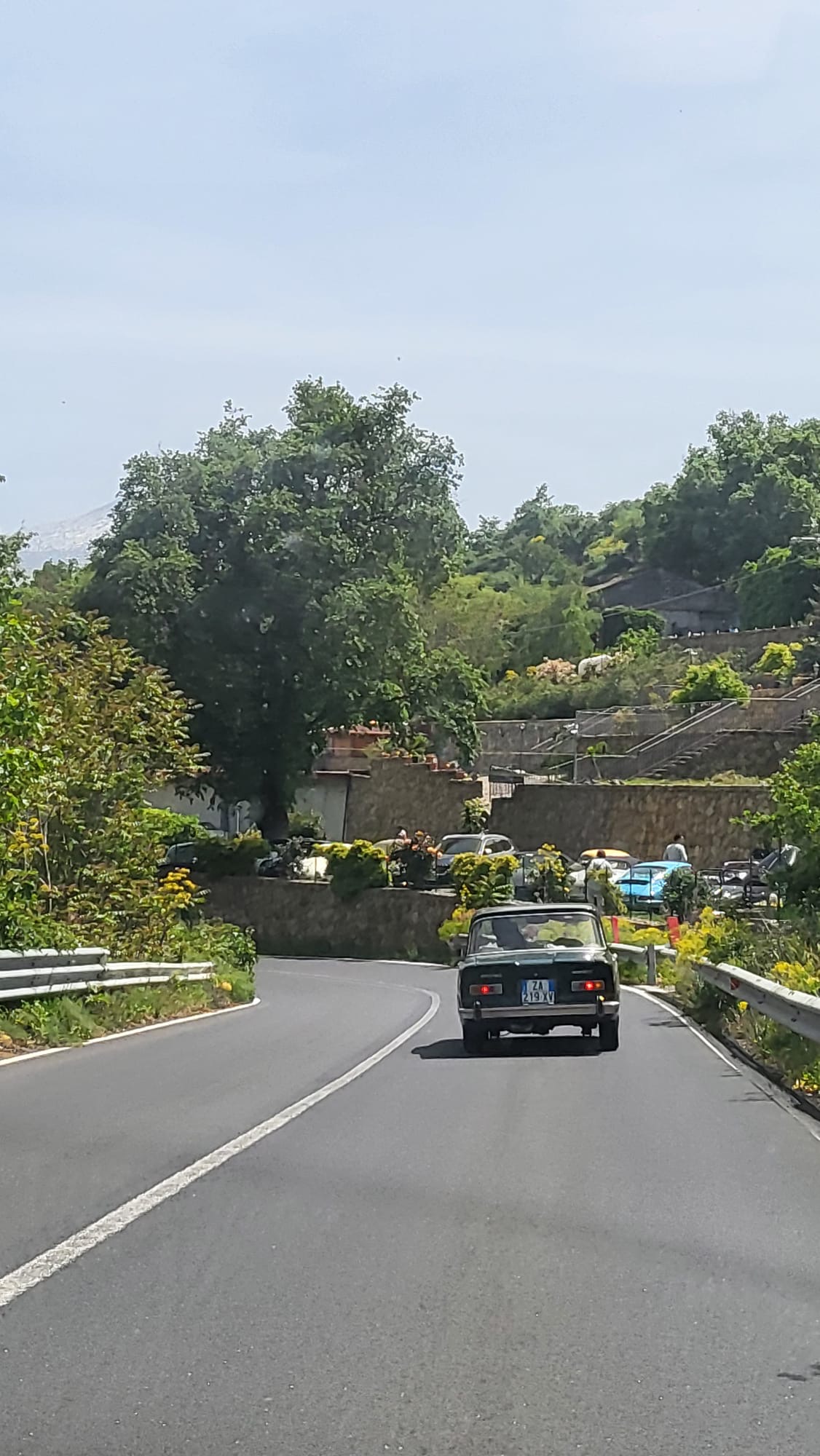

Photo Credits:  All photos were generously provided by LCDR Jonathan D. Asbury, USN, shown below with artistic consultant and wife Laura.


Friday, July 12, 2024

Lost Roadside Attraction Sequel: 1970 Salon de l'Auto at the Parc des Expos

  
Three years ago we posted a nostalgic review* of the spontaneous car show we saw every day on the streets as college students in France, along with photos my housemate took of the Paris Auto Salon we saw in  October 1970, not long after the semester began.  An automotive writer contacted me about publishing the photos, but I had to explain they weren't mine.  When I finally got in touch with my college friend, he mentioned that there were more photos and emailed them.  I decided there were enough to justify a post of their own; also, I'm lazy enough that I didn't relish the idea of re-writing that first post. So here, courtesy of Ron Budde, is the rest of that car show story from over half a century ago…
 
Though the star attraction of that Paris show over 50 years ago was the new Maserati-powered Citroen SM, Ferrari was still at or close to the top of many car enthusiasts' wish lists, and the crew from Modena brought a fleet of desirable cars. In the photo above, three mid-engined 246 Dino coupes, foreground and at left, wrap around a metallic brown 365GT 2+2 and a yellow 365 GTB/4, otherwise known as the Daytona. The 2.4 liter, 4-cam Dino V6, a product of an engine deal with Fiat that allowed them to use the same power plant in their front-engined Fiat Dinos, was part of a successful program to bring Ferraris to a wider audience than the big, V12-powered cars had found.
Another new face at the Paris Salon that fall was Alfa Romeo's Montreal, originally designed as a show car for the 1967 Montreal Expo by the young Marcello Gandini at Bertone, who had designed the spectacular mid-engined Lamborghini Miura in '66, and the 4-passenger Espada lurking in the background a couple years later.  The new Alfa GT, which had made its debut at the Geneva show in March of '70, substituted an aluminum, cross-plane 4-cam, 2.6 liter V8 for the familiar twin-cam 1.6 liter Giulia engine in the show car. It adopted that show car's nickname, Montreal, and derived the new engine from the 2 liter V8 in the Type 33 Stradale, and also in Alfa's endurance racers. The chassis of the Montreal, though, was the tried-and-true Type 105 from Alfa's sweet-handling GTV, and featured 4-wheel disc brakes and a well-controlled live rear axle. Another car on the Bertone stand was the Shake dune buggy prototype below, based upon the rear-engine, front-radiator Simca 1200S GT coupe, then in series production, for which Bertone supplied the Giugiaro-designed bodies. This was the era of the dune buggy.  While the Myers Manx was already selling many copies to fans in the US, especially California, Europeans took notice after one appeared with Steve McQueen at the wheel in 1968's The Thomas Crown Affair.  In an effort to get another production contract from Simca, Bertone built 2 Shake prototypes, and race car builder Matra made 2 more.
Another car making its debut at the show was Ligier's JS2.  Race driver Guy Ligier* had already built a couple of successful mid-engined JS1 road racing coupes with glassy Frua-designed bodywork and Cosworth Ford twin-cam 4 cylinder engines. His intention was to offer a production GT coupe using the 60-degree V6 engines (around 2.6 liters) made by Ford of Germany.  Mid-engined cars were trendy in this era, and the use of a mass-produced engine would have cost advantages.  But after this prototype made its debut with the Ford V6, Ford declined to provide engines, and Ligier adopted the 90-degree, 2.7 liter, 4-cam Maserati V6 and 5-speed transaxle from the new Citroen SM for his production cars. Ligier's company would build around 250 cars, including 7 Series 2 models with a 3.0 liter Maserati V6, before the fuel crisis of 1974 ended their GT car program. 
Porsche displayed the air-cooled, 4.5 liter, flat 12- powered 917 that had finally won the Le Mans 24 Hours four months earlier after years of chasing Ferrari and then Ford.  The rain-drenched event was depicted in Steve McQueen's heavily fictionalized film Le Mans*. The 917 engine was over twice the size of the flat 6 in the white 911 behind the racer.  Behind that 911 is a line of new mid-engined 914s, a project designed to give VW something sporty to replace the Karmann-Ghia, and Porsche an entry-level car.  It was, in that way, something like the 1965 Ferrari-Fiat agreement that produced Fiat and Ferrari Dinos, though those cars competed in a pricier category.

The Porsche 914 styling, with its flat sides and rectangular form, was not without its critics. The Heuliez 914/6 made its debut at the Paris Salon, and Jacques Cooper's design proposed a fastback coupe form that was more aerodynamic and more practical.  The nose displayed a lower profile, and the windshield was steeper. 
At the rear, a hatch provided access to luggage and the flat 6 engine.  The project had begun at Brissonneau & Lotz, which produced bodies for GM's Opel GT starting in '68. When B & L ran into financial troubles, Heuliez, known for making commercial bodies on Citroen chassis, took over and finished the car. Around the same time, Italian designers Frua and Giugiaro produced their own 914 alternatives. Because none of these designers had managed to convince Porsche management to build their cars in series, all their prototypes remained one-offs.  This Heuliez car was recently restored and sold at auction...
Even though that autumn show was called the Salon de l'Auto, motorcycle makers like BMW couldn't resist plugging their wares.  When I got back from an architectural tour of the Low Countries and Scandinavia in a Fiat 1500 shared with 2 other students, we look a look at Paris traffic, assessed the parking situation, and decided to sell our Fiat (think it was a '63) at the American Express.  One classmate wound up with a BMW R-50, but students with thinner budgets often went with French Mobylette mopeds.  Students with still thinner budgets, like mine, opted for the mainstream, classic bicycle.  Seem to recall that mine was a Roland Superluxe, which I recall leaving with our landlady in springtime when our sojourn in France was at an end...
*Footnote
The first part of this Lost Roadside Attraction post appeared here on April 19, 2021 under the title "Lost Roadside Attraction: 70s Car Shows on Paris Streets, and at the Parc des Expos."  We posted a brief history of Guy Ligier's race and road cars on November 15, 2020 entitled "Forgotten Classic: Ligier JS1 & JS2", and a review of Steve McQueen's film Le Mans on March 5, 2021.

*Photo Credits:
All photos were generously supplied by Ronald Budde.

Friday, July 5, 2024

Film Review: Notes on Michael Mann's "Ferrari"


Director Michael Mann's Ferrari, released on Christmas 2023, catches Enzo Ferrari and his namesake firm in a period of challenge.  Ten years after founding a car-making operation (mostly to support a racing team) in 1947, Enzo and wife Laura face stiffer competition from Maserati, at a time when both firms plan series production, to make hundreds of cars a year instead of a few dozen, to increase their cash flow.  Maserati had previewed the game-changing (for them) 3500GT road car early in 1957, and are a strong favorite to win that year's Formula One championship with their 250F and driver Juan Manuel Fangio.  Much to Enzo's annoyance, Maserati had won the '54 World Championship with Fangio in the 250F, beating the Ferrari Squalo (shark) shown below.  Mercedes had taken the World Championship in '55, and Ferrari had only managed it in '56 with Fangio driving what was actually a Lancia D50 with Ferrari badges, donated by Gianni Lancia to Ferrari when racing had bankrupted Lancia.  In a theme echoed many times on this blog, making racing cars is shown to be a great way to get rid of all your money...
As we are introduced to Enzo (played by Adam Driver) and Laura (Penelope Cruz), we find that this has been the case for them as well.  On top of financial worries, they are shadowed by the death in 1956 of their son Dino after a long illness.  Besides that '56 GP Championship won with a Lancia, there had been a bit of good news when Eugenio Castellotti had won the rainy, accident-plagued Mille Miglia, a thousand-mile endurance race on public roads, in the Ferrari 290MM below, but in the film we see Castelotti die the next year testing a GP car.  And Ferraris were beaten by Jaguars at Le Mans, the most important endurance race, three years in a row, including '57. When Enzo's accountant notes that Mercedes and Jaguar sell thousands of cars a year, using racing only as a form of advertising, he also points out that Ferrari sold only 98 cars in 1956.  Ferrari replies that for him, selling cars is only a way of supporting racing. His drivers point out to him that the English have "invented brakes", meaning the disc brakes on all those Jaguars and on the new, mid-engined Coopers, but Enzo waves the reference to Cooper away by saying that the horse must come before the cart.  This shows that at heart Ferrari may have been more of a poet than an engineer, because, after all, only front-drive cars put the horse before the cart, and these Fifties Ferraris all have their engines in front, but their driving wheels at the rear...
The film doesn't reveal the ways in which cash flow has gone the wrong way for Ferrari's car business, but the 290MM shown here is a textbook example.  It's a 3.5 liter V12, and shares its tubular chassis and 4-speed, rear-mounted transmission with the 3.5 liter, four-cylinder 860 Monza. Wait, you say, Ferrari made 12 and 4-cylinder engines of the same displacement? Yes, they did, and their engineers also created a small number of inline 6-cylinder engines up to 4.4 liters, V12s from 1.5 to 4.9 liters, and more conventional chassis designs with the transmissions right behind the engine in the decade from '47 to '57.  Even in Italy, with lower labor costs compared to the US or Germany, tooling costs must've been through the roof. Jaguar used only one engine and 2 chassis designs in this period, and Porsche only 2 different engines and 2 chassis.  And that simple Cooper with its relatively cheap, store-bought Climax 4-cylinder engine behind the driver would win the Formula 2 Championship in 1957, the year that Ferrari released a new V6-powered Formula 2 car named for his son Dino.  Cooper would win Formula 1 World Championships in '59 and '60, sending a shock wave through the racing world...
The film shows Ferrari showing up before the fateful '57 Mille Miglia, which starts at night, to talk with drivers, though he was known to avoid going to races as he'd seen enough accidents during his own career as a race driver. The night racing scenes are gripping; the production team built 7 replica racers for the scenes involving close racing, including the scene where Stirling Moss slides down a grassy slope after the brake pedal breaks off on his Maserati (this actually happened).  Other cars fit the period, though Enzo probably didn't drive the Peugeot shown in an early scene where he leaves the abode of his mistress; Motor Trend indicated in a '57 visit to Modena that he drove a Fiat.  That early scene underlines the tension between Laura and Enzo, as he spends more time with his mistress Lina (Shailene Woodley) and their young son Piero, in the wake of Dino's death. This subplot is important to understanding how Laura devoted more time to tracking her investment at the factory itself as Enzo spent more time away or secluded in his office, a phenomenon that led to the famous Great Walkout of October 1961, when 8 engineers left Ferrari in protest of what they viewed as Laura's interference. The Great Walkout followed Ferrari's winning the '61 World Championship with a modern, mid-engined, disc-braked product designed by those engineers, and led to their designs for competing makes like ATS, Bizzarrini, Iso, and most famously, Lamborghini...
There is some foreshadowing as Ferrari tells a driver, "Watch out for children and stray dogs; they're the biggest danger", and you catch a sense of foreboding when we meet a family at dinner just before the cars plunge along a tree-lined country road past their house. An accident that killed Ferrari driver Alfonso de Portago, his co-pilot Edmund Nelson, and 9 others, including 5 children, is depicted with relentless realism (this is not a movie for children).  Italian law led to criminal prosecution of Ferrari and tire maker Englebert, and they were only exonerated 4 years later when it was found a glass reflector in the roadway had slashed a tire.  Racing on Italian public roads, however, was banned soon after the race, which was won (as if it mattered) by Piero Taruffi*. When an engineer tells him that everyone is aware of the presence of death in racing, Ferrari replies that families and children are not aware of this.  After this scene, he walks his son Piero toward the mausoleum where Dino is interred, telling Piero, "You would have loved your brother.  He would have taken you everywhere."  The film leaves us there, about a year and 5 months before Ferrari finally introduced its first real production car at the Paris Auto Salon, 4 years and 5 months before the Great Walkout, nearly 8 years before an engine deal with Fiat that led to the popular V6 Fiat and Ferrari Dinos, and a dozen years before Fiat's acquisition of a 50% stake in Ferrari. The production cars and the Fiat deals helped Ferrari weather fallout from the Great Walkout, the costly endurance racing battles with Ford that occupied 5 years starting in 1964, and the need to meet the demands of a changing car-buying public.  But those are stories for another day… 

*Footnote:   Piero Taruffi (Patrick Dempsey) makes it clear it no longer matters to him when Ferrari calls to congratulate him.  The real Taruffi may have felt this wey, as he wrote an essay for the Saturday Evening Post later in 1957 criticizing the lax safety at motor races, and suggesting improvements.  For more on Taruffi and his TARF speed record cars, see "The Etceterini Files Part 31", posted here on June 11, 2024. 

Photo Credits:  
Top:  Neon 
2nd & 3rd:  the author
4th:  Lorenzo Sisti, Washington Post 
5th:  Eros Hoagland, Washington Post


Sunday, June 30, 2024

Racing Legends Meet a Mysterious Brazilian at Boulder Coffee & Classics


You wouldn't think that one of the landmark sports car designs of the Fifties would turn out to be something designed by an accountant and powered by a fire pump engine, would you?  But history has played stranger tricks.  One trend of the mid-to-late 1950s was the increasing popularity of fiberglass to lower tooling costs and get new designs into production quickly.  Examples include Chevy Corvettes, and Colin Chapman's first attempt at a GT car, the Lotus Elite from 1957. The elegant simplicity of Peter Kirwan-Taylor's sketches (he was, oddly, Chapman's accountant) was translated into the production prototype with the help of aerodynamicist Frank Costin. This was the first use of fiberglass as a structural material in a unitized body-chassis, here reinforced by a steel subframe for the engine and front suspension, with a roll hoop around the windshield to which the door hinges attached…
The 1,200cc single overhead cam Coventry Climax inline four was a lightweight unit with aluminum block and head, originally designed as a fire pump engine, and gained popularity with race car builders in the mid-Fifties owing to its lightness and high-revving nature.  
Iwas an ambitious project, and early cars suffered from warping and cracking (solved on later bodies built by Bristol), while all Elites were somewhat noisy because of the intrusion of the rear suspension upright towers into the cabin.  The Elite was produced through 1963, and was much more successful as a race car than as a practical road car.  And perhaps it's not so unexpected that such a landmark design would come from the sketchbook of an accountant.  After all, it has an elegant economy of line, and by all measures, its aerodynamic numbers work...
And what, by the way, is that intriguing orange car next to the Lotus?  If you could see the Sao Paulo license plate in front, you might have a clue.  Is it one of the fiberglass-bodied, VW-powered Pumas* that were built by Brazilian specialists with parts supplied by VW?  Well, that would be a good guess, but this 2-seat GT was built on a VW Type 3 chassis by Volkswagen do Brasil, and the company felt confident enough about its appeal that they tooled up to build the bodies in steel on the 94.5 inch wheelbase.  The body design by José Martins and Marcio Piancastelli combines a trendy Seventies wedge nose (with headlights too low for US regulations) with gentle ovoid contours.  This example runs on steel wheels, but cars were raced in Brazil with alloy versions of the same design, still with the steel body.  Production started in summer of 1972.
The rear view shows off the smooth curves that hinted at the car's role as a sort of Brazilian answer to the Porsche 912.  Engines, accessible under a flat cover below that rear hatch, included 1.6 liter and 1.7 liters in production, while there was also a 1.8 liter water-cooled SP3 prototype; all used the 4-speed manual VW gearbox.  The SP2 was a hit in Brazil, with over 10,200 built for model years 1972-'76.  And one German enthusiast magazine called it "the most beautiful VW in the world", which meant SP2 might have been a good replacement for the Karmann-Ghia, phased out in the US after 1974.  But VW was already planning its future around the front-drive Golf, and there would have been issues with those low headlights and skimpy bumpers.
Compared with the Aston Martin DB4 introduced in fall of 1958, the DB4 GT introduced a year later featured a shorter wheelbase (93" vs. 98"), and a more powerful version of the DB4's then-new twin-cam inline six.  With over 300 hp, it would enter competition with Ferrari's 250 GT SWB, and at the time was claimed to be the fastest road-legal production car.  "Production" meant 100 chassis, but most sources say only 75 were built, with another 19 bodied by Zagato in Italy.
Terry Hefty's 1959 car was the 3rd DB4 GT to be built, and was shipped to Nassau for road races there.  When the Aston that Stirling Moss was scheduled to drive was damaged beyond race-readiness, he raced this one. Everything went fine until the engine ingested a loose nut from the air box.  Decades later, Sir Stirling was reunited with this car and took it for a drive...
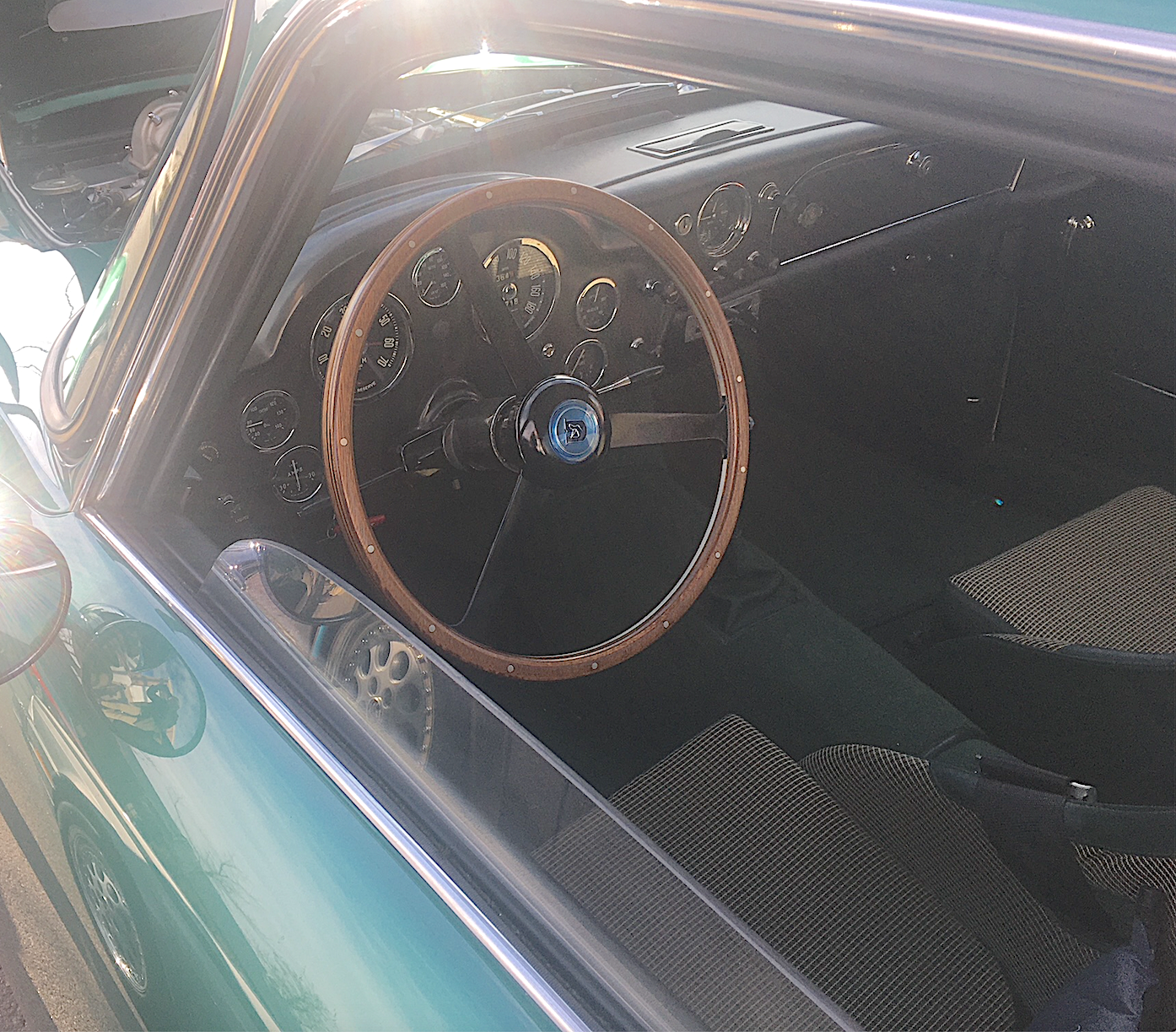
Only 30 examples of the DB4 GT were built with left-hand drive, and Aston's road-racing clientele sat on the thin-shell bucket seats that struck Coffee & Classics spectators as spartan. The instrument pod had appeared on Aston's Mark III version of the DB2/4 and on the DB4, and was a clever reference to the car's grille shape...
And while those customers, unlike DB4 customers, had to do without 2 rear seats, they got twice as many spark plugs.  All DB4 GTs featured a twin-plug version of the DB4's then-new 3.7 liter inline six with its twin overhead cams, aluminum block and heads.  Brakes were discs all around, with independent front suspension and a live-axle rear, much like the contemporary Maserati 3500 GT coupe. As with that Maserati, the body was designed and built by Superleggera Touring in Italy.
The Austin-Healey 3000 Mk. III  was introduced in spring 1964 and was built by BMC through 1967. The low-slung convertible with roll-up windows (and in MK. III form, a wood dash) joined the roadster in spring '62, but the Mk.III was only available as a convertible. Like the earlier 100-6 and 100-4, the 3000 wore a seductively curvy body design by Gerry Coker.  The engine was a 3 liter inline 6, and the 4-speed gearbox lacked synchomesh on 1st gear, but most examples the owner has seen have the overdrive his car features.
One thing the 1966 Volvo P1800S below shares with the Big Healey is that was an effort to offer a stylish GT car with powered by a reliable, if unadventurous, engine from a passenger car. Another is that Jensen Motors in England built the first 6,000 examples of the P1800 from late 1961 to spring 1963: Jensen also built all the A-H 3000 bodies.  That business about using a reliable production engine must have worked for Volvo; a P1800 holds the record for the most automotive miles traveled by a single private owner: 3.25 million...
During the same period as the Volvo P1800 (named for its 1.8 liter inline four) you could also buy a Porsche 912 or a BMW 1600.  The German makes both offered 1.6 liter fours; an air-cooled boxer in the Porsche, and a SOHC inline one in the BMW.  The latter make would begin its slow climb from obscure cult car to upscale lifestyle accessory by offering a 2 liter version of their engine in the compact, light 1600 body called the 2002. Car and Driver magazine nicknamed it "the whispering bomb".  That was in 1968...

This 1989 Ferrari Testarossa (Italian for "red head"; more on that later) is a frequent visitor to Sunday Coffee & Classics. The styling by Leonardo Fioravanti for Pininfarina manages to package the 12 cylinder boxer engine with its side-mounted radiators derived from Formula One practice, the reason for those form-dominating ducts and horizontal strakes on the car's flanks.  
The mid-mounted 4.9 liter flat twelve features 48 valves and sends power to the rear wheels through a 5-speed transmission with Ferrari's trademark gated lever.  The Testarossa name referred to the special series of road racers Ferrari developed in the Fifties; these Testa Rossas had their cam covers painted red, and were made in V12 and inline 4 (yes!) arrangements.  Testarossas (one word by the 80s) were possibly the first pop supercars, appearing after 1985 on TV's Miami Vice, and nearly 10,000 specimens were built between 1984 and 1996.  
This Ferrari 328 GTS (the S is for spider) is from the same era, and was built for the 1986 through '89 model years.  It followed the popular 308GT, with slightly larger 3.2 liter, mid-mounted 4-cam V8, with 5-speed manual transaxle and styling for the 2 passenger coupes and spiders also by Fioravanti at Pininfarina.  On the 4-passenger 308GT4 that began the 308/328 series, styling was by Bertone.  
In 1988 the 328 signaled Ferrari's move from the analog to digital world with the adoption of antilock brakes, with suspension lightly redesigned.  Overall the 308/328 series was one of the most popular Ferraris, with nearly 20,000 made, and one of the most practical for daily use.
Owing to difficulty In meeting US emissions standards which arrived in 1968, Alfa Romeo's 1750 GTV only made in into US dealerships for 1969 and 1971.  The styling was refreshed from the previous "step nose" design with a flush panel between the hood and grille (no vent at the leading edge of the hood) and small circular lights inboard of the headlights, with a new horizontal grille bar.  The DOHC engine, at 1779 cc, was happy to rev and offered more torque than the previous 1600.
The last version of the GTV offered Stateside was powered by a 2 liter version of Alfa's evergreen twin-cam, aluminum block four; named the 2000GTV and featured Spica mechanical fuel injection and a revised grille in which the famous Alfa shield was formed by projections in formed into the grille bars.  The last GTV before the Alfetta transaxle cars took over, it was offered in the US for the 1973 and '74 model years, with the decade-old Giugiaro-designed Bertone body still looking fresh...
We fade into the late morning finale with a view of the 8th Street lineup from Pearl Street, headed up by a 1980s BMC Mini powered by a Honda VTEC four that has somehow been shoehorned into the engine bay on the tiny, 10 foot-long car.  Like the Ferrari Testrossa, it's a frequent visitor to Coffee & Classics.  We wondered how it might do against that Ferrari on a closed mountain road (no street racing, please).  After all, 200 hp in a 1,500 pound car might be just as much fun as 380 hp in a 3,800 pounder.  And, come to think of it, that Mini has more horsepower per pound...

 *Footnote:  Our other surveys of Brazilian cars included the DKW-engined Puma, in "Audi's Intermission: DKW Monza, Puma and Fissore" (August 29, 2017), the "Willys Aero Saga: An Afterlife in Rio" (Aug. 29, 2019), and the Willys Interlagos in "Classic Revival Follies Part 4" (Dec. 27, 2023).  

Photo Credits:
All photos are by the author.