Featured Post

Friday, January 31, 2025

Ferrari and Vignale: Happy Together...for a While


This writer was intrigued by Vignale-bodied Ferraris before he knew they were designed by Giovanni Michelotti*, and a dozen years before he encountered a twin of the above car in a parking lot in Southern France in 1974.  Why?  Well, they seemed to hide complexities under their seeming simplicity, and even in a neighborhood where a grade school kid could get hit on his bike by a '54 Corvette (the author did) and drool over an Ace Bristol (the author did), nobody had one.  Also, they were light and fast.  The 166 coupe above, a 2-liter V12, is from 1950.  The simple, inwardly-curving alloy flanks are relieved by a subtle indent linking the front fenders to the rear, and in an era of flat, 2-piece windshields, this one-piece glazing is slightly curved.  Delightful, but rare.  Alfredo Vignale* liked the design enough that he built a similar-looking coupe on an Abarth chassis.
By 1951, Michelotti was experimenting with forms and details that would appear on many Vignale designs on Ferraris and other cars through the Fifties.  On the 212 berlinetta above, chassis #0179EL, headlights have been moved into the grille, now an oval egg crate that would become a trademark, and they are flanked by fog lights and projecting front fender forms.  Barely visible here is the extension of the vertical metal at the window sill into embryonic fins inset from the outer contours of the rear fenders. That effect is more pronounced on chassis #197EL, where the yellow fins contrast with black fenders on the Bumblebee car, a 212 model from 1952.
The Bumblebee also has an indented, contrasting panel echoing the curve of the front wheel well, like the larger Cunningham C3 coupes and convertibles produced by Vignale for American Briggs Cunningham during these same years. Where the Cunningham had conventional headlights, the Bumblebee sticks with the headlights-in-grille theme, with smaller fog lights than #179EL, and those projecting fenders that will soon enough show up in Mexico on some famous racers...
The 225 Sport below shows that Michelotti and Vignale would delete some decorative effects when their assignment was a road racer.  The 225, a one-year model (1952), marks the steady increase in the displacement of the Colombo-designed SOHC V12, in this case to 2.7 liters. Apparently Buick hadn't patented the idea of cooling portholes, or Vignale didn't care. Road racers, unlike GT cars, usually had sliding windows instead of the roll-up variety.  Ferrari built only 21 of the 225 Sport. 
The coupe below, from the same period, shows how non-standardized Vignale's efforts were. Note the taller greenhouse and recessed grille, and the flanges in the alloy fenders around the wheel openings.  Roll-down windows are a concession to comfort, but steering is still on the right.  Maserati was already offering left-hand drive.
At the rear, the bright trim at the color separation line emphasizes the tidy, rounded contours, along with the recessed tail lights and gently wrapped rear window. Upon first seeing a Vignale coupe in Road & Track during an era of big chrome and bombastic fins, the author and his classmates were thunderstruck...
1952 was a busy year for Ferrari and for Vignale.  The 225S gave way to the 250MM (after the Mille Miglia road race), and the V12 was now at the 3-liter displacement that would help make it famous.  As you may have suspected, Ferrari models were named after their individual cylinder displacements during this period.  Thus, a V12 model 250MM and a 4-cylinder 750 Monza were both 3-liter cars.
This 250MM coupe (or berlinetta, in Italian) has a lower-profile, more forward-slanting air intake than the earlier cars, and this one lacks the portholes.  
Vignale also built some 250MM spiders, and Phil Hill took delivery of one from New York Ferrari distributor Luigi Chinetti in spring of 1953. That's Hill's car on the left, on the way to the Pebble Beach road races, a bit more than 8 years before he became Formula One World Champion in a Ferrari. Note that Michelotti's design emphases the concave, inward-sloping panels below the doors with some bright trim.  Yes, some car makers were still putting trim on road racers.  Mr. Hill might have preferred disc brakes instead.  Despite the drums and the presence of the big 340 Mexico on the right, he won at Pebble Beach anyway. 
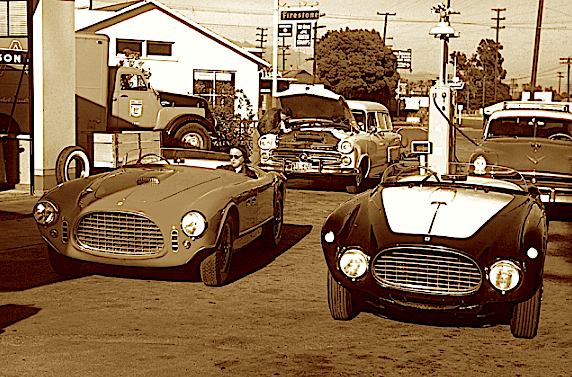
That tubular-chassis 340 Mexico above is the only one of the 4 Mexicos built in 1952 as a spider.  The others were coupes like the one shown at dockside below.  Note the projecting front fenders, an idea Michelotti adopted from his earlier work on the 212 chassis, and low-set headlights fronting a trough between those fenders and the hood.  Under that hood was the bigger engine NYC dealer and race driver Luigi Chinetti had requested, a new Lampredi design, still an SOHC V12, but at 4.1 liters, and linked to a 5-speed gearbox.  It would eventually grow to 4.5 and then 4.9 liters...
And it give the 340 Mexico its distinctive proportions, with around half the car's length taken up by the engine bay, as shown below. The cars were named for Mexico's Carrera Panamericana, a long-distance road race, and they competed there.  In 1952, Luigi Chinetti and Jean Lucas took 3rd place in a 340 Mexico coupe.  A small vent behind the door directs air to the rear brakes, and the vertical metal strip behind the door's leading edge may be an early effort at boundary layer air control...
Later in 1953, Michelotti sketched out a more aerodynamic approach to the competition spider. Overhangs were minimal front and rear, and on several of the cars the headlights were covered by plexiglass shrouds.  Vignale built this body style on the 166 Series II chassis, on the 250MM (the car below) and also on the 340MM.  
Note how the air outlets (to cool Ferrari's soon-outmoded drum brakes) visually elongate the stubby, rounded tail. This new, pared-down look might have foretold more work for Vignale and his designer Michelotti, but Scaglietti produced sleeker, lower-profile Ferrari competition cars based on Farina designs in '54. That year Pinin Farina's share of Ferrari's production increased, foreshadowing Ferrari's order for 30 Farina-bodied 250GT cabriolets in 1957, and the 250GT coupe the following year. The latter was the first series-produced Ferrari, with over 350 finding buyers before production ended in 1960.

Footnote
Michelotti's designs for Vignale on other chassis, including Maserati, Lancia, Cunningham and Triumph, are surveyed in "Michelotti and Vignale in the 50s & 60s: Pioneers of the Italian Line", in our archives for June 14, 2020.

Photo Credits:  
Top:  The Jensen Museum
2nd:  carrozzieri-italiani.com
3rd & 4th:  bonhams.com  
5th thru 9th:  the author
10th:  The Phil Hill Collection
11th:  youtube.com
12th:  George Havelka
13th & 14th:  youtube.com


Friday, January 17, 2025

Book Review: "The Formula" by Joshua Robinson and Jonathan Clegg

The Formula, a  book about Formula One during the period when it was essentially taken over by a British car salesman named Bernie Ecclestone*, appeared in 2024, when Ecclestone, who had divested himself of his ownership and management role,  announced that he was auctioning off his collection of F1 racers. The timing was just about perfect, and the authors, both of whom write for the Wall Street Journal, are well-suited to the task of focusing on the financial aspects of a sports story, as J. Robinson is the European sports correspondent and J. Clegg the sports editor.  Early on, the authors highlight the irony of Formula 1 being the only sport named after its rulebook, when, unlike in the worlds of soccer or baseball, Formula 1 rules are deliberately and drastically changed every few years.  Chapters are devoted to the efforts of teams to seek temporary advantage by meticulous and sometimes devious intepretation of those rules in engineering drivetrains, aerodynamics and tires.  And, against a background involving big corporate suppliers and sponsors, this effort involves lots of money...
Luckily for the reader, the financial story is far from a dry, statistical slog, because Ecclestone (at right above), who sold his Formula One Group to Liberty Media in 2017 at age 86, became famous during his 40 years of running F1 as a cunning, sometimes shifty deal maker who was one of the first to grasp the importance of TV contracts, deals between teams and corporate sponsors (especially the tobacco industry), and celebrity promotions. The Ecclestone era became known as a time when teams began to see bigger profits (though nothing like Ecclestone's), when costs of designing and building race cars snowballed, and when the control of the sport was essentially ceded by millionaires to billionaires...
It wasn't at all like that in the era when Ecclestone got interested in Grand Prix racing.  That period, covered in Robert Daley's The Cruel Sport*, was a time when driver fatalities were frequent, when teams often lost money shipping their cars from race to race, and when the cars themselves were painted in national or team colors, not with graphics or logos demanded by corporate sponsors. The first sponsorship logos appeared on a Brabham and a Lotus in 1968, a year after the last covered in Daley's book.  And it's kind of shocking to realize that seatbelts were not required by the FIA (Federation Internationale de l'Automobile) until 1972, the year that Ecclestone bought the Brabham team for 100,000 pounds. As a team owner, Ecclestone was a founder of FOCA (the Formula One Constructors Association) in 1974, and kept ownership of the Brabham team until 1988, after Nelson Picquet had won World Championships twice with it.  The drama surrounding the World Championship plays as big a part in the book as the high-level deal-making, with chapters on Ayrton Senna, Michael Schumacher, Lewis Hamilton's move from McLaren to Mercedes, and a gripping chapter on the Abu Dhabi GP in 2021, when Hamilton saw his hopes of a record 8th World Championship dashed by F1 race director Michael Masi's failure to follow the correct restart procedure after an accident. The authors are effective at highlighting the interpersonal conflict and professional discord that have escalated along with the financial stakes in F1. It all reminds this writer of a brief conversation he watched at Road America decades ago, when a boy of grade school age looked at the big wing on the back of a Can-Am racer and asked his dad, "Does that thing keep the car on the track?"  The dad replied, "No, son, it's money that keeps the car on the track."

 
*Footnote:  Our  brief review of "The Cruel Sport" was posted here on October 29, 2024 in "Book Reviews in Brief: Source Material for Car Wonks and Historians."  Our first mention of Bernie Ecclestone was in connection with his 1957 purchase of two historic Formula 1 cars, in "Celtic Rainmaker:  Connaught Ended the Longest Drought in Grand Prix Racing", posted on July 24, 2016.

Photo Credits:  
Book photos are by the publishers.  Photo of Bernie Ecclestone with Brabham BT44 is posted on youtube.com, from an interview by Tom Hartley Jr.  Photo of Lewis Hamilton is from motorcities.org.


Tuesday, December 31, 2024

Poeschl Architecture Projects


Beginning a retrospective of a life in architecture with a non-building may seem contrary to the demands of logic, but it makes some sense if given enough context.  For one thing, this pool in Big Sur is one of the most photogenic things we've done. For another, because it is essentially negative space filled with water, it survived a disastrous wildfire in 2016...
But we're getting ahead of our story.  One of the first projects to appear after I found myself on my own in 1999 was an addition to an existing, roughly 600 square-foot cabin in Palo Colorado Canyon, on a scenic, wooded hillside overlooking the Pacific.  The program called for adding enough space for a family with 3 children, several rescued dogs, and a keen interest in the great outdoors.  The program also required that we avoid removing trees whenever possible. These magical trees were one of the main attractions of this site. 
We transformed the existing cabin into a living and kitchen space opening onto a terrace over an existing, leaky pool, designed a two-story wing with added master bedroom and bath over two children's rooms and a reconfigured bath, and detailed a small bunk house with bath and outdoor shower for visitors.  As for the pool, we soon replaced it with a pool turned 90 degrees so that the long dimension was parallel to the contour lines of the hillside.  Construction was delegated to master builder Alfred Seccombe of North Star Construction in Carmel, and the work was published* about 5 years after completion.  It led to other work, including an unbuilt proposal for a house near Garrapata State Park, also in Big Sur... 
…and a tea house in Japanese style, which was to be added to an existing ranch-style house in Los Altos as a retreat for a client who wished to age in place, to use a phrase that later became popular.  As we designed this during a construction boom and we heard nothing from the owner for nearly a year, we assumed that the project had remained unbuilt.  Then just around the new year, we received a card from the owner:  "Tea house is finished.  Come have tea."
Before our tea ceremony, we admired the attention lavished on small details by master carpenter Takeshi Fukui, down to his selection of a landscape light for the garden (center above) which I'd forgotten.  This project was published* in summer of 2006.
At this time our practice was divided between Monterey Bay and Boulder, Colorado, but I was spending most of my time in Santa Cruz.  This allowed time for scheming other proposals, like this quick sketch for a compact 3-story house near the Santa Cruz Yacht Harbor, which remained unbuilt.
Sketches for an octagonal house on Hurricane Point in Big Sur, however, turned into something buildable after no small amount of discussion with our client, and after engineering and construction drawings were complete.  The owner's program was to honor the octagonal form of a house his uncle had built on the windy, scenic site in the 1960s, while replacing the deteriorated structure with something sturdy, yet open to the ocean views.  I took the photo below over a year before the project was complete. More photos will likely follow, as this retrospective is a work in progress.
During this time we also designed a house for another windy site above the Pacific, Pfeiffer Ridge in Big Sur.  Our client wanted something modest in size, focused on the ocean views, but with a strong feeling of shelter...

We designed a number of remodels and additions during this 2003-2008 period; the one below is a 2nd story addition to a ranch house in Carmel Valley, CA.
When the Great Recession came along, we focused our spare time (of which we had plenty) on designing several small standardized houses that could be suitable for factory production; the largest, the 982, was named for its area in square feet.  The curved roof shapes on the house echoed the Pfeiffer Ridge house, and were designed to resist high winds.
In 2011 we were hired to design an addition and new structure for the Faris Machinery Company in Colorado Springs, Colorado.  The final design shown below was built by autumn of 2013, and looks just like our computer model, sharing its horizontal emphasis, despite the tall spaces demanded by an overhead crane for repair and maintenance of heavy road equipment.
On July 22, 2016 the Soberanes wildfire started from an illegal campfire in Garrapata State Park.  We listened in suspense to news reports as the fire spread to Palo Colorado Canyon. By the time the fire ended in October, it was considered the largest wildfire in California (it has since been surpassed) and claimed the life of a fire recovery worker on the road crew.  It also destroyed 57 houses, including the house and cabin we had designed.  The builder sent us photos of the damage, but it was about 24 hours before I could manage to look at them.  A couple months later, the owners decided to have the same architect and builder replace the structures that had been destroyed.
Under the Fire Recovery program, we would be allowed exceed the area of the destroyed structures (including the barn, which we hadn't designed) by 10%, and Monterey Planning approved the initial scheme of a one-bedroom cabin perched above the replacement house, as sited originally, with two more cabins downhill from the pool.  The owners decided to make the house a meeting place for family and friends, with only one sleeping loft overlooking an expansive kitchen and entertainment space.  Their original program was to build a cabin for each of their two daughters and their son, but to provide a full kitchen only in the house, so the now grown-up kids would visit the parents frequently. Cabin 1 (at right above) would perch bedroom and living space above a carport, as Cabin 3 (at left above) perched that space above the barn space, with Cabin 2, just above Cabin 3, featuring a loft above living space.
The basic form of the house and cabins was set after we did computerized studies showing interior sunlight and shading at summer and winter solstices.  We were still working on integrating existing retaining and landscape walls into the scheme when the above model was made. Cabin 3, with curved roof, is 70 feet below Cabin 1.  The plan was to site Cabin 2, below, on the ground occupied by an old garden coop; it would have offered about 640 square feet of space for living, kitchenette and loft sleeping space...
Cabin 2 remained unbuilt owing to a change of directors at Monterey County Planning. The new director decided that though we were well within area limits under the Fire Replacement program, the proposed cabin was not on the site of a building that had burned down. That wasn't true of Cabin 1 (top in photo below) or the main house, so construction would proceed on those once we secured building permits for the house and Cabins 1 & 3...
Cabin 1, at the top of the site, sits above the house adjacent to the ravine that had provided a path to the 2016 fire.  We moved the new house about 16 feet north of that troublesome ravine.  Cabin 1, like the other structures, is built of non-combustible materials, with concrete forming the lower level and stair, steel framing the upper level, with copper roofing shading the 2nd level copper siding and glass, which like all glazing on the project, is tempered.
Landscape architecture, including the fountain above, re-using steps that survived the fire, is by Marie Goulet of Wild Land Workshop... 
That reinforced concrete stair enclosure with scupper above the curve earned the nickname "teapot" during construction. Inside, the space is illuminated by porthole windows, wall sconces, and lights concealed under the stair nosings...

A gravel path leads you west from Cabin 1 to the main house, which our clients have christened the Meeting House...
On the way there, you pass another metal fountain designed into a network of concrete retaining walls. 
This view captures the westward vista towards the ocean.  Like the house reconfigured to our 1999 plans, this one is only a bit over 1,800 square feet of enclosed space. The exterior decks expand that space into the outdoors. Banks of photovoltaic cells arrayed on the hillside provide electrical power.  
A view of the main house from the southeast...
And an overhead view from the southwest...
Those openings framed by steel beams are overlooked by the sleeping loft and clerestory windows above.  Combustible materials were allowed indoors, and we used wood to warm up the ceilings and kitchen cabinetry.
The surfboard shape of the kitchen island was inspired by the curving north window wall (below) whose form was dictated by the curving concrete stair that survived the fire.  We moved the replacement house to a position adjacent to that stair in order to avoid closeness to the ravine that had been a conduit for fire.  Also, the architect had spent lots of time (maybe too much) surfing in Monterey Bay.
Our client requested a curved roof over Cabin 3, which they've named the Sunset Lodge because it is farthest west on the site; Cabin 1 is now called the Sunrise Lodge.  The bridge reaches the living space and bedroom located on the upper level. The lower level has storage space that replaces space lost in the original barn.
As on the main house, glazed doors slide into pockets to permit an unobstructed view of the hillside and ocean beyond.
As noncombustible materials were only allowed outdoors for small items like guardrail caps, the builders painted the exterior soffits to match the grain and color of the interior ceilings, which are real wood...
...as shown in this view towards the northwest corner of the compact living space. The unobstructed arc of the clerestory window makes the space feel more open.
The original plan was to outfit the porthole window over the lavatory with a hinged porthole-shaped mirror.  Photos were taken after our very patient clients had finally moved in...
In 2023 the North Star Construction team posed on the ocean-facing deck of the main house to celebrate completion.  We want to take this moment to thank our own team, who helped with design, drafting and computer modeling during the quarter century time span of all projects illustrated here.  In chronological order, they were Sarah Francis, Larry Butler Jr., and Ben Lochridge. Structural engineering for the original Palo Colorado project and the fire recovery project was provided by Scott Haggblade of Donald Urfer & Associates.
The Palo Colorado completion was about five years after the first Fire Recovery building permit was released by Monterey County, and after builder Alfred Seccombe (on right below) invited me to judge sand castles in the annual competition* on Carmel Beach in August 2018. We leave our story here, with a reminder that you never quite know where fate will take you...

Photo & Image Credits
Top through 3rd + 5th & 6th: Alan McEwan
4th, 7th & 9th from top:  Sketches by the author
8th & 10th:  The author
11th through 16th:  Design by Poeschl Architecture; computer 3D models by Ben Lochridge
17th:  Moss Media
18th through 25th: Alfred Seccombe of North Star Construction
26th:  Moss Media
27th through 33nd:  Alfred Seccombe 
34th:  Moss Media
Bottom:  Alfred Seccombe collection

*Publications:  
The Los Altos tea house was published in the Fine Homebuilding Houses Annual Issue, No. 179, for Summer 2006.  Publisher:  The Taunton Press.

The Palo Colorado Canyon house was published in Homestyle by the Sea in the Fall 2008 issue, with an article entitled "On the Edge of Infinity".  Publisher:  Bay Publishing Company. 

For those interested in the annual sand castle competition, we posted a photo essay, "Sand Castle Magic", in this blog on Sept. 13, 2018.