Featured Post

Sunday, May 28, 2023

Classic Woodies: When Fine Carpentry Hit the Road


Naturalists tell us that Earth has lost about 1/3 of its forests* in the last 10 millennia, but that most of this loss occurred in the last 3 centuries.  Shipbuilding was a major cause.  As the empires of Europe depleted the forests at home, they sent their navies across the oceans to find and seize more forests so they could build more ships, and the cycle continued.  Back on land, carriage builders used wood, fabric and leather to frame and finish their coaches.  By the time the French apertif mogul Andre Dubonnet dreamed up this wooden torpedo-style body for Nieuport Astra to build on a Hispano Suiza* H6C in 1924, more advanced construction techniques were available...
Nieuport Astra, which had produced a streamlined racing monoplane before making its famous WWI fighter planes, constructed the bodywork of thin wood strips adhered to an aluminum framework with thousands of brass rivets.  The finished body weighed only 160 lb. Instead of using this 8-liter, 6-cylinder car as the land yacht it resembled, Dubonnet competed in Italy's Targa Florio with his Tulipwood Torpedo after removing those teardrop fenders, which must've appeared positively futuristic in 1924.  He finished in 6th place. 
Five years later, the wood-bodied Armstrong Siddeley* "shooting brake" below was ordered by the Duke of York, later King George VI.  Apparently he had been a fan of the sturdy but obscure (at least Stateside) marque since early on.  This car, intended for hunting excursions (thus the name) was based on the Armstrong Siddeley 30 hp. model (named for its taxable hp.) and featured a 5-liter engine with two inline 3-cylinder blocks with overhead valves.
During the same period, what the British called shooting brakes or estate cars were called station wagons in the USA, perhaps because they had enough space to hold passengers and their luggage when you picked them up at the train station.  The steam locomotive in the background of the Ford rendering below is a clue.  That the illustration shows a sunny, warm day is convenient, as this 1929 Ford Model A wagon offered only flexible side curtains to deal with inclement weather...
By the late Thirties, American wagons had moved on from side curtains, if not from wood-framed bodies. This Packard 110 wagon shows how a pricier wagon presented itself in 1940. The passenger cabin and doors are actually wood-framed. The 110 was the entry-level Packard, and featured an inline flathead six-cylinder engine.  The popular, eight-cylinder 120, the car which many credited with getting Packard through the Great Depression, was just above it in the lineup.
The spear molding was typical on Packards of the era, and the chromed vents are a deft touch...
Power for the 110 came from a 245 cubic inch (4 liter) inline, flathead six.  Transmission was a 3-speed manual.

The next year, Chrysler took a more streamlined approach with their Town and Country, which featured a steel roof over wood doors and window trim, and a center-opening trunk.  The 241.5 cubic inch inline 6 made 112 hp; this increased to 250 inches and 120 hp the next year. Note that the Town & Country is picking up passengers at an airport; the Douglas DC-3 is a cue that Chrysler was selling modernity...
But unlike the Packard 110 woody, the Town & Country wasn't a true station wagon.  The wood-framed trunk opened along the centerline, but there was no hatch above it. The modern, curved rear window was fixed in the fastback metal roofline.
After World War 2, Nash offered the wood-paneled Suburban below in fastback sedan form.  The name seemed a savvy choice, as it coincided with the postwar suburban housing boom.  Even as early as 1946, the year this car was introduced, this was a major trend.  A 234 cu. in. L-head inline 6 matched the Town & Country's horsepower, at 112.  Only 272 Suburbans were sold in 1946.
Ford offered wood-paneled wagons as well as Sportsman convertibles in 1946, and these came with their famous, 239 cubic inch flathead V8, making 100 hp.  Over 1,300 examples of the Sportsman were sold that first year.
The Mercury version of the Sportsman shown below offered a longer wheelbase (118 vs. 114 inches) than the Ford, but the same engine.  Priced at $2,209, it was a couple hundred dollars more than Ford's version.  Even in the deluxe category of convertible woodies, price apparently mattered.  Only 205 specimens of the Mercury Sportsman were sold in the only year it was offered, 1946...
Mercury sold more of its wagons, though: 2,797 in 1946. This example owned by Keith Carlson shows off wood-framed doors, passenger cabin (including roof) and tailgate.  Note that this '46 model has a different grille than the '46 convertible above, with a chrome frame and horizontal bars instead of the ragtop's vertical chrome slats in a painted frame. That's because it's a Canadian Mercury Monarch.  Production figures for the Monarch wagon are unavailable, but as total production for the whole Canadian Monarch line is estimated at less than 12,500 from '46 through '48, a period when Ford sold over 213,000 American Mercs, this must be a rare car...

The L-head Ford V8 remained at 239.4 cu. in. through the '48 model year in the Mercury, and was upped to 255.4 in the '49 model year.  It remained at 239.4 in the Ford...
While the dash and V-shaped windshield are the same as the Mercury sedans of the era, the wood ceiling has a nautical feel, and tells you that you're riding in something special...

Ford and Mercury continued to offer wood-trimmed wagons from 1949 through 1951, though with steel roof panels, and only in 2-door form.  GM continued its 4-door woodies for 1949, but only until mid-year on the Chevy, Pontiac and Oldsmobile. Then they switched to all-steel bodies, except at Buick, which continued to offer wood-trimmed Super and Roadmaster wagons, as we shall see.
Chrysler launched its new line of wood-paneled Town & Country convertibles and sedans in 1946, and built only 7 copies of the Custom Club Coupe version shown above, which had it gone into production, would've beat GM's pillarless hardtops to market by 3 years.  The sedan version like the '48 below abandoned the fastback form of the prewar T & C for a notched profile, while standard Chrysler sedans kept the fastback...
All Town & Country models shared the wide grille with high, somewhat inset headlights at the front edge of upward-slanting fenders; heavier and more complex-looking than the '41 model, and underlined by bulky-looking bumpers.  Inline 6 and 8 cylinder engines were offered in '46 on the sedan, while the convertible kept the inline 8 exclusively through the end of this style 1948, when the ragtop outsold the sedan. 3,309 to 1,175.
Chrysler introduced new body styles for all lines in 1949, and went to all-steel bodies on the 2-door Plymouth and Dodge wagons, reserving the fine carpentry for 4-door wagons, including the Chrysler.  The top Chrysler wagon was called a Royal, while the Town & Country name was reserved for this convertible, which was built on the Imperial's 131.5 inch wheelbase.  This example is a garage mate to Keith Carlson's Monarch woody.
The new Town & Country offered more coherent, modern lines, with steel door panels outlined by real wood trim, and Di-Noc wood-grained infill panels.  The 5.2 liter, inline 8 engine made 135 hp, and had to move 4,630 pounds of car.   At a list price of $4,665, the T & C cost just over a dollar a pound...
As they had in '46, Chrysler also planned a T & C pillarless hardtop, but this didn't appear until 1950, when for some reason the convertible disappeared from their lineup.  The 1950 T & C hardtop kept the inline 8, missing the 331 Hemi V8 intro by a year, but did feature 4-wheel disc brakes, which it shared shared with the Imperial, a first on a big car.  Chrysler built only 993 of the '49 convertible woody, and 700 of the hardtop '50 version. The T & C woodies disappeared for 1951, the year when all Chrysler wagons went to steel bodies...
During the same period, but at a completely different scale, Fiat built their 500 Topolino ("little mouse') with 569cc inline four and 4-speed gearbox. This postwar Model C Giardiniera ("gardener") wagon was offered from '49 with wood door, tailgate and side panels, along a with fabric top, until the last front-engined 500 (until the 21st century front-driver) gave way to the rear-engined 600 in 1956.  Comparing it with the Chrysler woody from this era says something about fuel costs in Europe, as well as the available space for parking and the available money for new cars during Italy's postwar recovery.  The Topolino's wheelbase was 78.7", compared to the Chrysler's 131.5", and weight averaged 1,433 lb., compared with the Chrysler's 4,630.   Fiat built 520,000 Topolinos over the model's life span, from 1936 to 1955.

When GM abandoned wood wagons in the Chevy, Pontiac and Olds lines in mid-1949, it had the effect of moving the fine carpentry up the price ladder and keeping it there, but only for a few more years.  Buick continued to offer its Super and Roadmaster wood-trimmed wagons until 1953, when it built this Roadmaster Estate Wagon.  And while '53 was the last year for woody wagons from Buick (and thus GM), it was the first year for Buick's new V8 engine.  So this '53 Roadmaster is a landmark car for a couple of reasons...
Doors featured steel lower panels with wood trim around the windows.  The Roadmaster version, distinguished by 4 portholes ("Ventiports" in Buick-speak) per fender to the Super's 3, sat at the top of the line, along with the limited-production Skylark convertible.  The new V8 displaced 322 cubic inches and made 188 hp. 
The wood-framed 2-piece tailgate opened clamshell-style.  In this last year of production, Buick sold 1,830 Super woodies and 670 Roadmasters.
Over in the Mother Country, Morris Motors threw their hat into the woody wagon sweepstakes with their Morris Minor (1948-'71) but only starting with their Series 2 Minor Traveller in 1952, the year before GM built its last woody. By the time the curved windshield appeared on Series  3 in 1956, the Minor was being produced by British Motor Corporation, the amalgam of Austin and Morris that also offered MGs, Austin-Healeys, Rileys and Wolseleys.  The car was still called the Minor 1000 when the Series V was introduced with 1,100 cc engine in 1962.  
That model still had the original-style dash with the big circular speedo in the middle, and more painted metal than you'd see in a modern car.  Simple but effective...
The Traveller estate stayed in production until April 1971, outliving the Minor sedan by 5 months.  By then under British Leyland management, the Traveller offered updated paint colors, but still had the same wood framing supporting a steel roof, and with the center-opening wood-framed tailgates. The Traveller model accounted for 280,000 of the 1.6 million Morris Minors produced. That's a pile of timber, by anybody's standards...
For historians out there, this means the Traveller outlived (by a bit) its smaller stablemate, the wood-trimmed Mini Countryman.The original front-drive, transverse-engined Mini Countryman wagon was offered by BMC badged as an Austin or Morris, and had authentic wood on the exterior, along with 4.2" more wheelbase and 9" more overall length that the Mini sedan, which was famously only 10 feet long.  The wood-trimmed Mini Countryman, called a 2-door estate by BMC, was continued through production of the Mk. II series (1967-'70); it was survived by the sedan and pickup (no wood trim on that) when the Mk. III took over.  Were these British wagons the last production cars you could call woodies?  It would appear so.


*FootnoteFor a revealing survey of the world's forests and the ways in which their fate is linked to the human one, see "Root and Branch" by Jill Lepore, in the May 29, 2023 issue of The New Yorker.  We took our first look at Dubonnet's tulipwood Hispano in "One of One: A Brief History of Singular Cars", on Sept. 7, 2015, and presented an overview of Hispano Suiza in "Swiss Precision, Spanish Drama, French Style", posted Sept. 25, 2017. The only Armstrong Siddeleys we've encountered were modern ones (well, sort of) and are pictured in "Hillsborough Concours Part 2:  Escape Road to the Past", posted July 29, 2018.  Finally, for a look at Dennis Varni's one-off, fastback '51 Studebaker bullet-nose woody, see "Green Streamline Dream", posted here on June 12, 2017

Photo Credits:
Top:  en.escuderia.com
2nd & 3rd:  the author
4th:  Keith Carlson
5th:  Ford Motor Company & Crawford Auto Museum
6th thru 9th:  the author
10th:  Chrysler Corp. on Flickr.com
11th:  eBay Motors
12th:  Wikimedia Commons
13th:  Ford Motor Company
14th:  Drew Shipley
15th thru 19th:  Keith Carlson
20th: Chrysler Corporation
21st:  Wikimedia Commons
22nd:  the author
23rd thru 27th:  Keith Carlson
28th thru 30th:  the author
31st thru 34th:  Keith Carlson
Bottom:  the author


Friday, May 19, 2023

Cars and Coffee (or Maybe Tea) in New Zealand: Deco Cars in Napier's Art Deco Downtown

Frequent reader Louis Bialy recently wrote to tell us a story about the convergence of old cars (our original excuse for these posts) with historic architecture (our other fave subject).  It's the story of the Napier Art Deco festival, which includes cars from the Art Deco period like the 1927 Lea Francis with teddy bear mascot above, as well as earlier ones like the 1920 Rolls Royce Silver Ghost below...
Note the crowds milling around all the old cars, something like you'd see at an American Cars & Coffee event, or on Ocean Avenue in Carmel, CA during Monterey Car Week... 

But this is the city of Napier, on the east coast of the North Island of New Zealand.  And how it came to acquire a downtown lined with Art Deco buildings forming a backdrop to this summertime (February) car fest is a story of seismic consequence...
In the year that this 1931 Studebaker President 8 Roadster was built (the then-new "ovaloid" headlights are a clue), a powerful earthquake slammed Napier, destroying its downtown.  Collapsing buildings and fires killed 256 people. In some areas, uplift of the ground level neared 9 feet...
The government and the community got to work quickly to rebuild from this catastrophe, and the Streamline Moderne style influenced the Sound Shell below, built in 1935...
...as well as the T & G Building completed in the following year.  Napier, along with Miami Beach, is considered a treasure trove of Art Deco and related styles today, and its Art Deco Festival celebrates that history.
The British Star Motor Company was in business from 1898 to 1932.  It was unrelated to the American Star, which only lasted from 1922 to '28.  The British Star had more style than the American one, which was fostered by William C. Durant. Back in 1908, he'd founded something called General Motors... 
This '36 Plymouth seems right at home in the land of Deco.  Back home in the America of 1936, Plymouth was 3rd in sales behind Chevy and Ford, with 520,000 cars sold.  In that Depression year, Ford sold "only"  930,000 cars. 
The grille, hood ornament and insignia on this green Plymouth show that it's a '35 model.  Power came from a 201 cubic inch, 82 hp inline six.  Plymouth, Dodge and Chrysler sales were good enough to finance construction of New York CIty's Chrysler Building, another Art Deco landmark...
The stately '36 or ''37 Pierce-Arrow* below was built not long before the Buffalo, New York manufacturer's swan song in 1938.  Like Packard, the company built its reputation with a smooth straight 8 but also built a V12.  A brief affiliation with Studebaker earlier in the Thirties presaged that company's ill-fated union with Packard in the Fifties.

Headlight nacelles formed into the fenders had been a Pierce-Arrow trademark forever, and must've seemed futuristic before becoming commonplace in the Forties.  In 1936, Pierce built 636 eight-cylinder cars and 206 V12s...
Pierce's main competitor before Cadillac's heyday was Packard.  Early in the 20th century, automotive hood ornaments attained a sophistication that would show up in automotive advertising half a century later.  The ornament below is on a Packard...

The Belgian Minerva marque started with bicycles in 1897 and by 1900 had expanded their line with motocyclettes.  In 1908 the firm took on a license for the Knight sleeve-valve engine, and this was the foundation for their subsequent line of cars, which was know for smoothness, high price, and high oil consumption.
The Graham Paige below looks like a 1930 model.  After early 1930, the company applied the Paige name only to its taxis and commercial vehicles.  Their run of success ended in the Deco era with a Streamline Moderne car, the Graham Hollywood, which used Cord 810 body dies, in 1940.  
Somebody obviously takes loving care of their Joan; she's an export model of the DeSoto, closely related to the 1938 Plymouth.  On the Plymouth, the chrome grille bars continued up into the painted chrome arc under the hood ornament.  Joan's is a friendly-looking face, all things considered...
The Auburn 851 Speedster* replica was in keeping with the Art Deco theme.  Only 143 of the supercharged originals were built in 1935-'36.
This example came all the way from Hawaii.  Modern wheels and tires tell it's a replica; the originals had four exhausts along the left (driver's) side of the engine bay, signaling the Lycoming straight 8 power.
Other Yankee iron from from independent car makers was on evidence, including this 1938 Senior Packard*.  Power could come from an inline 8 or a V12...
...as in the '36 V12 below.  By 1936 the Packard Twelve was at its peak size, 473 cubic inches, much more like a locomotive than the 320 cubic engine in the Super Eight from '37 to '39.
The 1930 Studebaker roadster below shows that the South Bend, Indiana company paid attention to style even before it famously took on Raymond Loewy as its design consultant later in the decade.  Compare it with the 1931 model pictured earlier and you can spot a lot of differences. The President inline 8 made 80 hp from 250 cubic inches that year.
The 1937 Buick below is a reminder that Buicks (today more popular in China than in the US) were once popular enough in the British Commonwealth to justify making them in right-hand drive.  King George of England was perhaps the most famous owner...but back then it was still called the British Empire.
This stately Rolls Royce from 1937, however, is a reminder that there will always be an England, or something very much like it.  Not sure if this is the Phantom III introduced in 1936, but the only Rolls V12 served official functions, and this car has official flags.  And that's a reminder there will be island nations like New Zealand as long as there are islands.  It's as good a place as any to complete our tour.

Photo Credits All color photos of the cars were generously provided by Louis Bialy, from Wiseman's Ferry in New South Wales.  Photos of Napier's architecture were found at  Wikimedia.

*Footnotes The Pierce-Arrow saga was summarized here in "Pierce-Arrow: From Gilded Cage to Silver Arrow", posted June 26, 2020.  We had a look at all the Auburn Speedster varieties in "Auburn Speedsters: In the Shadow of Cord and Duesenberg", posted July 8, 2020.  And we surveyed coach-built Packards a couple of times, in "Packard at the Peak: Ask the Man Who Owns One" on July 30, 2020, and "Hollywood Stars: Dutch Darrin's Designs for Packard", which appeared here on August 4, 2020.


Sunday, April 30, 2023

Rare Birds from Alfa and Lancia: First Boulder Classics & Coffee of 2023

We arrived around 8 this morning to find 8th Street south of Pearl lined with old cars, and a sizable crowd puzzling over seldom-seen creations like this Alfa Romeo SZ, also known as the ES-30, which was based on Alfa's 204 hp, 3.0 liter SOHC V6 engine  and rear-transaxle Model 75 chassis.  The SZ was styled by former Citroen designer Robert Opron, and when it appeared in 1989 some thought he must have been in a less-sentimental mood than when he designed the Citroen SM with its gentle curves.  No gentle curves here; the SZ looks like it might eat other cars for breakfast, and the composite body panels assembled by Zagato earned the car the nickname Il Mostro (the monster).
Only one color scheme was available on the SZ which Alfa offered from 1989-'91: the red with gray roof seen here.  From 1992-'94, Alfa offered an RZ convertible version with three color options.  The blunt, cubic form of Il Mostro's tail contrasts with the gentle curves of its Ferrari Dino and Chevy Corvette neighbors.  
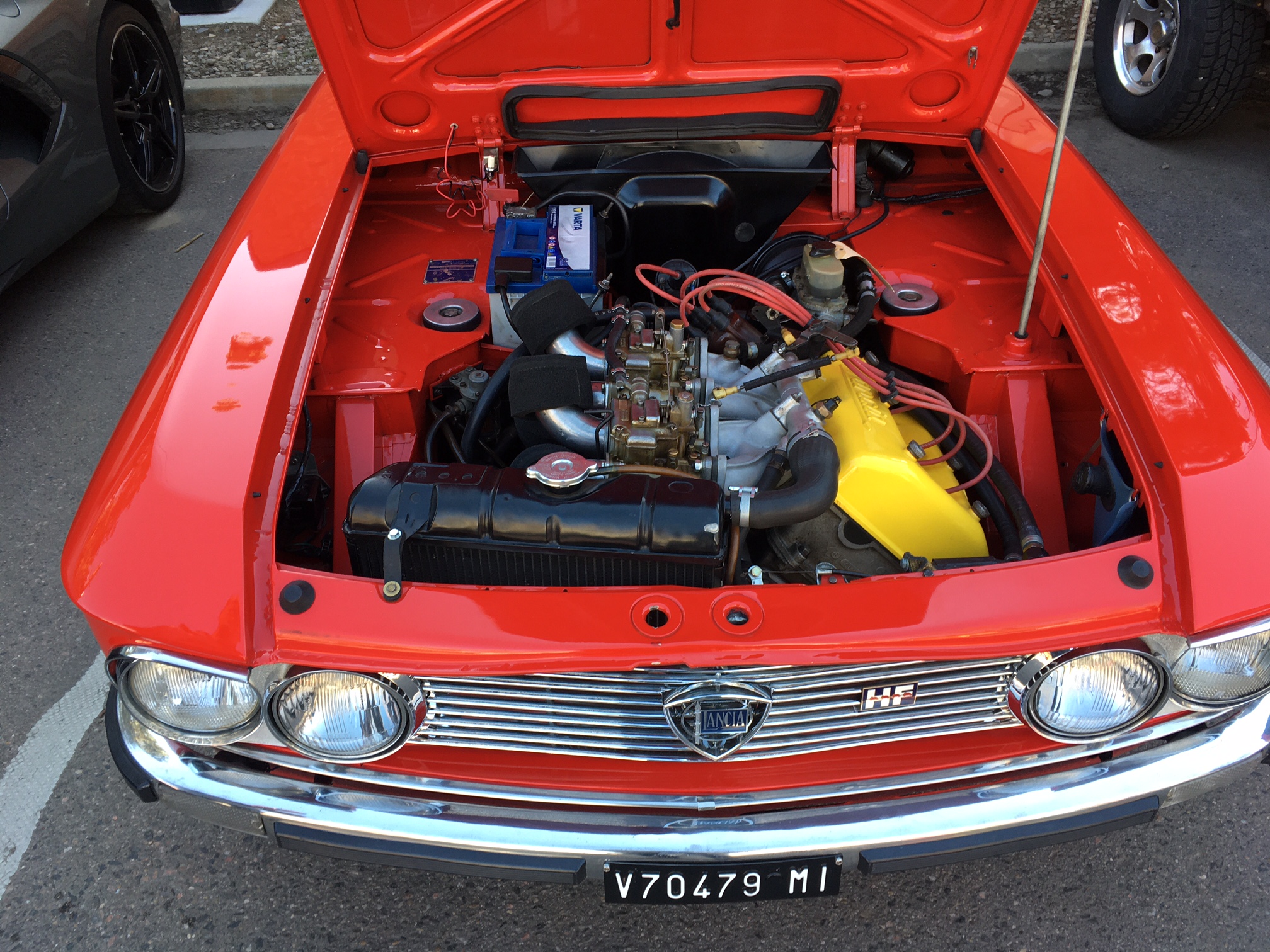
We soon found another rare visitor from Italy's Golden Age of eccentric design, but in the case of this 1972 Lancia Fulvia 1600HF, the evidence of wild nonconformism was mostly under the hood. The front-drive Fulvia features a narrow-angle (around 13 degrees) twin-cam alloy V4 tilted over at 45 degrees so the transaxle could drive equal-length half-shafts, reducing torque steer...
The result  was a tightly-packed engine room with the radiator casually tossed off to one side.  All-powerful Lancia engineers were adept at tossing mechanicals around; they'd built a successful Formula 1 racing car with the engine and driveshaft angled at 12 degrees to the car's centerline, all so the driver could sit lower, and rear transaxle for 50-50 balance. Perfectionists in the engineering dept. altered the angle between cylinders twice (by a degree or so) during Fulvia production, with the final (expensive) adjustment happening on this 1.6 liter HF model, which developed 115 hp in standard trim, but up to 160 in rally form...
And what, you ask, does HF* signify?  It means High Fidelity; but Lancia wasn't talking about the stereo system. They were honoring their customers; those who had repeatedly placed orders for new Lancias were rewarded with priority on the waiting list for the high-performance HF series of cars, which eventually included the mid-mounted Dino V6 powered Stratos HF, winner of the World Rally Championship.  Lancia was taken over by Fiat in 1969, and the Fulvia stayed in production until 1976.  Barely visible in the photo below is the subtle concave arc of the rear bumper and deck edge...
Engineering on the '62 Porsche Twin-Grille Roadster was already pretty familiar by the time it was bodied by D'Iteren Freres in Belgium.  One of under 250 examples of the model built, it was the last of a line of Type 356 roadsters built by Porsche.  Successors to the side-curtained, removable-windshield Speedsters, the roadsters featured wind-up side windows but were more adaptable to weekend club racing than the cushier 356 cabriolets with their body-colored windshield frames...

There were lots of other Porsches on view, including water-cooled modern 911s with rear engine locations (the white car pictured), and a mid-engined Cayman GT4 (not pictured).  And what appeared to be a black Ferrari wagon lurking in the background.  More on that later...
A more familiar Ferrari shape was this Dino 246 GT coupe from 1968.  It's a frequent visitor to these Sunday events, but it's so pretty we don't need an excuse to have another look.  A mid-mounted 2.4 liter, 65-degree V6 sits crosswise under the rear deck (the reason for the concave rear window) and drives the rear wheels through a 5-speed transaxle.
The Dino is no less graceful from the front, and is a reminder that when Ferrari first offered road cars to the public, they were small, lightweight vehicles, with engines at first limited to 2 liters (though they had 12 cylinders back in 1949).
The Alfa Romeo GTV6 shown below also featured a V6 of similar size, as well as a 5-speed transaxle, but in this case the engine was at the front and the transmission at the rear in a successful bid for 50-50 weight distribution. The Alfetta series coupes were designed by Giugiaro and introduced in 1974 with Alfa's famed twin-cam four; the lightly restyled GTV6 appeared in 1980 and continued until 1987.  It's parked next to a BMW 325 from the same era.
Alfa's earlier, more famous GTV style, also by Giugiaro, but while he worked at Bertone, appeared in 1964 and continued in production for over a decade, overlapping the Alfetta series transaxle cars. The silver car below is a late one, powered by a 2 liter version of  Alfa's classic, all-aluminum twin-cam inline four.  It's parked next to another car with an aluminum engine; this one is a 1962 Oldsmobile F-85 Cutlass convertible, with 215 cubic inch V8.

Other visitors to the show included a Lotus Seven as well as the new mid-engined Corvette, both covered in earlier Classics & Coffee posts.  The Seven would have been the lightest car at the event, were it not for a repeat appearance by a twin-cylinder Steyr Puch*.  Near show's end, we prepared for doses of coffee and jazz as the band Espresso tuned up at Spruce Confections, and one family went motoring off in this Ferrari wagon. Not exactly a station wagon like the old Volvo 240 in the background, but an attempt at a bit of practicality to go with all the noise and expense of a Ferrari, the GTC4 Lusso appeared in 2016, and was offered with V12 power and all-wheel drive.  A year later, there was a Lusso T variant with a turbocharged V8 and rear-wheel drive...
Our highly informal Best of Show award, though, goes to Frank Barrett's Lancia Fulvia 1600 HF because of its immaculate condition, combined with the cheeky audacity of its engineering. You may have doubts, because after all it was the fact that Lancia's engineering dept. was in firm control of the company (or, according to their accounting dept., totally out of control) that ended Lancia's financial independence. But on the way to that bankruptcy, Lancia's engineers* provided conversation starters for a thousand cars and coffee events around the world. The next Classics and Coffee in Boulder is scheduled for May 28; the season schedule is on view at fuelfed.wordpress.com.

Photo Credits All photos, including the bad ones, are by the author.

*Footnotes:
Further  notes on the Lancia HF rally cars appear in this blog in "Hi-Fi: Racing Red Elephants" from October 3, 2016.  The D Series Lancia race cars are discussed in "Prancing Elephants: Lancia's D Series in the Heroic Days of Road Racing", from October 8, 2016.  We had a look at that 2-cylinder Steyr Puch in our October 31, 2022 post: "Last Boulder Classics & Coffee of the Season:  A 1931 Bugatti Charms Children of All Ages."