Featured Post

Tuesday, June 27, 2023

Forgotten Classic: BMW CS----Rise and Fall of an Accidental Star

Things were looking up for BMW by the summer of 1965.  The Neue Klasse of sedans introduced with overhead cam inline fours and body designs by Wilhelm Hofmeister were selling well.  But some, including US distributor Max Hoffman, had already predicted the need for a new model to replace the expensive, V8-powered, Bertone-bodied 3200 CS coupe that would end production in September of that year.  Before that happened, BMW introduced this 2000 CS  coupe...
Comparing the Neue Klasse CS above with Giugiaro's design for the Bertone-bodied 3200CS below, you can see the same kink behind the rear side windows that was credited to Hofmeister. As both the Neue Klasse 1500 sedan and the rebodied "old class" V8 chassis 3200CS appeared at the Frankfurt Show in 1961, it's hard to say whether Giugiaro or Hofmeister invented this window kink.  No matter, the new four cylinder cars were the shape of BMW's future, while the 3200CS was the last of the hand-built V8 cars... 
Giugiaro's 3200 CS, above, previews his work on the Alfa Romeo GTV, while Hofmeister's work on the 2000 CS below shows plenty of Chevy Corvair* influence, including the more prominent horizontal crease, outlined in chrome, which unlike the subtle crease on the 3200CS, encircles the whole car...
This American market version of the 2000CS substitutes US-legal quad round headlights for the body-contoured units on the original, which are shown in the Hofmann ad in the top photo. The frontal design was a bit fussy, with the big twin-kidney grille fighting it out with the multiple vertical cooling slots above the bumper, as seen in the top 2 photos...
Also, there was a bit too much overhang forward of the front wheels, and the proportions were not quite right. And at around $5,100, which came close to the Stateside price of a Jaguar E-Type, the 2000 CS was not a huge sales success. What it took to resolve the proportions was the new inline 6 BMW introduced in 1968. This went into the new 2500 and 2800 sedans, and eventually the Bavaria sedan.  Along with the new sedans, BMW released a 2800 CS with the E9 body designation that year.  It got the 3 extra inches of wheelbase it needed to fit the new engine, and that fixed the proportions and brought the whole car into focus.  The 2800 CS made do with rear drum brakes, but with the 1971 introduction of the 3.0 CS and fuel injected 3.0 CSi, the car got the rear discs it had always needed.  It was a kind of accidental car, one that occurred at the intersection of BMW's new status as a mass-producer of sedans, and Karmann's traditional hand-built approach to making special touring cars...

But accidental or not, the new details, from the lights and the alloy wheels and the front fender air vents to the new grille, worked together to make a memorable composition that went well beyond its Corvair inspiration and the boxier, less-confident looking Neue Klasse sedans.

The BMW roundel emblems in the C-pillar behind the famous Hofmeister kink were alleged to function as air vents, but it's hard to imagine much air venting here. The rear windows opened anyway, and the door windows overlapped them in a fussy detail that probably leaked more air than these roundels.  At the front, the fuel-air mixture was handled by Weber carbs which replaced the Zenith originals on this example.  Everything under the hood was a tight fit, a sign of how this car was adapted from the earlier 4-cylinder CS...
The interior of Old Blue, the author's 1973 E9, included a wood Nardi steering wheel, wood veneer dash trim, red leather seating that contrasted nicely with the dark blue exterior, and power windows.  Old Blue had a 4-speed manual gearbox.

Somehow, the author had to include a shot of the complete tool kit that was suspended from the deck lid.  He seems to miss the tools almost as much as the car...
In spring of 1972, BMW released a lightweight GT version of the 3.0 CS, called the CSL.  It featured thinner gage steel for the main body panels, as well as aluminum doors, hoods and deck lids, along with reduced sound insulation and plexiglass side windows on most models.  Initially, visual clues were slight, with subtle stripes and bright metal wheel arch extensions...
By the mid-Seventies, things were getting pretty wild at BMW Styling, and the Batmobile CSLs were contending for top honors in the European Touring Car Championship. Crazy paint schemes obscured the clean lines and proportions of the original E9. Our photographer friend Denée provides a pleasant distraction from the cowcatcher front air dam on this car...
BMW Styling returned to subtlety for the road cars when Paul Bracq's design for the E24 replaced the E9 in January 1976. The new CS series began with a 630CS, 3 liter version and concluded in 1989 with the 635CSi.  The glassy roof echoed the original, but featured a B-pillar, and the sheer flanks de-emphasized the horizontal crease of the Hofmeister designs, though that famous window kink was still there...
Recently, BMW has elected to top its internal-combustion lineup with a new CS, which honors the old 3.0CS with another inline six of 3.0 liters.  This time around, though, the engine is a twin-cam, turbocharged 24-valve unit that pumps out 543 hp.  Perhaps taking their inspiration from the CSL Batmobiles, the car's body designers have gone out of their way to make the car look fierce, with a wildly over-scaled, sharp-edged version of the twin-kidney grille flanked by frowning headlights and a bevy of clashing creases, scoops and vents.  By lowering the signature BMW body flank crease to the zone between the wheel wells, they've finally gotten rid of any Corvair influence, but they've also gotten rid of a whole lot of visual continuity and the instantly recognizable identity that once went with BMW.  Drivers of the New CS, though, won't have to look at that messy front end, and they'll probably be distracted by all that power when they get on the loud pedal...

*Footnote:  
The influence of Chevrolet's Corvair on the design of Sixties BMWs and other European cars is reviewed in "Getting Over the Corvair, Part 1", posted March 16, 2016 and in the archives for that year.

Photo Credits:
Top & bottom:  BMW
2nd:  bringatrailer.com
3rd:  BMW, on es.motor1.com
4rd & 5th :  Isaac Stokes
6th thru 15th:  the author
16th:  Wikimedia


Thursday, June 15, 2023

Forgotten Classic: Lea-Francis, the Underdog with the Underhead Cam Engine

You might guess that the overhead shot above is focused on some kind of Jaguar, maybe a prototype for the XK120, or a rare 4-passenger version of that famous roadster by one of England's coach builders.  And it wouldn't be a bad guess, as the blue car is British, and from the same era. It's really a 1950 Lea-Francis 2.5 Litre Westlands Sports, and involves a tale of bankruptcy, engineering innovation, Formula 2 racing, design disaster, and bankruptcy again. R.H. Lea and G.I. Francis started building cars in 1903 and motorcycles in 1911, mostly as a subcontractor to Singer Motors, until in 1919 they began building Lea-Francis cars from components purchased from outside suppliers. The 1927 Type M Lea-Francis below shows off a polished aluminum bonnet to an audience in New Zealand.  Below that bonnet, the  original engine would've been a 1.5 liter overhead valve 4ED inline four from Meadows; other engines in the L-F lineup included a 1.3 liter four and a 1.7 liter inline 6. Suspension was by solid axles, and brakes were mechanical...
…as they were on the Type S that came along the next year. The Hyper Type S, or Hyper Sports shown below, built from 1928 to 1931, was the first brush by Lea-Francis with fame. The first production British supercharged automobile, it featured a 1.5 liter overhead valve Meadows inline 4 with Cozette supercharger. The car won the Ulster TT race in 1928, so Lea-Francis was becoming a household name (at least among the racing fraternity) when the Crash of 1929 brought hard times in the early Thirties…
The slanting radiator was a trademark feature of the Type S.  Some examples, like the one below, had fabric bodies.
After building 185 Hyper Type S models, the company found it was sailing into the headwinds of the Great Depression. After bankruptcy, it was reorganized under new management, and Hugh Rose, an engineer who had designed the twin-cam engine in Rileys and ERAs, designed a similar engine with twin cams on the sides of the engine block, and rocker-operated valves in hemispherical combustion chambers. Nicknamed the "underhead cam" engine, it found a home under the hood of this silver Corsica-bodied 14 Sports in 1938, the year after the new Lea-Francis regime announced its redesigned wares to the public.

Three of the Corsica-bodied Sports were built; a company director also had Carlton Coachworks build the Sports model shown below.  Despite its scruffy condition, it justifies a restoration; after all, there's only one car like it.  Just as the new Rose-engineered cars were beginning to make an impression, the outbreak of war put an end to production of civilian passenger cars.  The reorganized Lea-Francis concern had produced just 83 of its new cars.

Amazingly, just 9 months after we'd posted the above photos of the unrestored FYW622, the same car showed up after restoration at the Classics & Coffee event in Boulder, Colorado...
When we found the photos of this car in unrestored condition, it was listed as a 14 (taxable) hp model on the Bonhams Auction website.  The new owner identified this Carlton-bodied car as a 12 hp model.  The 12 is a 1.5 liter engine, while the 14 is just under 1.8 liters.
The same "underhead cam" 4-cylinder engine design would be applied to engine sizes up to 2.5 liters in the postwar period.
The level of attention given to the restoration is apparent when comparing these photos with the shots of the unrestored FYW622.
After World War 2, Westlands* Coachworks, which had also built bodies for Healey*, built just 29 examples of the graceful coupe below; this one is from 1948. Traditional separate elements like headlights, upright radiator, and sweeping fenders are proportioned to make the short chassis appear longer, and the glassy arc of the roof is almost modern...
L-F introduced the 6-light saloon below for 1949; production ended after 1951, when 170 to 200 of the 14 hp version had been built, with another 80 of the 18 hp (2.5 liter).  The aluminum body on ash frame is typical of the period, but this car introduced independent front suspension and hydro-mechanical brakes to the L-F line. The hydro-mechanical system featured hydraulic front drums and rod-operated rear drums.  Note the smooth integration of headlights into the fenders, and the sweep of the front fender line into the rear fender, a feature echoed 3 years later on the much more popular Armstrong Siddeley.  Only the tall greenhouse inhibits the impression of length on the 111 inch wheelbase.

Lea-Francis built far more of the less-costly 4-light saloon. With around 1,700 built in 14 hp form, the "4-light" was based on a late-Thirties body style; the Series II shown has headlights in the fenders, and this model got independent front suspension and hydro-mechanical brakes a year after the 6-light version.
In 1947 Lea-Francis released the 14 hp Sports, a 2-passenger roadster.  The first few cars had the 1.5 liter, 70 hp engine, but soon the engne was changed to the 1.8 liter with up to 87 hp. Twin carbs and high-lift cams were featured, but the design retained a rigid front axle and rod-operated mechanical brakes. The last 3 of the 111 cars built by 1949 featured independent front suspension and hydro-mechanical brakes...
The 2.5 Liter Sports introduced midway through 1949 was more than just a re-engined version of the 14 hp Sports.  It featured independent front suspension and hydro-mechanical brakes (with full hydraulics on the last few built), as well as a subtly different body, with winding windows replacing the side curtains of the earlier car.  Note also that the embryonic running boards between the fenders are gone, and the grille narrows more towards the base.  Overall, it was a  fine-performing remodel with up to 120 hp on tap.  Too bad it had to compete with the new XK120 from Jaguar; only 85 were sold.  At the same time, though, racing specialists Connaught* were adopting the Lea-Francis engine and chassis for their L2 sports cars and road racer L3.  In 2-liter form, it appeared in their Formula 2 chassis in 1952, and later in the F2-based 1.5 liter Connaught AL/SR sports racer, which Stirling Moss raced.  Late examples of the Connaught F2 used a version of the aluminum block L-F developed in an effort to compete with Offenhauser midget racing engines in the US. So Lea-Francis engines were making racing news again...
The year after the "standard" 2.5 Litre Sports appeared, Westlands* built the blue 2.5 Litre Sports 4-passenger below.  The fender line is a bit more modern than the standard car, with front fenders meeting the rear with unbroken flanks, like those on the Jaguar XK120. The design predicts that of the special Abbott-bodied 4-passenger XK120 that appeared a year later in 1951. The Westlands 4-passenger seems to have a bit more wheelbase than the 99 inches of the standard 2-passenger L-F.

The sketchy top and full instrumentation emphasize the sporting character of this car...
…as does the 2.5 liter inline four, developed post-war by Hugh Rose with the high cams of the smaller engine, but separate rocker boxes and twin carbs shown here.  Power for the 2.5 liter ranged from 100 to 120 bhp.  Only one of the 2.5 liter Westlands 4-passenger roadsters was built, with the others of the estimated dozen to thirty built being of the 1.8 liter variety.  Lea-Francis sales declined by the time the new 2.5 liter engine went into production, as the company was forced to compete with the higher-performance Jaguars, and the mass-produced "performance at a price" available from the Triumph TR2 and sleek Austin-Healey 100, both introduced in 1953. Efforts to promote the L-F engine to midget racers in the USA didn't succeed, and somehow the racing exploits of the Connaught team failed to help the Lea-Francis bottom line.

The car-building part of Lea-Francis succumbed to all that competition in 1954, and the company survived as a maker of farm equipment until 1960, when L-F built and exhibited 3 Lynx* prototypes on a tubular chassis design from 1948, updated with disc brakes and a 2.6 liter Ford Zephyr six.  All had the same blimp-like styling, and despite an eye-catching (to put it kindly) show car in mauve and gold, failed to garner any orders from customers.  As the financially-strapped company couldn't build any production versions without those customer deposits, that was the end of the Lynx, and of car production at Lea Francis.

Postscript:  
We updated this post when the Carlton-bodied car, FYW622, pictured before restoration in England, appeared at the Boulder Coffee and Classics event in April.  

*Footnote:  
The Westlands-bodied Healey models are depicted in "Forgotten Classic: Healey,  Before and After Austin", posted here on October 11, 2022.  The Connaught Formula 2 racers and sports cars powered by Lea-Francis engines are shown in "Celtic Rainmaker:  Connaught Ended the Longest Drought in Grand Prix Racing", posted July 24, 2016.  Finally, the design of the Lea Francis Lynx is analyzed in detail in "Worst Car Designs Ever, Part 2: Plastic Promise, Plastic Peril", in our archives for July 31, 2016.

Photo Credits:  
Top:  historics.co.uk
2nd:  Louis Bialy
3rd:  myclassicuk.com
4th:  flickr.com
5th:  Wikimedia
6th:  flickr.com
7th & 8th:  bonhams.com
9th thru 12th:  the author
13th:  postwarclassic.com
14th & 15th:  Brightwells Classic Cars
16th:  Dore and Rees Classic Cars
17th:  flickr.com
18th:  collectableclassiccars.com.au
19th thru 23rd: historics.co.uk
Bottom:  telegraph.co.uk


Wednesday, May 31, 2023

Boulder Classics & Coffee May 28: Memorable Gathering on Memorial Day Weekend


This Noble M400 was a new face at the Sunday Classics & Coffee event in Boulder.  It was designed by the British Noble firm, which had once made Ferrari P3 replicas, but production was outsourced to Hi-Tech Automotive in Port Elizabeth, South Africa.  Weight, around 2340 pounds, was close to that of the original Mazda Miata, but power   was lots higher.  425 hp. from the Roush-modified twin-turbo 3 liter Ford Duratec V6 was directed to the rear wheels through a 6-speed manual transaxle.  At least 75 cars were built from 2006 to 2007. 
Today's McLaren, shown above in go-fast red, weighs about 1,000 lb. more than the Noble, but makes 720hp in 720S version to 750 hp in the 750S from a twin-turobcharged 4.0 liter V8.  Zero-to 60 comes up in 2.8 seconds.  Ferrari's 246GT Dino (1968-'73) shown below was a pioneer of the mid-engine configuration shared by the McLaren...
But in the Dino the 2.4 liter 65-degree V6 was mounted tranversely behind the cockpit and sent 195 hp to the rear wheels through a 5-speed transaxle.  Bodywork was by Pininfarina.  
The modern Alfa Romeo 4C below, produced from 2013 to 2020, produced its power from a mid-mounted 1750cc turbocharged inline 16-valve four routing its 240 horsepower through a 6-speed transaxle with paddle shifts on the steering wheel.
The Lotus Sprint was called the Eclat in Euorpe, this holding to Colin Chapman's policy of naming his creations with the letter "E" (Elite, Elan, Esprit etc.) because he'd like the sound of Lotus Eleven.  Produced from 1976-'82, the Sprint was a fastback version of the wagon-back Type 75 Elite.  Both used the 16-valve, 2 liter Lotus twincam engine. They were, at the time, the most expensive four-cylinder cars, which spelled failure in the US market.  Oddly, rear brakes were inboard-mounted but reverted to drums, an apparent cost-saving move...
Last month's winner of our informal Best of Show award, the 1972 Lancia Fulvia 1600 HF, was joined by another famous (in Europe anyway) Lancia rally car, the Delta Integrale (1986-94) in the foreground.  

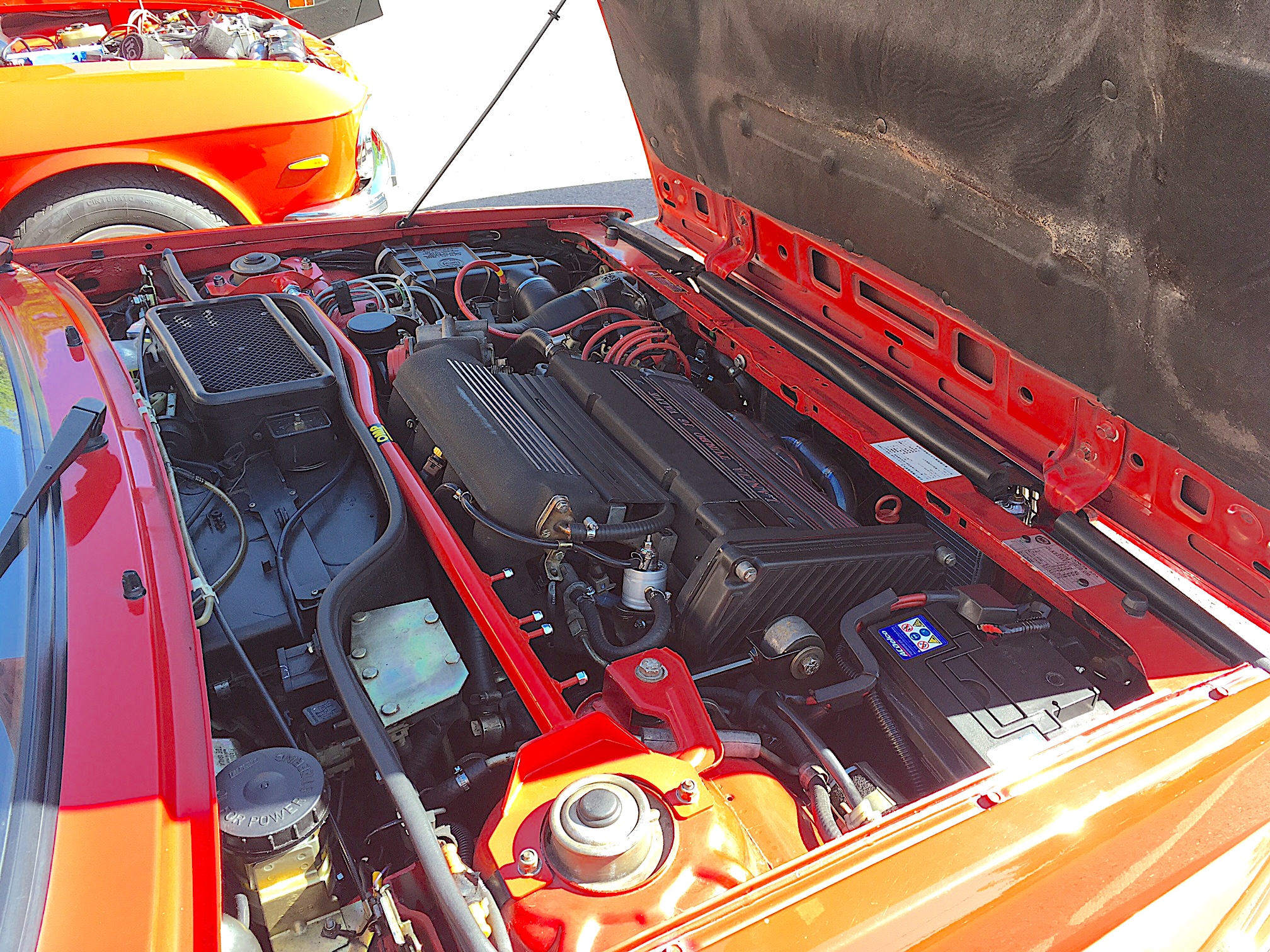
The cars are a study in contrasting approaches to rally car design by a firm that seemed to be guided by its engineers rather than its accounting department.  The Fulvia engine, below, was a narrow-angle twin-cam aluminum V4 of 1.6 liters driving the front wheels...
The turbocharged engine of the Delta Integrale was a 16-valve twincam inline four of the same size (eventually available in 2..0 liters), transversely mounted but driving all four wheels by using a torque-sensing center differential. Both cars scored major successes in international rally competition.
Two Alfa Romeo Berlinas designed in the Sixties showed up, a white TI model from 1968 and a red Giulia from 1970. Engine offered in the US were the 1600cc all-aluminum twincam six based on the 1300cc Giulietta.  Ironically, owing to US emissions regulations, those were two years when Alfas were not imported Stateside...

The Alfa Milano below was offered in the US from 1986-'89.  It was based upon the Model 75, and offered American drivers the experience of driving a sedan powered by a modern 3 liter, 60 degree overhead cam V6 with a 5 speed transaxle.  Long before BMW coined the slogan "The Ultimate Driving Machine", Italian manufacturers creating the sports sedan niche, Alfa with the twin-cam 1900, Giulietta and Giulia, and Lancia with the V6 Aurelia transaxle cars.  Here the Alfa provides company to a BMW 3 Series comvertible from the same era.

Healey historian and restorer Roger Moment's 1955 Austin-Healey 100 BN1 series (the first Austin-Healey) provides company to his friend John's Austin-Healey 100-6.  Mr. Moment was able to provide a tutorial on the differences between BN1 and the BN2 that appeared in 1956, and also on the 100-6 that was produced from 1956 to '59.  The BN1 and BN2 series featured a 2660cc liter inline four (the BN1 with 3 speeds, the BN2 with 4), while the 100-6 featured a 2639cc inline 6 and 2 inches more of wheelbase at 92 inches.  All engines featured overhead valves.   In return for the smoother six cylinder power, the 100-6 lost the charming fold-down windshield of the BN1 and BN2...

A Citroen ID Series wagon joined its sister car, a DS-21 on 8th St.   Both cars feature overhead valve inline four cylinder engines driving the front wheels...
Both cars also feature the self-levelling hydropneumatic syspension system that made Citroen famous upon its introduction at the Paris Auto Salon in 1955.  As Kevin Roberts' green DS21 sedan from 1972 demonstrates, the ride height was adjustable from a low, ground-hugging highway cruising mode to maximum ground clearance for unpaved roads.  The ID wagon has a manual 4-speed transaxle, while the DS has a 3-speed automatic.  Power steering was an option on the ID, but standard on the DS.
AIr-cooled Porsche 911s flank an Alfa Romeo 1750 GTV, offered by the Milanese firm from 1967 to `72.  Porsche abandoned its chrome bumper style to comply with US bumper laws for the 1974 model year.  Alfa Romeo managed to keep the chrome bumpers on the GTV until its final year in the US (1974) by fitting small bumper guards and claiming the car was a 2 passenger…the rear seats on the '74 cars were fitted with a sign that they were not to be occupied when the car was in motion.  Admirers of the earlier chrome-bumper 911 may wonder why Porsche didn't try this...
The lineup along the east side of 8th St. included a Porsche 912 from the '66-'67 period, a Volvo P1800 coupe from the same era, a 21st century Alfa Romeo 4c, a round tail light BMW 2002 that scored BMW's first success in the US market in the late 60s, and a bright green Mini from the era when Minis were built by BMC instead of BMW...
The Series 2 E-type was Jaguar's attempt to make their 2-seater into a more practical car. Improvements included a bigger air intake and radiator with twin multi-blade fans, upgrading the already powerful 4-wheel disc brakes, and adding bigger parking and tail lights. Not all improvements were greeting with joy by industrial designer types, though...
Ted Ax of Ax & Allies, Denver specialists in repair of vintage British machinery and for some reason Citroens too, brought this righthand-drive MGB from the golden age of that car and of British cars in general (the Sixties).  The car was kitted out with full rally regalia...
Parked next to the Ax MGB was a Series I E-type Jag that, if both car and driver make it to August 2023, the author will have had for 50 years.  Good heavens, that's half a century...
Overall, a memorable show on Memorial Day weekend.  Ace the Labrador pup gave it a fast wag of approval...
Photo Credits:
All photos are by the author.