Featured Post

Sunday, April 24, 2016

The Car Search Part 2: The Fun Factor


Today's effort is essentially Part 2 of Doing the Assignment; the assignment was to suggest some fun-to-drive replacements for a VW Thing that lives in Los Gatos, California.  We'll use the 5-star rating system defined in yesterday's posting to assess the escalating level of difficulty in restoring and owing these cars, and remind our readers that concepts like fun and beauty are highly subjective.  Now let's have some fun…

*Lotus Elise Series 2 (2001-11)
Experts agree; this thing is fun to drive.  Not a surprise, as it was designed for no other purpose; a lightweight, mid-engined tool for carving up switchbacks that offers only enough space for two smiling people and their weekend bags…your sheepdog and those sheets of plywood will need to go in the chase vehicle or stay at home.  The Series 2 was imported to the States, while the earlier Rover-engined Series 1 (1996-2001) stayed in England and Europe, with about 150 cars built for the Asian market by Proton in Malaysia. The Toyota engine offers reliability as well as smooth power, and the chassis design formed a basis for the (much more expensive, even used) Tesla Roadster.  This was the most popular Lotus in the American market, eclipsing the sales of the first Elan.  I interviewed an owner in Boulder, CO who uses one as her daily driver, and it's her all-time favorite.


**BMW Z-1 (1988-91)
The plastic-bodied Z-1 roadster was designed with high structural side sills for rigidity and impact protection; this led to the trademark doors which drop into the sills.  The windows automatically roll down when the doors are lowered, and the car can be driven with the doors open, but not legally in the US.  Never imported to the US when new, it's now legal to bring one in owing to the 25 year DOT limit.  The smooth 168 hp ohc inline 6, five- speed gearbox and front suspension are stock E30 series 325, while the multilink rear and flush belly pan were novelties.  Owing to the 45,000 Euro price tag and the subsequent arrival of cars like the Miata, sales were not as high as anticipated and only 8,000 were built.  Wonderfully comfortable seats, and all kinds of potential for performance upgrades...


***Alpine Renault A310 (1971-85)
Jean Redele's Alpine A110 became a collector's trophy by winning the Monte Carlo Rally and the World Rally Championship. The more practical & spacious A310  has  only recently generated some interest from collectors, and is an easier car to enjoy on a daily basis; claustrophobic rear seats are even provided for (smallish, let's hope) children.  The original 1600cc pushrod hemi 4 (127 hp) sat at the rear of a backbone chassis clothed with a fiberglass body fronted by an impressive full-width array of flame-throwing rally lights.  Late in 1976 came the 2.7 liter V-6 with 150 hp, and top speed went up from 131 to 137 but the car lost the full-width lighting. People who like the adrenaline rush provided by the background threat of animal oversteer (in other words, people who like Porsche 911s) will enjoy driving this car.  

**Lotus Elan +2 (1969-75)
If you think of the backbone chassis of the Alpine Renault turned around with the engine at the front and a driveshaft going through it to the rear, you've got the concept of the Lotus Elan, possibly the best car Lotus made prior to the current run of Toyota-engined GTs.  The lightweight, rigid chassis and 1600cc Ford engine block with Cosworth-designed twin-cam head made for a car that is still in my Pantheon of best-ever drives.  And I'd recommend the Plus 2 because the extra 12 inches of wheelbase makes for real room inside for the front occupants, as well as the slender, elegant proportions you see below.  Another advantage is that prices on the Plus 2 are not up with the 2 seater Elans, and that to compensate for the weight penalty of the longer body, a 130 hp Big Valve engine was made available in 1971.  UK and European markets got the final offering, the Plus 2S / 130-5 with a five-speed gearbox, and that, along with a galvanized replacement chassis if needed, could be the best combo.

***Lancia 2000 HF Pininfarina (1969-75)
The front-drive Fulvia V4, especially in HF or Zagato form, has attracted lots of interest from auctioneers lately, but the bigger, torquey flat-four Flavias and the later offshoots, the Pininfarina 2000 coupes, would be more relaxing to enjoy on a long trip.  Vignale built some Flavia convertibles and PF some Flavia coupes earlier in the series, but the object of my attention is the PF 2000 coupe which was built from 1969 on.  The elegant, glassy shape enclosed a well-outfitted interior with reasonable room for 4, and the Bosch fuel- injected HF made about 125 hp, and good use of the 5 speeds and 4 disc brakes.  


*Alfa-Romeo Series 105 (1962-75 for the series)
The 105 Series takes in a bevy of different-appearing cars which are all fun to drive.  My favorites are the Duetto (1966-70) which Dustin Hoffman drove in The Graduate, and the Zagato-bodied Junior Z pictured below (1970-75).  The series also included a run of square-rigged but very engaging sedans with the classic aluminum twin-cam 4 in displacements of 1300, 1600, 1750, and 2000cc.  There was also the delightfully balanced (dynamically and visually) Giugiaro-penned GTV built by Bertone and offered in the US thru 1974.  But the ones I sampled were the Duetto 1750 and a 1600 Junior Z*, and they were both so responsive it felt like they were alive.  A simple chassis design with a well-located live rear axle, 4 disc brakes and 5-speed transmission made good use of the eager engine.  The Junior Z was never officially imported, and the other Alfas were non-imports in 1968 and 1970 while the factory sorted out emissions, but now you could import any European market car from that period.  And any of these Alfas would be fun to run...

*Footnote:  The Junior Zagato was made in 1300 and later in 1600 versions, and the latter is rarer, with 402 built from late 1972 through 1973.  Alfa was still selling new ones as late as 1975, so that's the date we chose.  The 1300 Junior Z was considered a Series 105, while the 1600 version with 4 inch longer tail was a Series 115.  

Photo Credits:
Lotus Elise:  Wikimedia
BMW Z-1: carbase.com
Alpine Renault A-310: youtube.com
Lotus Elan +2S:  Lotus Cars
Lancia 2000 HF: movitcars.com
Alfa-Romeo Junior Z:  Wikimedia


Saturday, April 23, 2016

The Car Search Part 1: A Rating System

One reader writes that he's tiring of his VW Thing, and wonders what might be more fun. Something vintage and Japanese like a Honda S800, or old and British like a TR-6?  Or something more modern like a Mazda RX-7 or 8?  Or maybe an old Yankee land barge like a Hudson Hornet or Nash Airfllyte? Well, Duke Ellington said that good music was beyond category, and that's probably true of cars too. It's not for this writer to say that a '70 Alfa Junior Z is inherently more fun than, say, a '55 Imperial limo. Indeed, it's possible to imagine having some kinds of fun in the latter that would be very difficult in the former. However, it may be helpful to set up a rating system for evaluating possible automotive purchases.  I'm going to suggest a five-star rating system based upon ascending level of difficulty, and essentially reduce the measurement of difficulty to the one-dimensional challenge of finding spare parts. At the summit of our Challenge Scale, however, we'll have a rating which may deter some purchases, as it assigns a value to the possible emotional trauma associated with restoring certain kinds of old crocks. Once I've described the system I'll apply it to some example cars.  Here we go:

*One Star:  Drivetrain and body parts are available from the manufacturer, who is still represented in the US market.  One example would be the Acura NSX.  

**Two Stars:  Drivetrain parts (at a minimum) are still available in the US, even if the model in question was not officially imported.  Examples range from imports like the BMW Z1 to some domestic cars like 60s Lincolns and Cadillacs.

***Three Stars:  The car has been out of production for so long, and / or is so rare in the US, that parts are usually acquired by finding and dismantling a parts car.  I once had a Lancia Flaminia that fits into this category.

****Four Stars:  Drivetrain and body parts are only attained by making them.  Here one thinks of all manner of Twenties and Thirties classics, from Bugatti and Delage GP cars to Stutz Super Bearcats, and some more modern cars like early 50s Ferraris and Maseratis.

*****Five Stars:  Purchase of a vehicle in this category could potentially destabilize the purchaser's marriage, familial and even professional relationships.  If you've read this far, you've likely already pined for a car in this category, and it's lodged in your memory like a lost love from a soft-focus summertime of wasted youth.  It would be disrespectful of me to suggest any names. Far better to observe a silent Moment of Sadness before we proceed…

Today's examples would all offer a driving experience markedly different from that of an early 70s VW Thing, and also from each other.

*Mazda RX-7 Third Generation (1991-2002):
Yoichi Sato's design still looks clean and modern a quarter century later, and at 68,500 units was made in similar numbers to E-type Jaguars, but only offered in the US from 1993 thru '95.  Still, there should be enough of a selection available here to avoid Japanese market cars with their right-hand drive.  All had a 1.3 liter twin rotor, twin turbo engine with horsepower ranging from 255 to 280.  Think of a Miata with 300 extra pounds, but twice the power…

**Peugeot 504 Pininfarina Cabriolet and Coupe (1969-83)
If the Mazda is an authentic sports car for carving turns in the mountains on weekends, the PF Peugeot is a suave boulevardier suitable for the beach promenade.  Both coupe and cabrio share advantages of the sedan which was once familiar Stateside: a sturdy engine, nice handling and ride from 4 wheel independent suspension and disc brakes.  PF designer Aldo Brovarone gave these cars elegant proportions and clean details (avoiding the odd bent trunk from the sedan) and created a car that symbolized lounging on the Cote d'Azur as well as the original Mercedes 230SL.  Like Aldo Cello from those old wine commercials, he may not have spoken any French, but he knew what women liked.  Engines varied from 1.8 liter and 2.0 liter inline 4 (with carbs or injection) to the PRV V6 which also appeared in Renaults and Volvos.  I'd take the cabrio with the V6.  A victim of the OPEC oil crisis, it was made in less than 1,000 units from '75-'77.

***Fiat 2300S Ghia Coupe (1961-68)
Sergio Sartorelli's design echoed Ghia's (and Virgil Exner's) work on the Dual Ghia L6.4 prototype, and Aurelio Lampredi's sturdy pushrod inline six was good for 150 hp. and 120 mph in the S. Some versions had Abarth tweaks for rallying; all had 4-wheel discs & live rear axles like the contemporary Alfa 2600.  The interior was as luxe as those on senior Lancias and Alfas, with leather seats and full instrumentation.  A charming car; and a possible door opener to the Concorso Italiano for $25K to $38K.


****Delage D6 3 liter postwar (1947-53)
The D6 is the Dodge of French classics in a certain way, sturdy and reliable (unlike their GP cars) and lagging in market value until the recent boom.  Even now they're behind Delahaye or Talbot unless you find one bodied by Figoni or Saoutchik.  You might, however, be charmed just as easily by something like this 1947 Vutotal pillarless coupe by Letourneur et Marchand.  Their ready-to-wear line was bodied by Autobineau (think of an early 50s Mercedes), all with the Delahaye-derived pushrod 6 and Cotal pre-selector transmission, but with hydraulic brakes instead of the mechanical ones favored by Delahaye and Bugatti, because that's the way founder Louis Delage liked his brakes, and he stayed on as an advisor to the Delahaye-Delage combine after Delahaye's takeover in 1935.


*****Abarth Simca 2000 (1963-65)
Like many an object of unreasonable desire, the Abarth Simca 2 Mila is not what she would appear. Because of exposure to Fiat Abarths, people expect modified Simca engines here, or at least Simca engine blocks.  But the position of "Abarth" in front of "Simca" is a clue; the cars were designed to reflect racing glory on Simca, but had engines designed and built entirely by Abarth, twin cam inline 4s of 1300, 1600 or 2000cc mounted behind the Simca transmissions (a weak link).  The floor pan was a shortened version of the Simca 1000 and the 2 Mila (short nose shown) was available in Stradale or Corsa versions.  The latter, making around 202 hp, handily beat the Porsches in the European Hillclimb Championship, and may be considered a bargain at 1/6 the price of those same Porsches today.  Alloy bodies look like Zagato but were mostly by Sibona and Bassano.  Does the French chassis and transmission disqualify it from Italian car events?  Who cares?  I want one…

Photo credits:
All photos Wikimedia except Peugeot (classicdriver.com)

Wednesday, April 20, 2016

The Etceterini Files Part 7----- Almost Famous: OSCA


A couple of years ago, I called a guy about a Citroen DS-19 he had for sale.  We talked about the Citroen for awhile, and it struck me that this guy knew a lot about old cars, so I asked him  if he had any other interesting cars."Let's play a game, OK?  You name a make of car, and I'll tell you if I have one."

I started naming cars, and we blasted past Abarth ('yep"), Allard ("two"), Jaguar ("you need to ask?"), Lotus ("of course") and then I decided to name my favorite obscure car:  OSCA.

"I actually have two OSCAs.  Come and have a look at that Citroen and I'll show you the other cars."

So I called on an old friend who also likes cars, and we went over to have a look.  When we arrived we saw a pretty standard-looking suburban house with a couple of garages and an outbuilding or two.  The Citroen, the object of my quest, shared outdoor space with a few other makes in various stages of repair.  Our friend met us at the front door and showed some photos of his SCCA racing career on the walls.  But once he opened the garage doors and we wandered inside, I felt much like I had as a high school student, when a gallery owner on Chicago's Michigan Avenue had opened up his storage room to preview a collection of Matisse canvasses he was cataloguing for an exhibit.  There they were, one great painting after another, paintings I'd seen in books, just leaning against the walls…

And here, on jack stands, a Morelli-bodied OSCA MT4 (Maserati Tipo, 4 cylinder) with the trademark cheese-grater grille from the mid-50s awaited completion of a long, painstaking rebuild...
…aiming at a result like this.
A sleek, low S187 from the late 50s looked ready to race again, but it was hemmed in by a Lotus Eleven, MGs, and an Allard...
It had once been raced by the Briggs Cunningham team in the 750cc class.
And so the time had come to recollect the glories of the OSCA, which was Almost Famous during the Golden Age of American road racing.  The Maserati brothers founded their first firm in 1914, an inauspicious year for Italy, Europe and humanity.  They began making spark plugs, and after the Great War ended, they made racing cars under contract to Diatto, but when that company quit racing in 1926, the brothers took their last design for Diatto, a 1.5 liter twin cam, and raced it successfully under their own name.  It quickly led to orders for more race cars, but staying competitive meant frequent expenditures on new designs and new tooling.  By 1937 the brothers were seeking a more reliable source of income, and sold their company to the Orsi family, agreeing to stay on as consultants for 10 years.  Racing success in these interwar years included back-to-back wins for Maserati at the Indy 500 in 1939 and 1940.  Two years after World War 2, the consulting contract ended and three of the brothers (Ernesto, Ettore and Bindo) began to build racing cars again.  Because they'd essentially sold the Maserati name along with their car factory, they showed a real sense of humor by giving the firm the deadpan name Officine Specializzate Costruzione Automobile…translating roughly to "workshop specializing in car construction."  The brothers were soon designing, building and testing racing engines. Among the forgotten efforts of their workshop was the 4.5 liter V12 originally developed as a GP engine to be shared with Gordini (see "Etceterini Files Part 6" in these pages), and which led to this brutally focused, Zagato-bodied coupe, essentially a Formula 1 car in a road car suit, built for Clemente Biondetti in 1951...
A spin-off of this engine was an inline 6 for Formula 2; the basic engine architecture was shared with Gordini.  Only a handful of the Formula 2 cars were built, along with 3 sports cars using the same engine.  These 2000S cars outwardly resembled the 1.5 liter MT4 which Stirling Moss employed to catapult OSCA (and himself) to fame, by winning the 12 Hours of Sebring outright in 1954.  Driving Briggs Cunningham's car as prepared by Alfred Momo (see "The Etceterini Files Part 5" in these pages), Moss and co-driver Bill Lloyd blew away opposition that included Jaguars and Ferraris with nearly three times the power.  Overnight, lots of name drivers in American road racing wanted OSCAs, and those who could afford the sticker price ($9,000 to $10,000) bought them.  Somewhere around 6 dozen of the MT4 series were eventually built; here's Stirling Moss making OSCA famous (well, almost) at the old airfield course in Florida...  
As a way of utilizing that name recognition to reach a wider market, the Maserati brothers planned a joint project with Fiat, with the Torinese giant agreeing to manufacture an engine of OSCA design for use in Fiat roadsters as well as in a road-going OSCA GT car.  Other than a handful of coupes, most of which wound up on race tracks anyway, OSCA had never made a serious touring car (with heater, bumpers, etc.) before.  The first fruits of cooperation with Fiat appeared in 1959 as the Fiat-Osca 1500S, and they gave Fiat a high performance "halo car" to entice Americans and increasingly affluent Europeans (something it later tried with the Ferrari-engined Fiat Dino V6). Fiat soon increased engine size a bit for the 1600S, and the OSCA GT cars, when they appeared in the early Sixties, shared this displacement, though the OSCA version of the engine was a bit different, with forged connecting rods and other tweaks for anticipated race duty.  A couple of the resulting OSCA 1600 GTs were bodied by Touring Superleggera (black car below), a handful by Fissore, and most fetchingly, several dozen by Zagato with the signature double-bubble roofline. Note that on the silver gray Zagato, the air extractor vents for the cabin are integrated with the headroom-enhancing bubbles.  

Zagato also built a lower, sleeker version of the 1600 GTZ which was more focused on road racing.  Go ahead; pretend you don't want one...
Stirling Moss wanted one, and found a rare FS372 with desmodromic valves (mechanically opened and closed, another way for the Maserati bros. to bankrupt themselves on R & D).  Here he is in the Bahamas, demonstrating his baby about 57 years after that Sebring win...
In an ideal world, this is where the story would end.  Happy collaborations, increased sales, solvent Maserati brothers.  Fiat sold thousands of the Fiat-Osca, but the brothers had trouble breaking into three figures with their own version, and as noted above, they couldn't resist spending money on racing car development.  So in 1963, they sold their enterprise again, this time to motorcycle manufacturer MV Agusta, which made the odd decision (as evidenced by the photo below) that what the world really wanted was to pay OSCA prices for cars that looked a whole lot like Fiats.  It was all over by the end of 1967.
Postscript:  Privacy considerations prevent me from sharing the identity of the OSCA owner.  If you're lucky, you may meet him at the races someday yourself.  He's such a nice guy that he'll be happy to share some of his vast knowledge about rebuilding old machinery, or even offer to give you a Citroen, as long as you'll just tow it out of his life...

Photo credits from top:

1.)   Denée Foti
2.)   Wikimedia
3.)   Denée Foti
4.)   racingsportscars.com
5.)   carbodydesign.com
6.)   media.crash.net
7.)   Bonham's Auctions
8.)   2000gt.net
9.)   forum.autohoje.com
10.) Wikimedia
11.) classiccarcatalogue.com 

Wednesday, April 13, 2016

Whatever Happened to the Good Old Station Wagon?


Back around 1960 or so, one of my grade school pals recoiled in horror when his dad threatened to buy an International (Harvester) Travelall, a forerunner of what would now be called an SUV.  "But, Dad, that thing's just a truck."  Just a truck; that pretty much said it all. Back in 1960, none of us would have predicted that well within 5 decades thinly disguised trucks would be a mainstay of the Cadillac and Lincoln lines, and that station wagons as we knew them (rear-wheel drive, simulated wood siding, thrumming V8 power, and a low enough profile that you ducked your head when getting in) would eventually vanish from the Ford, Chevy and Dodge lines.  In the minds of mid-century kids, station wagons were just as cool as cars, only a little more useful when we wanted to go camping or canoeing. Trucks, though, were farm implements...

Two old friends called yesterday from their home near Stanford to ask what kind of new car they should buy.  As their kids are grown and they already have a nice BMW coupe to drive to official functions like weddings and funerals, I told them to buy a new Mazda MX-5 Miata.  Not too expensive, and the only car to make both Automobile Magazine's All-Stars list (the fun factor) and the Consumer Reports Top Ten (the reliability factor).  "No", they replied, "we need something that will fit our tandem Jack Taylor bike."  I knew better than to suggest a minivan, and before I could suggest an SUV, they clarified, "No SUVs.  Those things are just trucks."  Apparently the Mid Century Mind is still alive and well, even though some of us have trouble remembering where we left our car keys…

So I plowed through the online catalogs and car mag test reports, and leaving out the SUVs and crossovers realized there aren't many real station wagons left.  First of all, I eliminated the Minis (too small for that bike) and, though I like my Subaru Legacy wagon, in 2016 you can only get it as an Outback (8.7" of ground clearance) and, come to think of it, my friends won't need the standard all-wheel drive either.  I like the new Tesla Model 3 but there's a waiting list and I'm not sure the bike would fit.  The VW Golf Sportwagen is smallish but might almost do the job.  At $22k to $27k it seems reasonable, and the recent diesel scandal may have left VW outlets in a dealing mood.  Passat wagons are no longer available stateside, and the Audi Allroad has mandatory AWD, and 50.5 cubic feet of space goes with a fairly steep tag of $42k to $45k.  The tasty BMW 328 wagon has a similar wheelbase to the Audi at 110.6", more space at 53 cubic feet, 20 more hp at 240, and costs the same at $42,650.  All-wheel drive's mandatory at BMW, which in my experience leads to more frequent tire replacements.  So if it has to be a wagon, I'd settle on the Volvo V60 in the non- Cross Country, front-wheel drive version.  The same 240 hp as the BMW, but easier on tires and easier on the starting budget at $36,150.  Less storage space than the Audi or BMW at 43.1, but you can take the front wheel off the bike and stack the suitcases…

But my favorite program would still be to leave that Jack Taylor tandem (a lovely collector's item) at home and put two Moulton collapsible bikes in a new MX-5 roadster and then head for the hills, or better still, down Highway 1 to Pfeiffer Beach in Big Sur.  As an added benefit, having separate bikes for two people will allow those independent explorations so essential to personal growth. Right?


Photo credits:
1954 Chevrolet Nomad Motorama show car:  General Motors


Sunday, April 10, 2016

The Future in the Rearview Mirror: Tesla Model 3 vs. NSU Ro80

The recent unveiling of the popular-priced (well, $35k anyway) Tesla Model 3 has reminded those of a certain age (old enough to remember attending Jefferson Airplane concerts, for example) of another time when we were expecting the imminent replacement of the reciprocating internal combustion by something better.  The reception of the Model 3 can be summarized as a gaggle of glowing reports about its performance, packaging and range, and a whiff of disappointment about its form and detailing.  In short, it looks like the Tesla engineers reminded the stylists that no large front air intake was needed, but the stylists got the memo late in the design process and erased the grille at the last minute… 


A few critics had apparently been expecting a more fearless, groundbreaking design, something equivalent to the Citroen DS-19 in 1955.  Or to today's subject car, the NSU Ro80 from 1967.  It appears that the Tesla crew prioritized engineering a flawless drivetrain over inventing a brave new look to house it.  This is probably better than producing a mind-blowing exterior shell with under-performing mechanicals.  Exactly that happened back in the era of light shows and communes, when the Teutonic engineers at NSU, known mostly for microcars and motorcycles, dreamed up the first mass-produced passenger sedan with a Wankel rotary engine.  NSU had pioneered production of the engine for automotive use in their tiny Wankel Spider in 1963, and Japan's then-obscure Mazda had released their Cosmo, a coupe for 2 (compact) passengers, a couple of years later.   


A quarter century after the birth of NSU's problem brainchild, one Ro80 loyalist commented that if anyone noticed his car at all, they probably thought it was a late-model Ford Taurus.  Indeed, many of the car's features which had startled with their freshness in 1967 had become commonplace  by the early 90s.  The revolution starts at the front of the car, with compound, covered headlight units matching the contours of the tapered snout.  Designer Claus Luthe produced an intuitively aerodynamic form, with wind-tunnel testing revealing a Cd of 0.35; this was tuned down to 0.34 in production versions.  By the 1980s, this rounded wedge form with low belt line and tall, glassy cabin had entered the design mainstream, along with the car's front-drive format, 4 wheel disc brakes (inboard at the front, as would be adopted on Audi's 100), and power rack & pinion steering.  The encircling belt line crease (seen on earlier NSUs and first on the Corvair) is here shorn of chrome and integrates the door handles into the form, as well as forming a shallow ledge over the tail lights and license plate recess.  The new car quickly gathered praise from automotive journalists, winning European Car of the Year for 1968, and thousands of orders from customers.  The twin-rotor engine was noted for its smoothness and responsiveness if not for fuel efficiency (15 to 18 mpg). NSU still had a backlog of orders to fill when the first complaints about reliability came in.  The apex seals which formed the contact between the rotor tips and the sides of the chambers in which rotors revolved suffered from early failure, and NSU had to replace hundreds and then thousands of them under warranty.  After awhile, Ro80 drivers meeting on the road would flash a finger count of engine rebuilds through the windshield.  These rebuilds and replacements quickly bankrupted the little company, and VW-Audi took over.  Improved apex seals like the graphite-aluminum type used by Mazda greatly increased engine life and lowered oil consumption, and the Ro80 lived on as the sole NSU production model through 1977.  By the time the new, improved Ro80s began to acquire a good reputation, the 1973 OPEC oil embargo reduced the demand for fuel-thirsty cars.  The Ro80 is now attracting notice from car collectors, and will always stand as a cautionary tale about the risks designers and engineers face when sketching out a bold new future on a blank sheet of paper, or computer screen…

Photo credits:
Top:  Tesla Motors
Middle + bottom:  Audi-NSU

Sunday, March 27, 2016

The Etceterini Files Part 6--- Gordini: French Connection, Chicago Subplot

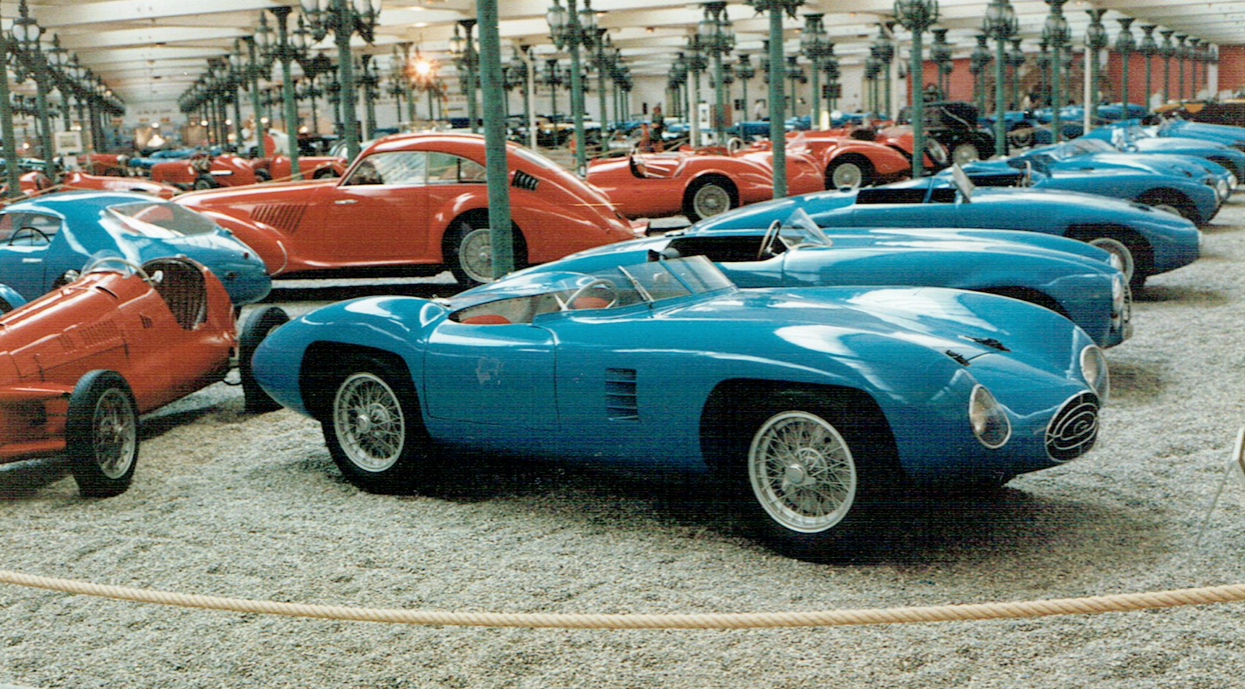
You may be wondering what the Gordini, made on Boulevard Victor in Paris in the 1950s and known (if not famous) for Grand Prix cars, is doing in a series on etceterini, which were Italian road racers, usually small and often based on Fiat engines.  At first glance the Gordinis, painted French racing blue and often with 6 or even 8 cylinders, don't seem to fit.  But founder Amedee Gordini, known in France as "le sorcier de la mecanique" for his wizardry with machines, was born in the Italian region of Emilia-Romagna (home to Maserati, Ferrari and Lamborghini), and moved to Paris in 1926 after Italian army service during the Great War.  He surprised race fans with the performance he coaxed out of a  Fiat Balilla in the early 30s, then in '34 approached Italian-born Simca director Henri Pigozzi about going racing.  He persuaded Pigozzi to support Gordini's racing efforts by making running gear available from the Simca product line…which consisted entirely of Fiats built under license at their big factory in Nanterre.  So the Gordinis fit the etceterini pattern because they started small and were Fiat-based in a roundabout way.* This pattern continued into the postwar period.  Below is a Type 15 from 1950, based on a Simca 4 cylinder block and with Gordini head incorporating twin overhead cams. 


The pattern changed after the 1951 season when the light, nippy Gordinis blew up a lot of their supercharged 1.5 liter engines and Simca withdrew its support, forcing Gordini to finance his operation by selling the occasional car, collecting starting money, and selling seats in his racers to wealthy privateer enthusiasts.  For the 1952 season, there was a new Gordini Formula 2 engine, a light alloy inline six with gear-driven overhead cams.  The engine had opposite effects on Gordini's fortunes at the bank and on the track, as it was expensive but gave the little blue cars a fighting chance.  For '52 and '53 the governing body for the World Driving Championship had decided to run it by Formula 2 rules after Alfa Romeo dropped its participation and narrowed the field, so Gordini's new engine would allow his cars to be more competitive in a variety of settings. You're likely wondering how a tiny, cashed-strapped machine shop could develop a new engine in such short order.  So we need to look at another Italian connection, the one to the Maserati brothers…

Earlier, in 1949-50, Gordini had explored a project with the Maserati brothers at OSCA to jointly develop a 4.5 liter V12 for the then-current Formula One, and after failing to persuade Simca to finance the engine, obtained funding from Emperor Bao Dai of Indochina.  Only a handful of the OSCA Type G (for Gordini) had been built by the time the rule change obsoleted them, and by then Gordini had dropped out of the shared engine program.  But he salvaged something of value from the effort anyway, as his deal with the Maserati brothers allowed him to share the basic architecture of the new OSCA F2 engine (it was like one bank of that 4-cam V12), and allowed twice as many cars to challenge the new F2 Ferraris and Maseratis.  Why did the Maserati brothers want to beat the Maserati cars?  Because years earlier they'd sold their name along with their original car company (you're likely beginning to suspect that building race cars is risky business) and were now focused on making OSCAs. Compared with the OSCAs, the Gordinis looked more like the kind of racers that daydreaming school kids would draw (think "The Little Car That Could") and they proved that they could indeed prevail, given a twisty track and a crafty driver who could avoid flying out of the car (more on that later).  The new Type 16 Gordinis had some surprising success in 1952, including Jean Behra's outright win over the new 4-cylinder Ferrari 500s at Reims, and in 1953 American drivers Harry Schell and Fred Wacker bought rides in Gordinis.  Wacker, from the same family for which Chicago's Wacker Drive was named, had formed that city's chapter of the SCCA in 1948, and started racing in an MG. Prior to his brief GP career, he was known as a jazz musician, and for an accident which essentially ended racing on public roads in the United States, and prompted improvements in safety measures for spectators. In the 1952 race at Watkins Glen, Wacker moved left to avoid a collision with a Cunningham, and the rear of his car clipped a curb. Spectators lined the street, and a group of them were actually sitting on the curb.  Several people were injured, and a 7-year old child died.  It's not clear whether the shadow cast by this disaster prompted Wacker to pursue a racing career abroad; what is clear is that he soon encountered European notions of driver safety.  Here's Fred Wacker leading Andre Pilette at the Belgian GP on the first day of summer in 1953...


Note that Wacker's Gordini is taller than Pilette's Connaught, which typifies the lower, wider stance designers were already seeking, and which would lead eventually to mid-engined designs.  Wacker noted that in his first test drive he nearly fell out of the car through that tall side cut-out. Remember, there were no seat belts then.  According to Wacker, the approved technique was to push against the firewall with your left foot to keep your back firmly planted.  You would, however, eventually need your left foot for pedal duty… In his first race, a non-championship event, the GP des Frontieres at Chimay, Wacker took 3rd, the first podium finish in a postwar GP by an American and only 2.5 seconds behind Trintignant's winning Gordini.  In the Belgian GP pictured, his first championship event, Wacker finished 10th, 2 places behind Harry Schell.  It was the first GP race featuring two Americans.  At his next event, the Swiss GP at Bremgarten, Wacker flipped the car on his last practice lap and was rushed to the hospital with a fractured skull, extensive friction burns, and fractured ribs.  

He returned to the GP circus late in the '54 season, and Wacker's two year old, 2 liter F2 car was now competing against the 2.5 liter F1 cars in that year's new formula.  After breaking the transmission at Bremgarten, he managed 6th place at Monza.  This was remarkable, considering he was competing against the all-conquering Mercedes-Benz team, the new Ferrari 625s, and a Maserati 250F.  He ran two more races before retiring from the sport. Gordini plugged their 2.5 liter six, already used in sports cars, into the T16 and saw Jean Behra win at Pau and Cadours, both non-championship races.  Then, in mid-1955, they introduced the new Type 32, with a lower profile, 4 wheel independent suspension and 4 wheel disc brakes, inboard with twin calipers at the rear.  In the photo below, the Type 32 contrasts with the older design. 


The surprise under the hood was a beautiful 2.5 liter straight 8 with twin overhead cams driven by a gear train from the front of the crankshaft.  Along with the Mercedes W196 and ill-fated (though transverse mid-engined) Bugatti 251 from the same year, it marked a brief return of straight 8s to racing, just as they were disappearing from passenger cars, and before designers turned to more compact engine and chassis configurations.  Unlike the Mercedes which won back-to-back GP championships in '54 and '55, the Type 32 was too heavy to be very competitive...


There were a few 3.0 liter straight 8 sports racers too, and a couple of these were sold to enthusiasts, including the writer Francoise Sagan.  Unlike the Formula 2 engines or the stillborn V12, the straight 8s had no OSCA equivalent and have to be considered the purest of Gordinis. The expense of building them hastened the bankruptcy of Gordini's machine shop in the Boulevard Victor, and Renault brought Gordini into its competition department in 1957.  There the Sorcerer worked his magic on hotter versions of rear-engined sedans, and eventually on engines for the Alpine Renaults that won Monte Carlo Rallye and World Rally Championship, as well as the mid-engined Alpine Gordini V8s that raced at Le Mans.  In 1977 the first turbocharged Formula 1 engine, a 1.5 liter V6, contested a GP.  It had Gordini's name on it.  Gordini died in May 1979, weeks before it won its first race.


*Like other etceterini, Gordinis were built in tiny numbers.  There were lots of types, culminating in Type 32, but the highest chassis number I've found in race entries is #44.


Photo credits:

Top:       1950 Gordini Type 15, Wikipedia
2nd:        Fred Wacker in Gordini Type 16 at Spa 1953, 8w.forix.com
3rd:         1955 Gordini Type 32 & Type 16, Wikipedia
4th:         1955 Gordini Type 32 (Chassis #42), the author
5th:         1955 Gordini Type 32 (Chassis #42), the author
Bottom:  1953 Gordini Type 24 (Chassis #37S), the author


Friday, March 25, 2016

Roadside Attraction: The Beach Chalet, San Francisco


During the Great Depression and for awhile into the postwar period, dedication plaques on public buildings often identified the construction firm simply as "builder" rather than "general contractor".  I like this.  With one word choice, it transports the category of achievement from the dry legal realm to a viscerally physical one.  Imagine being able to point to the Empire State Building (or Rockefeller Center, or one of those big WPA dams) and say, "We built that."  Many of these projects were vast, complex and difficult enough that people died to get them built.  It's fitting that the builders are recognized in print, because sometimes they figured out solutions in the field that evaded architects and engineers in the drafting room.  Today's roadside attraction isn't on that huge scale, but it's a work of art whose very nature commemorates the people who made it. This is the Beach Chalet, a great place to end a cross-country journey or just a jaunt across the city.  Situated at the end of Golden Gate Park, it marks the end of the continent as well, and offers a commanding view of Ocean Beach.


Architect Willis Polk designed the original building in a Spanish Revival style for the City of San Francisco.  Built in 1925, it provided a lounge and changing rooms on the ground level, while the upstairs featured a bar and restaurant.  In a 1936 renovation sponsored by the Works Progress Administration, Lucien Labaudt was commissioned to produce a series of frescoes on the ground floor.  These wrap around the main reception lobby, and provide a view of the life and history of the city which is idealized and stylized so that it conveys a kind of innocence.  Models for many of the figures in these murals were provided by the people working on the renovation and also in city government, and their roles are identified in the plaques spotted at intervals along the walls.

After viewing the murals, you can check out the ground floor gift shop or the Park Chalet, which serves light meals in the space behind the main lobby.  Or you can take the stairs instead of the elevator to the Beach Chalet Brewery and Restaurant upstairs, as this will provide a chance to appreciate the wood railings and balusters with sea creatures carved by Michael von Meyer as part of that 1936 renovation, and the mosaics by Lucien Labaudt and tile craftsman Primo Caredio.


The building served as Coastal Defense HQ for the Army during World War II, and the VFW took it over for a long while after the war, with meeting rooms upstairs and a bar downstairs.  The bar became popular with bikers but not with many neighbors, and the building deteriorated, a process which continued for a few years after the VFW vacated it in '81, the year the Park Service declared it a National Landmark.  Restoration work was finished under a City program in 1989, but the building remained vacant until a 1996 grant from Friends of Recreation and Parks allowed ADA upgrades, and the Truppelli family opened a new craft brewery upstairs behind the bar, with restaurant seating offering spectacular views of windswept Ocean Beach.  Should you make the wise decision to avoid braving the riptides across the Great Highway, you can enjoy a Riptide Red while you watch surf videos on the flat screen over the bar, or linger over dinner while you contemplate the sunset through those big windows to the west.


To get there, set the controls in your driverless Google car to:

The Beach Chalet
1000 The Great Highway
San Francisco, CA 94121

Photo credits:

Top:  Wikipedia
Mural panorama:  matterport.com
3rd (mural):  the author
4th (Stair with railing):  artstheanswer.blogspot.com
5th thru 7th (railing sculpture):  the author
Sunset from 2nd floor:  yelp.com