Featured Post

Wednesday, September 9, 2020

Forgotten Classic: Lagonda--- A River Ran Through It

Eons ago when the author took this photo at the Monterey Historic Races, the main attraction was the resolute Britishness of Snoopy's vintage ride. It's a 1929 Lagonda 2 Litre with lightweight, sporting fabric bodywork, and a long-stroke 4-cylinder engine, an "underhead cam" design that appeared in 1925.  The idea of this engine with its twin lateral cams operating overhead valves through rockers was that the head could be removed without disturbing the valve timing. Other features, like the mechanical brakes operated by cables and rods, were typical of British cars of this vintage.  The Lagonda was a car named after a river; Lagonda was the Shawnee name for the creek that ran through a scenic gorge near Springfield, Ohio, the home of company founder Wilbur Gunn. He moved to England in 1891, and began building motorcycles in 1898.  3-wheelers and light cars followed.
By late 1934  when the M45 tourer below appeared, Lagonda had expanded its line with larger offerings and had adopted the Meadows 4.5 liter inline six which had already powered the Invicta, another British sports car.  Smaller engines from Henry Meadows Ltd. powered cars from Frazer Nash, Lea-Francis and also HRG. The big, overhead-valve six made up in sturdiness what it may have lacked in engineering ambition... 
Sturdiness and reliability worked for Lagonda in 1935 when an M45 prepared by London dealers Fox and Nicholls won the Le Mans 24 Hours; it beat Alfa Romeos and Bugattis with more cylinders and cams, and with lighter engine blocks.  The M45 racers served as the prototype for the M45 Rapide which the firm offered to customers.  The red car is a 1935 example.
Building expensive racers during a depression was a risky business though, and Lagonda entered receivership that year, then came out of it under the ownership of Alan Good, who in turn hired W.O. Bentley as chief engineer. Good abandoned producing the smaller models in favor of the larger, more expensive ones. Bentley, released from his consulting arrangement with Rolls Royce 4 years after selling Bentley Motors to them, first applied his talents to improving the Meadows six. This was done in a series of "Sanctions", running from Sanctions I through IV. Bentley designed an aluminum cylinder head, and eventually a performance version with twin spark plugs per cylinder. 
The LG6 featured Bentley's new chassis design, with independent front suspension by torsion bars.  It appeared at the 1937 Earls Court Motor Show with a sister car, the V12 with engine entirely of Bentley's design.  Both cars were available in a variety of wheelbases with coachwork built at the Lagonda factory in Staines. The example shown above and below is a 1939 LG6* sports tourer. 
Bentley's most ambitious design for Lagonda, however, was the V12.  This 60 degree design was also sized at 4.5 liters like the LG6, but featured a single chain-driven camshaft per cylinder bank. In addition to the bodywork offered by the factory, custom coachwork was offered by firms like Vanden Plas and James Young, which produced the V12 drophead coupe below in 1939. The streamlined form with teardrop fenders is unlike the angular, "razor edge" style the same firm pioneered on coupes and sedans for Bentley...
The touring version of the V12 in this car developed 175 hp, while a racing version with 4 carburetors was good for 220 hp, and that Lagonda was fast and reliable enough to take 2nd and 3rd places at the 1939 Le Mans, the last 24 hour race before the war that ended the whole V12 project, along with the LG6.  According to the Lagonda Club, before shifting into war production, the company produced 82 of the LG6 model and 185 (Richard Langworth says 189) of the V12. Total production of the 4.5 liter six, including the pre-Bentley M series, was 841.
Bentley designed a new engine for Lagonda's postwar restart, and industrialist David Brown bought the company in 1948 to get the tooling and rights to this 2.6 liter twin overhead cam six. He'd bought struggling Aston Martin the previous year.  Bentley's engine proved to be the one thing that saved the new David Brown automotive combine from the fate suffered by firms like Lea Francis, Alvis and Armstrong Siddeley...the fate of having their lunch eaten by William Lyons and his Jaguars.
In 1949, the year the new engine appeared in prototype DB2 Astons at Le Mans, the Lagonda 2.6 appeared.  Styling was an unconvincing mix of 1930s themes and hesitant modernism, and doesn't look very imposing even when parked next to a Morris Minor (that's the maroon car).  The rounded nose looks to a new era, while the prewar fender lines don't have enough wheelbase to get much swoop going.  The twin-cam engine is a star, though, and the swing-axle rear suspension is the first independent one in a British production car. Brakes are hydraulic, with inboard drums at the rear. When the Jaguar Mark VII appears the next year, it will have a bigger twin-cam six in a more expansive package ("Grace, Space, Pace") and it will easily outsell the Lagonda...
But Tickford will body some charming 2.6 dropheads like the one above.  When sales slow down and a Lagonda dealer decides to have Tickford rebody a few leftover cars in the style shown below, it becomes the prototype for the 3 liter that takes over from the 2.6 after '53. Visually and in engine size, the car parallels the Graber-styled Alvis* that will appear around the same time.
A four-door saloon is offered alongside the drophead, and proves more popular.  Along with the bigger version of the six, the car retains the swing-axle rear.
There was a two-door sports saloon model for a couple of years, but by the time Lagonda production ended with the 1958 model year, only the 4-door and drophead were offered.
But Lagonda didn't end its run before appearing for one last fling at Le Mans, now sponsored by parent David Brown and featuring a 4.5 liter V12 with twin-plugs per cylinder, 4 chain-driven overhead camshafts and a tubular space frame chassis. The new car qualified at Le Mans in 1954, but retired after an accident in the 4th hour. 
Only two of this brave, promising DP115 model were built, showing different grille styles but similar cutaway front wheel arches and sweeping curves in bodywork resembling Frank Feeley's design for the Aston DB3S* which appeared the previous year.
The engine had no relation to the prewar V12, but was instead more like two of the postwar Lagonda sixes angled at 60 degrees.  The cars proved troublesome, and David Brown's team elected to concentrate on the six-cylinder cars, eventually winning Le Mans with a DBR1 in 1959...
Perhaps because of that success at Le Mans, it wasn't quite the end of the Lagonda story. The '59 race victory helped sales of the new DB4 which had appeared at the end of '58. So David Brown commissioned a new saloon design from Superleggera Touring, which had designed the fastback coupe of the DB4 as well as the open Volante version.  When the Lagonda Rapide, named after the prewar performance models, appeared in 1961, it looked much like a stretched version of the DB-4 Volante, only with 4 doors, a hardtop, and canted headlight units echoing the Touring-bodied Lancia Flaminia...
In terms of chassis design, it was much like a stretched DB4, except that a De Dion rear suspension replaced the DB4's conventional solid axle.  The engine was the then-new Tadek Marek-designed 3.7 liter from the DB4. Testers criticized the restricted rear passenger room, and noted that Jaguars offered similar performance for less money. Ultimately, though, the Rapide was a victim of the DB4's success.  A full order book for the DB meant there was no excess production capacity, and production ended in 1964, after only 55 were built...
The William Towns-designed Aston DBS appeared in 1967 and overlapped production of the DB6, which it eventually replaced.  This larger, heavier car gave David Brown the idea of reviving the Lagonda again on a stretched Aston chassis, and the prototype appeared in 1969; David Brown sold Aston Martin Lagonda later that year, the year the first V8s finally appeared. The Lagonda prototype looked exactly like a stretched Aston this time, right down to the DBS grille...
With the DBS V-8 in production, AML's new management decided to produce the Lagonda prototype, now known as the Lagonda Series I, with the V8 in the DBS chassis with foot-longer wheelbase, oval Lagonda grille and single headlights...
But the 1974 model launch ran into the fuel crisis and recession triggered by the Arab oil embargo, and prospective customers noted the eye-watering price, especially compared with the new Mercedes S-Class and the Jaguar XJ, which now offered a V12 engine.  Those Jaguars again, with their competitive performance and tempting price tags, were a problem, while in Lagonda's price class, Bentleys offered more space.  AML wound up building only 7 of the Series 1 before giving up the effort.
But AML's management liked Bill Towns, and gave him the job of coming up with a Lagonda Series 2 that would justify its high price.  Towns by this time had adopted the wedge theme as his own, and came up with a sharply folded and creased wedge notchback with flattened grille and elongated nose for the new car, which surfaced in 1976. Rear seating space was sacrificed for the 4-door coupe look, perhaps a sign that nobody had learned from the Rapide misadventure...
AML spent almost as much development money on the futuristic digital instruments as it did on the rest of the car.  Though it had teething troubles, the car actually worked better than that early digital dash, which was a disaster.  The single-spoke steering wheel idea was cribbed from Citroen, but it fits the theme...
The various versions of the Towns-designed Lagonda were, by Lagonda standards, a commercial success.  Hundreds were built, even though they never made it to the top of Consumer Reports reliability ratings.  Production ended in 1990, and Ford, the owner of Aston Martin and Lagonda from 1987, began to look for a new Lagonda for the Nineties. They showed the Lagonda Vignale* in 1993...
As Ford also owned Vignale and Ghia, they were able to use the Italian design studios to build something around the new V12 engine, which was loosely based on Ford V6 designs. Visually, the car had no similarity to any Ford, or any recent Lagonda.  It was as exuberantly rounded and flowing as the Series 2 had been abruptly angular... 
...and for once, a Lagonda had space in the rear seat.  Even though it was the best thought-out of the various modern Lagonda revivals, no production ensued, perhaps because Ford also owned Jaguar at this time.  In 2007, Ford sold Aston Martin, and the Lagonda name went quiet for nearly a decade.  In 2015 Aston Martin, under new ownership, tried again with the Lagonda Taraf on a "sale only to invited clients" basis, and managed to sell 120. Apparently many went to the Middle East. Styling was clean, conventional and inoffensive. Price was a million dollars a copy; perhaps the car should've been named the Tariff,  as the main attraction seems to have been that it cost half a million bucks more than a standard plutocrat luxobarge like a Rolls Royce or a senior Bentley. The same team showed a promising all-electric Lagonda Vision Concept in 2018, but we haven't seen it since.  It's not certain we've seen the end of the Lagonda, but right now the name doesn't even appear on a river. The Shawnee tribe's watercourse in Ohio has sadly been renamed Bucks Creek...

*Footnote
:  Lagondas have appeared twice in these posts, first as one of the stars of "Nineties Concept Cars Part 5: Lamborghini Raptor and Lagonda Vignale", posted on 1-25-19, and then in a supporting role in "Speeding Into Darkness: Film Noir Cars", posted 3-31-20.  Aston Martins have appeared too many times to list here, but the most comprehensive survey was "Rescued from Obscurity: Aston Martin in the Fifties and Sixties", posted on 5-11-20. The Graber-bodied Alvis was the subject of "Forgotten Classic: The Graber Alvis", posted 1-22-16.

Photo Credits:
Top:  the author
2nd:  wikimedia
3rd:   pinterest.com
4th & 5th:  Linda La Fond
6th & 7th:  classicdriver.com
8th:  imcdb.org
9th:  wikimedia 
10th:  youtube.com
11th:  The David Brown Corporation Ltd.
12th:  Classic & Sports Car Magazine
13th:  le mans-history.com
14th & 15th:  drive-my.com
16th & 17th:  classicdriver.com
18th thru 20th:  bonhams.com
21st & 22nd:  wikimedia
23rd & 24th:  the author
Bottom:  wikimedia

Monday, August 31, 2020

Future in the Rearview Mirror: Pininfarina's World of Tomorrow

Pininfarina moved to the forefront of Italy's (and that meant the world's) independent car design studios during the 1950s.  By 1960, Battista "Pinin" Farina's firm had amassed a portfolio of notable designs for show cars as well as production models for Alfa Romeo, Lancia and Ferrari in Italy, Peugeot in France, BMC in Britain, and Nash in America.  They had moved into large scale series production of bodies for Alfa Romeo, Fiat and Peugeot. At the beginning of a new decade that would become associated with radical change, Pinin Farina and engineer Alberto Morelli proposed a radical rethinking of automotive form.  It was the PFX*, and it proposed a diamond-plan layout for the 4 wheels, simplifying suspension and drivetrain with a single steered wheel at front (no Ackerman effect required to adjust inner and outer turning radii) and a single wheel driven at the rear by a diagonally-mounted 4 cylinder engine (no differential needed either).  The goals were to get the noise and heat of the drivetrain behind a spatially-efficient passenger cabin, reduce aerodynamic drag, and increase directional stability with those tall fins.  The car was exhibited at 1960's Turin auto show, but did not attract any orders from major manufacturers...  
By 1961, Pininfarina had compounded "Pinin" and Farina into a single name, and ditched the diamond-plan wheel layout for the Pininfarina "Y", which appeared at that year's Turin show. The engine was at the rear, but in a more conventional arrangement with a differential driving the two parallel rear wheels.  At first, PF kept the stabilizing fins...  
...but later shaved them off the car so the body forms presented a more unified, flowing appearance.  
Pininfarina, along with other coach building houses like Vignale, offered so many futurist bubble show cars during this period that automotive journalists began to wait for "next year's Turin egg." The PFY survived, and was exhibited during Monterey Car Week nearly three decades later.
As the Swinging Sixties shifted into high gear, Pinin Farina, who died in spring 1966, seemed to realize that the concept cars which might best attract attention from car manufacturers would be ones based upon racing and sports cars. There were some innovative sedans, notably the 1967 BMC 1800 Aerodynamica that influenced the Citroen CX of 1970, but the PF cars that captured the public's imagination, and perhaps design contracts from car makers, were stunners like the 1969 Abarth Scorpione 2000, designed by Filippo Sapino. In it, PF adapted a rear-engine chassis, and echoed the monospace wedge popularized by competitor Giorgetto Giugiaro, with sci-fi motifs blasting car design into the Space Age...
Sapino's design had subtleties that rewarded close examination. It wasn't really a monolithic form, but only appeared that way in plan and elevation. Breaks in the planes surrounding the one-piece lift-up cockpit canopy allowed air flow into the hooded air intakes flanking the cabin.  A deft touch was the use of the slanting plane connecting the front fenders to house the pivot for the single windshield wiper.  At the rear, PF made an asset of the increasingly outdated rear-mounted engine (mid-engine designs had already taken over racing) by exposing the engine to view, and detailing the trademark Abarth exhaust like a rocket motor.
During his brief time with Pininfarina before becoming famous at Ghia, Sapino also designed the 512S Berlinetta Speciale, the first Ferrari show car to move away from flowing curves to an almost-monolithic wedge, amended by the modeling of the front fenders as well as the deep air intakes which flanked the one-piece canopy with its combined windshield and roof surface. 
The view below shows how the roof rises slightly between the air intakes, and how the fenders rise above the hood surface, unlike on the Scorpione from the same year. Despite the name, the car was actually based upon the chassis of a wrecked 612S Can Am car, and the engine block in the original show car had no internals, so the car was towed up a hill for the Pininfarina photos in the wild outdoors. While the Berlinetta Speciale was not a functioning car, it would have sufficed as a prop in a science fiction movie about racers in the 21st Century...  

If Ford's GT40 was, at 40 inches from road to roof, the lowest car ever offered to the public, Pininfarina's Ferrari 512S Modulo was one of the lowest cars never offered to the public. Strictly a concept car to wow crowds (and especially auto industry execs) at shows, the 1970 Modulo, penned by Paolo Martin, measured 36.8 inches from road to rooftop.  It was wide at 80.3 inches, anticipating (perhaps) later mid-engine production Ferraris like the Testarossa. Despite the mid-mounted 5 liter V-12, wheelbase was a tidy 94.5 inches, only a bit more than the compact 250 SWB from the Sixties, also designed by PF.  Access was again permitted (grudgingly) by a one-piece canopy over the true monospace wedge form organized around the red-accented planar break encircling the car.  With 550 hp on tap, zero to sixty came up in 3.1 seconds.  With nearly floor-to-ceiling side windows, passing 18-wheelers must have been a cinematic experience... 

Pininfarina maintained its position as an independent design consultant for major manufacturers well into the 1990s, producing 21,000 Cadillac Allanté 2-seat convertibles with PF-designed bodies from 1987-93, as well as designs for Alfa Romeo, Peugeot and Ferrari.  But none of them were as exuberantly futuristic as their show cars from the Sixties, perhaps reflecting a less optimistic vision of the future that technology was going to offer. There was less production work as the century turned, and less design work as car manufacturers that had done so much outsourcing of components brought design in house. In December 2011 Pininfarina announced that it would discontinue automotive production, ending over six decades of innovation.

*Footnote:  The PFX mechanical layout and body design are depicted in more detail in "Architect-Designed Cars: Part 2", in these posts for 5-21-17.  The Abarth Scorpione 2000 concept car was given the essay treatment in "Pininfarina Abarth Scorpione 2000: It Looked Like Rocket Science", from 6-6-16.

Photo Credits:
Top (PFX) & 2nd (PFY):  Pininfarina
3rd (PFY):  allcarindex.com
4th (PFY): George Havelka
5th thru 7th:  Pininfarina
8th:  George Havelka
9th:  Pininfarina
10th: George Havelka
11th & Bottom:  Pininfarina

Tuesday, August 25, 2020

Bertone's Bookends: Alfa Romeo BATs

The early Fifties marked a time of change for Alfa Romeo, founded in 1910, and for Carrozzeria Bertone, which had been founded two years later.  Alfa introduced its first mass-produced car, the middle-class 1900, in 1950, in time to address the demand for cars in an economy rebuilding after World War 2.  Nuccio Bertone had taken charge of his father's coach building house after that war, and was seeking design as well as production contracts with auto firms.  Alfa released the new 1900 in chassis form for special bodies by Pinin Farina, Castagna and Touring, in order to attract attention to the new line.  Bertone, with new chief designer Franco Scaglione*, a student of aeronautics, aimed to create a car with a minimum drag coefficient (Cd) in order to exploit the performance potential of the Alfa inline four, one of the first mass-produced engines (along with the Jaguar XK) with dual overhead cams.
When their Berlina Aerodynamica Technica (BAT) appeared in 1953, it stunned crowds at auto shows.  The nose was low and the hood dipped below the curved fender forms, with headlights concealed behind doors flanking the twin-nostril grille.  The first car, BAT 5, set the pattern for the series with its covered wheels, compound-curved greenhouse, integrated fins formed into the light alloy body panels, and teardrop shapes repeated in the cabin plan and body section.  The BAT name seemed appropriate to English-speaking enthusiasts, because the car's fins, intended to increase directional stability, reminded them of bat wings.
The cabin was purposeful without being stark, with hooded instruments directly ahead of the driver and seats contoured to provide side support under cornering loads...

Bertone had attracted production contracts from Chicago's S.H. Arnolt for a series of special-bodied MGs and then the famous Arnolt Bristol in 1953, but was still trying to land an order from Alfa.  In 1954, the firm showed Scaglione's BAT 7, with a lower-penetration nose, cleaner flanks, and more fully enveloping fins.  Decades before "biomorphic design" became a catchphrase, the BAT 7 reminded onlookers of some kind of exotic sea creature. It's shown below, and at the center of the trio of cars in the top photo.
The photo above shows how the fins wrap over the roof.  Headlight mountings were changed so the lights descended from the top of the air intakes; the photo above shows them retracted. Scaglione lowered the nose of BAT 7, and the car achieved the lowest drag coefficient of the three original BATs, a figure of 0.19, stunning even by today's standards. Top speed was over 120 mph. Headlights are pivoted downward for use in the photo below. Absence of bumpers helped the lines and the aerodynamics, and kept weight down, but highlight the fact that BAT 7 was not aimed at everyday use.

The interior view shows the contoured seats with side bolsters, the rear-hinged "suicide" doors and right-hand drive unique to BAT 7, and also the lateral and rear visibility problems posed by those enveloping fins.  By now Alfa management was paying attention, and had awarded Bertone the contract to design and build a new coupe on their upcoming Giulietta chassis.  That car, with a new all-aluminum twin cam engine of just 1300cc, would find a new market for small performance cars, and shake up the industry.  

All three original BATs appeared together for the first time at Pebble Beach in 1989.  Below we see the relatively tame silver BAT 9 in the foreground, with the metallic blue BAT 7 parked between it and the gun-metal gray BAT 5...
With BAT 9 in 1955, Scaglione and Bertone seemed to aim for a more practical, "daily driver" iteration of their BAT concept.  They reduced the scope and complexity of the fins, simplified body contours, and substituted covered headlights for the concealed, pivoting units of the previous two versions.  The traditional Alfa grille at the prow may have been a signal to Alfa management that the car was ready for limited production.  But Alfa was committed to large scale production of Scaglione's design for the Giulietta Sprint* (40,000 would eventually be built), and a healthy number of Scaglione's Sprint Speciale*, both of which would keep Bertone's assembly lines, which would soon rival those at Pininfarina, humming for years. 
The strong horizontal ledge Scagione introduced on BAT 9, in the foreground below, as well as the shape of the split rear window shown in plan view in the topmost shot, have been cited by the Blackhawk Museum Curator Tim McGrane as possible influences on GM Styling's design for the 1963 Corvette coupe. The window design on the Chevy is similar, but the horizontal crease on that car is located well above the wheels, and wraps around the entire car, as it does on GM's seminal 1960 Corvair.  BAT 9 four years before the earliest Sting Ray prototype, so American designers, who attended European car shows, had plenty of time to study it... 
After a long career designing and building cars for Alfa Romeo, including Giorgetto Giugiaro's  GTV (1963-76) and the Gandini-designed V8 Montreal (1970-77) as well as  bodies for Fiat, Simca, Iso and Lamborghini, Bertone designed and built the Volvo 780 coupes in the 1990s, and produced Opel cabriolets for GM into the 21st century.  The Alfa connection faded, until 2006 when Dr. Gary Kaberle, a dentist who had bought BAT 9 from a used car lot as a teenager and kept it for decades until selling it to support medical treatment for  his wife, provided a new opportunity for Bertone to design a successor to the BAT series.  Working under Stile Bertone's design chief David Wilkie, designer Valery Muller reinterpreted the original tapered, winged form as a series of planar intersections, fitting the bodywork after wind tunnel studies to a Maserati GT chassis (chosen for the long wheelbase) with modern Alfa 8C drivetrain. The overall impression was perhaps more science fiction than biomorphic...
…but the design provided the same restricted outward side and rear vision as BAT 7 had, five decades earlier.  Perhaps this mattered less in the era of rear vision cameras.  The BAT 11 was scheduled to make an appearance at the Geneva Salon in 2008, but the display was cancelled owing to the bankruptcy of Carrozzeria Bertone, the car-building arm of Gruppo Bertone. The new car was shown instead at a private party for designers, and I photographed it 4 years latter at Concorso Italiano in California, amid rumors that Stile Bertone might soon disappear.
The end of designing cars, and later of building cars, for the great Italian design houses like Pininfarina and Bertone was part of a pattern that included the decline of custom one-off bodywork in the 1960s, the disappearance of boutique car builders like Abarth, Iso and eventually De Tomaso that began in the 1970s, and the rise of in-house design and prototyping facilities at major manufacturers in the last years of the 20the century.  Added to this was that fact that firms like Bertone, Pininfarina and Zagato were run by family members with varying degrees of devotion to, and talent at, the disciplines of industrial design and business management. Gruppo Bertone declared bankruptcy in spring of 2014, and its collection of 79 concept cars, prototypes and classic Bertone-designed production cars was auctioned the following summer.  It turned out that the saga of Bertone's rise to prominence, as well as its eclipse as a force in the industry, was bookended by these Alfa Romeo idea cars. 

Postscript:  This essay marks the 5th anniversary of this blog, which began on August 25, 2015 with "A Review of the Monterey Auction Weekend."  235 essays and over 116,000 visits have followed that moment.  I want to thank everyone who has had a look, and send out the hope that the next five years are more promising than this last one.

*Footnote
:  To view the BAT series in the context of other one-off cars, please check into our archives for "One of One: A Brief History of Singular Cars", posted on 9-7-15.  Franco Scaglione's memorable designs for Bertone and others are surveyed in "Unsung Genius Franco Scaglione: The Arc of Success", posted on 12-20-17. 

Photo Credits:
All photos are by the author except the following:
Top:  wikimedia
3rd from top (BAT 5 rear view):  George Havelka
4th (BAT 5 interior): classicdriver.com
7th (BAT 7 interior): classicdriver.com

Friday, August 14, 2020

Microcars at Mid-Century: Before the Bubble Burst

The pattern for the post-World War II microcar phenomenon may have been set in the 1930s, when Fiat introduced its Topolino, or "little mouse", powered by a 569 cc water-cooled inline 4. The Topolino put Italy on wheels, and prompted specialists to offer high performance equipment. One of these, Siata, offered overhead valve cylinder heads, and eventually, a Gran Sport roadster with all their special equipment packaged in a lightweight body by Zagato. The 1937 example shown below set some of the themes for postwar sports cars offered by other Italian specialists in what would become the etceterini class, but also for the postwar appearance of microcars, scaled-down vehicles where economies would be achieved by weight saving and simplicity.  At first, these microcars, like the somewhat larger Fiat Topolino as well as the Siata shown here, would follow the format of simply scaling down the form as well as the mechanical layouts of conventional cars.  But the quest for efficiency would eventually foster unconventional approaches...


After World War II, fuel shortages and flattened economies encouraged development of even smaller cars than the Fiat Topolino. In France, Rovin exhibited a tiny cabriolet powered by a 260cc, single cylinder engine at the 1946 Paris Salon. This cyclops-eyed D1 was superseded by the D2 with 423cc air-cooled twin, and twin headlights, the next year. The D2 qualified, like the Citroen Deux Chevaux, as 2 fiscal horsepower, and made about 10 actual horsepower.  Body design, like Zagato's work on the Siata Gran Sport, was clearly based on the idea of simply miniaturizing all the elements of a larger car...  
That was not the case with Renzo Rivolta's Isetta, which appeared in 1953.  In order to maximize interior space, the Italian manufacturer Iso* came up with a body form that the French would eventually dub "monospace".  At the time the egg-like Isetta appeared, the monospace form, with its elimination of separate hood and deck, had only been seen on delivery vans. The curving window forms echoed modern fighter planes.  Along with the body form, Iso reduced entry and egress to a single door at the front face of the car, a reminder that Iso manufactured refrigerators. The steering wheel pivoted outward when the door was opened, giving access to 2 seats.  A rear-mounted two-stroke, split-single, air-cooled engine just under 240cc provided power.  The Isetta was about 4.5 feet wide and 7.5 feet long.  For perspective, that's 2.5 shorter than the BMC Mini that would appear in half a dozen years...
Of course, because it was Italian, the Isetta made an appearance at the Mille Miglia, where it won the Economy Class.  Note that car was a four-wheeler, with the rear wheels so close together that a differential was not needed.
Of more importance than the Isetta's competition career was its value as a business plan for Iso and for BMW, which was licensed to produce the car in Germany, substituting their own 250cc single-cylinder motorcycle engine for the Iso unit.  BMW began production in 1956, just in time for the fuel shortages brought on by the Suez Canal conflict.  BMW sold ten thousand Isettas that first year, about twice the total production of Iso's Isetta cars and delivery vans combined.  The Isetta not only launched Iso as a car builder, it insured BMW's survival at a time when the sales of their expensive V8 luxury cars had faded.
Early versions of the BMW Isetta had the same bubble glass greenhouse as the Iso version. There was also a folding-roof convertible version, for those who needed more ventilation than the sunroof offered...
BMW introduced a 300cc engine in 1956, and late in that year released a new Isetta coupe with sliding windows, which allowed greater ventilation than the earlier bubble top.  A sliding window Isetta is shown below, parked in front of a rear-engined BMW 700 cabriolet.  These 700s were powered by a twin-cylinder, air-cooled engine, and were part of BMW's effort to fill the yawning gap between the Isetta microcars and the big, slow-selling BMW V8s.
In 1958, the year before the conventional-looking 700 appeared, BMW had tried to fill that gap with the 600 Limousine.  Anticipating the minivan at a smaller scale, the 600 had a twin-cylinder engine at the rear, an entry door at the front, and one door on the passenger side.
The photo below shows all doors and lids open. The pivoting steering column was borrowed from the Isetta.  The "Limousine" name seems comically ambitious today, but compared with the Isetta 300, the 600 might as well have been a limo.  Space utilization was good, but the car was not a huge hit with upwardly mobile Germans in the early Sixties...
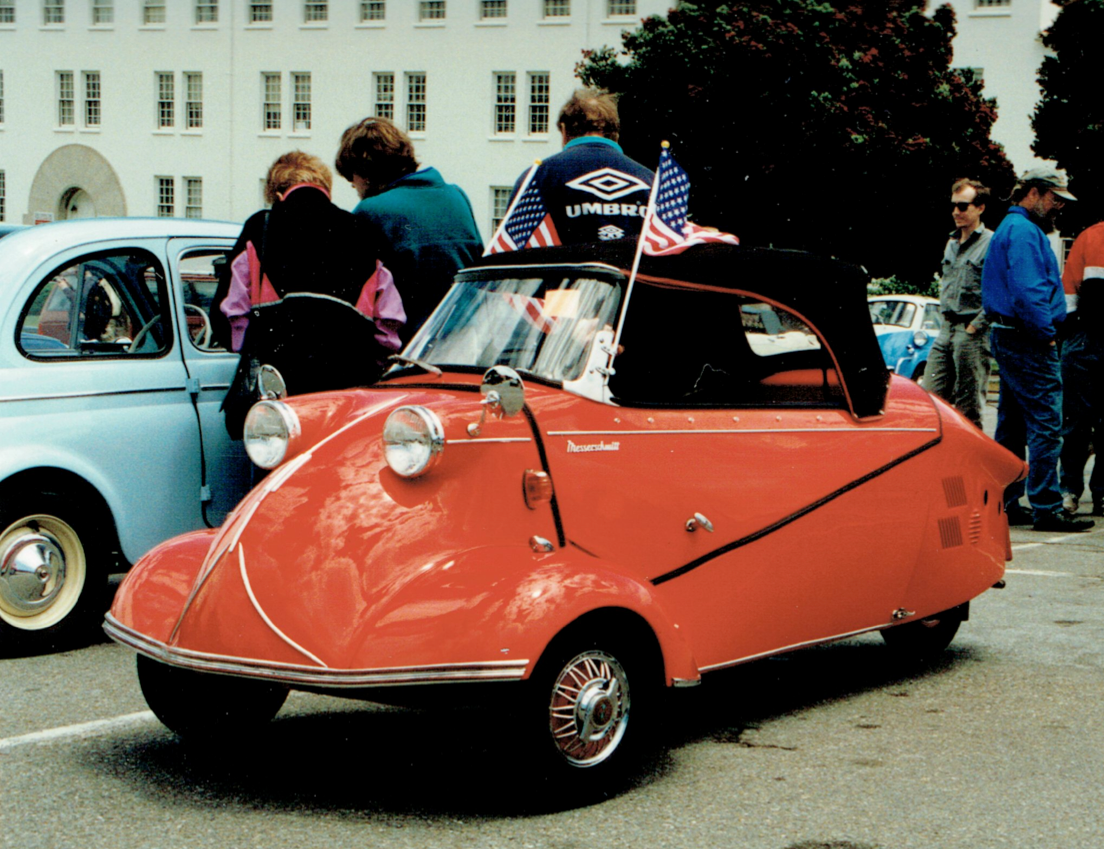
Messerschmitt tried to cover the Isetta's market territory from 1955-64 with their KR-200 Cabin Scooter, which offered an aircraft-style canopy and 3 wheels. The rear engine was a single cylinder two-stroke unit.  Steering was by a handlebar arrangement...


FMR offered more prosperous, or at least more adventurous, customers the TG500, based upon the Cabin Scooter chassis, but with 30 cubic inch air-cooled inline twin offering more sporting performance.  The aircraft style canopy and tandem seating recalled fighter aircraft. And there were 4 wheels...
Also in Germany during these years, Hans Glas* in Bavaria offered his Goggomobile line of microcars.  The T250 sedan appeared in 1954, and featured a rear-mounted, two-stroke, air-cooled inline twin.  Visually, the T250 was a scaled-down conventional sedan, with 3-box styling and none of the adventures in space utilization offered by the Isettas.  Production of this design, with larger engine options, continued until 1969...
Italy's Piaggio concern, makers of the Vespa motor scooters, got into the microcar business in 1957 with the Vespa 400.  They elected to manufacture the car in France, where it might not have had such direct competition from the then-new Fiat 500.  Styling was conventional but charming, and power came from a 400cc, rear-mounted two-stroke, air-cooled inline twin cylinder engine. Production continued through 1961.


Autobianchi's Bianchina, based upon Fiat's Nuova 500 microcar which appeared in 1957, shared its conventional 3-box massing with the Vespa 400. It shared its rear-mounted 500cc (30 cubic inch) 4-stroke, air-cooled inline twin with the Fiat. Parked next to the Bianchina is an Abarth 595 version of the Fiat 500.  Front-opening "suicide" doors were replace by conventional ones after 1965, and the car was produced into 1975. 
The Fiat 600, introduced in 1956, had done its part to advance the trend toward rear-mounted engines already seen at VW and Renault, and which soon spread to Simca, Rootes Motors in England, and even to GM with the Corvair.  The 600 was at the upper range of our microcar class in overall size, and a bit above the 500cc engine size which many consider an upper limit for the microcar class.  If that's the case, the Abarth Fiat 850TC, with twice the power of the original 600, would be considered a muscle car in this category...
Like many motorcycle manufacturers during this period, Germany's Zundapp attempted to entry the microcar market with the Janus, which proposed front and rear opening doors to access front and rear-facing seats.  The mid-mounted single cylinder two-stroke engine offered interesting weight distribution and space utilization, but not much in the way of power.  Sales price was too high to be competitive, and less than 7,000 copies were sold from introduction in 1957 to 1958, when production ended.

Imitation is perhaps the sincerest form of flattery, and before the bubble of the microcar movement burst with the end of the Suez crisis and the return of Western Europe's economic boom in the Late Fifties, Isetta production had been licensed to Velam in France, as well as to car makers in Argentina, Brazil and Spain.  Heinkel built its own bubble car, with a sleeker and glassier form, but the same front-entry format, and single-cylinder 4-stroke engines of 175 or 200cc, in 3 and 4-wheeled guises.  The Heinkel Kabine was built from 1956 through 1958 in Germany, and from 1960-'66 by Trojan in the UK, and also in Argentina until the mid-Sixties.  BMW sold over 161,000 Isettas before their bubble popped in 1962.  Luckily for them, they  had a second act ready when the sales of the bigger, more conventional 700 Series sputtered.  It was called the Neue Klasse, and it led to the immortal 2002.    

*Footnote
:  The Goggomobil and related Glas automobiles were featured in our post entitled "Forgotten Classics: Frua Designs for Hans Glas & BMW", from 12-2-18.  The Isetta's origins and engine design were profiled in "Born From Refrigerators: Iso Rivolta", posted on 9-20-18.

Photo Credits:
All photos are by George Havelka except the following:
Top & 2nd:  the author
3rd (Rovin D2):  Automobiles Rovin, featured in Jalopy Journal
4th & 5th (Iso Isetta):  isomillenium.it
14th (Messerschmitt Tiger): wallhere.com
15th (Goggomobil 250):  wikimedia
16th (4 elevation shots of Vespa):  voicesofeastanglia.com
17th (Vespa ad): Piaggio, featured on voicesofeastanglia.com
20th (Zundapp Janus): reddit.com
21st (Zundapp Janus): Lane Musuem, on wikimedia
Bottom (Heinkel Kabine):  wikimedia