Featured Post

Saturday, September 26, 2020

The First Modern Car? Round Up the Usual Suspects...

Looking back at the 20th century, a century famous for massive manmade calamities, it's intriguing to note how often futurist optimism pops up.  This may have been because people mired in one of two world wars, a global pandemic, or a worldwide depression had to assume the future could only get better, or because it was a time of rapid progress in technology despite, or maybe because of, all that conflict.  As this blog is supposed to be about cars, and as the current pandemic affords time to sort through shoeboxes full of photos from car shows and museums, this might be a moment to round up some candidates in the contest for First Modern Car...
Vincenzo Lancia's Lambda, which appeared in 1922, is a contender.  It was the first production car with load-bearing unitized body construction, which it combined with independent front suspension using sliding pillars and coil springs.  The engine was the first production V4, with a narrow 14-degree angle and a single overhead camshaft.  Engine sizes varied from 2.1 liters to nearly 2.6 during the car's 9-year production run.  The construction system made it light; the '27 model at the Revs Institute above weighs just 1,720 lb.  The spotlight barely visible in the above shot can be detached and used as a flashlight, another example of the Torinese engineer's practical thinking...
In Paris, André Citroen liked the unitized body idea, and unlike Lancia, made the roof part of the unit on his similarly low-slung Traction Avant.  The first front-wheel drive car to be mass-produced, it became a hit with everyone from gangsters to the gendarmerie right after it appeared in 1934. Engines were initially inline fours (the 7 and 11 were named for their taxable horsepower) and starting in 1938, an inline six. Designers André Léfebvre and Flaminio Bertoni added 4-wheel independent suspension and rack & pinion steering to the low stance made possible by the unitized body-chassis. The car had a long production run ending in 1957, two years before the BMC Mini parked behind it appeared. The tranverse-engined, front-drive format of the Mini predicted the powertrain arrangement that would take over mass-market car design in the 1970s. Like the Traction Avant, the Mini featured unitized construction.
In Czechoslovakia at the same time, aerodymicist Paul Jaray teamed up with engineer Hans Ledwinka at the Tatra motor works to produce the Type 77, which made extensive use of light alloys in the rear-mounted, air-cooled V8 engine of 3 to 3.4 liters, and independent suspension with swing axles at the rear.  The light alloy body panels were mounted on a steel platform chassis. The engine was of dry-sump design, and featured hemispherical combustion chambers. The advertising claims it is "the car of the future." Hundreds were built from 1934 to 1938, largely by hand, as Type 77 production overlapped that of even more innovative Tatra models...
Meanwhile, in Auburn, Indiana, the struggling Auburn Cord Duesenberg combine looked to reverse its declining fortunes with something more forward-looking than their stylish but conventional Auburns and their expensive Duesies with their twin-cam, 32-valve inline eights. The engineering solution turned out to be a front-wheel drive V8,  but with with a pre-selector transmission not unlike the French Cotal unit in Delahayes.  Gordon Buehrig designed a low-slung streamliner with minimal decoration, rear-hinged hood, and retractable headlights. The early 1935 prototype below has a 6-light greenhouse and body sides that curve inward top to bottom...
The production car that caused a sensation at the New York Auto Show in November 1935 had a simpler greenhouse and straighter side section, but the simplicity and restraint of the design was like nothing else on display.  The two-tone color scheme on the Westchester sedan below is atypical...
...and the car looked better in solid colors.  Here an 810 sedan is parked in front of one of the streamlined travel trailers that appeared in the Thirties.  The troublesome transmission meant the car was slow to enter production, and during a short career in 1936-37 the Cord 810 and supercharged 812 sold only about  2,300 cars. 
Film maker Cecil B. DeMille and actress Marsha Hunt show off a 1936 Model 810 Phaeton. The supercharged 812 model appeared the next year and added another 45 hp to the Model 810's 125, but the external exhausts cluttered up the trademark "coffin nose".  Cord's 810 is the cleanest American design of this era...
The same year the Cord 810 appeared, Tatra introduced its new Type 87, another comprehensive effort to envision the modern car.  The new V8 was a 2.9 liter, and featured a single overhead cam per cylinder bank, retaining the dry sump of the Type 77.  Visually, the car was hard to mistake for anything else, with a single dorsal fin splitting the compound curves of the windowless, one-piece engine cover.  A tiny window in the panel separating the cabin from the engine room allows a bit of vision  through the vented lid.
At the front, the triple headlights signaled the designer's resolute rejection of anything conventional, and the three-piece wraparound windshield provided a panoramic view for the driver. 
The Tatra 87 and its predecessors provided enough engineering ideas for Ferdinand Porsche in his design of the Volkswagen Type 1 (the Beetle) that Tatra sued VW* in the postwar era, and won a settlement in the 1960s...
Aerodynamics were also on the mind of Giovanni Savonuzzi when he designed the Cisitalia 202 CMM (Coupe Mille Miglia) for fledgling car maker Piero Dusio in 1946. A small cabin, teardrop-shaped in plan and elevation, is inset above the exuberantly contoured alloy panels of the lower body.  The hood plunges below the front fender peaks to a low-set air intake, and tall stabilizing fins emerge from skirted rear fenders.  The curious bystander is probably reflecting that nothing like this has appeared at this Forties service station before...
The rear view shows off the talent of the panel beaters who formed those fins into aluminum.  A boundary layer air control device appears, probably for the first time on a car, above the hinged rear hatch, also a novelty.  All this effort was aimed at obtaining maximum performance out of a 1.1 liter (66 cubic inch) Fiat-based overhead valve inline four.  The performance obtained was good enough to allow Tazio Nuvolari to take 2nd place overall in the 1947 Mille Miglia, at the wheel of a Cisitalia spider with similar fins.
The Cisitalia story* highlights that much of the progress made in the early postwar era was in aerodynamics and body design, while many auto makers took advantage of a seller's market by repackaging prewar chassis and engine designs...
The production model 202 coupe, also designed by Savonuzzi and built by Pinin Farina, was credited by historians as the template for what came to be called the GT car.  An example was exhibited at the Museum of Modern Art exhibit entitled "Eight Automobiles" in 1951, and MOMA acquired a specimen for their permanent collection.  The light and elegant hand-built form of the Cisitalia came at the price of about two Cadillacs when new...
Over in South Bend, Indiana, Studebaker likewise emphasized body design innovation in their first new postwar car.  As conceived by Raymond Loewy Associates with designers Robert Bourke and Virgil Exner on board, the 1947 Studebaker offered a startling new rendering of automotive form, if not in its chassis and engine design.  The Starlight Coupes with their cantilevered roofs and wraparound rear windows were offered in base model Champions (shown) and the longer Commander chassis.  The new envelope bodies were given new proportions, with much longer decks than prewar cars, and the modeling of forward-leaning rear fenders and front wheel openings imparted a sense of motion, as well as avoiding the slab-sided look of other envelope bodies.  Despite comedians' jokes ("Which way is it going?"), the new Studebakers reached a wide audience, and the new style stayed in production through 1952, after which Studebaker replaced it with another groundbreaking design from Bourke at Loewy Associates.
It was Lancia, however, that first integrated a radically new engine and chassis design into a postwar production car.  The Aurelia B10 Berlina first appeared in 1950, with a modern, all aluminum 60-degree V6 in front along with Lancia's famous sliding pillar front suspension. At the rear lived the clutch and a 4-speed transaxle, with trailing arm independent suspension and inboard drum brakes.  The doors opened along the car's centerline, without a central pillar.  The design provided performance (especially in the 2.0, 2.3 and 2.5 liter versions that followed the original 1.8), and unprecedented handling balance which allowed Lancias to beat more powerful cars in long-distance road races.   
Beginning in 1951 Pinin Farina provided the shorter-wheelbase B20 coupe ('52 example above), and it became the prototype for the modern GT car.  In 1954 PF released the B24 Spider, and in 1956 replaced it the B24 Convertible with winding windows shown below.  A De Dion tube replaced the trailing arm rear suspension on the B20 in 1954; all the open cars had that feature.  And all Aurelias reflected a kind of serious, practical (though costly) modern design approach that characterized a company run by engineers.
If the Lancia Aurelia was the most modern early postwar car in engineering terms, the Citroen DS 19 was perhaps the first modernist car. When the Traction Avant's design engineers Léfebvre (chassis) and Flaminio Bertoni (body) decided to surpass their masterpiece from 1934, they started with a clean sheet of paper for everything but the engine, which in deference to fuel costs was the 1.9 liter OHV four.  Everything else might have come from a science fiction movie, including the 4-wheel independent hydropneumatic suspension with adjustable ride height, the disc brakes, and of course the front-wheel drive. An engine-driven pump provided power assistance to steering and brakes, and to the adjustable suspension.  The transmission was unusual too; semi-automatic and clutchless, with shifting assistance provided by hydraulics.  When first shown at the Paris Salon in autumn of 1955, the DS19 attracted crowds like no other car...

And it was a modernist car in the same sense that the steel and glass Case Study houses being built in California were modernist houses.  Lines were aerodynamic, clean and spare, without reference to traditional norms or expectations, in the same spirit as Charles and Ray Eames' molded plywood chairs. Citroen's designers presented their drivers with a single-spoke steering wheel, avoiding the "lance effect" of earlier steering columns.  In a similar way that modern architects adapted industrial components to housing, the DS19's rear fenders could be removed by undoing a single bolt, and the adjustable height control could be used when changing a flat...
In the Fifties and Sixties, Americans who drove Citroens lived in, or aspired to live in, these kinds of houses. They sat in Eames lounge chairs and read stories by Isaac Asimov, while listening to Dave Brubeck on their Heathkit stereos.  They'd built those stereos from kits, because after all, they were engineers, or school teachers...like mine.  She gave me my first ride in a Citroen DS.
The roof was formed in fiberglass while the body was steel.  At the front, conventional grilles were eliminated, and air intakes were formed into the bumper and below it. The pillars framing the panoramic windshield are remarkably thin. The lights at the rear of the roof were provided to catch the attention of following drivers, and distract onlookers from a drop in height between the rear roof surface and the rear window.
Later versions included Chapron*-bodied coupes and convertibles like the one below, a less costly ID19 with manual 4-speed gearbox, and break (station wagon) models. Larger engines, still inline fours, were eventually offered in 2.1 and 2.3 liters.

Even though the DS had relatively limited influence on the design of cars that were not CItroens, its 20-year production career as essentially the same design makes it a strong contender for the most successful (and in engineering terms, perhaps the most obsessive) modernist car, if not the first modern one.  Floating along the boulevard in a DS, it was hard to deny the notion that engineering innovation had already made the world a better place, and that we were somehow already living in the future...

*Footnote:  In these posts, Hans Ledwinka's designs for Tatra, and Tatra's successful postwar lawsuit against VW, are reviewed in "Cars & Ethics: A Word or Two on VW", from 11-27-15.  Cisitalia was the focus of  "The Etceterini Files Part 11: Fiats as Fine Art", from 4-22-17.  Chapron-bodied Citroens and other French makes are featured in "The French Line Part 3: Henri Chapron", posted on 2-12-20.

Color Photo Credits:  
All color photos are by the author.

Monochrome Photo Credits:  
Tatra Type 77:  Tatra Works (now Tatra Trucks a.s.)
Cord 810 Prototype:  angelfire.com
Cord 810 Weschester rear view:  Auburn Cord Duesenberg Club (www.acdclub.org)
Cord 810 Phaeton:  paper-dragon.com 
Cisitalia 202 CMM front view:  wikimedia commons
Cisitalia 202 CMM rear view:   Danville Concours d'Elegance
Cisitalia 202 advertising:  Cisitalia Automobili
1947 Studebaker:  The Studebaker National Museum
Lancia Aurelia B10 Berlina:  imcdb.org
Citroen DS-19 overhead view with crowd:  revivaler.com
Citroen DS 19 dash:  en.wheelsage.org
Citroen overhead front view:  netcarshow.com
Case Study 9 House:  br.pinterest.com
Eames Lounge Chair:  Herman Miller

Saturday, September 19, 2020

Vanishing Roadside Attraction: WPA Post Offices

Demonstrators gathered at the Bronx General Post Office in autumn of 2013 to demand that it be saved, not just as a building, but as their post office. The structure, designed by Thomas Harlan Ellett, was completed in 1937 and designated a New York City Landmark in 1975; it made the National Register of Historic Places in 1980.  The massive brick masonry structure with its tall marble-faced arches owes something to the modernist as well as neoclassical movements of the Thirties, and the exterior features two stone sculptures, "Noah" by Charles Rudy and "The Letter" by Henry Kreis.
The Bronx G.P.O. occupies the entire block on the Grand Concourse between 149th and 150th Streets, and its expansive granite terrace reinforces its role as a public space.  The U.S. Postal Service is popular with the public, with approval ratings hovering between 84 and 91%. When the above crowd gathered, they were responding to moves by the Post Office to sell off hundreds of properties as part of cost-saving measures. The cost-saving measures, in turn, were prompted by a 2006 law passed by Congress requiring the Postal Service to fund its pensions for the next 75 years.  A careful search will reveal no privately-owned entities required by law to fund their pensions for the 75 years ahead, and very few entities of any kind with their public approval routinely averaging well over 80%...
Around 1,100 post offices were built during the New Deal, many as part of Works Progress Administration efforts to create jobs and offer improved mail service.  They have proven to be popular buildings, partly because of their style and solidity of construction, and also because of the public art that was included in the projects from their inception...  
Inside the Bronx GPO, 13 murals called "Resources of America" were completed by Ben Shahn and his wife, Bernarda Bryson, in 1939. These tempera-on-plaster frescoes were landmarked along with the building's interior in 2013, the year of the demonstration, and the year before the Bronx GPO was sold to developers...
Unlike contemporary work by artists like Charles Sheeler, the images by Shahn and Bryson exalt  the humans rather than the machines.  The government contract was awarded as a result of a blind competition, after Shahn and his wife has already achieved some fame in the art world...
When the building was sold for $19 million to a developer in 2014, Studio V Architecture created an extensive scheme to adapt the building to host mixed uses including retail and restaurants, and to save the murals.  But the initial effort collapsed, the building was sold again in 2018, and as of 2019 the project was only partly complete, with a rooftop restaurant open at present.  In the meantime, by April 2019 Bronx residents had lodged complaints with their Congressional representative about delays in mail delivery.  This was before a newly-appointed Postmaster General took further steps to sideline mail-sorting equipment and reduce staff hours. This was also before the full impact of a global pandemic could be absorbed, along with the effects on medical supply deliveries by slowdowns in mail...
Across the country in Oak Park, Illinois, a new post office designed by architects White and Weber began construction in 1933, the worst year of the Depression, and after Congressional action in 1935 to provide about $70,000 of added funding, was finally finished in August of 1936. This New Deal post office is still serving its original purpose...

The Oak Park Post Office at 901 Lake Street has always had good architectural company. Right across North Kenilworth Avenue at its intersection with Lake Street is a seminal work of Prairie Style public architecture, Frank Lloyd Wright's Unity Temple*, completed in 1908...
The completion of the work was celebrated with a postcard, complete with pastel colors straight out of National Geographic.  Note that there's a bit more traffic in the 1936 postcard shot than in the monochrome construction picture from the depths of the Depression, three years before... 
This is what the Oak Park Post Office on Lake Street looks like today.  The stripped-down neoclassicism of the limestone exterior has weathered well, and the Streamline Moderne grillwork above the entry, with its stylized tribute to the history of American transport from horses and covered wagons to monoplanes, has been preserved.

The skylit interior of the Oak Park Post Office has retained its original materials and finishes, along with elegant lighting fixtures echoing Art Deco and Streamline Moderne... 
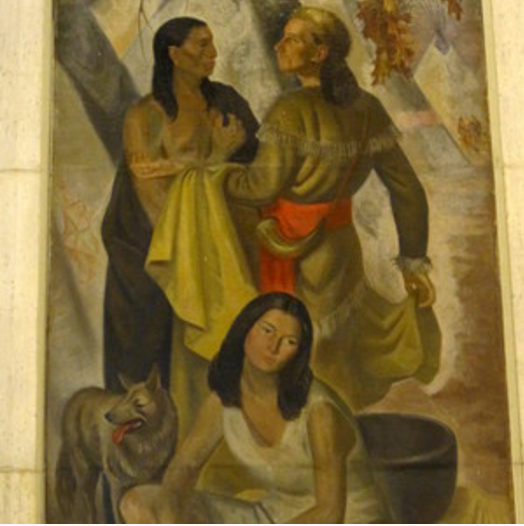
Also inside are J.Theodore Johnson's four murals, completed in 1939, telling stories from American history. This one is entitled "La Salle's Search for Tonti, 1680".  As with many murals from the WPA period, the viewpoint is that of the European settlers rather than that of the continent's original inhabitants.
                                        
Way out West, the City of Golden, Colorado went through five different post office locations before acquiring a New Deal post office in 1940.  Designed by Louis A. Simon, its plan and form was adapted to a number of other New Deal post offices.  It's still in service, and is shown below in its original form, with copper roof shape and rooftop lantern echoing the land forms of the mesas beyond...

An awkward entry enclosure added in 1959 mars the clean lines of the original, but the building is well maintained, and serves a growing Front Range community...

The interior of the Golden Post Office is more modest in scale and ambition than the Oak Park one, but like Oak Park it offers a generous helping of public art.  Kenneth Evett painted "Building the New Road" in oils and tempera in 1941 as a WPA project, after studying with Thomas Hart Benton.  It depicts a lunchtime break in the building of a road in Clear Creek Canyon (I've been on that road).  The painting combines romanticism and realism, depicting workers of different races, their wives and children, and some softening touches contrasting with the hard landscape...including a little girl feeding a chipmunk, a horse waiting for some hay, and two dogs possibly scheming how to steal some lunch. It's a vision of people working together to build their way out of hard times.  It wasn't the way the country always worked, but it was the way school kids were taught it should work.  Less than 3 decades later, it was a country that sent explorers to the moon...
A few miles to the south and east, this South Denver post office was completed in 1940 with funding from the U. S. Treasury. The symmetrical facade echoes the spare, modern classicism of other Federally-funded projects during this era, but the mix of bricks and limestone suit the smaller scale, and the hipped roof with its red clay tiles may be a nod to the region's history as well as its propensity for snow.
Inside, there's nothing as grand or expansive as the Bronx or Oak Park post offices, just a series of linked spaces providing counters for mail service and places for customers to stand.  There is a mural, however, that's been obscured by a clunky lighting installation...
When you get past that industrial lighting you realize that there is something to see here, and that the painter, Ethel Magafan, treated "The Horse Corral" with affection and a robust sense of form. The tempera work was completed in 1942, a time when the outcome of the wars then raging in Europe and the Pacific was much in doubt.  Still, the artist seems to find her perspective on man and nature as fitting together in a kind of essential harmony, with the curves of living creatures echoing the shapes of the hills beyond. There's a kind of optimism here too, optimism that might have been hard for many to maintain as the world lurched from a global depression into global war. It's an attitude that may serve us at the present moment, if we can find it somewhere under that Western sky...

*Footnote:  For an earlier essay on a WPA project, see "Roadside Attraction: The Beach Chalet, San Francisco", posted March 25, 2016.  For a photo essay on Frank Lloyd Wright's Prairie Style architecture in Oak Park, including the Unity Temple, see "Chicago: City of Architecture, Film and Ideas Part 1", from Nov. 2, 2017.

Photo Credits
Top:  New York Daily News  
2nd & 3rd:  6sqft.com
4th & 5th:  welcome2thebronx.com
6th:  Studio V Architecture, reproduced at newyorkyimby.com
7th, 9th & 12th:  livingnewdeal.org
8th:  the author
9th:  digitalcommonwealth.org
10th:  pinterest.ie
11th & 13th:  livingnewdeal.org
12th:  Kimberly Ah
14th:  City of Golden, Colorado
15th thru 17th:  the author
18th:  livingnewdeal.org
19th & 20th (bottom):  the author

Wednesday, September 9, 2020

Forgotten Classic: Lagonda--- A River Ran Through It

Eons ago when the author took this photo at the Monterey Historic Races, the main attraction was the resolute Britishness of Snoopy's vintage ride. It's a 1929 Lagonda 2 Litre with lightweight, sporting fabric bodywork, and a long-stroke 4-cylinder engine, an "underhead cam" design that appeared in 1925.  The idea of this engine with its twin lateral cams operating overhead valves through rockers was that the head could be removed without disturbing the valve timing. Other features, like the mechanical brakes operated by cables and rods, were typical of British cars of this vintage.  The Lagonda was a car named after a river; Lagonda was the Shawnee name for the creek that ran through a scenic gorge near Springfield, Ohio, the home of company founder Wilbur Gunn. He moved to England in 1891, and began building motorcycles in 1898.  3-wheelers and light cars followed.
By late 1934  when the M45 tourer below appeared, Lagonda had expanded its line with larger offerings and had adopted the Meadows 4.5 liter inline six which had already powered the Invicta, another British sports car.  Smaller engines from Henry Meadows Ltd. powered cars from Frazer Nash, Lea-Francis and also HRG. The big, overhead-valve six made up in sturdiness what it may have lacked in engineering ambition... 
Sturdiness and reliability worked for Lagonda in 1935 when an M45 prepared by London dealers Fox and Nicholls won the Le Mans 24 Hours; it beat Alfa Romeos and Bugattis with more cylinders and cams, and with lighter engine blocks.  The M45 racers served as the prototype for the M45 Rapide which the firm offered to customers.  The red car is a 1935 example.
Building expensive racers during a depression was a risky business though, and Lagonda entered receivership that year, then came out of it under the ownership of Alan Good, who in turn hired W.O. Bentley as chief engineer. Good abandoned producing the smaller models in favor of the larger, more expensive ones. Bentley, released from his consulting arrangement with Rolls Royce 4 years after selling Bentley Motors to them, first applied his talents to improving the Meadows six. This was done in a series of "Sanctions", running from Sanctions I through IV. Bentley designed an aluminum cylinder head, and eventually a performance version with twin spark plugs per cylinder. 
The LG6 featured Bentley's new chassis design, with independent front suspension by torsion bars.  It appeared at the 1937 Earls Court Motor Show with a sister car, the V12 with engine entirely of Bentley's design.  Both cars were available in a variety of wheelbases with coachwork built at the Lagonda factory in Staines. The example shown above and below is a 1939 LG6* sports tourer. 
Bentley's most ambitious design for Lagonda, however, was the V12.  This 60 degree design was also sized at 4.5 liters like the LG6, but featured a single chain-driven camshaft per cylinder bank. In addition to the bodywork offered by the factory, custom coachwork was offered by firms like Vanden Plas and James Young, which produced the V12 drophead coupe below in 1939. The streamlined form with teardrop fenders is unlike the angular, "razor edge" style the same firm pioneered on coupes and sedans for Bentley...
The touring version of the V12 in this car developed 175 hp, while a racing version with 4 carburetors was good for 220 hp, and that Lagonda was fast and reliable enough to take 2nd and 3rd places at the 1939 Le Mans, the last 24 hour race before the war that ended the whole V12 project, along with the LG6.  According to the Lagonda Club, before shifting into war production, the company produced 82 of the LG6 model and 185 (Richard Langworth says 189) of the V12. Total production of the 4.5 liter six, including the pre-Bentley M series, was 841.
Bentley designed a new engine for Lagonda's postwar restart, and industrialist David Brown bought the company in 1948 to get the tooling and rights to this 2.6 liter twin overhead cam six. He'd bought struggling Aston Martin the previous year.  Bentley's engine proved to be the one thing that saved the new David Brown automotive combine from the fate suffered by firms like Lea Francis, Alvis and Armstrong Siddeley...the fate of having their lunch eaten by William Lyons and his Jaguars.
In 1949, the year the new engine appeared in prototype DB2 Astons at Le Mans, the Lagonda 2.6 appeared.  Styling was an unconvincing mix of 1930s themes and hesitant modernism, and doesn't look very imposing even when parked next to a Morris Minor (that's the maroon car).  The rounded nose looks to a new era, while the prewar fender lines don't have enough wheelbase to get much swoop going.  The twin-cam engine is a star, though, and the swing-axle rear suspension is the first independent one in a British production car. Brakes are hydraulic, with inboard drums at the rear. When the Jaguar Mark VII appears the next year, it will have a bigger twin-cam six in a more expansive package ("Grace, Space, Pace") and it will easily outsell the Lagonda...
But Tickford will body some charming 2.6 dropheads like the one above.  When sales slow down and a Lagonda dealer decides to have Tickford rebody a few leftover cars in the style shown below, it becomes the prototype for the 3 liter that takes over from the 2.6 after '53. Visually and in engine size, the car parallels the Graber-styled Alvis* that will appear around the same time.
A four-door saloon is offered alongside the drophead, and proves more popular.  Along with the bigger version of the six, the car retains the swing-axle rear.
There was a two-door sports saloon model for a couple of years, but by the time Lagonda production ended with the 1958 model year, only the 4-door and drophead were offered.
But Lagonda didn't end its run before appearing for one last fling at Le Mans, now sponsored by parent David Brown and featuring a 4.5 liter V12 with twin-plugs per cylinder, 4 chain-driven overhead camshafts and a tubular space frame chassis. The new car qualified at Le Mans in 1954, but retired after an accident in the 4th hour. 
Only two of this brave, promising DP115 model were built, showing different grille styles but similar cutaway front wheel arches and sweeping curves in bodywork resembling Frank Feeley's design for the Aston DB3S* which appeared the previous year.
The engine had no relation to the prewar V12, but was instead more like two of the postwar Lagonda sixes angled at 60 degrees.  The cars proved troublesome, and David Brown's team elected to concentrate on the six-cylinder cars, eventually winning Le Mans with a DBR1 in 1959...
Perhaps because of that success at Le Mans, it wasn't quite the end of the Lagonda story. The '59 race victory helped sales of the new DB4 which had appeared at the end of '58. So David Brown commissioned a new saloon design from Superleggera Touring, which had designed the fastback coupe of the DB4 as well as the open Volante version.  When the Lagonda Rapide, named after the prewar performance models, appeared in 1961, it looked much like a stretched version of the DB-4 Volante, only with 4 doors, a hardtop, and canted headlight units echoing the Touring-bodied Lancia Flaminia...
In terms of chassis design, it was much like a stretched DB4, except that a De Dion rear suspension replaced the DB4's conventional solid axle.  The engine was the then-new Tadek Marek-designed 3.7 liter from the DB4. Testers criticized the restricted rear passenger room, and noted that Jaguars offered similar performance for less money. Ultimately, though, the Rapide was a victim of the DB4's success.  A full order book for the DB meant there was no excess production capacity, and production ended in 1964, after only 55 were built...
The William Towns-designed Aston DBS appeared in 1967 and overlapped production of the DB6, which it eventually replaced.  This larger, heavier car gave David Brown the idea of reviving the Lagonda again on a stretched Aston chassis, and the prototype appeared in 1969; David Brown sold Aston Martin Lagonda later that year, the year the first V8s finally appeared. The Lagonda prototype looked exactly like a stretched Aston this time, right down to the DBS grille...
With the DBS V-8 in production, AML's new management decided to produce the Lagonda prototype, now known as the Lagonda Series I, with the V8 in the DBS chassis with foot-longer wheelbase, oval Lagonda grille and single headlights...
But the 1974 model launch ran into the fuel crisis and recession triggered by the Arab oil embargo, and prospective customers noted the eye-watering price, especially compared with the new Mercedes S-Class and the Jaguar XJ, which now offered a V12 engine.  Those Jaguars again, with their competitive performance and tempting price tags, were a problem, while in Lagonda's price class, Bentleys offered more space.  AML wound up building only 7 of the Series 1 before giving up the effort.
But AML's management liked Bill Towns, and gave him the job of coming up with a Lagonda Series 2 that would justify its high price.  Towns by this time had adopted the wedge theme as his own, and came up with a sharply folded and creased wedge notchback with flattened grille and elongated nose for the new car, which surfaced in 1976. Rear seating space was sacrificed for the 4-door coupe look, perhaps a sign that nobody had learned from the Rapide misadventure...
AML spent almost as much development money on the futuristic digital instruments as it did on the rest of the car.  Though it had teething troubles, the car actually worked better than that early digital dash, which was a disaster.  The single-spoke steering wheel idea was cribbed from Citroen, but it fits the theme...
The various versions of the Towns-designed Lagonda were, by Lagonda standards, a commercial success.  Hundreds were built, even though they never made it to the top of Consumer Reports reliability ratings.  Production ended in 1990, and Ford, the owner of Aston Martin and Lagonda from 1987, began to look for a new Lagonda for the Nineties. They showed the Lagonda Vignale* in 1993...
As Ford also owned Vignale and Ghia, they were able to use the Italian design studios to build something around the new V12 engine, which was loosely based on Ford V6 designs. Visually, the car had no similarity to any Ford, or any recent Lagonda.  It was as exuberantly rounded and flowing as the Series 2 had been abruptly angular... 
...and for once, a Lagonda had space in the rear seat.  Even though it was the best thought-out of the various modern Lagonda revivals, no production ensued, perhaps because Ford also owned Jaguar at this time.  In 2007, Ford sold Aston Martin, and the Lagonda name went quiet for nearly a decade.  In 2015 Aston Martin, under new ownership, tried again with the Lagonda Taraf on a "sale only to invited clients" basis, and managed to sell 120. Apparently many went to the Middle East. Styling was clean, conventional and inoffensive. Price was a million dollars a copy; perhaps the car should've been named the Tariff,  as the main attraction seems to have been that it cost half a million bucks more than a standard plutocrat luxobarge like a Rolls Royce or a senior Bentley. The same team showed a promising all-electric Lagonda Vision Concept in 2018, but we haven't seen it since.  It's not certain we've seen the end of the Lagonda, but right now the name doesn't even appear on a river. The Shawnee tribe's watercourse in Ohio has sadly been renamed Bucks Creek...

*Footnote
:  Lagondas have appeared twice in these posts, first as one of the stars of "Nineties Concept Cars Part 5: Lamborghini Raptor and Lagonda Vignale", posted on 1-25-19, and then in a supporting role in "Speeding Into Darkness: Film Noir Cars", posted 3-31-20.  Aston Martins have appeared too many times to list here, but the most comprehensive survey was "Rescued from Obscurity: Aston Martin in the Fifties and Sixties", posted on 5-11-20. The Graber-bodied Alvis was the subject of "Forgotten Classic: The Graber Alvis", posted 1-22-16.

Photo Credits:
Top:  the author
2nd:  wikimedia
3rd:   pinterest.com
4th & 5th:  Linda La Fond
6th & 7th:  classicdriver.com
8th:  imcdb.org
9th:  wikimedia 
10th:  youtube.com
11th:  The David Brown Corporation Ltd.
12th:  Classic & Sports Car Magazine
13th:  le mans-history.com
14th & 15th:  drive-my.com
16th & 17th:  classicdriver.com
18th thru 20th:  bonhams.com
21st & 22nd:  wikimedia
23rd & 24th:  the author
Bottom:  wikimedia