Featured Post

Saturday, November 6, 2021

Colorado English Motoring Conclave Part 2: Production Cars and Fast Plastic

We covered antiques and rarities in Part 1 of this year's Colorado Conclave survey, and the idea for Part 2 was to cover production cars.  But "production" can be a slippery term when you're talking about England's specialist car makers.  For example, Aston Martin's DB 2/4 was that firm's most popular version of the DB 2...maybe because the "/4" indicated extra seating in the fastback coupe, which Aston optimistically called a saloon. 764 copies of the DB 2/4 found buyers, and 565 were the Mark I version shown.  But of those, only 73 were drophead coupés like this one; the rest were the then-novel hatchback.  So during Mark I production from 1953 through '55; Aston Martin Lagonda built about 2 dozen of these convertibles every year… 

They were nicely turned out, with alloy-paneled coachwork by Tickford, and the 125 hp from the 2.6 liter DOHC Lagonda inline six (140 hp in the 2.9 liter Mk. II) gave the 2,700 pound car lively (but not Jaguar level) performance.  Then again, the point of the Aston was its handbuilt exclusivity, and the drophead delivered that...

You probably wouldn't expect to encounter a Citroen from a French crime thriller at an English car show, unless you knew that Citroen operated an assembly plant at Slough, 20 miles west of London, starting in 1926.  This catered to a stong British market for CItroen's early rear-drive cars (over 20,000 sold in Britain by 1923) and naturally continued when Andre Citroen launched the pioneering front-drive Traction Avant series in 1934. This one, a "barn-find" Traction Avant* Light 15 model from 1954, features a 1.9 liter inline 4. The Big 15 model featured a 2.9 liter six.


Products of Citroen's Slough Works included a Deux Chevaux truck supplied to the Royal Navy, and ID 19s sent to Connaught Cars*, which having sold off its GP racers, was modifying these IDs with bucket seats and DS instrument panels as the British market-only D-GT, and doing a brisk business.  Citroen's Slough branch became a sales and service operation after 1965...

The Slough-built Citroens, like the "slow-built" early Jaguars, featured wood interior trim and leather seating (unlike their French sisters) along with the requisite righthand drive. The Jaguar Mark V below, from 1951, was built just as Jaguar was phasing out the Standard-based six cylinder pushrod engines with Jaguar-designed OHV heads, to the new twin-cam XK series. These were among the first Jaguars that Max Hoffman imported into the car-hungry postwar US.  Like the Citroen, they are good examples of Thirties body design that survived into the Fifties. The Citroen's unit construction and front-drive, however, were more predictive of future design trends...

A trio of Jaguar XK 120s lines up for spectators.  The Conclave invites all visitors to vote on their favorite cars in each category, and as Britain had dozens of manufacturers during the decades covered, there can be a lot of categories.  And with nearly 500 vehicles (including motorcycles) expected, there were plenty of choices. The red XK120* below is a roadster (or  open top sports) with side curtains instead of the roll-down windows on the blue drophead coupé.  The XK120 dropheads and fixed-head coupés added wood dash panels and door caps. Wire wheels were an option throughout the production which began in 1949 with the roadster; the   fixed-roof arrived for 1951, and the drophead for 1953.  Ordering the knock-off wire wheels meant deleting the rear wheel spats shown on the roadster.  

The XK series of Jaguars had performance to match their sensational looks, and that sold them to Americans.  In its first version, the 3.4 liter (210 cubic inch) inline six made 160 hp, as much as the then-new Cadillac V8. Later SE versions offered 180 hp, and by 1953 the C-Type head offered by US Jaguar dealers meant 210 hp, which was near what the Chrysler Hemi offered.  All XKs featured aluminum heads with inclined valves operated by chain-driven dual overhead cams.  The XK 120 gave way to the more practical XK 140 during 1954, and by 1957 the 140 would be the first production car with 4-wheel disc brakes.
Ironically, Jaguar chief William Lyons had originally planned to offer this engine first in a luxury sedan called the Mk VII, and had stylist Malcolm Sayer dream up a two-seat roadster as a sort of rolling display stand for that engine while engineers readied the big sedan.  When it showed up at the Earls Court auto show in autumn of 1948, though, it attracted so many deposits that Jaguar found itself in the sports car business.  When the big sedan appeared, it featured a mix of traditional and modern features, with smooth curves enclosing a leather-lined interior complete with wood dash and seatback picnic tables, all fronted by a traditional radiator.
This one is a Mk IX; both the Mk VIII and Mk IX differ from the Mk VII in having the swoop of chrome trim running from the upper front to the lower rear fenders.  This was used as a color separation line on two-tone cars.  Jaguar was unable to resist two-toning in the 1950s, but unlike Mercedes they never caved in to tail fins...  
A British racing green 3.8 Mk II lounges in the sun; it shares the leather interior, wood trim and picnic tables with the bigger Mark IX and contemporary Mark X.  You're probably wondering how a Mark II followed a Mark V by a decade; you'd need to know that the 3.8 liter sedan appearing in 1959 was Version 2.0 (bigger windows, bigger engine) of the 3.4 and 2.4 liter sedans that Jaguar introduced in 1956…these, however, were known only in retrospect as Mark I.  Jaguar nomenclature has never been a study in linear logic.  No matter, the compact, powerful, disc-braked sedans were a hit with police (and gangsters) and with Britain's equivalent of stock car racers...
Likewise, while Jaguar made C, D, and also E-Types like these specimens lined up on the lawn below, there were never any A or B-Types. Illogical, no? Well, when Jaguar introduced their two-time Le Mans-winning road racer in 1951, it was originally called the XK120C (competition) in order to convince race organizers that this was just a version of their production car.  Eventually, Jaguar would build 50 or so or what they finally called the C-Type.  It was followed in '54 by the D-Type (a 3-time Le Mans winner) logically enough, and when in 1961 the company decided to capitalize on the resemblance of their new production sports car to the D-Type racers, they called it the E-Type. This photo shows all three flavors of Series 1 E-Type*, with OTS (open two seater, often called roadster) in red on the left, 2+2 coupe in center with 2 added seats, 6" more wheelbase and taller roof, introduced for the '66 model year, and the original 2-passenger fixed-head coupe on the right. The 2+2 chassis would eventually form the basis of the Series 3 V12 in 1971; all Series 3 cars had the 102" wheelbase, not for a longer engine (it wasn't) but for more cabin space.
The E-Type, with its 4-wheel independent suspension joining all-disc brakes and stressed-skin body construction, looked like a revolution as the Sixties were just beginning, but at the end of the Fifties, British Motor Company's senior engineer Alec Issigonis (later Sir Alexander) launched what would be a more far-reaching revolution with his Minis, transverse-engined front-drive urban runabouts with surprising room for four within an 80" wheelbase and 120" overall length. The 850cc cars were sold by Austin as the Austin 7 and Morris Mini Minor. Mini* became a separate make in 1969, and BMW retained the Mini brand after purchasing Rover Group in 1994. The transverse engine, front-drive scheme became a space-saving template for later cars like the Fiat 128 and VW Golf.  BMW launched a larger, modern Mini in 2001.  It retained the front-drive tranverse engine layout, but engines and transmissions were no longer forced to share the same oil...
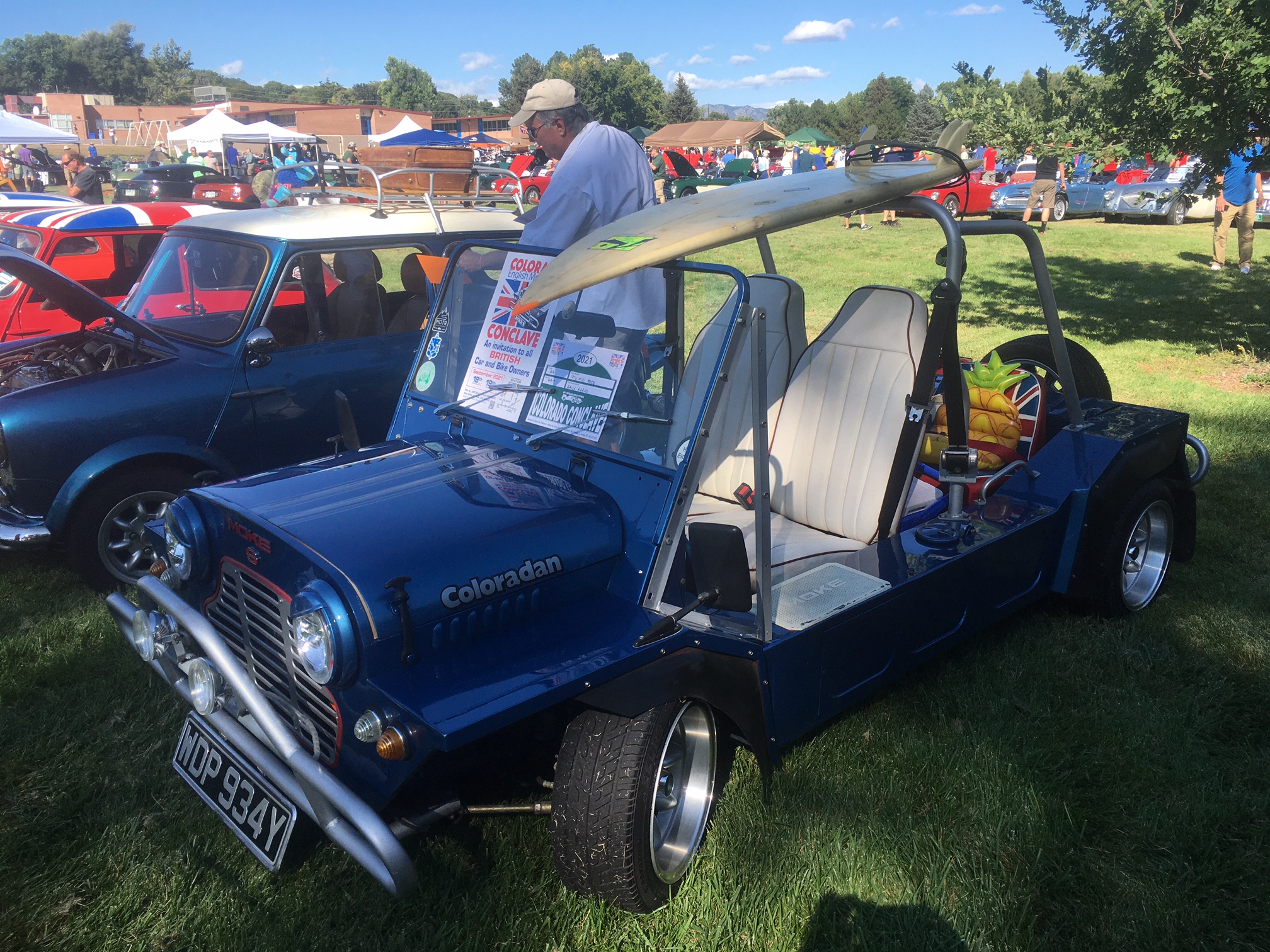
The original Mini Countryman wagon had authentic wood on the exterior, along with 4.2" more wheelbase and 9" more overall length. In addition to the Countryman, de luxe "badge-engineered" versions were built with extended trunks (think of the later VW Jetta vs. Golf) and traditional RIley or Wolseley radiator grilles. But the Mini that really became a fashion statement in Swinging Sixties London was the Mini Cooper S, a performance version originally launched by John Cooper's race car outfit (whose mid-engined racers won Formula 1 driver and manufacturer titles in '59 and '60) and adopted by BMC in much the way they'd adopted Donald Healey's Hundred to become the Austin Healey 100-4.  Especially after Paddy Hopkirk won the '64 Monte Carlo Rally (Minis would go on to win 4 rally titles), the Mini was the car for rock stars, pop singers and aspiring actors to drive around London.  BMC launched the Mini Moke, an elemental front-drive utility vehicle, in the same year, and would continue production into 1993...
The Italians got into the Mini act as well, with Innocenti* building a version which became popular on Europe's crowded city streets.  It offered the same drivetrain as the BMC versions (this one's a Cooper-spec. 1000) and the added refinement of roll-down door windows with the triangular vent panes that also appeared on some Australian versions of the Mini.  This one also has flared wheel arches over wider wheels.
A couple years before the first Mini, Colin Chapman attempted a revolution in roadgoing sports cars with the Lotus Elite. This green Elite participated in the Colorado Grand* rally, and headed up a line of Lotus cars spanning decades, each one an example of extracting lots of performance out of relatively small engines by minimizing weight and optimizing aerodynamics. All the cars in this row are bodied in fiberglass, and they were all fast enough to make car enthusiasts want them, despite the Lotus reputation for fragility and high maintenance demands... 
The Elite (Type 14) at the right below appeared in 1957, and was Colin Chapman's first attempt at a series (if not mass) produced, dual-purpose sports car that could be raced on weekends and driven to the office on workdays. A 1.2 liter, single overhead cam Coventry Climax four featured aluminum block and heads, and was based on that firm's fire pump engine.  To its left, a red Elan drophead with 1.6 liter Ford-based four and Cosworth-designed twin-cam head.  Then, in white, a mid-engined Esprit Series 3 with Lotus-designed 16 valve twin-cam 2.2 liter four and Citroen 5-speed transmission, which outlived the Citroen Maserati in Lotus products (Citroen sneaks into our all-English show yet again).  Barely visible beyond it, a 21st century, green Lotus Elise with  mid-mounted Toyota power...
For that pioneering Elite, Peter Kirwan-Taylor designed an elegantly simple aerodynamic body that was, after the tiny Berkeley (see end of this essay) the first unitized fiberglass body-chassis to reach production. It featured a steel subframe for the front-mounted engine, with a reinforcing roll hoop around the winshield, to which the door hinges attached. Weight was only 1,455 pounds, and this meant that the most highly tuned Climax engines (95 or 105 hp) offered startling performance to go with razor-sharp handling.  Even with the base 75 hp engine, England's Motor magazine reached just under 112 mph, and 0-60 in 11.4 seconds in 1960. This came at a price; that year the P.O.E. price in the USA was $4,108 for that base Elite, only $400 less than a Jaguar XK150 with nearly 3 times the power.
The flat tail with recessed panel was unique in 1957, and predictive of Sixties GT designs. Sound transmission into the cockpit was a problem, especially from the rear suspension towers. Because of the deep interior door recesses, the compound-curved side windows needed to be removed and stowed for real ventilation, an all-or-nothing proposition.  Despite these impracticalities and its high price, the Elite managed to qualify as a production car in racing classes, and more importantly to put Lotus on the map as a car maker.  Before giving way to the more practical, steel backbone chassis Elan after 1963, Lotus claimed that they'd built 988 Elites. It's not certain that all these body / chassis units turned into finished cars, however, as some Elites were sold in England as kits to help lower the price.  
One surprise visitor to the show was this Berkeley, a minimalist 2-seater more in the spirit of the original Lotus 7 than the Elite, though it featured, like the Elite, a unitized fiberglass body-chassis (here reinforced with alloy) in 1956, a year before the first Elite, just in time to respond to the minicar boom prompted the Suez crisis and resulting fuel shortages. It was a product of designer Laurie Bond's proposal to Berkeley Coachworks' Charles Panter; Berkeley Ltd. had gained experience with fiberglass as England's leading builder of travel trailers but was looking for something that would offer steadier cash flow than the seasonal caravan business. The original front-drive Berkeley, offered in 4 or 3 wheel form (another tax-saving option, like those Elite kits) was powered by 2-stroke, 2 cylinder engines. This example, like the 1958 Road & Track test car, originally had a 328 cc Excelsior twin, making about 18 hp.  Their test weight for the 70" wheelbase car was 850 lb., and it reached 50 mph in a leisurely 28 seconds, topping out at 58 mph (65 with the top up). There was also a 3-cylinder, 492 cc version, and in one, Lorenzo Bandini won the 750 class at the '58 Monza 12-hour race.  
This example, however, has been retrofitted with a Honda motorcycle engine making around 3 times the horsepower of that old 2-stroke.  Fast plastic indeed... 
*Footnote:  Previous posts in this blog referencing some of the subject cars follow.  Dates are in parentheses:

Aston Martin DB2/4: "Rescued from Obscurity: Aston Martin in the 50s & 60s (5-11-20).
Citroen Traction + BMC Mini: "First Modern Car: Round Up the Usual Suspects (9-26-20).
Connaught:"Celtic Rainmaker: Connaught Broke the Longest Drought in GP Racing"(7-24-16).
Jaguar XK120: "Game Changer: Jaguar XK120" (7-16-17).
Jaguar E-Type: "Racing Improves the Breed" (8-13-17). 
Innocenti sports and GT cars: "The Etceterini Files, Part 4:  Innocenti 186 GT" (2-3-16).
This year's Colorado Grand Rally was pictured in "Summertime Dream" (9-26-21).

Photo Credits
:  All photos are by the author, except for the shot of the 3 Jaguar E-Types in a row (14th from the top) which was posted online by members of the Rocky Mountain Triumph Club.


Sunday, October 17, 2021

Coffee & Classics Boulder, 9-26-21: A Spaceship and a Sting Ray Highlight a Deeper Field

The early morning light streamed in unearthly colors on the September 26 edition of Boulder's downtown classic car event, and it seemed for a minute we'd had an extraterrestrial visitor to go with nature's light show.  Then again, the photographer had not yet had his morning dose of caffeine …

When Citroen's DS 19* made its debut 66 Octobers ago, showgoers at the Paris Auto Salon were as stunned as if an alien spaceship had landed there.  Engineers Andre Lefebvre and Paul Mages had added self-leveling hydropneumatic syspension with adjustable ride height to Citroen's front-drive system, along with hydraulically-assisted brakes (with inboard front discs and trademark "mushroom" brake button) and power steering, along with a clutchless, hydraulically-assisted 4-speed semi-automatic transmission.  The DS (pronounced déesse, which means goddess in French) sat on a 123" wheelbase with short rear overhangs and was noted for cloud-like ride and grace under stress; one was credited for saving Charles De Gaulle even after its tires were punctured during an assassination attempt. Robert Opron redesigned the front end to include the aerodynamic, glass-covered directional inner headlights  in 1967.Citroen's design team also deployed the spare tire for energy absorption in front-end collisions, and specified the trademark single-spoke steering wheel so that with the front wheels pointed straight ahead, the rim would pivot inward, aiming the driver at the center of the car in a collision. The narrow A-pllars combined with a low beltline to provide unobstructed vision. The instrument panel with round gauges on this 1972  DS 21 could be the most conventional-looking element  in the car; less sci-fi than the sweeping, mid-century minimalism of Bertoni's original '56.*    Body designer Flaminio Bertoni sketched a low, sleek form with aerodynamic nose, flanks decorated only by a crease, and a minimum number of panels, with no visible rocker panels below the doors, or visible interstices between them. The rear fenders were removable by undoing a single bolt, and the adjustable-level suspension made changing a tire easy. Those tires, from the beginning, were Michelin radials; Michelin owned Citroen from 1934 to 1974. Bertoni added the rocket ship lights at the rear of the roof as a visual distraction after raising the rear edge of the fiberglass roof panel (a first on a production car)  to allow for additional rear headroom.    

By the time the DS 21 arrived in 1965, the sturdy pushrod inline OHV four (aluminum heads, hemispherical combustion chambers) was punched out to 2,175 cc and 109 hp.  Citroen introduced the DS 23, just under 2.4 liters, in 1973, the year after our '72 subject car. The DS had attracted 79,000 orders with deposits during that '55 Paris Salon; to attract  a still wider audience CItroen introduced the ID 19 in '57, still with hydropneumatic suspension, but with a manual gearbox and simplified braking system.  It was $500 less than the DS, or $2,800 in the USA in 1959...


Some cars showed up from earlier Coffee & Classics Boulder events, including the green Jag on the left, event organizer Mike Burroughs' immaclate red '95 AMG Mercedes C36 just right of center, and the black Ferrari 328 GTS barely visible on the right. We had better shots of the Ferrari in our July 27 post, and the AMG was here for the late June event, posted July 16.  It was surprising to realize that the AMG is now 2 decades old, almost old enough to be called a vintage car…
Already a vintage car according to the SCCA, your local DMV, and Chevy fans everywhere, the '63 Sting Ray was the first Corvette coupe (not counting show cars & earlier removable hardtops) and the only one with the distinctive split rear window, which allowed the rib formed into the car's fiberglass roofline to run from the windshield header all the way back to the point of the fastback, albeit at the cost of rearward vision.  GM management nixed the two-piece backlight for succeeding years of the fastback, which also featured doors extending into the roof, and side windows curved in plan...
This change probably did not please Larry Shinoda, who'd designed the shape of the 1959 Stingray racer for GM Styling VP Bill Mitchell that had all the essentials of the later Sting Ray except the chassis, which was the mule for the cancelled '57 Corvette SS* racer.  For the '63 chassis, Corvette project engineer Zora Arkus Duntov finally got fully independent suspension (transverse leaf springs rear, coils front), lighter weight, a shorter wheelbase (98", down from 102") and finally, in 1965, 4-wheel disc brakes, though fuel injection left the option list after that year.  It was the first production Corvette to be checked in a wind tunnel, but it would suffer from front-end lift through the '67 model year, the last one for this design.
After the otherworldly Citroen and the Chevy inspired by a sea creature, it took a Ferrari to bring us back to earth, sort of. Our Ferrari of the Month is a 575 Maranello, built from 2002-'06, which followed the successful and similar-looking 550 Maranello, the company's V12-powered 2 seater flagship introduced in 1996 to replace the mid-engine flat-12 Testarossa, featuring a 4-cam 5.7 liter engine with a 65 degree angle between cylinder banks, unlike the original Colombo and Lampredi engines (60 degrees). The 575 M was the first V12 Ferrari to offer the Magneti Marelli "automated manual" 6-speed transaxle in addition to a conventional 6-speed. Over 2,050 of the 575 M were built; around 1 in 9 had the manual gearbox. There were also half a dozen GTZ variants made by Zagato with their trademark "double bubble" roof. The GTZ version was, like the original handful of Ferrari 250 Zagatos*, hundreds of pounds lighter than the "standard" car shown here, which weighs about 4,200 pounds.  
Dan McCarthy brought another of his two '49 MG TC roadsters; this one is supercharged. Ron Farina brought the 2nd of his two 1962 Jaguar Mark 2 saloons…it seems like our English car fans like to have a spare in case of a strike or work slowdown by Lucas, Prince of Darkness.
Ron's green Mk. 2, however, has been upgraded to a 4.2 liter six from an '84 XJ-6. Originally featuring electronic fuel injection, Ron has returned it to carbs for a more mid-century look.  
The McCarthy TC has a surprise under the hood too, as it features a Shorrock vane-type supercharger, which was offered as an after-market accessory and became popular  after MGs equipped with them set speed records in 1951...
The Shorrock supercharger fits neatly next to the 1,250cc XPAG inline four; it offers about 40 to 45% more power than the standard 54 bhp.  In the Fifties and Sixties the Shorrock was the most popular blower used on English cars.
The condition of this 72-year old car matches that of its black and silver garage mate, which showed up at the August 29 Classics & Coffee...
19-inch wire wheels were a standard feature; the badge bar was a popular accessory intended for the display of car club badges, before decals took over the world...
The lime-green '72 Mini hot rod with Honda VTEC power was shown in detail in our post for Sept. 12, 2021, on the August 29 Coffee & Classics.  The somewhat-less-green '67 Jag next to it was the focus of "Boomer's Story: Buy an Old Jaguar; Save a Marriage", posted May 31, 2019.
The Alfisti showed up with GTVs and the 4C coupe below; it was as close to a new car as could be found. Introduced in 2015, the mid-engined turbocharged 16-valve, 1.7 liter four made 237 hp, and sent power to the rear wheels through a 6-speed automated manual.  Weight was in the Miata class, 2,465 pounds.  Prices were closer to Lotus territory, though, which accounts for rare sightings of the 4c on our streets.  The coupe was discontinued after 2019, and the soft-top spider after 2020…

So far we haven't seen a Coffee & Classics downtown without an Alfa GTV…or a Porsche.  
The MG, Austin Healey Sprite and Jaguars were not the only cars on view with power units from the Mother Country, as one participant brought this happy-looking Nash Metropolitan Series 56. Though the two-seater Metro had American styling (esp. after the two-tone Z-trim was added in '56), the car was assembled by Austin in England and powered by Austin inline fours.  Initially 1.2 liters (42 hp, about like a Beetle), the 85" wheelbase mini Nash received a 1.5 liter four with 10 more hp halfway through the 1956 model year. That makes this Metro a Series 56, and the mid-century color scheme, inside and out, was straight out of the catalog. 
The FuelFed crew plans another Coffee & Classics Boulder, and the final one of the 2021 season, for Halloween Sunday morning, October 31, with the lineup of cars forming at 8 along 8th Street just south of Pearl Street, and the festivities running until 10.  Mild and sunny weather is predicted for the last week of October, so there won't be a need for participants to mount their snow tires…probably.

*Footnote:  The design of Citroen's DS was featured in "The First Modern Car? Round Up the Usual Suspects", posted here on Sept. 26, 2020, and in "The French Line Part 3: Henri Chapron", posted Feb. 13, 2020. We showed the original dash design for the Citroen DS19 in "Instrument Panels: A Dash of Design", posted June 28, 2017.  The Corvette SS that donated its chassis to the '59 Stingray prototype was profiled in "Forgotten Classic: Chevy's Corvette SS Ran Before the Ban", on July.18, 2020.  The Ferrari 250 GT Zagatos were featured in "Body by Zagato Part 1: Ferrari and Maserati in the Fifties", posted March 31, 2020. Supercharged MGs from the classic era are shown in "Colorado English Motoring Conclave Part 1", posted Oct. 2, 2021. 

Photo Credits:  All photos are by the author.


Tuesday, October 12, 2021

Book Review: "Automania" from MoMA, about Automania at MoMA (+ Bonus Film Review)...


The current Automania exhibit at New York City's Museum of Modern Art, which will be on view until January 2, 2022, is a kind of sequel to MoMA's Eight Automobiles* show of 1951, which kicked off the whole business of displaying cars as art, and was followed at MoMA by Ten Automobiles* in 1953. The cars pictured on the hardcover exhibit catalog, also called Automania, give you a preview of MoMA's selection of design landmarks on the way to the modern car*, but the book, and the show, are not shy about noting that we've somehow never reached automotive nirvana.  Reviewing the show in the New York Times, Jason Farago noted that it would've been hard to mount an exhibit glorifying the car after a summer of record fires and floods caused by fossil-fueled climate change, and to MoMA's credit their show includes art and film highlighting the car's effects on cities, and on our lives in them.  But we're going to confine this review to the book, and comment on the exhibit after visiting MoMA...

The book begins with images from the MoMA shows from 1951 and 1953, but leaves out images of a 1999 MoMA show that included the Toyota Prius hybrid and the ill-fated GM EV-1 electric. It's clear Automania aims to present an overview of the automotive phenomenon in the 20th century, and that phenomenon was centered on internal combustion. This approach is international and interdisciplinary in scope, including early automotive art and photography, images from pop art and films, the chapter "Pioneers of Modernism" including Gropius, Wright and Corbu, a chapter called "The Look of Things" on industrial design and Detroit styling, critiques of Detroit's planned obsolesence, chapters on the individual vehicles on display (for a list see Footnotes), and a concluding chapter called "Carmageddon" about, well, the auto-asphyxiation of civilization. In their treatment of car culture, curator Juliet Kinchin and contributors Paul Galloway and Andrew Gardner give more weight to Detroit's styling and mass marketing influence than, for example, to the version of car culture that exploded in post-WW2 Los Angeles.  During the first third of the seven-decade span between that first show and the current one, more and more of Los Angeles, for example, began to look like the above photo from the air, and like the photo below at night...

My dad and mom moved us to LA in 1957, and we saw this happening. My dad took a job at Kaiser Steel, where the engineers rode around the plant on bicycles. We took walks around Whittier, once passing Richard Nixon's childhood home ("If Eisenhower has another heart attack, that guy could be President…"), and watching riders on horseback canter through the orange groves that would soon be cut down for more tract housing. What MoMA calls car culture was all around us, a mix of hot rodders and SCCA racers running on postwar optimism.  We lived in a newer part of town on a corner lot; neighbors across the street drove "his and hers" Alfa Romeo 2500 Pinin Farina cabrios from the turn of the decade, and a nifty, teardrop-tailed DKW (ancestor of Audi) hardtop as their city car. The 3 cylinder 2 cycle  sounded like a Vespa.


Across the street around the corner lived my new friends Bruce and Linda Nelson, whose older Swedish cousin Thorsten had just brought over a new Volvo, indicating, we hoped, that he planned to stay awhile. We'd never seen one; I thought it looked like a '47 Ford. One night my dad and I were walking in a part of town where there weren't many sidewalks. A policeman stopped and asked my dad where we were going. My dad explained we were just taking a walk, and noted we'd recently moved here from Chicago. The cop said, "Well, I could tell you weren't from here.  Nobody walks in LA…" We left LA after around a year, because while my dad and I saw the orange groves and the horses and the beach and took an interest in all the strange cars, my mom mostly saw LA as that dark picture of a night freeway with the endless stream of traffic


Three years after my family left LA, Road & Track, the car enthusiast's monthly source of road tests and racing news, published urban planner VIctor Gruen's Our Enemy the Automobile*, and editor John Bond thought it was important enough to headline it on the cover of the April 1961 issue.  In it the planner who had fathered (with mixed feelings) the shopping mall and the pedestrian mall defines the car as ineffective intracity transport, citing stats that show retail business dropping in downtown areas over the years as car visits increase. He notes that then-current planning guidelines adopted in major American cities viewed pedestrians as nothing more than "obstacles to traffic flow." And while the Austrian-born urbanist admits to liking his car, he knows when not to use it.  Gruen correctly predicts that the pedestrian malls proposed as panaceas to revive downtowns will not succeed unless they are part of a master planning effort integrating public and private transport, pedestrian routes, parks, housing and commercial space.  In other words, city planning on the Scandinavian model...


In 1963, a couple years after Gruen's article appeared in Road & Track, British animator John Halas and screenwriter Joy Batchelor released Automania 2000, a darkly comic look at cities and lives dominated by the car. Plot and imagery from Automania 2000 feature prominently in MoMA's "Carmageddon" chapter.  In a way, their focus on this film is a kind of shorthand for a broader discussion of cars and urban planning.  What we saw around us in LA, and what the directors of Automania 2000 saw, was a more haphazard, chaotic urbanism than car-focused urbanists like Le Corbusier and Frank Lloyd Wright expected. The film anticipates a lot of phenomena that were (in the current phrase) trending well before the new century arrived. Among these were the dominant role of computers in design and marketing, the expansion of synthetics in food (and seemingly everywhere else), and the failure of proliferating freeways, street-widening projects, and parking structures (some replacing historic buildings) to reduce the gridlock that spreads from rush hour to take over the entire day in many big cities.  Note the similarity of the cartoon image below to the aerial photo of LA where we began… 

You can find Automania 2000 for free online, and it's worth the less than ten minutes of your day it will occupy.  In scenes eerily predictive of Jean Luc Godard's traffic jam 4 years later in Weekend, we see families getting so used to traffic jams that they get groceries and dinners delivered to their cars. The mad scientist who keeps redesigning cars to be more habitable in these conditions finally eliminates production lines by designing cars that reproduce themselves, kind of like computer viruses.  This leads to madly reproducing cars inundating city centers, piling up around monuments in a sea of metal.  Instead of leaving us here, the authors of Automania the book give us some images of Ant Farm's Cadillac Ranch and SITE's Ghost Parking Lot, then finish with a chapter on the Smart Car.  Talk about anticlimaxes...

*Footnote:  The ten vehicles displayed at MoMA's Automania are listed here. Where we have featured these vehicles in previous blog posts, dates are shown in parentheses. In general MoMA has picked some pretty good exemplars of modern car design, but we think the 1959 BMC Mini conceived by Alec Issigonis had a far bigger impact than the Smart Car, and this is reflected in our essay, "The First Modern Car? Round Up the Usual Suspects…" posted Sept. 26, 2020.  MoMA's vehicles: Volkswagen Type 1 Sedan ("Cars & Ethics: A Word or Two on VW", Nov. 27, 2015), Airstream Travel Trailer ("When Mobile Homes Were Really Mobile", July 30, 2017), Willys-Overland Jeep, Cisitalia 202 (Sept. 26, 2020 & April 22, 2017), Citroen DS (Sept. 26, 2020 & Feb. 12, 2020), Fiat Nuova 500 (1957 rear-engine design)Jaguar E-Type (May 31, 2019 & Aug. 13, 2017), Porsche 911 (July 10, 2016), Ferrari Formula 1 Tipo 641 from 1990, and the Smart Car Coupé. 

Photo Credits:  

Top:  Road & Track cover photo by H.E. McDonald, from the author's collection
2nd:  Wikimedia
3rd:  pinterest. com
4th & 7th from top: the author.
5th:  flickr.com
6th:  bringatrailer.com
8th & 9th:  Halas & Batchelor 


Saturday, October 2, 2021

Colorado English Motoring Conclave Part 1: Rarities and Curiosities on 2, 3 and 4 wheels

When we drove through the entrance to the 2021 Colorado English Motoring Conclave we saw a line of motorcycles, a reminder of a time when Nortons, BSAs and Triumphs shared the roads with Harleys, Indians and even a few BMWs, before most Americans had heard that BMW also made cars, and at least half a decade before the first Honda motorbikes appeared in Los Angeles.  
The red Vincent above is part of that era.  Vincent HRD made its last motorcycle in 1955, but   decades later its legend was polished by Richard Thompson with his popular 1991 ballad, "1952 Vincent Black Lighting", and more recently, a documentary film on Rollie Free (now there's a name) and his Bonneville speed record attempts on a Black LIghtning.  There were all kinds of BSAs and Triumphs and Nortons on view as well...
We may not have found anything on two wheels as rare as that red Vincent, but we followed this 1925 Rolls Royce Twenty onto the grounds at Oak Park in Arvada, Colorado. It's a genuinely rare car nowadays, and a reminder that there may always be something like an England...
The Twenty, named for its taxable horsepower, was introduced in 1922 and powered by a 3.1 liter inline six. Four-wheel drum brakes with servo assist were the big innovation the year this car was built.  Aimed at "owner-drivers" who wanted something smaller than the SIlver Ghost, the Twenty gained a reputation as a doctor's favorite, and was made in over 2,900 copies before being superseded by the 20/25 during 1929.  Though "copies" may be a misleading term, as all R-R Twenties featured bespoke bodywork by a variety of England's custom coachbuilders...
The event brought dozens of MG enthusiasts onto the field, where they had a field day. Jeff  Brock's 1933 L-Type was the oldest MG we could find out there, but not by much.  The L-Type may surprise Americans conditioned by models TC, TD, TF and A to think of the MG as a small four-cylinder car with robust but simple mechanicals. Yes, the L-Type is small, with a 1,087 cc engine aimed at competing in the 1,100 cc class.  But that engine is an inline six cylinder with single overhead cam and crossflow head, derived from the Wolseley Hornet also offered by Morris Motors.  In original basic form this engine produced 41 hp at a high (for the period) 5,500 rpm.  In supercharged form as used in the K3 model, this engine developed nearly 3 times the power…

The design is an example of the "separate & distinct elements" school of thought that prevailed before streamlining and teardrop fender forms drifted across the English Channel from the Continent.  Cycle fenders, flat external gas tank with polished spare tire mount, and red and black paint scheme accentuate the effect...
Bill Bollendonk's 1935 MG KN also derives its power from a version of the same single overhead cam inline six, this time the bigger N-Type with 1,271 cc.  This version is supercharged, and the car participated in the Colorado Grand*, a thousand-mile rally run each summer on scenic Western Colorado roads.
As with the L-Type, the body design is a composition of distinct and separate elements.  The fin-shaped exhaust outlet was a feature of serious road racers in the Twenties and Thirties.
Over in Triumphland, we found Dale Will's 1936 Gloria Southern Cross model, the first we'd encountered, and a sports version of the Gloria saloon. The Gloria was offered in 4 and 6-cylinder versions, with engines Triumph built under license from Coventry Climax, featuring overhead inlet valves and side exhausts. The big six was just under two liters; this example is powered by an inline four of just under 1.8 liters.  The four had a shorter wheelbase than the six, but is a bit wider and longer than the MG T-Type.

The design of the Southern Cross anticipated the styling of the MG TD in a way, representing a sort of smoothing out of Twenties proportions into a something more like mid-Thirties (by conservative British standards) design.  In the case of MG, though, that change occurred a decade and a half later...
By then, Triumph had been absorbed into the Standard Triumph combine, and had offered the 1800 Roadster (1946-'48) and 2000 Roadster late in 1949. It was the last production car offered with a dickey seat (called a rumble seat Stateside), where a few examples of the roughly 4,500 Roadsters were sold.  Engine was  a version of the inline four Standard had offered to Jaguar pre-WW2, with Harry Weslake-designed overhead-valve heads.
The wide cabin with bench seating for 3 forced use of a column shifter.  On the 1800, this was a 4-speed, while standardization of Standard Vanguard parts (excuse the pun) meant the 2000 had to make do with 3 speeds.  Triumph fans in the Mother Country complained about the change of direction from sporty Southern Cross to sedate tourer, as shown by the newer car's chubbier lines and leisurely performance (about 27 seconds to 60).  They would be reassured by the arrival of the TR2 in 1953.  Nowadays, though, the Roadster is a charming reminder of an era before consumer clinics and computers designed cars.  Note the way the top portion of the 2-piece deck lid can be used as a windshield for rear passengers...
Morgan Cars introduced its first 4-wheeler in 1936.  Powered initially by a 1.1 liter Coventry Climax inline four that made it a natural competitor to the just-introduced MG TA, it was called a 4/4 because it had 4 wheels and 4 cylinders, 33% more wheels and twice as many cylinders compared with the Morgan Super Sports trikes that had preceded it.  By 1953, when the last of the "flat radiator" Morgans of the style shown below was built, the +4 model shared something with the Triumph Roadster above, that being the Standard Vanguard engine.
We did mention curiosities on 3 wheels as well as 2 or 4, and we weren't kidding.  The  green Morgan below seems to be one of the species of 3-wheelers that Morgan phased out when they ushered in 4-wheeled motoring. Actually, though, it's a 2017 model. Morgan introduced its 21st century 3-Wheeler* in 2011 to celebrate the firm's centenary.  Concessions to the new century include roll bars, disc brakes, and a high-torque, 2-liter V-twin built by S & S.  As with Morgan trikes of old, the engine sits well ahead of the front axle, where it can be used as a bumper when needed...

If there was a more unique car on the field than those Thirties MGs and the 21st century Morgan trike, it was this MG EX186* belonging to Joe and Cathy Gunderson of Littleton, Colorado. It's the only one ever built, and was smuggled out of Britain by conspiring MG engineers in a shipping container marked "Parts" in the late Fifties when British Motor Company brass decided to cancel the racing and speed record programs that gave this car its Twin Cam engine, and Stirling Moss a bunch of speed records.  San Francisco MG dealer Kjell Qvale saved the car, and may have even driven it.  Decades later, after saving EX186 from dusty oblivion and restoring it, Joe and Cathy asked Qvale about his experience with EX186.  All he would say is, "I know nothing about this car." 

Cathy Gunderson mentioned that when she encountered legendary racers Denise McCluggage and Sir Stirling Moss at a car show, Denise had asked Moss whether he thought the paint color on EX186 was a little odd.  Sir Stirling, who had set a record at over 245 mph in the metallic green, mid-engined MG EX181 at Bonneville in 1957, stepped back from the car and said, "No, this is exactly the color."  Both drivers then signed the racing helmet displayed below.  We can be sure that helmet, like EX186, is the only one of its kind...

*Footnote:  We chronicled the most recent running of the Colorado Grand in "Summertime Dream" (September 26, 2021). Morgan's design swings between traditional and modern are the subject of "Morgan Goes Modern…Almost" (June 9, 2021). This essay also tells a bit more about the revived Morgan trike, and the stillborn electric version. The stranger-than-fiction MG EX 186 story is told in "MG EX 186 at Colorado Conclave of British Cars" (October 14, 2017).

Photo Credits:  All photos are by the author.