Featured Post

Monday, December 6, 2021

Forgotten Classic: Gordon-Keeble—Sign of the Turtle


A sharp-eyed reader* captured the two cars below at a rainy vintage car gathering at Lime Rock this autumn.  He'd never seen an example of the blue car in the foreground.  Though the turtle insignia on the nose seemed a mystery, it appears whoever determined the parking order knew something about it, because they placed the mystery car next to another car by the same Italian body designer, Giorgetto Giugiaro. 
The turtle emblem on the car's nose gives little clue as  to  the car's origins, and certainly no clue of its performance potential. But one thing this silver-blue Grodon-Keeble GK-1 shares with that bronze Mangusta beyond its body designer is American power. The 1960 Bertone-bodied GK-1 prototype ran with a Chevy 283, while the Ghia-built Mangusta designed half a dozen years later featured a midship-mounted Ford 289.  What was the Gordon-Keeble, and what's that turtle doing on its prow?
Well, it started with the Peerless, a coupe with a tubular space frame chassis, De Dion tube rear suspension and Triumph TR3 engine.  The design by Bernie Rodgers for partners John Gordon and James Byrnes was built in an old tank factory operated in World War I by the namesake American Peerless car company.  After the alloy-paneled prototype, Peerless built around 325 fiberglass-bodied GTs from 1957 through 1960.  
After Peerless ran out of funding, designer Rodgers managed to build another 40 Warwick GT cars from 1960-62, including 2 with the aluminum Buick V8 that appeared a few years later in Rovers. At the same time, a guy named Jim Keeble (who'd also tried the Buick in his Peerless) went into partnership with John Gordon, with a plan to make a V8-powered GT based on the Peerless chassis, but with a new body design.
Gordon and Keeble apparently felt that styling of the Peerless and Warwick (2 examples above) was somewhat lacking in any strong theme. They had more confidence in the Peerless chassis design, and re-used all the basic elements, adding rear disc brakes to join the ones at the front, and moving the twin fuel tanks from their risky and space-robbing position below the Peerless doors. For styling, they approached Bertone in 1959...   
The Giugiaro-designed GK-1 prototype wowed crowds when it appeared at the 1960 Geneva Show. Tightly contoured around the space frame and with a glassy cabin, it was the picture of modernity; the E-Type Jaguar was 13 months in the future.  The prototype impressed GM execs enough that they promised to supply Chevrolet V8s for the production cars…327s instead of the 283 in the prototype they tested.  In those fiberglass-bodied production cars, 0 to 60 came up in under 6 seconds, with a top speed around 140 mph.  As with many largely handbuilt cars, detail differences between examples show up…for example, the more circular wheel openings on the dark blue car below, compared with the ovoid openings on our silver-blue mystery car.  They all got the turtle emblem though, because a pet turtle had wandered into a photo shoot of that first GK-1. It was adopted as a good luck mascot...
But the partners' luck didn't hold.  For one thing, they'd underestimated how long it would take to get the new car into production. The first production GK-1 emerged from their plant in 1964, nearly 4 years after the first showing. As we shall see, this allowed some competitors (even some with American V8 engines) to beat them to the market.  Gordon and Keeble had also underestimated production costs.  By the time production ended in 1967, they'd sold 99 cars; one more was assembled from stock after the closure.  A later effort by De Bruyne with an uninspired restyle resulted in one completed car.  The problem with the GK-1 was, after all, not lack of styling; it was lack of a cost accountant.
Even though the Gordon-Keeble team failed in their mission of filling thousands of garages in America and the Mother Country with sort-of-affordable American-powered, Italian-tailored, British-built GTs, they may have provided what we'd call "proof of concept" to Milanese industrialist Renzo Rivolta, who commissioned Bertone to come up with a 2+2 GT car not long after the Gordon-Keeble first appeared.  Designer Giugiaro applied similar proportions and greenhouse design to the steel-bodied, Chevy 327-powered Iso Rivolta GT* that went into production in 1962.  This example was parked not far from the GK-1.  Over 8 years of production, 8 times as many of this Iso were produced as of the Gordon-Keeble, partly reflecting the penalty imposed by the 4-year delay in getting Gordon's GT into production. Eight years after Gordon-Keeble folded its tent, Iso Rivolta was bankrupted by slow sales prompted by the 1973 fuel crisis. Both stories demonstrate that a good way of getting rid of all your money during this era was to manufacture exotic cars...

*Footnote:  Giugiaro's De Tomaso Mangusta design was pictured and analyzed in "The Italian Line: Ghia Part 2—From Custom to Corporate", posted October 31, 2020.  We surveyed Iso Rivolta history in "Born From Refrigerators: Iso Rivolta", posted September 20, 2018.

Photo Credits:   
*Top & bottom photos:  LCDR Jonathan D. Asbury, USN.   
2nd, 3rd & 6th:  Wikimedia  
4th:  en.wheelsage.org
5th:  gordtonkeeble.org.uk
7th:  pinterest.com


Sunday, November 28, 2021

Halloween Coffee & Classics Boulder: Top Down Motoring in the Rain


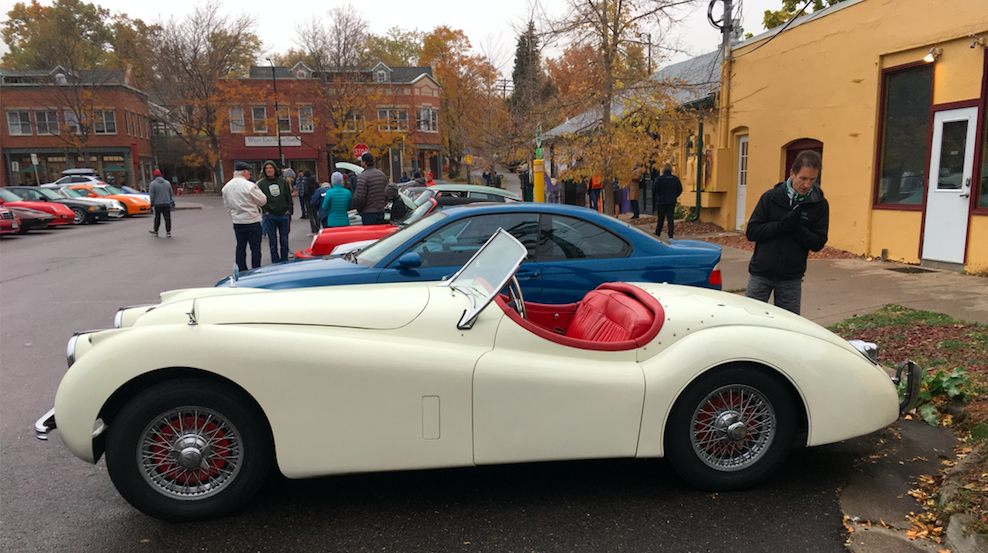
The last Coffee & Classics event of the year was on October 31, coinciding with what was supposed to be a sunny, warm Halloween. I woke up around the 8 AM starting time and noticed the gray skies and persistent, chill drizzle. Deciding that few of the regulars would want to show their prize cars in the rain, I got on my old (and maybe classic) Bianchi cycle to pedal downtown. Halfway there, Paul Schultz passed my bike on Broadway in his Jaguar XK 120 roadster, top down and rooster tails of water shooting off the tires...

The XK120* roadster displays its swashbuckling lines to the hardy crowd that showed up  early.  Roadsters were the first XK120s, appearing in autumn 1948 at the London's Earls Court show, causing a sensation, and joining Britain's postwar export drive the next year.  Soon enough, movie stars were driving them, and Detroit noticed, with Chevrolet launching its Corvette two-seater in 1953, the year of this example, and Ford releasing its Thunderbird for the 1955 model year, the year after Jaguar made the switch from their 120 to the XK140.
The leather-lined cockpit allows little space between the wood steering wheel and the driver. In this case, owner Paul has switched the original wheel for a smaller diameter one with a flat hub, eliminating the bullet shaped hub that he described as "as lance aimed at your chest."  Roadsters have this padded leather sill around the cockpit and side curtains rather than windows.  Fixed-roof and drophead coupes have roll-down windows, along with wood dashes.
Ron Farina made up the other half of the Jaguar contingent with his 1962 Mark II Sedan, here parked next to a Porsche Boxster which, like the XK120, had its top down.
The surprisingly big turnout also featured plenty of older, air-cooled Porsches, including the red 356 coupe below, and the fleet of 911s flanking the chartreuse 914 and the black Ferrari 328GTS we featured in our photos of the July 25 event, posted July 27...

This metallic brown example was the previous model, the 308 GTS.  The 3 liter, 4 cam V8 engine powered the Dino 308 GT4, the 2+2 Bertone-bodied coupe introduced for the 1974 model year; it was joined by the Pininfarina-styled 308 GTB coupe the next year, and the GTS spider for 1977.  Early GTBs featured fiberglass bodies with alloy hoods;  PF switched to steel for model year 1977. The 308 series had a long run, staying in production through 1985, and was the most popular series Ferrari had yet made, with over 12,000 sold.
The damp but diverse field included 2 Citroens, Alfa Romeos including the green Giulia 1600 Super Berlina from the Sixties and the red, turbocharged 4C from the recent past.
Those Citroens included the two cars with hoods open below (no, there was no mechanical trouble), the green DS21 on the right below, and the gray Deux Chevaux on the left...
One repeat visitor we covered in our October 17 post on the September Coffee & Classics was this Citroen DS21 belonging to Kevin Roberts.  We missed showing two features, though.  One feature is the patented hydropneumantic suspension pioneered by Citroen.  The photo below (taken at Boulder's NCAR* campus) shows the adjustable-height, self-leveling suspension at its maximun height...
While this photo shows the directional headlights, with the inner light following the front wheels, and heated glass covers conforming to the fender contours.  This feature was left off US-bound models because of lighting regulations, but this '72 model has the Euro lights above the US-spec. side markers and bright metal trim.  
The CItroen 2 CV (Deux Chevaux, named for its 2 taxable horses), produced from 1948 to 1990, was Pierre Boulanger's idea of a minimal-cost car for everyman, and put French farmers on wheels…the tubular-frame seats could be removed to transport farm animals, and the compliant suspension with its horizontal springs connecting front wheels (the driving ones; it's a Citroen) with the rears, allowed farmers to drive across fields with a basket of eggs without breaking any.  This example was built after the 1960 discontinuation of the original 375 cc flat-twin air-cooled engine; it features a 600 cc twin cylinder making 29 hp. 
The rear view of the 2 CV shows its folding canvas top, sensibly deployed in the closed postion on this rainy Sunday.
No, that's not a Porsche Type 904 below.  Only around 112 were built in 1964 and '65, and that, along with their success on the racetrack, makes them more expensive today than some real estate, even here in pricey Boulder...
It's a Beck 904 replica built in 2017, here flanked by two Porsche 993 coupes which represent the last of the air-cooled Porsches. Together the 904 and those late 911s represent the cleanest and most coherent examples of Porsche body design (Note to irate readers; please use Comment line to disagree).
The Beck 904 has two features in common with Porsche's original; these are a fiberglass body and an air-cooled flat six.  Wait, you say, wasn't the 904 a four?  Well, most of them featured Dr. Fuhrmann's well-proven but complex 4-cam in 2-liter form, but Porsche built 7 with the then-new, SOHC Type 901 engine from the 911, which was also new at the time.  This Beck 904 has a 3.2 liter engine, so it's a real hot rod.  The other feature was the fiberglass body; the original 904 with its fiberglass body bonded to the chassis was the first fiberglass-bodied Porsche offered for sale.
Alfa's Giulia Super Berlina (sedan) was a favorite of police and also of a few people who wanted to escape the police, along with rally drivers.  Introduced in 1962 and restyled 6 years later for the 1750 Berlina, the upright design hid the potential of the well-proven, aluminum twin-cam Alfa engine, and made the car into a kind of sleeper.
Speaking of sleepers, the 1995 AMG Mercedes C36 qualifies as one, and also as a competitor to the BMW M3. 
The C36 features a 3.6 liter twin-cam inline six with four valves per cylinder, and makes about 280 horsepower.  The W202 body style was made from 1993-2000.
At least one or two BMC Minis show up every month; our October Mini was a 1988 model imported to the US from Japan, with a 997 cc version of the transverse four.  Minis appeared in 1959, and were engineer Alec Issigonis' idea of a minimal urban car, and an interesting contrast to the larger Citroen 2CV, also a front-drive minimalist concept  "Original" Minis would be made until October 2000, when the last car, a red Mini Cooper, rolled off the line after an over 40-year run, almost matching the 42-year run of the 2CV.
All the drivers who surprised us by driving to the event with their tops down would wind up leaving the event that way as well.  They included the driver of this Triumph TR-6.  As more than one spectator pointed out after an unusually dry October in Boulder, this hoped-for moisture provided weather that probably felt like home to the English cars. I'll need to remember that if it ever rains here again.  Maybe I'll even have new weatherstripping on my English car by the time Coffee & Classics Boulder resumes next May...


*Footnote:  *Footnote:  Jaguar's XK120 was featured in "Colorado English Motoring Conclave Part 2:  Production Cars and Fast Plastic", posted November 6, 2021, and in "Game Changer: Jaguar XK120", posted July 16, 2017. We featured a photo essay on architect  I.M. Pei's National Center for Atmospheric Research on May 26, 2019.


Photo Credits:  All photos are by the author.


Coffee & Classics future events:  Check online @fuelfedboulder for next season's schedule.


Friday, November 19, 2021

Epic Traffic Jam or the End of Civilization in Godard's "Weekend" (Either Way, a Car Spotter's Dream)

In 1967, Jean-Luc Godard made a film called "Weekend." It seemed to anticipate the student demonstrations that would begin in May 1968, launching social disruption that would spread across France as labor unions launched strikes in sympathy. Before the story begins, Godard conveys uncertainty about how seriously we should take his film, with captions noting on the one hand that this is a film "adrift in the cosmos" and a bit later that the film was "found in a dump."
Meeting Godard's protagonists doesn't give us much better grounding. Early on, we see Corinne (Mireille Darc) and Roland (Jean Yanne), a married couple, plotting with their respective lovers to do each other in after seizing the assets of Corinne's ailing father; their plans for the old guy are not wholesome. These are not people with whom we will identify as we follow their plot and the subplots that lurch into view around them...
These subplots soon include an explosion of road rage in the parking lot below their Paris apartment, when drivers of a blue Mini and a red Matra 530 get into a fight over a fender-bender. Godard seems on top of automotive fashion in the French middle class; the Mini was a chic city car and the mid-engined Matra represented the latest automotive trends in 1967...
Unlike Roland's 1960 Facel Vega Facellia cabriolet, a car with an engine so trouble-prone that it bankrupted the company. Godard seems to be spoofing the pretensions of his characters (and their class) with this pretty but fickle car.  When a small boy accosts Roland for backing into his mom's Renault, he teases the man for driving "a crap Facel." Their argument escalates, of course, and soon the boy's mom comes out to remonstrate (above). Then Roland attacks her car with a paint gun while the boy's dad shows up with a real gun (below) and fires warning shots. This conflict is presented as farce, not far from the tone of American situation comedies.
This tongue-in-cheek tone continues when Roland and Corinne finally make it onto the road, only to confront an epic traffic jam filmed in one long take over nearly a mile. In droll scenes reminsicent of the animated British film Automania 2000* from 4 years earlier, most motorists seem resigned to their fate. Roland ignores the rules of the two-lane road, making his own lane as he tries without success to cut in line.  Meanwhile, stranded motorists play card games as the minutes pile up into hours... 
Others play chess, seemingly oblivious to evidence of other kinds of pile-ups.
Still others pass soccer balls to pass the time.
While patient, imperturbable workhorses do what horses must do...
Images of caged monkeys, a caged llama, and caged lions may be Godard's deadpan way of asking who is really trapped here, and why...

Meanwhile, Roland and Corinne are getting nowhere...
…along with everyone else, whether they've stayed in their lane or not.
Below, our protagonists attempt to slip their Facellia behind a red late-Fifties Panhard Dyna Cabriolet Grand Standing (almost a movie title in itself) while a Renault Dauphine hugs a tree.
Godard shows us more abandoned roadside wrecks being towed away, yet we see no evidence of anyone coming to the aid of victims laid out along the roadside. The tone is morbidly satirical, and maybe a reminder that the term "black humor" was invented by French critics to describe stories by Jonathan Swift. The humor works because it's based on exaggeration of things we could see in society and out on the road in 1967, and the traffic jam gives Godard a way to show how people use their cars as projections of themselves, as well as symbolizing materialism.   
This traffic jam occupies around a fifth of the film's running time, and while it's a car spotter's dream, it's a nightmare for humanists.  Godard offers title cards announcing episodes, and "The Class Struggle" begins when Roland and Corinne, having just escaped the traffic jam, witness a collision between a Triumph and a farm tractor.  In a sharp and witty argument, the privileged passenger of the roadster (her boyfriend having expired at the wheel) and the farmer exchange insults that expose their prejudices.  This accident scene, like the others, is notable for the liberal splattering of ketchup on the victims, which is ironic because the French normally disdain using that condiment anywhere else...
Roland and Corinne decline to wait for the police to bear witness to the accident, instead driving on in the rain toward the country house of her parents. They stop to pick up a female hitchhiker, only to be carjacked by the woman's gun-toting boyfriend, who's been hiding behind a wreck. He informs them that he's here to launch the flamboyant era of film-making, and proves he's a magician by prompting Corinne to pull a rabbit from the glovebox.  This isn't the first or last time Godard reminds us we're watching a film...  
After escaping the carjackers, Roland and Corinne encounter Emily Bronte and Tom Thumb, and Roland wonders why they are trapped in a film with crazy people.  Emily Bronte delivers a poetic speech about the cosmos.
The protagonists run a cyclist off the road, and then crash their Facel into a multi-car pileup; showing the car used as an actual weapon is another way of satirizing "normal" aggression behind the wheel. Now Roland and Corinne are on foot, still fixated on reaching that country house, and we are reminded that one title that Godard considered for "Weekend" was "The Odyssey".  
Roland and Corinne escape on foot from more flaming catastrophes after some failed efforts at getting help, eventually hitching a ride with piano movers... 
After a grand piano is unloaded at a working farm, Godard treats us to Mozart's Piano Sonata No.18 in D Major, and the pianist delivers a lecture on the harmonic virtues of Mozart, noting echoes in modern pop (he mentions the Beatles), decrying modern "serious" music, to which he claims nobody listens...
For a moment it seems we are, for the first time in this film, in real civilization, and Godard lets us linger there for awhile.  He shows us a farm family and workers enthralled by the music, and his camera makes a couple of slow 360-degree circles around the farmyard, pondering the simple geometry and workmanlike order of the buildings and farm machines.
Maybe this is a comment on the value of art, and maybe it's here to remind us how order and harmony look and sound.  
Our protagonists are still determined to get to that country house.  While attempting to thumb a ride, they are rejected by motorists after they fail a quiz: Do they prefer Mao or Johnson?  Are they in a film? A crew on a garbage truck picks them up, and then delivers a lecture on colonialism and capitalism. These scenes don't work as well as the epic traffic jam or the piano session, perhaps because the humor of exaggeration doesn't apply.  Roland and Corinne eventually get to her father's country house to discover that he has died, and contend with her mother over his fortune. This episode doesn't end well, but by this point in the film we expect nothing will...
"Weekend" begins with an epic traffic jam, but it ends with something that looks a whole lot like the collapse of civilization. The easy satire of exaggerating human aggression and greed gives way to scenes of  armed revolutionaries invading a picnic, taking hostages including Roland and Corinne, slaughtering farm animals, killing Roland, and indulging in cannibalism (well, it appears to be a piece of chicken; this is not a film for vegans). Several critics thought this was a masterwork back in 1968. Today this approach to satire no longer works; showing motorists engaged in armed conflict after a fender-bender wouldn't be such a case of exaggeration now. In an era of mass shootings in supermarkets and schools, Godard's 1967 vision of armed assault on innocent bystanders is showing us what we already know. "Weekend", like the society it depicts, falls apart at the end.  We can look at it and say, "We've seen this movie before."

*Footnote:  We took a look at Godard's first film, a groundbreaker that also featured a lot of cars (mostly stolen), in December 27, 2020, with "Stolen Cars and Stolen Kisses in Jean-Luc Godard's 'Breathless'."  A review of the British animated film "Automania 2000" which in 1963 predicted traffic jams lasting years (along with the collapse of civilization) was posted here along with a review of the museum catalog for MoMA's current Automania exhibit on October 12, 2021. And classic cars featured in classic thrillers are pictured in "Speeding Into Darkness: The Cars of Film Noir", posted March 21, 2020.

Photo Credits:  All images are from "Weekend", copyright 1967 by Films Copernic.