Featured Post

Saturday, September 16, 2023

Roadside Attraction: Louwman Automobile Museum in the Hague (Part 1)

The Louwman Museum in the Hague, Netherlands houses a car collection that began with the purchase of a 1914 Dodge by car importer Pieter Louwman in 1934. In the decades since, the collection has grown to over 200 cars, which are now housed in a buiiding designed by Michael Graves and dedicated in 2010.
The collection includes the 1901 Darracq 8-hp model above.  Its single-cylinder, air-cooled engine was just under a liter in displacement, and drove the rear wheels through a 3-speed gearbox.  From the same nation a few years later, the bright blue Grégoire 12/14 HP Coupe de Voyage below offered motorists 13 hp from a 2.2 liter, 4-cylinder engine.  Divided-light windows may have been intended to provide a touch of home, but allowed less than maximal outward vision...
During this era, Robert Nicholl Matthewson, a wealthy and we'd guess, pretty eccentric Scotsman living in Calcutta, decided to build the Swan Car in the foreground on a 1910 Brooke 25/30 hp chassis. Large quantities of silk, feathers and gold leaf were involved.  The idea was to attract attention; the mission was so thoroughly accomplished that Matthewson decided to sell the car to the Maharajah of Nabha. The Baby Swan car in the background was commissioned for the Maharajah's 9-year old son...
A dozen years later, Italy's Vincenzo Lancia made a revolution with his low-chassis, V4-engined Lambdas with their unitized body construction and sliding-pillar, independent front suspension.  Produced in 9 series until 1931, the Lambda sold over 11 thousand examples...
In France, aviator Gabriel Voisin offered another interpretation of modernism, with body designs perhaps influenced by Cubism, and light alloy bodywork on many examples influenced by his World War I aeronautical experience.  Engines used the sleeve-valve system...
Jean Bugatti's design for the Bugatti Type 50 Coupe Profilée was more focused and less whimsical than the Swan Car.  Introduced in 1932 when the designer was 23 years old, the car was named for its futuristic profile, which featured a windshield angle of less than 30 degrees. At Jean's behest, dad and founder Ettore Bugatti had purchased a couple of Miller racing cars, and the T50's five liter inline eight reflected the twin overhead cams and inclined valves of the American racers. Despite the advanced, light alloy engine design, the T50 held onto mechanically-operated brakes, and rigid axles front and rear...
Bugatti exhibited the yellow and black Type 57 Grand Raid roadster in 1934, shortly after production of the 3.3 liter, twincam eights began.  The body was built by Gangloff of Colmar, not far from the Bugatti factory in Molsheim, Alsace Lorraine, and the name referenced long-distance rallying.  The cut-down windshield and lack of a top wouldn't offer much protection against the elements during a Grand Raid, but those twin headrests, part of the original design, reek of adventure...
By 1936, horseless carriage pioneer Panhard Levassor had released designer Louis Bionier's Dynamic series, which combined themes of Art Deco with Streamline Moderne.  The rear-drive car was offered in sedans, coupes and cabriolets on 3 wheelbases, and with 3 choices of inline six-cylinder, sleeve-valve engines.  Louwman's 1937 X77 is powered by a 2.8 liter; there were also 2.5 and 3.8 liter versions. Despite the choice of sleeve valves, a retrograde engineering feature also appearing on Voisin cars, over 2,700 Dynamics were sold by 1940.

Also around this time, Joseph Figoni of coachbuilder Figoni et Falaschi began to body Talbot-Lago and Delahaye coupes and roadsters in the seductive teardrop style shown below.  After Anthony Lago took over the old Darracq firm from the British Sunbeam-Talbot-Darracq comnbine, he moved to emphasize high performance with short-chassis sports cars powered by a 4 liter inline, overhead valve 6.  The cars were still called Darracq in England to avoid confusion with British Talbots, and featured a Wilson pre-selector 4 speed gearbox.
Bugatti's car production was derailed by World War II and never really recovered, while the Delahaye & Delage combine, as well as Talbot-Lago, began to offer cars again soon after war's end.  This Delahaye Type 135MS was bodied by Carrosserie Pourtout in 1946, and was powered by a 3.5 liter overhead valve inline six driving the rear wheels through a Cotal electromagnetic pre-selector gearbox. Unlike its sister Delage 3 liter and rival Talbot-Lago, the Delahaye had not yet changed from mechanical to hydraulic brakes.
Bodywork on the postwar Talbot-Lago below was by Chapron.  After war's end, Lago increased engine size to 4.5 liters, and added high, side-mounted cams operating overhead valves in hemispherical combustion chambers through short pushrods.  Not dissimilar to the valve system in the English Riley and ERA, the Talbot-Lago 4.5 liter powered grand touring cars as well as GP single seaters.
The Austin A90 Atlantic from 1948-52 was a charming but unsuccessful attempt to appeal to the American car market. Parked next to a "step-down" Hudson from the same era, the Atlantic was offered in convertible and coupe versions, and powered by a 2,660 cc overhead valve inline four. When the British Motor Corporation popped that same engine into the svelte, pared-down Austin Healey 100, they finally made a splash on the American side of the Atlantic...
Crosley, which made the 750cc single-overhead cam 4-cyinder sedan below in CIncinnati from 1946 through 1952, was unique among American car makers in offering a car that was small even by European standards.  Crosley also offered a station wagon, a pickup, and a Jeep-like Farm-O-Road model with power takeoff for use on farms, building about 84,000 vehicles in the postwar period.  This green 1950 model is parked next to a yellow and white Nash Metropolitan, which, while only a bit larger than the Crosley, was built by BMC in England for Nash and later, American Motors. The SOHC engine in the Crosley was favored by American amateur racers in the small-bore class, and adopted in modified form by Bandini in Italy.
Also in the same era as the Crosley, but maybe on another planet in terms of ambitions and purchase price, Spain's Pegaso Z102 featured a 4-cam, light alloy V8 driving the rear wheels through a 5-speed, non-synchro transaxle. Two alloy-bodied "Cupola" coupes were built in 1952, perhaps inspired, like Alfa Romeo's Disco Volante (Flying Saucer) by UFO stories; the Louwman Museum's example is apparently the lone survivor.   
The Cupolas got their name from their bubble-shaped rear windows.  Unlike the more famous Pegaso coupes by Touring Superleggera, including the "Thrill" showcar, the Cupolas were designed in-house at Pegaso's facility, which was shared with truck and bus manufacturing under the state-owned ENASA operation.
The cockpit design shows a shift lever nicely shaped to fit the hand; it operates the 5-speed transaxle featured in all Pegasos. Around 7 dozen Pegasos were built between 1951 and 1958, and despite the car's showy mechanical features, few had any success in competition.  
This wasn't true of the Lancia road racers from the same period.  Like Pegaso, the Lancia D-series featured rear-mounted transmissions for better balance and handling. The aluminum engine in this D-23 was a 60-degree V6 like that in the production Aurelia model.  But instead of pushrods, it featured 4 overhead cams, twin spark plugs per cylinder and made 220 hp from just under 3 liters.  Rear brakes were inboard but were still drums.  A D-20 coupe with the same engine took 3rd place in the '53 Mille Miglia, and the shorter-chassis, 3.3 liter D24 won the '53 Carrera Panamericana with Fangio driving, the '54 Mille Miglia in the hands of Ascari, and the '54 Targa Florio.  Just as Lancia's racing program was bankrupting the company, the D-25 model received disc brakes.  The Louwman collection's D23 is the only one left of 3...
Mario Boano's namesake coachbuilding firm designed and built the sleek, alloy fastback body on the 1955 Abarth 209A, a sister car to the 207A competition spider; both were front-engined, rear-drive cars powered by modified Fiat 1100 engines. The next year, 1956, Fiat would introduce its rear-engined 600 model, and Carlo Abarth would begin to make the tiny, 600-based, Zagato-bodied sports racing coupes that were the source of his firm's eventual fame.  Also in 1956, the Suez crisis underlined importance of fuel economy and the value of small cars.  Soon enough, the rear-engined Fiats were joined by even smaller microcars from BMW and others...
While Spain's Pegaso factory was winding down car production to concentrate on trucks and buses, and Abarth was shifting its attention to modifying the new, rear-engined Fiat 600, West Germany's Zundapp, known for motorcycles, was introducing its first and only car, named the Janus for its forward and rearward-facing doors, which accessed seats facing front and rear, which in turn flanked a mid-mounted, single cylinder 2-stroke engine of 245 cc. Braking was by 4 drums.  While the Janus was in time to meet fuel economy concerns caused by the Suez crisis, production was only around 6,900 units and 1958 was the final year.  Despite the central engine position and owing to the car's light weight, handling characteristics of the Janus, which featured rear swing axles, could change greatly with the addition of rear passengers...
A rear-engined, wicker-seated Shellette Spider beach car based upon the Fiat 850 brings the collection into the Seventies. This example, built in 1976, was one of two owned by Simon Kingston, who lived on a yacht moored in Monte Carlo during summers, and used the cars on shorebound trips.
Also built in 1976, and arguably aimed at the same yacht-owning Monte Carlo clientele, Italdesign's Maserati Medici II pampered 4 occupants inside the then-fashionable wedge-shaped shell styled by Giorgetto Giugiaro.  Power came from a 4.9 liter V8; only one Medici II was built.  It seems a fitting end for this survey of the Louwman collection; their epic collection of microcars and bubble cars is a story that will have to wait for another day.
Photographer George Havelka marvelled at the presence of bikes everywhere, and at the odd little city cars parked among the cycles.  His comment: "Bikes EVERYWHERE in Netherlands. Everyone rides. Car lanes.  Bike lanes.  Trolley tracks.  Walkways.  All color-coded.  Very organized and civilized…Boring landscape but all else is wonderful.  Food, beer, people, architecture, manners…"  
Photo Credits:
All photos were generously supplied by longtime reader and contributor George Havelka.


Thursday, August 31, 2023

Monterey Car Week 2023: Auctions, Pebble Beach Concours, and a Day at the Races

Note to subscribers:  We missed attending Car Week due to hosting a local film night.  Keith Carlson*, a fan of cinema, architecture, dogs and historic cars (and also as it turns out, a fan of ladies in hats) sent us an epic trove of photos so we could celebrate our 8th anniversary in the blogosphere the way we began, thinking out loud about Car Week…
One of the stars of the 2023 Monterey Car Week auctions was this Jaguar XKSS, one of 16 road-equipped versions of the D-Type racer with bumpers and weather protection (sort of), sold new in California way back in 1957.  My '58 Road & Track Test Annual questions the practicality of the XK-SS as daily transport, but praises its abilities as a weekend racer: 0 to 60 came up in 5.2 seconds, and top speed was 149.  The list price was $5,600, but one imagines buyers paid more to get a specimen after a fire at Jaguar's factory shut down production.  Neither of the 2 cars R & T sampled, however, went for $13,205,000, which was the winning bid for this one. Hmm, dark blue with a red interior, favorite color scheme...
Were there any bargains on offer at Monterey?  Well, at the other end of the price and power scale, this Autozam AZ-1 went out the door for just $20,000.  Built by a Mazda subsidiary with turbocharged, mid-mounted Suzuki 657cc power (3 cylinders, 12 valves, 64 hp), the kei-class AZ-1 featured gull-wing doors.  The AZ-1, built from late 1992 to late '94, was not quite as nippy as the XK-SS, with 0-60 in 9 seconds and a top of 87 mph.  You're not likely to see another one at your local Cars & Coffee, though, and it's our nominee for Bargain of the Weekend.  For those with more expansive (and expensive) ambitions, there was plenty of stuff on offer..
You may be thinking the car below is a Bugatti Type 35 from the Roaring Twenties, but the black wheels and brass trim are giveaways that it's a modern Baby II, a revival of the Baby Bugattis that Ettore Bugatti built for a few lucky children back then.  Like them, it's electric, but at a bit larger scale.  At 75% of the original Type 35 size, the Baby II makes the neighboring 1930 Bentley Speed Six look even more enormous than it is...
…and it manages the same trick with the Hispano-Suiza on the other side.
There were plenty of American classics at the auctions too. Here, a cream-colored Cord 812 keeps company with a tan 810.  The Twenties Packard beyond reflects the optimism of its era with a period-correct color scheme...
Here, an Auburn 852 sits next to a Hudson Terraplane that looks like it would follow you home if you whistled.  The maroon car beyond the Hudson appears to be a Darrin-bodied Packard Convetible Victoria.
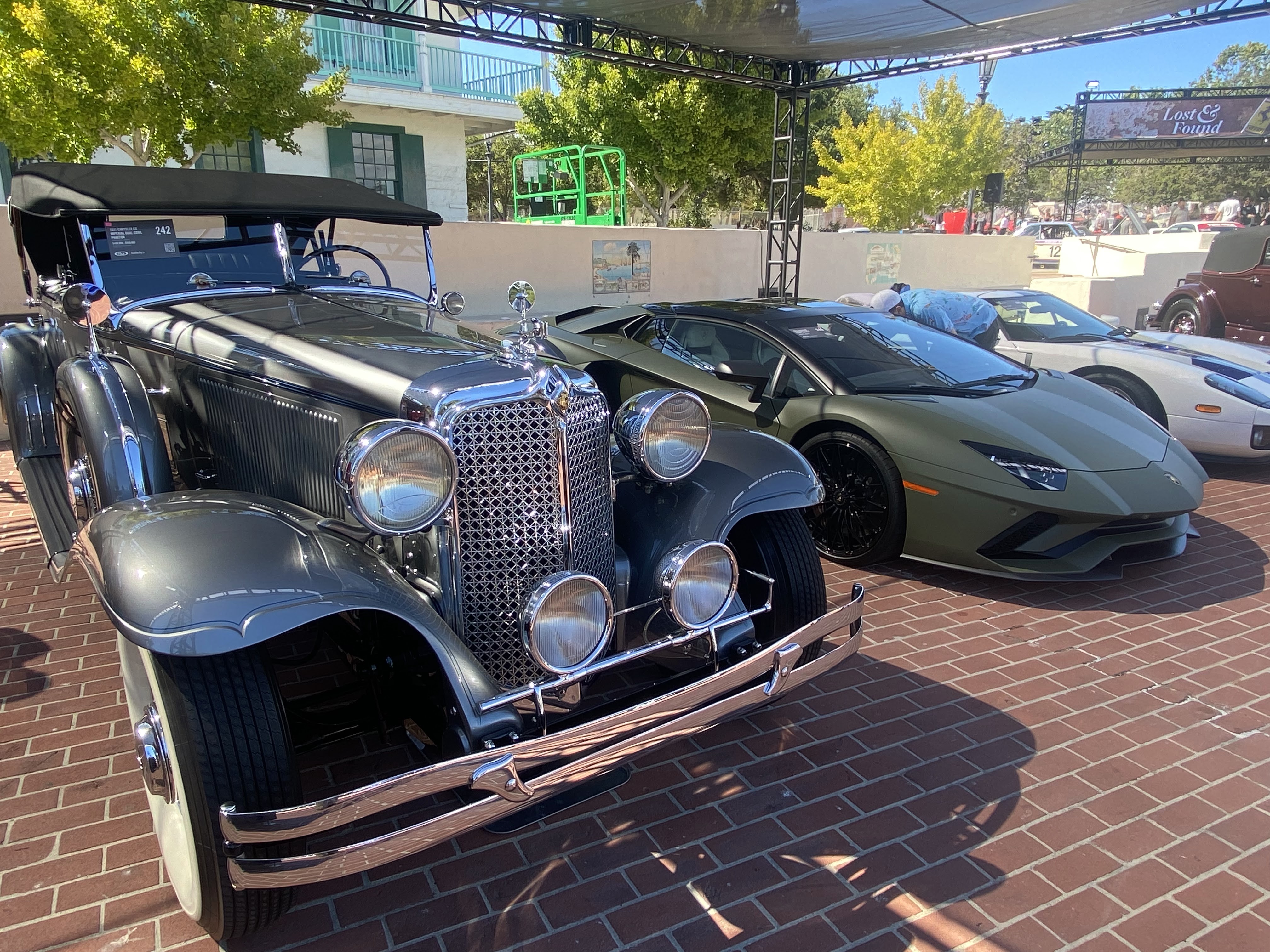
Sitting next to a matte-finished 21st century Lamborghini, this Chrysler Imperial from the early Thirties was enough to make anyone nostalgic for shiny paint...
All polished up for the occasion, a 1930 Murphy-bodied Duesenberg Model J, a late Thirties Lagonda Rapide, and a Rolls Royce.  
Here, two Bugatti Type 57s (built1934-40) flank a Type 37 or 37A GP car from the late Twenties. We're not sure if this is a T37 or 37A because there was one of each at the auctions.  It seems that during Car Week, vintage Bugattis are almost as common in Monterey as Subaru wagons are in everyday Boulder, Colorado... 
RM Sotheby's took bids for a 1954 Ferrari 500 Mondial, one of 32 built, including the 2nd Series cars introduced in '55.  This example had been wrecked and burned in the mid-Sixties, and had not been given much loving attention since...
Given its condition, it's kind of stunning that the winning bid was $1,875,000.  Then again, the car came with one of the Lampredi-designed, monoblock twin-cam four cylinder Ferrari engines, and a transmission too.  It appears, however, that some assembly will be required.
After the auctions, over at the Pebble Beach Concours on Sunday, things seemed a bit more…assembled.  The fully assembled car below is a 1939 Delahaye Type 165, bodied by Figoni & Falaschi in swoopy Streamline Moderne style, with skirted wheels and retractable windshield.  Power came from a detuned version of Delahaye's 4.5 liter, 3-cam racing V12, with aluminum block instead of the magnesium used in the successful GP car, and a single spark plug per cylinder vs. 2 for the racer that beat the Mercedes at the Pau GP in 1938.
Possibly influenced by futurist sketches made by illustrator Geo Ham, Figoni also produced handfuls of streamlined, teardrop-fendered bodies on lighter, sportier Delahaye and Talbot-Lago chassis.  This Torpedo Cabriolet, on a 6-cylinder, short-chassis Delahaye Type 135, first appeared in 1936; next year the engine size went from 3.2 liters to 3.5.  Under a dozen of this style were built.
Owners and fans often wear outfits that match the period and style of their favorite cars; the lady below is standing beside a 6-cylinder, 3 liter Delage (sister car to Delahaye, but with hydraulic brakes instead of mechanical ones thanks to stubborn Louis Delage). Just beyond it is a FIgoni-bodied Talbot-Lago...
Another wild outfit, this time posed in front of a Saoutchik-bodied grand tourer.  Too bad our trusty photographer didn't get a shot of the front (on the car).
One is somehow reminded of the Randy Newman song, "You Can Leave Your Hat On." Just in time for champagne...
We're not sure if this suit signifies a concours judge...
Another idea of style, on the instrument panel of an early 1930s Packard...
Here, the business end of a Duesenberg from the same period...
Details, details...
Concurrent with the auctions on August 17 through 19, Laguna Seca hosted the Monterey Motorsports Reunion.  Last year, this was probably the best way to see the greatest variety of cars in action, and seemed a bargain compared with the Pebble Beach Concours.  One economic point is that a simple baseball cap will always suffice for any visit to the races...
This year, there was a similar mix of vintage racers, from the horseless carriage era to the dawn of the digital age.  Most cars on the track, however, are as analog as this C1 Corvette.
Unlike some of the sports cars shown above, single-seat, open-wheel racers have no practical use outside the regulated confines of vintage racing.  So there are always a great variety of them at Laguna Seca, from pre-WW2 GP cars, to Indy cars, Formula Juniors and Formula Atlantics.  This means there's always a great variety of exposed engines for gearheads to investigate, too.
It seems fitting that we finish this photo essay with, in essence, the same car that began it. The yellow racer below is a D-Type Jaguar, built from 1954 to '57 and designed to win Le Mans, which it did in 1955, '56 and '57.  Jaguar's last road racer with a live rear axle, the D featured a wind-cheating shape by ex-aircraft designer Malcolm Sayer, and of course, the 4-wheel disc brakes pioneered on the C-Type.  It stopped better than the Ferraris, and this made it possible to beat them.  You don't see them as frequently at vintage races as you did in years gone by, and the eye-watering auction price of that XK-SS (a road-going D) may tell you why.  But on a trip to the historic races at Laguna Seca in 1980, I was driving through San Francisco traffic in a TR6 when I heard a low booming noise right behind me, and got passed by a D-Type on its way to the same place.  It got there sooner...
*Footnote:  For commentary on last year's Monterey Car Week in these posts, see "A Car Week Side Trip: Sleeping Beauties Somewhere in California (Aug. 24, 2022), "Concours d'LeMons: Monterey Car Week Viewed Upside Down" (Aug. 27, 2022), and "Monterey Car Week 2022: A Day at the Races" (Sept. 5, 2022), Our first-ever post was "A Review of the Monterey Auction Weekend, August 14-16, 2015", from August 25, 2015.
Photo Credits:
All photos were generously supplied by longtime reader and contributor Keith Carlson.  For Keith's collection of wood-bodied cars, see "Classic Woodies: When Fine Carpentry Hit the Road", posted May 28, 2023.


Sunday, August 27, 2023

Forgotten Classic: OSI's Alfa Romeo Scarabeo, Mid-Engined Pioneer

The mid-engined revolution had already taken over automobile racing by October 1966, when Alfa Romeo showed this Scarabeo show car at the Paris Auto Salon. Engineered by Giuseppe Busso and Orazio Satta as a prototype for a lightweight, affordable racer for the road, the car showed off sharp-edged curves penned by Sergio Sartorelli at OSI* (Officine Stampaggi Industriali), a firm which produced Ghia designs in larger numbers than Ghia could manage, and also produced some wild show cars.  Design of the Scarabeo had begun with Alfa's team early in '66, after management had assigned design of a mid-engined V8 race car to Carlo Chiti's rival team at Autodelta.  

It was an era for wild show cars, and the Scarabeo (Italian for scarab) combined features seen on some others.  Lamborghini had shown-off its transverse V12-engined Miura in chassis form in 1965, and Bertone had shown the Corvair Testudo with jet fighter-style canopy access in '63. Like Testudo and GM's '62 Monza GT concept car, the Scarabeo's access canopy provided unimpeded forward vision through a windshield wrapping into side windows with no "A" pillars, and its engine, borrowed from Alfa's GTA, was mounted transversely behind the passenger, with the driver seated as far back as possible behind the righthand steering wheel. The idea was that this location would provide optimal driver responses to vehicle dynamics. The chassis was composed of large-section steel tubes, with the fuel tanks mounted in the tubes flanking the seats (perhaps better for weight distribution than for impact safety).  A 5 speed manual transmission was in unit with the engine.  
This layout allowed a compact and lightweight vehicle; about 10 inches shorter and 1,000 lb. lighter than the 1990 Mazda Miata, on a wheelbase of just 84.65 inches. But safety regulations presented problems for the canopy access, and Alfa's main markets were not well-suited to the righthand drive limitation. So for the second Scarabeo prototype, the design team went with more conventional doors, and rearranged the mechanical bits to allow for lefthand steering.

This second prototype featured fewer sharp edges than the original, and even the Kamm-inspired tail was a bit less sudden in its appearance.  What it gained in practicality, though, it seemed to lose in dramatic impact.  The Scarabeo team also produced a prototype for a racing barchetta; though this car was tested, the bodywork was not completed.  
One year after the first appearance of the Scarabeo, again at the Paris Auto Show, Alfa Romeo proposed another road racer for the street.  In fact, Autodelta's Type 33 Stradale was named for the street. It employed a chassis of large-section tubes similar to the Scarabeo.  Developed as a road-going version of the 2 liter, 4 cam V8-powered Type 33 racers, it shared their mid-mounted engine location, but unlike the Scarabeo, the engine was mounted longitudinally.  While the Stradale shared the Scarabeo's focus on low weight, it was in no way focused on a low budget.  In 1968, it was the most expensive car offered to the public, and only 18 chassis were produced; 8 of these had the Franco Scaglione-penned body shown here.  Engineer Busso would try again for a low-cost mid-engine production car in 1972 with the Scarabeo II, mounting a 2-liter version of the twin-cam Alfa four under a highly modified Zagato Junior Z body.  That car, like this Stradale and Scarabeo prototypes 2 and 3, is now in the Museo Storica Alfa Romeo*.  Alfisti would need to wait for a mid-engine production Alfa until the release of the 4C model in late 2013.

*Footnote:
Other Alfa Romeo prototypes in the Museo Storico Alfa Romeo were profiled here in a 3-part series with Part 1 posted May 8, 2022, Part 2 on May 19, 2022 and Part 3 on May 30, 2022.  OSI's equally radical design for the Silver Fox Le Mans racer was featured in "The Etceterini Files Part 23---OSI Silver Fox:  And Now, For Something Completely Different", posted February 8, 2021.

Photo Credits: 
Top and 2nd from top + 7th from top:  carrozzeria-italiani.com
3rd:  OSI, featured on drives.today
4th:  Perspective drawing from OSI, featured on roarington.com
5th & 6th:  Museo Storico Alfa Romeo
Bottom:  George Havelka


Thursday, August 17, 2023

Corvette Grand Sport vs. Shelby AC Cobra: A Duel That Only Happened Once (or Twice)


If you'd wandered down the right street during a rare April snowstorm in Philadelphia a few years back, you might have seen this car slide past on the slick asphalt.  "Hmm," you might've thought, "looks like an old Sting Ray hot rod.  Somebody must have wanted to go racing a whole lot..."
Well, somebody did want to go racing a whole lot, and it was Zora Arkus-Duntov, chief engineer for the Corvette program at General Motors.  By autumn of 1962, as the new Corvette Sting Ray was attracting crowds in Chevy showrooms, Duntov and his team of engineers were preparing to launch a lightweight version of the car, with the goal of making 125 examples to qualify as a production car to compete in the SCCA with the Ford-powered Shelby AC Cobras, which were stealing all the glory from Corvettes on the tracks back then…
By late 1963, Duntov's team had built only 5 Grand Sports; the first two were roadsters made from cut-down coupe bodies like chassis #GS002, shown on that snowy demonstration day at the Simeone Foundation Museum.  3 cars were coupes like the one below, now on display at the Revs Institute.  Lacking production car qualification, the Grand Sports were slated to compete in SCCA's C-Modified class, where they were not well-suited to the competition.  At Nassau Speed Week in December, though, a free-form Trophy race was scheduled where the new Grand Sports could run against the Cobras.  Chevy's "production car" program had been based on a modified 327, but at Nassau the Grand Sports were powered by aluminum-block 377 cubic-inch engines with Weber carbs, special heads including hemispherical combustion chambers, and around 480 hp.  In order to match the stopping power of the disc-braked AC Cobras, the Grand Sports abandoned the Sting Ray's drum brakes for Girling discs. And the chassis was a new, tubular one. GM management, unlike the brass at Ford, was shy of direct involvement with racing, so "ownership" of the cars was transferred to Texas oilman John Mecom's team, and a crew of Chevy engineers suddenly decided to take their winter vacations in the Bahamas...
The Grand Sports were claimed to weigh around 1,980 pounds, over half a ton less than the standard Sting Ray.  On race day in the Bahamas, the new Grand Sports beat the Cobras in their first official race appearance.  The photo below may be a sign of the front-end lift that drivers reported at speed, or of the car's eyeball-flattening acceleration...
Shortly after that Nassau performance, GM management pulled the plug on the Grand Sport program, ending Duntov's hopes of getting those 125 production cars.  Grand Sports raced Cobras again, but in different classes, and without success.  Two Grand Sports finished the Sebring 12 Hours run on the first day of spring in 1964, but they ran in a class for prototypes over 3 liters vs. 5 liter GT class for Cobras, and lost, McKean Chevrolet's GS in 18th place behind a production Sting Ray in 16th place, and way behind the Cobras, which took 4th through 6th places. Shelby and Ford would eventually have their final revenge for the Nassau rout, with Shelby qualifying the Cobra Daytona coupe (6 built) as a "production" car like the standard roadster in 1964, and winning the FIA Manufacturers Championship with it in 1965.  
The 3 Grand Sport coupes were the only '63 Corvette fastbacks without the famous "split window" feature.  Rearward visibility took priority over styling, as it would on the '64 and later Sting Ray coupes.  Eagle-eyed readers will also note that this backlight has a more radiused shape to clear the fuel filler, and probably to avoid stress cracks in the thin, hand-laid fiberglass selected for these lightweights. In addition to all the functional slots, vents and louvers, the Grand Sports had something missing on all production Sting Rays, a deck lid (barely visible in the 2nd photo from top).  This was not for luggage (a flat space behind the seats atop the 50-gallon fuel tank would suffice) but for access to the battery and the differential cooler. The huge flares for wider wheels on the Grand Sport interrupt the dominant horizontal crease shown on the standard Sting Ray below…
One feature shared by the standard Sting Ray was a tendency toward front-end lift, a result of the forward-slanting section of the nose.  It's pretty though, and the Sting Ray was the first production Chevrolet to be tested in a wind tunnel...
Half a dozen years earlier, in another attempt to field a serious road racer, Duntov's team had taken their wind-tunnel tested, magnesium-bodied, tubular-chassis Corvette SS* shown below to the 1957 Sebring 12 Hours, where the car impressed drivers and crowd before retiring with teething troubles.  Shortly after that race appearance, GM management decided to comply with a new Automobile Manufacturers Association ban on racing, and the SS was retired, prefiguring Duntov's later disappointments.
Like that SS prototype, all 5 original Grand Sport Corvettes survive, and were gathered for the photo below some years ago at the Amelia Island Conrours; this was before the Simeone Foundation roadster (wearing silver blue paint below) was returned to the blue on white, as-raced color scheme it wore during that romp in the snow.  Despite their abbreviated racing careers, these Grand Sports are probably the most sought-after Corvettes on the planet.
*Footnote:  For more details on that magnesium-bodied Corvette SS, see "Forgotten Classic: Chevy's Corvette SS Ran Before the Ban", posted July 18, 2020. Lance Reventlow's adventures with Chevy-powered Scarab racers are reviewed in "Timing Is Everything: Reventlow Scarab Saga", in the blog archives for 6-2-17. For a look at other special Corvettes that happen to have metal bodies, visit our series of posts on Corvettes bodied in Italy by the likes of Pininfarina, Vignale and Scaglietti, starting with "The Italian Jobs: Corvettes in Italian Suits" (2-24-16), followed by "The Italian Jobs Part 2: The Kelly Corvette Was the First Postmodern Car" (2-27-16), "The Italian Jobs Part 3: Another Eurovision Corvette" (3-10-16), and "The Italian Jobs Part 4: Saved From the Crusher" (3-13-16).  

Photo Credits:
Top and 2nd:  youtube.com
3rd & 4th + 7th & 8th:  the author
5th:  The Revs Institute
6th:  General Motors
9th:  George Havelka
Bottom:  Corvette Info Center