Featured Post

Sunday, September 24, 2023

Roadside Attraction: Georgia's Automobile Museum (No, Not That Georgia)


Sharp-eyed readers would have already guessed from the Soviet Era Volga sedans shown above that we're not visiting a car collection in, say, Atlanta, even without the "Tbilisi Automuseum" lettering on the building, not to mention the illegible (to most of us) lettering above it.  And indeed, this car collection is housed in the Republic of Georgia, a democratically-governed nation facing West (in a couple of senses) across the Black Sea, and with a high scenic view to area ratio...
It's a country traversed by picture-postcard mountain ranges with lakes nestling in green valleys.  Our count on the mountain ranges is 10, but if you count the Greater and Lesser Caucasus separately from the Caucasus we're at a dozen...
Mountains provide a backdrop for this GAZ-20 Pobeda (Russian for "victory") four-door cabrio. The Pobeda was the first post-WWII Russian car design that was not a copy of a foreign design. After a couple dozen handbuilt prototypes appeared in 1946 and early production cars suffered problems with body integrity in 1948, the Gorky Automobile Works (GAZ) revised the 2.1 liter, side-valve 4-cylinder car, the first Soviet car with 4-wheel hydraulic brakes, and one of the first anywhere with flush-sided pontoon bodywork, and it stayed in production into 1958. Most Pobedas were sedans; about 14,000 cabrios were produced from 1949 to '53 owing to short supply of steel roof stampings.
The Pobeda cabrio appears to have delighted our volunteer photography crew*, but we're not sure if they were permitted to drive it off the premises...
The successor to the Pobeda, the GAZ-21 Volga, was introduced in 1956 and overlapped Pobeda production.  In the same size category, it was designed with a 2.4 liter OHV inline 4, but the first thousand cars feathred the flathead Pobeda.  Another independent design, the Volga reflected a bit of Ford influence in its styling, and an automatic transmission based on the Ford-O-Matic was offered.  Its 106" wheelbase was 4" more than the Volvo Amazon (Type 122) that appeared  the same year.
The Volga enjoyed a similar reputation for sturdy durability as that Volvo model, and was one of the first Russian cars to be exported in significant numbers...
For those reasons the GAZ-21 Volga had a long production life, and wasn't replaced by the 2.45 liter, aluminum-block 4-cylinder GAZ-24 Volga until 1970; a wagon appeared in 1971. Wheelbase increased to 110", the new car was shorter, lower and more space efficient, with room for 6.  This design was successful enough that Belgian-assembled models were sold as the Scaldia Volga M24, with the final facelifted Volga M2410 available from 1985 to 1992, the year after the Soviet Union officially dissolved...
Before these original designs appeared, however, Russian car manufacturing depended upon foreign designs.  If the GAZ 4 pickup below reminds you of a Ford Model A, there's a good reason. A 1932 agreement between the Soviet goverment and Ford Motor Company licensed use of Ford's designs.  The Tbiiisi museum's restored GAZ 4 is one of less than half a dozen that remain.  The museum also has a Ford Model A wagon as a reference car.
This GAZ M-1 went into production in 1936, and was based on the design of the Ford Model B from 1932, the transitional 4-cylinder model between the Model A and the more famous '32 Ford V8.  The first version of the M-1 ("M" standing for a factory named for Molotov, of cocktail fame) used a side-valve V8 engine based upon drawings supplied by Ford. The second series had a more rounded grille shape, and an engine based upon the 6-cylinder Dodge D5.  This particular 1st series M-1 was the personal car for Lavrenti Beria, enforcer of Stalin's purges as head of the dreaded NKVD...
When the Moscow Small Car Plant sought a design for a smaller postwar car than the  Pobeda then in the works, it looked to GM's Opel Division in Germany, and adapted the Kadett K38 series for this Moskvitch 401 series that went into production at the end of 1946...
The Moskvitch 400 and 401 were replaced by the restyled 407 in 1956, and the new car featrured improvements like independent front suspension, a better heater and available radio. Even though private automobile ownership was not yet widespread in the Soviet Union, the Moskvitch 407 scored some success in export markets in Scandinavia and Eastern Bloc countries, competing with cars like the Fiat 1100 and Hillman Minx, which it resembled...

The restyled Moskvitch 408 prototype appeared in 1960, with the 408 and 412 series production cars running from 1964 to 1975.  Power was provided by a 1.4 liter inline 4 gasoline engine, or a 1.7 liter diesel 4.  Styling and size resembled the contemporary English Ford Cortinas, but as with the Volga designs, the Sixties Moskvitch was a homegrown effort.

The need for a more modern product led to a Soviet deal with Fiat.  In exchange for Russian steel used in its Italian plants, Fiat would license production of a modified version of its 124 sedan (new in 1966) at the new Togiatti plant in Russia's Samara region. The plant and related new town were named for Italy's Communist Party leader. The car, known as the Zhiguli in Russia and Lada in export markets, was powered by a Russian-designed OHC inline 4 of 1,200 or 1,300cc, and offered thicker sheet steel in the bodywork, along with aluminum drum rear brakes instead of the Fiat discs.  It was produced in Russia from 1970 until 2012, and was the second most-produced car model after the original VW Beetle, with over 17 million examples hitting the highways of Europe and Asia...
Special police versions included two series of Wankel-powered Zhiguli-Ladas, but these suffered the same durability problems as the NSU Wankels...
The Ukrainian Zapororzhets ZAZ-965 & 965A production spanned the Sixties, starting with a Fiat 600-influenced sedan shown below in '60.  It wasn't a Fiat copy though; the rear-mounted engine was an air-cooled V4 rather than a inline water-cooled unit, and early cars had magnesiium blocks.  Engine size went from just under 750cc to just under 900cc during this period.
The 965A was succeeded by the 1.2 liter V4 Model 966 in 1966, but production of the two models overlapped for 3 years. The new model, with its Corvair-influenced styling, had a longer production life span than the Corvair (or most cars really), with production ending in 1994, and exports going from Ukraine to Western Europe and Scandinavia, with some cars being sold with Renault power plants instead of the air-cooled V4...

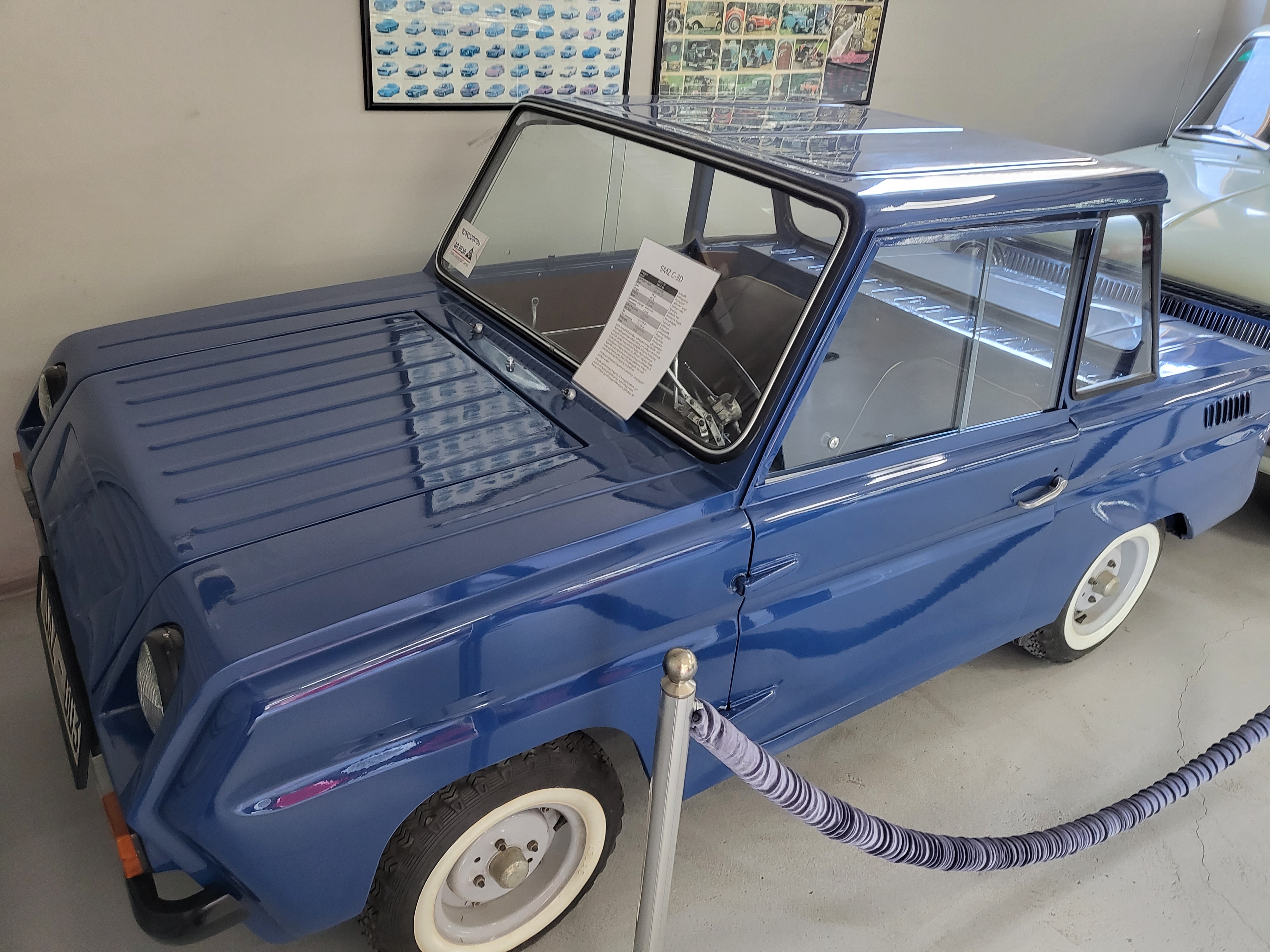
The SMZ S-3D was classed as a "cyclecar" and offered by the government only to citizens with eligible disabilities, somewhat like the "invalid cars" built by AC in England, and was in production form 1970 to 1997.  Rear-mounted power for the 2-passenger car came from a 350cc, 17 hp (DIN) two-stroke engine. Weight was just under 500 kg, but this was considered high owing to the use of steel body panels...

Meanwhile, at the opposite end of the size and ambition scale, Russian officialdom, the nomenklatura and apparatchiks that made the Soviet bureaucracy function (until somehow it stopped), moved from the Zis limousines and parade cars that were copies of early Forties Packards from Detroit, to this GAZ-12 Zim, that was in production from 1950 to 60.  Resembling a cross between a late 40s Cadillac (especially that grille) and a Checker cab from the same era, it was an original design powered by a 3.5 liter inline 6.  Also made as a 4-door cabrio like the Pobeda, it was technically available for private purchase, but the 40,000 ruble price, twice that of a Pobeda, put it out of reach.  The "M" in Zim was to honor Molotov, but after he fell out of favor with Nikita Khrushchev in 1957, the "M" disappeared, and it was just the GAZ-12...
This GAZ-13, a white Chaika, was one of the few offered in anything but black during the 1959-'81 production, or offered to anybody other than a member of the regime-affiliated nomenklatura. It was gifted by the Kremlin, though, to the first woman cosmonaut, Valentina Tereshkova.  Power came from a 5.5 liter V8, wheelbase was in the Beyond Imperial (in all senses) category at 135.8", and styling, like that on the even more exclusive and chrome-laden Zil, was derivative of the 1955 Packard.
Rear views of the official apparatchik cars reflect Detroit influence down the decades from the pudgy attempts at streamlined curves of the late Forties, to the chromed and be-finned Fifties, and the bland recdtangularity ushered in by the Seventies... 
Most Chaikas were painted black, with the exception of two-tone show cars for the 1958 Brussels World's Fair, and government cars that exceeded a mileage limit set by the State were reconditioned as "wedding cars."  Painted white like that Cosmonaut Chaika, these were popular well into the present century as ceremonial rentals...
The last Chaikas, like the GAZ-14 model below, were assembled from leftover parts in 1989 after Gorbachev ordered discontinued production the previous year as a part of his perestroika policy of reducing the privileges enjoyed by the nomenklatura. Remaining to this day in Moscow, however, are the 2-way "Zil lanes" reserved for government officials and emergency vehicles. These days, though, the nomenklatura in Putin's regime are likely to take to these lanes in chauffeur-driven German luxury makes, rather than in Chaikas or Zils...


Photo Credits:  All color photos were generously provided by longtime contributor LCDR Jonathan D. Asbury, 


Saturday, September 16, 2023

Roadside Attraction: Louwman Automobile Museum in the Hague (Part 1)

The Louwman Museum in the Hague, Netherlands houses a car collection that began with the purchase of a 1914 Dodge by car importer Pieter Louwman in 1934. In the decades since, the collection has grown to over 200 cars, which are now housed in a buiiding designed by Michael Graves and dedicated in 2010.
The collection includes the 1901 Darracq 8-hp model above.  Its single-cylinder, air-cooled engine was just under a liter in displacement, and drove the rear wheels through a 3-speed gearbox.  From the same nation a few years later, the bright blue GrĂ©goire 12/14 HP Coupe de Voyage below offered motorists 13 hp from a 2.2 liter, 4-cylinder engine.  Divided-light windows may have been intended to provide a touch of home, but allowed less than maximal outward vision...
During this era, Robert Nicholl Matthewson, a wealthy and we'd guess, pretty eccentric Scotsman living in Calcutta, decided to build the Swan Car in the foreground on a 1910 Brooke 25/30 hp chassis. Large quantities of silk, feathers and gold leaf were involved.  The idea was to attract attention; the mission was so thoroughly accomplished that Matthewson decided to sell the car to the Maharajah of Nabha. The Baby Swan car in the background was commissioned for the Maharajah's 9-year old son...
A dozen years later, Italy's Vincenzo Lancia made a revolution with his low-chassis, V4-engined Lambdas with their unitized body construction and sliding-pillar, independent front suspension.  Produced in 9 series until 1931, the Lambda sold over 11 thousand examples...
In France, aviator Gabriel Voisin offered another interpretation of modernism, with body designs perhaps influenced by Cubism, and light alloy bodywork on many examples influenced by his World War I aeronautical experience.  Engines used the sleeve-valve system...
Jean Bugatti's design for the Bugatti Type 50 Coupe ProfilĂ©e was more focused and less whimsical than the Swan Car.  Introduced in 1932 when the designer was 23 years old, the car was named for its futuristic profile, which featured a windshield angle of less than 30 degrees. At Jean's behest, dad and founder Ettore Bugatti had purchased a couple of Miller racing cars, and the T50's five liter inline eight reflected the twin overhead cams and inclined valves of the American racers. Despite the advanced, light alloy engine design, the T50 held onto mechanically-operated brakes, and rigid axles front and rear...
Bugatti exhibited the yellow and black Type 57 Grand Raid roadster in 1934, shortly after production of the 3.3 liter, twincam eights began.  The body was built by Gangloff of Colmar, not far from the Bugatti factory in Molsheim, Alsace Lorraine, and the name referenced long-distance rallying.  The cut-down windshield and lack of a top wouldn't offer much protection against the elements during a Grand Raid, but those twin headrests, part of the original design, reek of adventure...
By 1936, horseless carriage pioneer Panhard Levassor had released designer Louis Bionier's Dynamic series, which combined themes of Art Deco with Streamline Moderne.  The rear-drive car was offered in sedans, coupes and cabriolets on 3 wheelbases, and with 3 choices of inline six-cylinder, sleeve-valve engines.  Louwman's 1937 X77 is powered by a 2.8 liter; there were also 2.5 and 3.8 liter versions. Despite the choice of sleeve valves, a retrograde engineering feature also appearing on Voisin cars, over 2,700 Dynamics were sold by 1940.

Also around this time, Joseph Figoni of coachbuilder Figoni et Falaschi began to body Talbot-Lago and Delahaye coupes and roadsters in the seductive teardrop style shown below.  After Anthony Lago took over the old Darracq firm from the British Sunbeam-Talbot-Darracq comnbine, he moved to emphasize high performance with short-chassis sports cars powered by a 4 liter inline, overhead valve 6.  The cars were still called Darracq in England to avoid confusion with British Talbots, and featured a Wilson pre-selector 4 speed gearbox.
Bugatti's car production was derailed by World War II and never really recovered, while the Delahaye & Delage combine, as well as Talbot-Lago, began to offer cars again soon after war's end.  This Delahaye Type 135MS was bodied by Carrosserie Pourtout in 1946, and was powered by a 3.5 liter overhead valve inline six driving the rear wheels through a Cotal electromagnetic pre-selector gearbox. Unlike its sister Delage 3 liter and rival Talbot-Lago, the Delahaye had not yet changed from mechanical to hydraulic brakes.
Bodywork on the postwar Talbot-Lago below was by Chapron.  After war's end, Lago increased engine size to 4.5 liters, and added high, side-mounted cams operating overhead valves in hemispherical combustion chambers through short pushrods.  Not dissimilar to the valve system in the English Riley and ERA, the Talbot-Lago 4.5 liter powered grand touring cars as well as GP single seaters.
The Austin A90 Atlantic from 1948-52 was a charming but unsuccessful attempt to appeal to the American car market. Parked next to a "step-down" Hudson from the same era, the Atlantic was offered in convertible and coupe versions, and powered by a 2,660 cc overhead valve inline four. When the British Motor Corporation popped that same engine into the svelte, pared-down Austin Healey 100, they finally made a splash on the American side of the Atlantic...
Crosley, which made the 750cc single-overhead cam 4-cyinder sedan below in CIncinnati from 1946 through 1952, was unique among American car makers in offering a car that was small even by European standards.  Crosley also offered a station wagon, a pickup, and a Jeep-like Farm-O-Road model with power takeoff for use on farms, building about 84,000 vehicles in the postwar period.  This green 1950 model is parked next to a yellow and white Nash Metropolitan, which, while only a bit larger than the Crosley, was built by BMC in England for Nash and later, American Motors. The SOHC engine in the Crosley was favored by American amateur racers in the small-bore class, and adopted in modified form by Bandini in Italy.
Also in the same era as the Crosley, but maybe on another planet in terms of ambitions and purchase price, Spain's Pegaso Z102 featured a 4-cam, light alloy V8 driving the rear wheels through a 5-speed, non-synchro transaxle. Two alloy-bodied "Cupola" coupes were built in 1952, perhaps inspired, like Alfa Romeo's Disco Volante (Flying Saucer) by UFO stories; the Louwman Museum's example is apparently the lone survivor.   
The Cupolas got their name from their bubble-shaped rear windows.  Unlike the more famous Pegaso coupes by Touring Superleggera, including the "Thrill" showcar, the Cupolas were designed in-house at Pegaso's facility, which was shared with truck and bus manufacturing under the state-owned ENASA operation.
The cockpit design shows a shift lever nicely shaped to fit the hand; it operates the 5-speed transaxle featured in all Pegasos. Around 7 dozen Pegasos were built between 1951 and 1958, and despite the car's showy mechanical features, few had any success in competition.  
This wasn't true of the Lancia road racers from the same period.  Like Pegaso, the Lancia D-series featured rear-mounted transmissions for better balance and handling. The aluminum engine in this D-23 was a 60-degree V6 like that in the production Aurelia model.  But instead of pushrods, it featured 4 overhead cams, twin spark plugs per cylinder and made 220 hp from just under 3 liters.  Rear brakes were inboard but were still drums.  A D-20 coupe with the same engine took 3rd place in the '53 Mille Miglia, and the shorter-chassis, 3.3 liter D24 won the '53 Carrera Panamericana with Fangio driving, the '54 Mille Miglia in the hands of Ascari, and the '54 Targa Florio.  Just as Lancia's racing program was bankrupting the company, the D-25 model received disc brakes.  The Louwman collection's D23 is the only one left of 3...
Mario Boano's namesake coachbuilding firm designed and built the sleek, alloy fastback body on the 1955 Abarth 209A, a sister car to the 207A competition spider; both were front-engined, rear-drive cars powered by modified Fiat 1100 engines. The next year, 1956, Fiat would introduce its rear-engined 600 model, and Carlo Abarth would begin to make the tiny, 600-based, Zagato-bodied sports racing coupes that were the source of his firm's eventual fame.  Also in 1956, the Suez crisis underlined importance of fuel economy and the value of small cars.  Soon enough, the rear-engined Fiats were joined by even smaller microcars from BMW and others...
While Spain's Pegaso factory was winding down car production to concentrate on trucks and buses, and Abarth was shifting its attention to modifying the new, rear-engined Fiat 600, West Germany's Zundapp, known for motorcycles, was introducing its first and only car, named the Janus for its forward and rearward-facing doors, which accessed seats facing front and rear, which in turn flanked a mid-mounted, single cylinder 2-stroke engine of 245 cc. Braking was by 4 drums.  While the Janus was in time to meet fuel economy concerns caused by the Suez crisis, production was only around 6,900 units and 1958 was the final year.  Despite the central engine position and owing to the car's light weight, handling characteristics of the Janus, which featured rear swing axles, could change greatly with the addition of rear passengers...
A rear-engined, wicker-seated Shellette Spider beach car based upon the Fiat 850 brings the collection into the Seventies. This example, built in 1976, was one of two owned by Simon Kingston, who lived on a yacht moored in Monte Carlo during summers, and used the cars on shorebound trips.
Also built in 1976, and arguably aimed at the same yacht-owning Monte Carlo clientele, Italdesign's Maserati Medici II pampered 4 occupants inside the then-fashionable wedge-shaped shell styled by Giorgetto Giugiaro.  Power came from a 4.9 liter V8; only one Medici II was built.  It seems a fitting end for this survey of the Louwman collection; their epic collection of microcars and bubble cars is a story that will have to wait for another day.
Photographer George Havelka marvelled at the presence of bikes everywhere, and at the odd little city cars parked among the cycles.  His comment: "Bikes EVERYWHERE in Netherlands. Everyone rides. Car lanes.  Bike lanes.  Trolley tracks.  Walkways.  All color-coded.  Very organized and civilized…Boring landscape but all else is wonderful.  Food, beer, people, architecture, manners…"  
Photo Credits:
All photos were generously supplied by longtime reader and contributor George Havelka.