Featured Post

Tuesday, January 23, 2024

Roadside Attraction: The Salvador Dali Museum, with a '41 Cadillac in the Courtyard


During the 1960s, the mayor of Figueres, Salvador Dali's birthplace in Catalonia, asked if the artist would like to donate one of his works to the town's museum.  Dali instead suggested creating a new museum for dozens of pieces he would donate, inside the space of the town's municipal theater, which had been badly damaged by air raids during Spain's Civil War, with only its perimeter walls surviving.  Dali liked the location because it had housed the first-ever public exhibit of his work, long before the war. He also suggested including works by other Surrealists, and worked tirelessly on the design for the museum until it was finally open to the public in 1974. The exterior parapets of the radically reconfigured Teatro-Museo included a series of large sculptural eggs to complement an airy interpretation of a geodesic dome by architect Emilio Pérez.  Why eggs, you may be wondering.  Well, why not eggs?
Dali had enthusiastically adopted the automobile, and featured cars in his paintings as early as 1924. Cadillacs from the 40s would also figure in Dali paintings with titles like "Clothed Automobiles" and "Dressed Automobiles". They were paintings of 1941 Cadillacs that were, sure enough, wearing clothes.  It appears that General Motors never took up the challenge of using them in their advertising program, though.  It is not surprising, then, that Dali decided that a good focus for the museum courtyard would be provided by the Cadillac Series 62 that he'd gifted to his wife Gala...
And of course, it wasn't just any Cadillac Series 62, but a four-door convertible, one of around 400 built in the last year for that body style, 1941, two years after the end of the Spanish Civil War, in which Dali stayed neutral, and in which Pablo Picasso sided with the Republicans*.  The installation called "The Rainy Cadillac" was said to have been inspired by a piece called "Rainy Taxi" exhibited by Dali in Paris in 1938.  Like that piece, the courtyard Cadillac has two occupants, but here the chauffeur is not a shark, and there's some greenery to keep the driver and passenger company.  And a watering system to fog up the windows, because this is, after all, "The Rainy Cadillac."  
It's all in the "waking dream" spirit of Surrealism, and the Dali Museum in Figueres is said to be the most all-encompassing surrealist object made by the artist, as he spent time on every detail, including the sculptures in the courtyard windows reflected in the glass below...
Other than than being a 4-door convertible, the Dali Caddy was like others of its era, with a 346 cubic-inch L-head V8, independent front suspension and hydraulic brakes when Ford (and some English car makers) still favored mechanical ones. 1941 was the first year for the Hydramatic transmission option, with about 30 percent of Cadillacs equipped with it. But Gala's Caddy would not be entering the courtyard under its own power...
While it seems like the logical way to get this car into the courtyard would have been to drive it in before the outer enclosure was complete, the car was craned in, maybe because Salvador Dali liked theatrical touches, and after all, this had once been a theater building.
The boat which is now perched on a sculptural column in the courtyard also entered it by crane. Here it's seen making its grand entrance with that crowning dome in the background...
And though Gala's Caddy already had the standard hood ornament supplied by General Motors, Dali decided the car needed a more notable ornament.  The massive "Queen Esther" created by Austrian sculptor Ernst Fuchs seems an exercise in surrealist irony, a hood ornament so heavy that she would keep the vehicle from going anywhere...
But that was probably part of the artistic intent.  Once this museum and its signature courtyard were complete, Gala Dali would never need to ask the question, "Where is my large automobile?"  She would always know it had a safe place for its mechanical slumbers.   
Dali moved into the Teatro-Museo in 1984 after being injured in a fire at his house in nearby Pubol.  He died of heart failure at the Teatro-Museo in 1989, and is buried there, in what he considered the largest Surrealist object, and his most complete work.

*FootnoteDali lived in France for the duration of the Spanish Civil War, from 1936-39, and went to the United States in 1940, returning to Catalonia in 1948.  

 *Photo Credits:  
All color photos were graciously provided by Veronika Sprinkel, a frequent commenter in early days of this blog.  

Monochrome photos of the Cadillac installation and the building under construction are from the Dali Museum at salvador-dali.org.  The monochrome exterior shot is from Wikimedia Commons.


Thursday, January 11, 2024

Roadside Attraction: Lagomar Cave House in Lanzarote, Bought on an Impulse and Lost in a Card Game

If you ever travel to the island of Lanzarote in the Canaries and have an interest in architecture, you'll probably hear the name César Manrique.  He was born in Lanzarote in 1919, and after fighting in the Spanish Civil War and briefly pursuing architectural studies, established a career as a sculptor, artist and advocate for sustainable tourism.  He succeeded in obtaining a long-standing ban on high-rise hotels* on Lanzarote, and in outlining planning regulations aiming for visual harmony...  
And along with designing an art and culture center, numerous houses and the Timanfaya National Park visitor center, Manrique came up with the design concept for this cave house near the village of Nazaret for British developer Sam Benady, whose goal was to create a kind of show house that would spur orders for other (perhaps less ambitious) structures.  Local sculptor Jesus Soto designed and detailed the interior spaces, and Benady's team began construction on the site of a lava rock quarry in the early 1970s.  

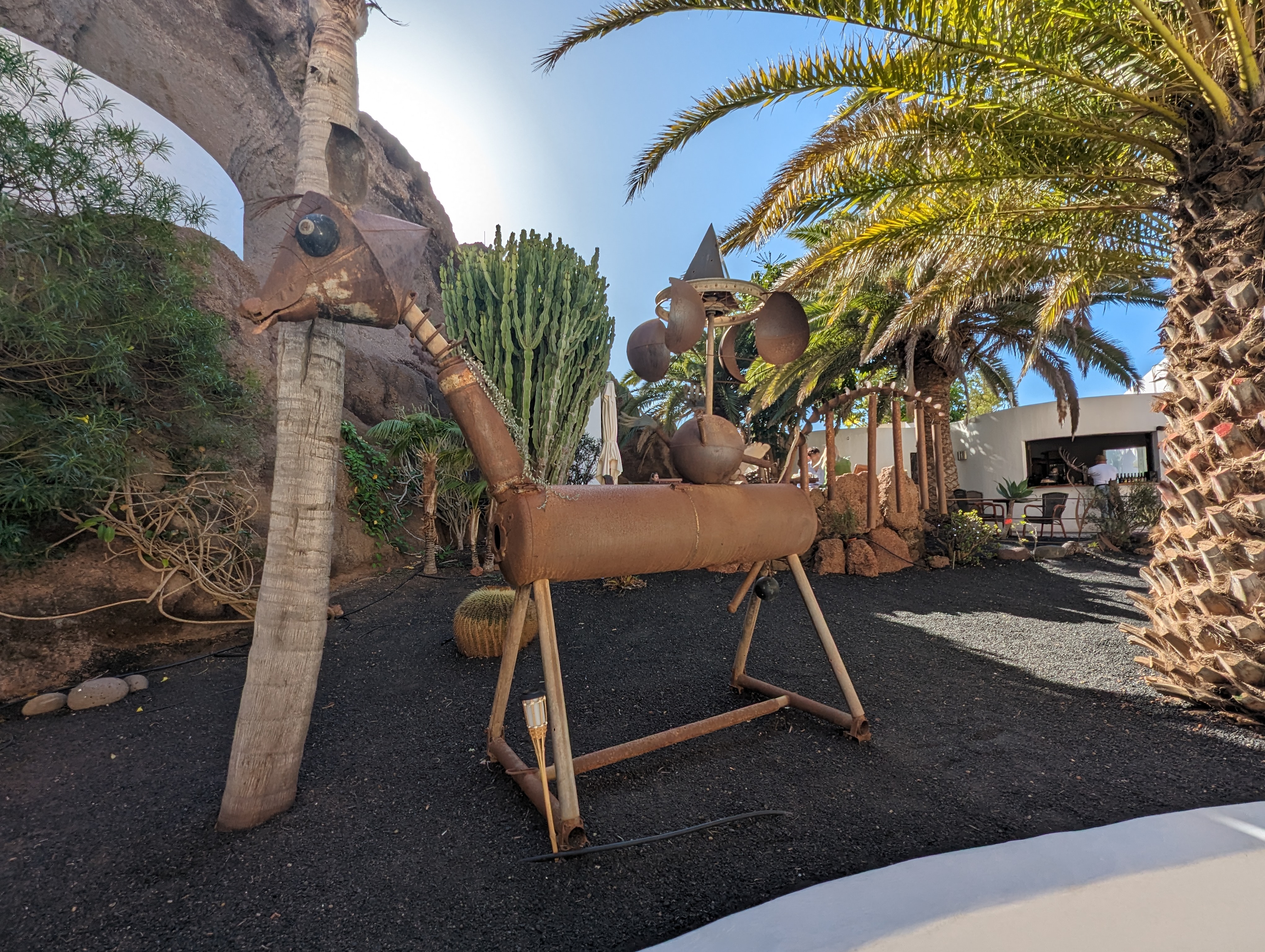
A good-humored spirit comes along for the ride with formal invention, enhanced by individual sculptures placed around the garden, with sculptural curves of the white building forms around and above the pool, and visible high on the cliffs... 
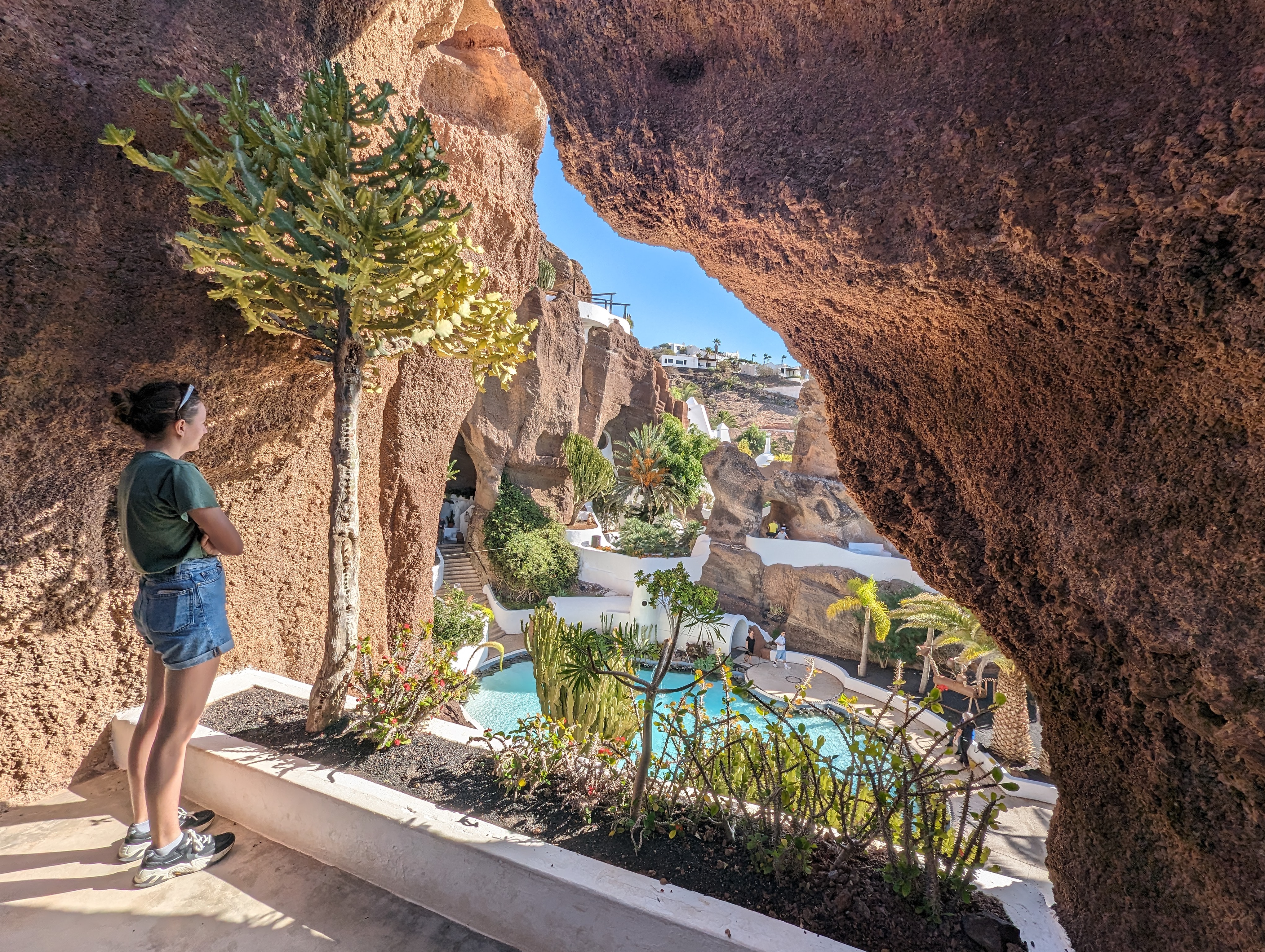
The approach to the cave house, which is arranged around a garden and swimming pool, follows Manrique's dictum of using the existing rock formations as a guide to creating a kind of organic architecture.  Man-made structures inserted into the cliffs are painted white, as are the exterior walls of the volcanic island's more traditional houses. These white walls are in keeping with Manrique's color guidelines, which also restricted paint colors for wood trim on windows and doorways all over Lanzarote to a palette of bright green taken from fishing boats, dark brown, and along the seaside, bright blue...
Above, a tunnel leads to an entry carved into the cliffside.  Soto designed interior spaces with the aim of transporting inhabitants to a world of dream or fantasy.  As with the work of Antonio Gaudi*, an aura of mystery pervades its many levels. Below, a water tunnel leads to a stairway...
...one of several carved into the rock.  Handmade light fixtures of metal and blown glass accentuate the shapes of openings and walls.
Just how many levels there are is not readily visible, as not all areas are open to the public. The house is just under 530 square meters in area (that's 5,700 square feet), so there's plenty to explore beyond those closed spaces.  The pool and water tunnel are at the ground level, and a bedroom and game room are one level up, and a narrower set of steps ascends to enter the caves.  According to photographer Veronika Sprinkel*, "Overall the place ebbs and flows with the shape of the cave, so in many cases the idea of one level is a little subjective."
Soto's design for the interior spaces follows dictum of letting the rock formations generate the architecture.  
Even the rooms that are mostly enclosed by rock walls and ceilings have openings to stunning outdoor views...
The house passed through the hands of a few different owners after a famous actor bought it and then lost it in a card game, until in 1989 a married couple, Dominik von Boettinger and Beatriz van Hoff, both architects, bought Lagomar with the idea of renovating and opening it to the public. They added a restaurant that serves as a space for art exhibits and cultural gatherings, and opened the renovated cave house to the public in 1997.
We've finally arrived at the game room, with a card table that serves as a reminder to tell that story about the actor who lost this house in a card game.  You were probably beginning to wonder if we were ever going to get around to it...
Sometime in 1972, a Spanish film crew arrived in Lanzarote to film "L'Isla Misteriosa y el Capitan Nemo" with actor Omar Sharif in the title role of the Jules Verne story.  The film was fairly faithful to the original story, and was released in March 1973. The story involves shipwrecked sailors sheltering in a cave, and encountering Captain Nemo, sheltering in a watery grotto along with the Nautilus. During the filming, Omar Sharif happened upon Benady's cave house, then still under construction.  Enchanted by the idea as well as by the living space (and maybe under the influence of that film script), he decided on the spot to buy the place.  A couple of days after Sharif moved in, Sam Benady (seated to the right of Sharif below) challenged him to a bridge game, with the house as the center of the bet.  Sharif lost at bridge, and the house passed back to Benady.  What the actor did not know at the time was that he had lost to someone who'd won the European bridge championship.  Still, despite his brief ownership, the house is known today as the Casa Omar Sharif, or Lagomar.

*Photo Credits:  
All photos were graciously provided by Veronika Sprinkel, a frequent commenter in early days of this blog.  

*Footnotes:  
Antonio Gaudi's Casa Mila was featured in our post from June 26, 2019, entitled "Roadside Attraction: Gaudi's Casa Mila".  The one exception to the Manrique-sponsored prohibition of tall buildings on Lanzarote was the construction in 1974 of the Arrecife Gran Hotel, a 15-story exercise in routine modernism.  It's not clear why an exemption from the rule was granted, but the hotel is the exception that proves the wisdom of the rule... 


Sunday, December 31, 2023

Roadside Attractions: Charles Sheeler's Cityscapes and Industrial Landscapes

"Church Street El", an oil on canvas from 1920, is an overhead view of Broadway and Wall Street, with the elevated train tracks and towering buildings dramatized by bright colors, sharply-defined shadows, and radically simplified shapes.  It's all about the dynamism of the Machine Age and seems to reflect a kind of optimism, though it was created by Charles Sheeler only two years after the most destructive war in history...
At first, you might think "City Interior", from 1935, is from a different artist.  Here, Sheeler depicts the deep space of the industrial heart of a city in careful detail, with machinery and ductwork casting heavy shadows that contrast with the bright wedge of sky above.  At first it could be mistaken for a photograph.  But Sheeler has used painterly skills to draw us into the train yard, emphasizing its size and power with the shadowed human figures receding into the distance...
Eight years before, an advertising firm had hired Charles Sheeler to photograph Ford's new River Rouge factories.  The integrated facility on 900 acres above the confluence of the River Rouge with the Detroit River had its own steel mill and electric power plant.  Featuring buildings designed by Albert Kahn, the Rouge complex was completed in 1928, the year after Sheeler photographed the criss-crossed conveyors above.  Few human figures appear in Sheeler's photos of River Rouge.  When they do, as in the photo of the giant stamping machine below, they seem overwhelmed by the vast scale and mass of the machines.
By the time Sheeler painted "American Landscape" in 1930, the 1929 Wall Street market crash was sending shock waves through the economy.  In "American Landscape", though, the composition seems serene and orderly, with only a tiny human figure running along the train tracks to remind us that people work here.  This approach is consistent with Sheeler's view that the giant industrial complexes were the Machine Age equivalent of cathedrals in the medieval era.
Sheeler painted "Classic Landscape", below, in 1931, as the Depression deepened and labor unrest spread among workers who still held jobs. The light-filled order of "Classic Landscape" shows us clearly organized geometry with no humans to create conflict.  The diagonal railroad tracks create movement, and underline a sense of power.  When Mexican artist Diego Rivera was commissioned by the Detroit Institute of Arts to paint 27 frescoes for its building the next year, he took quite another approach, with two murals showing workers at the River Rouge plant.
By the time Sheeler painted "Rolling Power" in 1939, strikes had exploded across the car industry, with walkouts and sitdown strikes affecting Ford, GM and Chrysler, and men from Ford's Service Dept. attacking labor organizers, including Walter Reuther, on a pedestrian overpass at River Rouge. Where Rivera's murals depicted the roots of human conflict in the era of mass production, Sheeler focused on the detached, impersonal mechanism of power itself.  Facing "Rolling Power", you realize it cannot be a photograph, because no functioning locomotive was ever this clean, and everything is in focus, even that puff of steam… Ford's River Rouge plant was the last major Detroit car maker to unionize, in 1941.
By the time Sheeler painted "Incantation" in 1946, critics had labeled his style Precisionism.  In this depiciton of an oil facility, the artist has distilled the forms and their shadows into a kind of essence, and the title seems to imply that these forms are, like cathedrals or pyramids, offered as some kind of tribute to a higher power.  And ominously, that they may have their own power, detached from, and beyond, the human realm.  These implications may resonate as we enter the era of artificial intelligence...
In the painting below from 1949, architectural forms and textures are superimposed and seen from several viewpoints, emphasizing how Sheeler used photography as a tool to advance his grasp of composition.
By "Continuity #2" in 1957, Sheeler was back on the industrial beat, assuming a low vantage point to depict the U.S. Steel blast furnaces in Pittsburgh, assembling the composition of light and shadow by reversing and superimposing photographic negatives to make studies before executing this version in tempera on board.  This painting dates from the era that steel and auto companies were at the pinnacle of industrial might in America.  As with our first example, "Church Street El", there's not a soul in sight.  There is an animating spirit here, but it's all in the geometry...

*Footnote:  For perspectives of  American landscapes and cityscapes by other artists, you may want to visit these posts on our site:

"Roadside Attraction:  John Register's Abandoned Diners and Sleepy Motels", Feb. 24, 2018.
"Roadside Attraction:  Night in the City by Wayne Jiang", Feb. 28, 2018.
"Roadside Attraction:  The American Gas Station as Visited by Hopper, Evans, Lange, Ruscha and Hitchcock", Nov. 9, 2019.


*Photo Credits:
Top:  De Young Museum website
2nd:  Worcester MA Art Museum
3rd:   Metropolitan Museum of Art
4th:   Boston Museum of Fine Art and Lane Collection
5th:   Museum of Modern Art, New York
6th:   The National Gallery, Washington DC 
7th:   The Philadelphia Museum of Art
8th:   The Brooklyn Museum
9th:   Artsy.net
10th:  Sotheby's 

Wednesday, December 27, 2023

Forgotten Classic Revival Follies Part 4: Willys Interlagos (Willys?) Reinvented, Sort of...

After a certain amount of rumor and anticipation about a project that was supposed to launch a revival of Italy's Carrozzeria Viotti just under a decade ago, the mystery was resolved when the wraps were taken off the car in a slickly-produced video, and at the Bologna Motor Show in 2014...
What appeared was a smoothly aerodynamic, mid-engined coupe dreamed up by Emanuele Bomboi, styling chief of the revived Viotti, and something called Fast Design.  A couple of engines were mooted by the makers, including a 3.8 liter twin-turbo flat six (apparently Porsche) and a Chevy LT-1 V8, but it's not clear if any cars beyond the prototype were built, and what powered them.  Despite the car's frontal similarity to the French Alpine A110 rally cars of the Sixties and Seventies, the name was a real surprise: Willys Interlagos AW380 Berlinetta...
"Tribute to a Legend", the video released by Viotti tells us.  This was likely confusing to a modern European audience, who may have never heard of a Willys Interlagos coupe, and may have lacked any recollection of the Willys* name at all, unlike an older generation who may have associated it with the Jeeps that helped win World War II.
But for some reason, the Viotti / Fast Design effort was named after a license-built version of the Alpine Renault A108, the model preceding the more famous A110 and offered from 1962-'66 by Willys in Brazil...
Like the Alpine A108, the Willys Interlagos, named after a race track, was a tidy little rear-engined coupe with Renault Dauphine-based drivetrain and fiberglass bodywork by Giovanni Michelotti.  Like the French A108, it was offered in coupe, convertible and 2+2 versions, though we've never seen examples of the 2+2.  
The steel backbone chassis was shared with the A108, along with double-wishbone front suspension, rack and pinion steering, and disc brakes front and rear.  The original engine offered was the 845cc Dauphine inline four making about 60 hp with Gordini aluminum head, sending power to swing-axle suspended rear wheels through a 4-speed transaxle.  Not the stuff of legends, perhaps, but a sweet little car... 
Sweet enough that Willys of Brazil sold 822 over a 4-year period. It never, however, established anything like the competition record of the more powerful French cousin that came after it, the Alpine Renault A110.  And it's unclear whether any specimens of the Willys Interlagos were sold in Europe during its production life.  So the decision by Viotti to hang the fate of their revival* project on a not-quite-classic car unfamiliar to Europeans seems an odd one.  
There may have been other problems with selecting that name.  Though Viotti had purchased the Willys "W" logo, Fiat Chrysler apparently had rights to the name, and felt confident enough that it reintroduced "Willys" in 2020 on special Jeep models. This practice continued after Stellantis took over in 2021.  And late in 2017, the Renault Group issued its long-rumored 21st century version of the legendary Alpine A110 that had won the French Rally Championship in 1968 and '69, the European Championship in '70, and the World Rally Championship in 1973.  The new mid-engined car is on the left below, with its over-achieving ancestor on the right.  The front-end styling of both cars is a clear sign that the Alpine A110 is really the "legend" that Viotti had in mind for their tribute all along.  They just didn't have rights to the Alpine name... 


*Footnote:  For a look at other Willys cars produced in Brazil, see "Willys Aero Saga: An Afterlife in Rio"  posted here on August 29, 2019.  A photo essay on the Alpine Renault A310 and its predecessor A110 appeared here on January 9, 2021, entitled "Forgotten Classic: Alpine Renault A310."  Before we knew this business of attempting to revive mostly (or completely) forgotten makes of car was going to be a trend, we posted an essay on the ATS revival.  Then it got to be a trend, and we did a numbered series.  Here are the makes, the titles and the dates:

ATS:  "Forgotten Classic Revival Show: ATS 2500 & 2500GTS", Nov. 11, 2018.
Connaught:   "Forgotten Classic Revival Follies Part 1: The Connaught", March 31, 2021.
Spyker:   "Forgotten Classic Revival Follies Part 2: The Spyker Saga", April 8, 2021.
Frazer Nash:  "Forgotten Classic Revival Follies Part 3:  Frazer Nash, the 3rd Time Around", 
April 30, 2021.

*Photo Credits:
Top thru 4th from top:  Carrozzeria Viotti official video
5th:  Wikimedia
6th: pinterest.com
7th & 8th:  bringatrailer.com
9th:  Renault Group

Thursday, November 30, 2023

Annals of Design: Why So Many SUVs & Pickups, and Why So Dumb-Looking?


Remember modern cars?  You know, in that brief period when everything was getting sleeker and closer to the road, when American manufacturers were finally abandoning pushrods for overhead cams, and live rear axles for independent suspension. A time when Ford outsold the competition from Japan, and all other cars too, with the Taurus. And those other cars were getting more aerodynamic and weight-conscious as well, reflecting a seemingly universal concern for fuel efficiency... 
  
In 1993, Ford celebrated its success with their 2nd generation Taurus.  Wonder what the top selling vehicle was that year?  It was Ford's F150 pickup.  The not-so-aero styling was a holdover from the 80s, but popularity of pickups was on the rise, spurred by the success of the compact Japanese imported pickups and also by advertising...
By 1997, when Ford went for the aero look for their new F Series, advertising of pickups and SUVs was in the midst of a boom. Car manufacturers claimed they were just giving customers what they wanted, but between 1990 and 2000, SUV advertising jumped ninefold.  When you spend 1.5 billion bucks telling people what they should want, it's not surprising that hordes of them decide they want that very thing...  
Pickups ads and commercials were mostly aimed at men, but SUV ads aimed appeals to women based on the faulty notion that bigger, heavier vehicles were Inevitably safer. In fact, because of their high center of gravity and slower transitional response, SUVs were involved in more single car accidents during this period than any other types of car. Those ads worked anyway; by 1999 about 40% of SUV sales were to women.  Recent data indicates that pedestrians experience more fatalities in accidents involving SUVs. Then there's the fact that SUVs average 20% higher fuel consumption than cars.  Early in the boom, Nissan advertised its SUVs with the tagline "You may run out of planet."  Well, yeah...
It all seemed to start with the move of urbanites to the suburbs, a trend that was evident when Chevrolet offered its first Carryall Suburban in 1934; the one below is a '37 all-steel model. You may also recall a Plymouth Suburban, a conventional wagon based on a car. The "Suburban" name was trademarked by U.S. Body & Forging of Indiana, a company that built wagon bodies for GM, Chrysler, Nash and Studebaker, all of whom used the name at one time or another.  After the end of World War 2, the steady flow of city dwellers to suburbia became a flood, and truck-based wagons began to sell to customers who didn't own farms, hotels or inns.  (By the way, that's what Chevy called a "diamond crown speedline grille" on that '37.  My dad had a '37 sedan for awhile.)
Well, late in 1962 the Kaiser Jeep people did something original; they combined a new body designed by Brooks Stevens with their new single overhead cam inline six and added four-wheel drive, with options like independent front suspension and even automatic transmission.  We didn't know it then, but we were looking at the first SUV, and by the late 70s this long-serving replacement for the humble Willys Jeep wagon was the car to have among country club types in Denver suburbs.  
Readers of a certain age may remember the comic exaggerations of 60s car ad illustrations, where Wide Track Pontiacs looked a whole lane wide, and front seats looked as wide and flat as Nebraska wheat fields.  Well, have you looked at a Suburban lately?  No wonder it needs a 42 gallon fuel tank and only gets 16 mpg.  Not all SUVs and pickups are huge, but in the first 4 months of 2022 they took almost 73% of the US car market.  Why are they so popular?  Well, the profit incentive behind those commercials is one answer.  According to Automotive News*,  SUVs and crossovers averaged around 50% higher in price than standard cars.  And owing to the way the fuel economy standards are written, vehicles classed as SUVs (including crossovers with unitized bodies like cars, rather than separate truck frames) also get a break on their mileage standards.  And the more SUVs a car maker sells, the lower the bar is for their corporate average mileage.    
The EV tax credits that are part of the Inflation Reduction act also favor SUVs.  If you buy an electric car, you're eligible for a tax credit on purchases up to $55,000. For SUVs, though, you can get a tax credit on vehicles costing up to $80,000.  And of course, a big electric SUV will be using around 20% more energy than an electric car, which may be of concern if that electricity is coming from a coal or gas-fired power plant.  And most big SUVs, like the gas-powered Yukon XL below, seem designed to flaunt the whole idea of consumption, with no recognition that every vehicle, no matter how it's powered, needs to slice through the air...
Stellantis now offers the bloated Jeep Grand Wagoneer L below as competition for the Suburban and Yukon XL. With a 6,700 lb. curb weight (50% more than the original) and on a 130" wheelbase (20" longer than the original), it probably wouldn't exist without those SUV-friendly fuel economy standards.  Fuel consumption is the same as the Suburban, here owing to the use of a 510 hp twin-turbo inline six.
Rivian, which began with an exclusive contract to make electric vans for Amazon, first offered the R1T 4-door electric pickup, and now offers the R1S SUV below in various configurations ranging in price from $78k to $90k.  Styling is not as adventurous as the all-electric premise, except for those cartoonish headlights.  Unlike driving a Grand Wagoneer though, you'll never need to stop at a gas station except to use the bathroom...
In 2015 Ford moved to bodying all its F150s in aluminum to save weight.  Starting in spring of 2022 they offered their all-electric Lightning pickup, and that has an aluminum chassis in addition to the alloy body panels.  Base price was about $23k less than the Rivian truck, and sales were good.  The concern for weight-saving didn't carry across to aerodynamics; the style is standard-issue truck, outlined with some zappy lighting.  Judged against other pickups, though, the Lightning looks like progress.


*Footnote:  
For facts and perspectives, we consulted David Goewey's 1999 article "Careful, You May Run Out of Planet", then "The Real Reason Americans Keep Buying SUVs", by Arian Horbovetz at Streetsblog USA (usa.streetsblog.org) from Nov. 15, 2022, and Elizabeth Kolbert's essay, "Why SUVs Are Still a Huge Environmental Problem", from the March 3, 2023 issue of the New Yorker.  Kolbert points out that France has introduced a purchase tax of ten Euros per kilogram for every vehicle over 4,000 pounds, and Washington, D.C. now has escalating purchase taxes for vehicles over 3,500 pounds.

Photo Credits:  
Top thru 3rd from top:  Ford Motor Company
4th & 5th:  Wikimedia
6th:  Kaiser Jeep Corporation
7th & 8th:  General Motors
9th:  Stellantis N.V.
11th:  Wikimedia
12th:  Ford Motor Company