Featured Post

Sunday, September 15, 2024

Monterey Car Week 2024: Historic Racers in the Paddock at Laguna Seca

Friday was our day for the vintage races at Laguna Seca, and the best way to see the cars up close was in the paddock.  There were so many historic cars we wondered about listing them in chronological order, then considered alphabetical order, and decided to start with this car because of the heroic story attached to it.  It's an Alfa Romeo 3000CM (3.5 liter DOHC inline six), one of 4 coupes and 2 spiders bodied by Carrozzeria Colli.  Juan Manuel Fangio took 2nd place in the 1953 Mille Miglia with it.  What's so special about 2nd place, you ask?  Well, take a close look at the photo below...
You'll notice that the front wheel on the passenger side doesn't seem to be following the driver's side front wheel on this RHD car. That's because the steering linkage on that side had broken, and Fangio had to complete most of the 2nd half of the contest with only one steerable front wheel. This, in a race with 577 entrants, a race run on public roads lined with spectators. That Fangio was able to finish at all is a testament to his skill, endurance, and maybe, just a bit of luck...
Another car Fangio made famous was under the shady canopy of the display-only selection of historic cars not racing at Laguna Seca. It's a 1956 Maserati 250F originally raced by Stirling Moss.  Fangio won his 4th consecutive World Championship in a 250F in 1957, the year that Maserati introduced a 2.5 liter 60-degree V12 to race alongside their DOHC, twin-plug inline six. Drivers liked the handling balance of the 250F with its 4 & 5 speed transaxles; mechanics might have preferred its straightforward design compared to the Mercedes W196 Fangio had piloted in '54 (splitting his drives with Team Maserati)  and '55, and the Lancia Ferrari D50 with which he'd taken the world title in '56.
Among the smaller cars being readied to race during Car Week was this Fiat Abarth 1000. This body design replaced the earlier, Zagato-designed and built (except for late versions by Corna) Record Monza body style in 1961. The new body design by Mario Colucci for Abarth featured headlights under rounded plastic covers and an oval opening for an optional auxiliary radiator. The 1000 engine was offered with twin-cam Abarth head and Weber carburetors, as well as a Monomille version, a play on words that signified the displacement as well as the single cam in block with pushrod valve operation.
This 1000 has the longer tail with upturned spoiler that first appeared in 1963.  Early bodies for the Monomille pushrod-engined cars and Bialbero versions were built by Beccaris, a small, specialist coachbuilder. So-called "long-nose" versions of the Monomille with exposed (and less aerodynamic) headlights were bodied by Sibona and Basano.  As with most Abarth models, production figures are sketchy, but these cars are rare today.
This Alfa Romeo Giulietta Sprint Zagato was designed by Ercole Spada and premiered at the Geneva Salon in March 1960.  With alloy body and plexiglas windows, the SZ was lighter and faster than the Bertone-bodied Sprint.  Over 200 were built...
...in a style called "round tail", after the Coda Tronca, Kamm-tailed version appeared in 1961 and continued into 1962, with disc brakes in front.
It was the Giulia TZ, though, that incorporated the most extensive engineering changes in the Zagato-bodied, series production Alfas. The "T" stood for tubolare, the tubular chassis that Alfa engineers adopted along with fully independent rear suspension, the first on an Alfa production car. Braking was by discs all around.  Under that forward-hinged hood and fender assembly, the 1.6 liter twin-cam engine was tilted an an angle. 112 were built between 1963 and '65, with another dozen of the lower, fiberglass-bodied TZ2 with twin-plug, dry-sump engines.
Below is one of 21 Lotus 17 models built to a design by Len Terry.  Brought on by the success of the Lola Mk. 1 (see below) against the Lotus 11, it was the first fiberglass-bodied road racer offered for sale by Lotus, and the last front-engined one. 
The Climax engine was offered in various sizes including the 1,098 cc FWA, 1,216 cc FWE, and 1,460 cc FWB.  The 17 was not successful when introduced, owing to early failures of the MacPherson strut front suspension, which was replaced by conventional wishbones on many cars.  By the time Colin Chapman's team had changed this detail, racing had moved on to mid-engined cars.  The new Lotus 18 was one of those...
And so was the Lotus 19 below.  Built from 1960-62, and designed to take Coventry Climax engines from 1.5 to 2.75 liters, it featured an improved version of the Lotus-designed 5-speed sequential lightweight transaxle that had caused trouble on the Lotus 15. Chapman nicknamed the car the Monte Carlo after the Lotus victory in the 1960 Monaco GP.  Cooper had similarly named their 2-seat road racer the Monaco after a Cooper won there in '58.
The Lotus 23 was the company's mid-engined offering to small-displacement club racers. Made in 1962 and '63, with Climax engines under 750 cc and Cosworth engines ranging from 1 liter to 1.6 liters, the Lotus 23 hit some kind of sweet spot.  Around 130 were built.  Owing to changes in racing rules, the 23 offered a regulation trunk space, windshield wipers, head and tail lights, and even a horn.  Bodywork was fiberglass over a space frame.
The 1958 Denzel 1300 below is a rarity, with Austria's Wolfgang Denzel building under 300 cars in a decade starting with the first prototype in 1948; production ended in 1959.  Like Porsche, Denzel modified VW engines and kept them at the rear, moving from steel bodies to aluminum in the mid-Fifties, with low weight being a priority for the weekend racers who bought these cars.  Only the roadster style was offered. 
My '58 Road & Track Test Annual featured a test of a WD 1300 roadster (there was also a 1500) and the alloy-bodied car was lighter (by over 500 lb. at 1,415) and quicker than the Porsche 1600 coupe tested the same year, with a 0-60 time of 13.7 seconds. It was more expensive too, at $4,695 compared to $3,790 for the Porsche.  Both synchromesh and non-synchro transaxles were offered; the test car had the "crash" box.  Gee, one wonders if this could be the same car that Road & Track tested...
The 1957 Maserati 200SI below is from the same era.  The "I" signifies compliance with International racing rules and means that it was one of the series built to comply with then-new FIA racing regulations requiring full weather protection, full-width windshields, and bigger doors. Early versions of the 200S featured 4 speed gearboxes, while later ones were offered with 5 speeds. 
Though Maserati production cars broke with the Italian tradition of not offering upper crust cars with left hand drive earlier than Lancia or Ferrari, their racers often came with RHD.  Bodywork on this car was by Fantuzzi.
Ferrari's 166 with Superleggera Touring Barchetta ("little boat") bodywork became famous when Luigi Chinetti, the eventual US East Coast Ferrari distributor, won the 1949 Le Mans 24 Hours in the 2 liter V12, beating a field of cars with larger engines.  It launched a long saga of racing success for the Colombo-designed, 60-degree, SOHC V12...
With maybe the most successful run belonging to the 3 liter version of the engine, including the 250GT short-wheelbase Pininfarina coupe below, its dry-sump engined Testa Rossa relatives, and of course the dry-sump, disc-braked 250GTO that Ferrari somehow got homologated as a version of their 250GT production car...
The bodywork on this 1956 Devin Special may look familiar if you have an Ermini in your garage. Its Oklahoma-born creator, Bill Devin, settled into the fertile LA hotrod scene after WW2, raced cars in the SCCA starting with a Crosley Hotshot, then worked up through various Ferraris, and actually invented belt-driven overhead cams but never took out a patent.  Devin couldn't patent the lovely bodywork mounted over Joe Huffaker's tubular chassis (one of 2) because molds for his fiberglass shells were taken directly from the Scaglietti body of an Ermini Type 357.  Even if you just count the roughly 30 complete Chevy-powered Devin SS cars the company sold in the late 50s, Devins in this style probably outnumber Erminis.
Frank Nichols' Elva cars (from "Elle va", French for "she goes") were first conceived as less expensive alternatives for club racers to compete with cars from Lotus and Cooper.  Elva originally based his cars on production components (Ford 10 engines, Triumph front suspensions like this Mark 1 from 1955) and saved money by early adoption of fiberglass bodies, but #814 here was originally equipped with a 1.5 liter Maserati four, and has an alloy body.  Mark 1 was the first Elva for sale to privateers, and the Mark 1B featured an Elva-designed front suspension.
By the time Keith Marsden designed the Mark 6 for Elva in 1961, the mid-engined revolution was in full swing, but it was his design for the Mark 7, aimed at the under 2 liter class for sports racers, that expanded Elva's success, especially with distributor Carl Haas in Chicago. Introduced in 1963, the car introduced disc brakes and 13" wheels, with adaptability for 1.6 liter Ford Cosworth twin-cam engines, the then-new BMW four, and even a 1.7 liter version of the 4-cam Porsche. Just under 6 dozen examples of the Mark 7 & 7S left Elva's shops between 1963 and '65. 
Lola's Mark 1, introduced by designer Eric Broadley in 1958 and powered by the familiar 1,100 cc Climax four, began to beat the aging Lotus 11 soon after it appeared.  The Lotus 7 next door is a reminder of how much progress British specialist car makers made in the late 50s.  Early Mark 1s had alloy bodywork over tubular space frames, but fiberglass  bodies appeared in 1960.
The Lola T 70 below followed the mid-engined Mk. 6 GT that, though only built in 3 examples, inspired Ford's GT40.  Introduced in 1965 and made in coupe versions for endurance racing as well as the open cars that competed in big-bore SCCA races and the Canadian American Series, the T70 was popular by racing car standards, with over 100 built before the last one left the Lola workshops in 1969.  Power units included reliable small-block Chevrolets and an unsuccessful Aston Martin V8 at '67 Le Mans.
The fetchingly graceful Chevron B16 below appeared the same year the Lola T70 ended production.  After the 1969 launch of the light, Formula 2 Ford Cosworth-powered Group 4 sports prototype racer, other engines like the Mazda rotary and BMW M-10 were tried by Chevron, which built just under two dozen of these cars.

Engineer John Tojeiro, who'd designed a prototype bought by AC Cars for their 4-wheel indy suspension Ace in the early Fifties, applied his talents to the 1,100 cc class of English club racers after that success.  The result was this lightweight, graceful, alloy-bodied Tojeiro Climax from 1957.  As it resembles the Mk. 2 version built in 4 examples in '58, and that body was designed by Maurice Gomm, we suspect this was too.  The chassis is a space frame type, and the engine leans to avoid a hood bulge.  Competitors "in period" included the Lola Mk. 1 and Elva Mk. III.
Briggs Cunningham's C-4R, powered by a Chrysler 331, was lighter than his previous efforts, and came closer to his goal of winning at Le Mans than any others.  They were handicapped by the lack of disc brakes, but still took 4th place there in 1952, and 3rd as well as 5th place in 1954.  A C-4R won the Sebring 12 Hours in 1953.  Two roadsters and one Kamm-tailed coupe, the C-4RK, were built.
The first version of Malcom Sayers' immortal D-Type Jaguar saw competition in 1954, with what was later called the short-nose body configuration, but only after the factory tried the longer snout.  With 4-wheel disc brakes and that signature stabilizing fin, D-Types won the Le Mans 24 Hours three times in a row, 1955 through '57. 
Aston Martin's DP215 endurance racing prototype was designed around the 4 liter DB5 engine in 1963, but also allowed enough space for the V8 that would finally make its debut at Le Mans mid-mounted in a Lola T70.  As with the V8 project, Aston Martin's racing prototypes were the victims of limited budgets; despite this, DP215 qualified 4th at Le Mans.  It was the last front-engined Aston Martin road racer.
Over at GM that same year, Chevy's Corvette guru Zora Arkus Duntov briefly persuaded management to support development of the lightweight Grand Sport to counter Carroll Shelby's SCCA success with his Ford-powered AC Cobras.  The original plan was to build over a hundred cars, but only 5 escaped the factory before GM's racing ban shut down the program.  
Alfa Romeo's Type 33 mid-engined road racers first raced in 1967, powered by 2-liter, 4-cam V8s designed by engineer Carlo Chiti, who had designed the V8s in the short-lived 2.5 liter ATS GT and 1.5 liter GP cars. 5 open Type 33 spiders were built with this periscope-style air intake. Autodelta developed the T33/2 version for 1968, and one of these took won the 2-liter class at the 24 Hours of Daytona that year.
The Chaparral 2 was the first car designed by the Texas team of Jim Hall and Hap Sharp, and used an aluminum version of the small-block Chevy engine.  The design may have adapted its pointy snout and headlight placement from Larry Shinoda's similarly mid-engined Corvair Monza GT show car, but the lift-reducing air dams were all Chaparral's.  From 1963 through 1965 seasons, the Chaparrals won well over half their races against international competition, and introduced an automatic transmission midway in '64.  As with that aluminum engine block, this may have involved some help from GM.
Dan Gurney's Eagle Indy cars, like the one below, appeared with his Formula 1 cars in 1966 as designed by Len Terry, who followed the basic layout of his design for the Lotus 38.  Some collectors, and a more than a few designers, think these Eagles are the best-looking open-wheel race cars ever built. They remind one of Gurney's famous question: "If you have a chance to make something beautiful and you don't, what does that say about you?"  A feast for the eyes, and a fitting place to end our tour of the paddock...


*Footnote:  Stories on the following cars have appeared before in this blog.  Titles and dates are in parentheses.

Alfa Romeo 3000CM Superflow ("After the Flying Saucers", Aug. 5, 2018)
Abarth ("The Etceterini Files Part 13", Jan. 15, 2018)
Lola ("1st. Impressions of the Monterey Historics: Whatever Lola Wants", Aug. 28, 2018)
Elva ("Forgotten Classic: Elva GT 160---She Goes with BMW Power", Nov. 7, 2020)
Tojeiro ("Forgotten Classics: Designed by John Tojeiro, Aug. 13, 2021)

Photo Credits:
All photos are by the author, except for the monochrome of Fangio's Alfa 3000CM at the Mille Miglia, which came from museofangio.com.



Saturday, August 31, 2024

Monterey Car Week 2024: Autobahn Oldies and Missing Legends

Thursday afternoon, after checking out the Mecum auction offerings, we wandered over to Legends of the Autobahn in Seaside.  I was looking for my old BMW 3.0 CS, which has been restored by its new owner, who has exhibited cars at the Legends event before.  Though there were all kinds of modern Audi, BMW and Mercedes products on show, it was so easy to drift down memory lane that this writer never quite made it to the newer cars.  First stop was this 1980 BMW M1, a mid-engined, transverse inline six-powered GT developed for Group 5 racing and made in 453 examples from 1978-'81.  Body design was by Giorgetto Giugiaro at Ital Design.
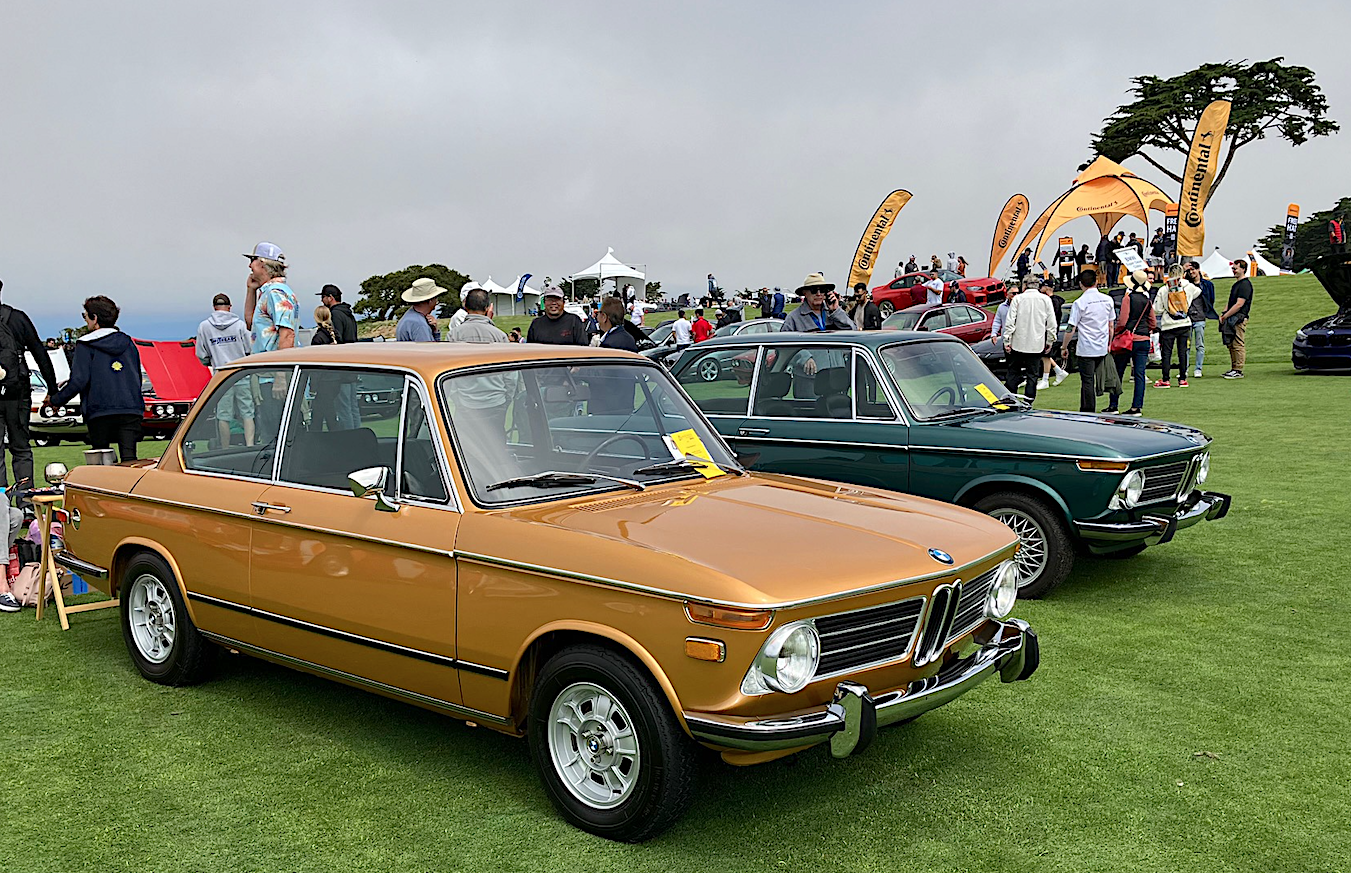
There were so many 60s and 70s BMWs on display that it was a bit like a class in post-midcentury Bimmer history, especially considering the BMW 600s and 700s we'd seen at the Little Car Show in Pacific Grove on Wednesday.   It's easy to forget that BMW was not always a luxury lifestyle accessory in the USA, and that it was really the 2002, as sort of 2-liter factory hot rod version of the trim, light and compact 1600 sedan, that put the make on the map in America, especially after a positive 1968 review in Car & Driver.  There was a definite Corvair influence in the car's lines, but it was shorter, lighter, and in tii form as shown here, more entertaining than the Neue Klasse 4-door sedans that had launched the new SOHC inline four cylinder BMWs in 1962.
The 3-door hatchback Touring body style shown below was added to the line in 1971, but never imported into the United States.  Though it was part of the 2002 line, it was called 2000 Touring because, one guesses, it had more than 2 doors...
Before the 1600 two-door sedans appeared in 1966, BMW contracted with Karmann to build the bodies for a 4-passenger GT coupe powered by a 2 liter version of their SOHC four.  Called the 2000CS, the glassy pillarless coupe found more customers in Europe than the US, where its covered headlight detail was changed to meet regulations, and where it was priced close to Jaguar's E-Type.
The popularity of the CS went up, along with its price, in 1968 when BMW introduced the 2800 CS with inline 2.8 liter six. It used the 4-wheel independent suspension of the other Neue Klasse cars, and the SOHC configuration with an aluminum head on cast iron block.  Braking was by front discs and rear drums. The revised body style by Wilhelm Hofmeister was designated E9 by BMW. Visually, the main improvement came from the 3" increase in wheelbase to fit the new engine, giving more graceful proportions, and the sharper, lower nose design with smaller kidney grille framed by oblong grilles containing the headlights. The E9 was actually a bit lighter than the preceding 2000CS, and more aerodynamic.
Bodies for the revised CS were still made by Karmann...
The 2800CS was replaced by the 3.0CS and fuel-injected CSi during 1971.  In addition to the increase in displacement to 3 liters, rear disc brakes joined the ones at the front.  The car remained in production through 1975.
We were hoping that BMW USA would bring a specimen of their new Vision Neue Klasse as videos of the car are now on their website.  For people who miss the glassy lightness and visual simplicity of classic BMWs, who may not need a truck-like SUV, and who are befuddled by new BMWs with their huge Bucky Beaver grilles (even on electric models, where they admit no air) the spare, simple lines of the new car (shown below) seem to begin a new chapter.  We especially like the trim line crossing the side windows and connecting the hood shut line to the revived Hoffmeister Kink. Too bad BMW wasn't moved to bring one of these new cars to the Legends show...
The car below is a reminder that the BMW design group called BMW Technik took a similar bold leap in the late Eighties. It's a BMW Z1*, and the reason you may not have seen one was that it was never imported Stateside.  The first in the Z-series of two-seaters, it was one of the first BMWs featuring multi-link rear suspension, and was powered by an SOHC inline six of 2.5 liters sending 168 hp to the rear wheels through a Getrag 5-speed gearbox.  8,000 examples were built from March 1989 to June 1991.  There were 66 Alpina RLE* versions with a 2.7 liter, 200 hp six.  Though the car is a bit shorter than the 1st Series Mazda Miata, the wheelbase is longer at 96.3 inches.  Weight is 2,760 lb.  
The body, designed by Harm Lagaay in 1986, is composed of plastic panels over a steel chassis, and the high, reinforced structural sills gave rise to the car's most intriguing detail: doors that retract into those sills after the windows retract into the doors. The car can be driven with the doors open...
...and looks like this with the doors closed.  The Z1 is slowly being discovered by collectors and design fans.
The Mercedes-Benz 300SL was discovered by collectors long ago, and there seemed to be a fleet of concours-condition SL Gullwings and Roadsters everywhere you looked during Car Week.  Vickie Gilmour's '57 example should win an award for a car that actually gets driven frequently.  She's had the car for fifty years, and still enjoys driving it whenever weather and traffic conditions permit.  If there had been a prize for Almost Daily Driver, this SL would've deserved it.  


Another car that would have delighted the Legends audience, as it is a real legend of Formula 1 and racing technology, didn't show up at this free event because it was sitting in a hotel lobby in downtown Monterey.  This Mercedes-Benz W196 Streamliner from 1954 was raced by Juan Manuel Fangio, and along with its open-wheel sister cars helped Fangio win the World Championships in 1954 and 1955.  Design is credited to Alfred Neubauer and Fritz Nallinger.  Features included magnesium alloy bodywork as well as an inline eight cylinder engine of 2.5 liters making 257 hp and featuring desmodromic valves.  Unlike the 3.0 liter sports racing version with block made of exotic light alloy, the experimental M196 engine featured steel cylinder liners welded to steel heads, and sheet steel water jackets welded in place.  This car ran like a legend, still looks like one, and was brought to Car Week as a preview to its offering at auction in October...

*Footnote:   More details on the Z1 and Alpina RLE can be found in "Forgotten Classics: BMW Z1 and Alpina RLE", posted here on Nov. 24, 2018.

Photo Credits:
BMW Vision Neue Klasse:  BMW USA.
Mercedes-Benz W196 Streamliner:  RM Sotheby's Auctions. 
The remainder of the photos are by the author.

Thursday, August 29, 2024

Monterey Car Week 2024: Auction Observations


During Car Week in Monterey, the exuberance of the auctioneers' performances nearly matches the bark fests by the California sea lions out at Fisherman's Wharf.  It's one way you can reflect on your location in space and time, whether you're the kind of person who can get excited about an elegant '31 Chrysler Imperial CG roadster (above) or a first-year Maserati Ghibli (below). We checked out the offerings at Mecum early on Thursday, as bidding was in process, and later at RM Sotheby's on Friday night, and mostly have comments on value (engineering, esthetic, historic) as it's easy to get distracted by the auction focus on price alone.
Maserati's Ghibli was designed by Giorgetto Giugiaro for Ghia in 1966, a productive year which also saw his groundbreaking design for the De Tomaso Mangusta.  Both cars went into production in '67, and were harbingers of the trend toward wedge profiles and creased flanks.  The engineering was fairly conservative, compared to supercar competitors like Lamborghini's transverse mid-engined V12 Miura and Ferrari's transaxle 275 GTB4.  By contrast, the Ghibli offered a 4.7 liter, 4-cam V8 and a live rear axle.  This early production car has a trunk lid that opens just above the bumper, giving a false impression of a low load height, but the actual opening ends at the trailing edge of the deck, as with later cars with simple flat lids. This car was fitted with a 4.9 liter engine during restoration; these became a factory option in 1970.
This 1936 Packard 120 Convertible Sedan is unusual not only for its condition, but because de luxe body styles like the convertible sedan were more common on the bigger 160 and 180 series.  The 120 was the entry-level eight-cylinder Packard; we mention the $50,000 sale price to highlight the fact that bargains often show up at Mecum.
When Albrecht von Goertz designed the 507* for BMW in the mid-Fifties, it was the result of Max Hoffman, their New York distributor, lobbying the company for a stylish roadster he could use to generate showroom traffic. This had worked when he had lobbied Porsche for the Speedster.
The sleek, 3.2 liter V8 powered roadster stunned show crowds when it appeared in 1956, but production complexity and costs limited Series 1 production to 34 units in that year and in early '57. The Series II was designed with detail changes including a relocated fuel tank, and production continued through 1959.  Only 252 examples were built, and BMW lost money on each car.  This '59 Series II was number 242, and negotiations are still going on at this writing, against a background of a $1,500,000 reserve. 
This car pointed out that stories of failure (like BMW's 507) are often as intriguing to historians (and apparently, buyers) as stories of success (like Ford's GT40).  It's one of three Scarab* Formula1 cars built by Lance Reventlow's LA outfit after his success with three Chevrolet-powered Scarabs in SCCA road racing.  For their 1960 design, the Scarab team stayed with the front-engined Indy roadster format, with DOHC engine design by Leo Goossen, who had designed similar inline fours for Offenhauser and Meyer-Drake.  Unlike on those engines, and under the influence of the '54 Mercedes W196, Goossen added desmodromic valves, mechanically opened and closed.  The car was ready for the last year of the 2.5 liter Formula, after Jack Brabham had won the F1 Championship convincingly in '59 with a mid-engined Cooper...
Those engines were the weak point of the Scarab F1 effort, as the team faced trouble including fuel as well as oil starvation, bearing failure, and valve failure.  It is thus amazing that this car has an intact desmodromic-valve Scarab engine.  Despite the cautionary tale of Scarab's Formula 1 woes, the car sold without difficulty.  One wonders if the new owner plans to race it in vintage events... 
This '51 Ferrari 212 Inter was one of four 4-passenger coupes built with alloy coachwork by Ghia. Unlike with their bodies for the 2-seat coupes raced by Ernie McAfee in the Carrera Panamericana, Ghia seemed to have trouble with the proportions of the 4-seat format, though the car is cleanly detailed...
The body's bulk seems to overwhelm the Inter chassis, with the wheels far inset from its flanks.  With a $400,000 offer, the car remains unsold against a stated $525,000 reserve and $600k to $800k estimate. Wait a minute, you might ask, doesn't revealing a reserve undermine its function as a reserve?  A good question, in the view of this writer, who has only sold one car in an online auction, and is thus not an expert on auction procedures.
Amazingly, this 1969 Lamborghini Miura S has appeared on this blog on three previous occasions, and we encountered it at the Concorso Italiano in 2018.  It's kind of noticeable in that color scheme, which is a thumb in the eye of the current vogue for military gray sports cars, often in matte finish, which makes them look like full-scale plastic replicas of themselves... 

Not the case here. The effect of lime yellow (someone called it green) over blue is like something straight out of Josef Albers' Interaction of Color.  The rest of it is "standard" Miura S, with transverse 3.9 liter 4-cam V12, with the engine sharing oil with the 5-speed transaxle because engineer Dallara's project was inspired by the BMC Mini (a story* told elsewhere in this blog). The last 98 SV versions got rid of the troublesome shared oil feature, and many Miuras have this "baffle" mod.  No mention of it in the Mecum summary, though, and negotiations are still going on regarding sale... 
Porsches outnumber pickups and Toyotas at so many Car Week venues that one experienced auction visitor commented gleefully on this Just Another Porsche syndrome. This car, however, is anything but just another Porsche.  It's a Type 718, or RSK, which first appeared in mid-1957 as a replacement for the 550A/1500RS, using the same tubular chassis design with a more aerodynamic, lower profile body. The flat four engine was the same 4-cam design with roller-bearing crankshaft, mid-mounted as on the 550 and sending power to the rear wheels through a 5-speed transaxle.
This '59 example, though, is one of a half dozen central (single) seat RSKs built (our of a total of 34 cars); the central seat series began with a car built for driver Jean Behra to compete in Formula 2.  Porsche fans may be reminded by this Formula 2 special of Porsche's only Formula 1 victory.  That was scored in 1962 with a 1.5 liter car, but Dan Gurney's French GP ride was powered by a 1.5 liter flat eight.  Someone was impressed with the historicity of this car, but not enough to fork over $3 million, so discussions are ongoing...
There were Cobras aplenty; here a 427 and a 289 once owned by actor Steve McQueen flank a rare, lightweight Ford GT40...  
Part of what one observer noted as a numbing surplus of Mercedes 300SLs heads a lineup of Detroit iron, or fiberglass, in the case of the '63 Stingray coupe. 
Only 99 copies of Ferrari's 330GTS were built from 1966-'68, compared with nearly 600 of the GTC coupe version; both cars featured 5-speed transaxles like the red 275 GTB4 adjacent.  If the latter car has the SOHC V12 engine claimed in the catalog, it's somehow gotten the wrong power plant, maybe during restoration.  The "4" in GTB4 refers to the 3.3 liter, 4-cam engine that replaced the SOHC V12 in the first 275GTB; that '67 date is a clue, as GTB4 production started in 1966.
This Ford GT40 lightweight from 1969 is a machine that you're even less likely to encounter at your local cars & coffee.  One of 10 lightweights, if you don't count one or two GT40 roadsters built with an aluminum honeycomb chassis (most GT40s had steel honeycombs), this one features lighter aluminum in the roof section, and still has its original engine and chassis.  Unlike the later Mk. IV, which was an all-American effort, chassis and bodies for the GT40 Marks I through III were built at Ford Advanced Vehicles in Slough, England.
The GT40 story highlights different views of efficiency that prevailed at Ford and Porsche.  In 1969, the model year of this car, Ford won the Le Mans 24 hours with the exact same car that they'd used in 1968.  Ford was second to Porsche in the FIA International Championship for Makes in 1969, when Porsche used over 4 dozen cars (selling most off after rebuilding) to secure the title.  The previous year, Ford had won the FIA Championship using only 4 cars.  While it's true that Porsche amortized some of its high racing costs by selling off rebuilt cars, it seems that team manager John Wyer ran a tighter ship at Ford.  Today, however, someone at Ford may be regretting the decision not to hold on to this historic car.  It sold at auction for $7,865,000.
This 1936 Delahaye* Type 135 Competition Court (for short chassis) was, like the GT40, a sort of homologation special, based on the firm's 3.5 liter OHV inline six.  The short chassis was never listed in Delahaye's factory literature (mais non; she was encore plus confidentielle), but just over 2 dozen were built to qualify for road races that included Le Mans, where Delahaye won in 1938, with two other Delahayes coming in 2nd and 4th. Six of the short-chassis cars were bodied in this teardrop style by Figoni* and Falaschi in 1936; eleven torpedo roadsters were also built to Joseph Figoni's design.
All Figoni's designs included teardrop fenders with skirted rear wheels (and front wheels as well on the torpedo roadsters), while the coupe's graceful fastback with central fin underlined the streamlined theme and distracted from the somewhat stubby proportions.  Right hand drive was common on upper crust French cars into the Fifties; the lever left of the wheel is the control offering 4 speeds for the Cotal electromagnetic preselector shift.  A floor-mounted lever allows selection of forward, neutral and reverse. The Type 135 thus has 4 speeds forward, and 4 in reverse...
We could go on about the importance of Figoni's teardrop designs in the genesis of Jaguar's XK120 coupe (and have, in other posts), especially the sleeker Talbot-Lagos with their concealed headlights and oval side windows, but thought this car was pretty convincing as an artifact of a lost era.  With rarity and Delahaye's racing history behind it, this Figoni teardrop looked like a safe bet to attract interest, and it did.  Negotiations are still going on regarding the price, though.


I decided to leave the mobile phone at the hotel when wandering off to RM Sotheby's auction on Friday night with a car enthusiast friend, so I could be unencumbered doing something people once called "having an experience". Thus I missed taking shots of the 1940 Packard Custom Super Eight 180 Darrin above, one of 9 survivors Sotheby's claims of eleven built.  This bracingly clean Darrin* design (low-slung for 1940, no trace of running boards) was, considering its rarity, as much of deal as the $50k 120 4-door convertible at Mecum.  The car sold for $240,800 while we watched, a pile of money, but less than the $275k-$325k auction house guesstimate. The spectacular Ghia-bodied Fiat 8V Supersonic below from 1953, however, didn't sell, despite a similar car selling last year at RM for a sum that would buy all 9 surviving Packard 180 Darrin Convertible Sedans.  So the present owner gets to spend some more time with this Fifties Futurist creation, one of 14 Fiats with this body style, which Ghia also applied to an Aston Martin, a Jaguar, and a Conrero Alfa.  The 2 liter 70-degree Fiat V8 (Fiat called it 8V because they thought Ford owned rights to "V8") is known as an engine with design flaws leading to fragility, but the Supersonic is a work of art. A 25% decline of what the Wall Street Journal considers top-shelf classics is only seen by some as a crisis in an increasingly financialized economy, where private equity firms buy up troves of housing units, and we see investment funds devoted solely to the cars WSJ might recommend. Our post-auction walk to the Sandbar & Grill, at Municipal Wharf 2, was interrupted by a delightful interlude watching a colony of sea lions bark at each other, and maybe at us. What, I wondered, would these wild creatures tell us about their world, if they could? After 3 days of almost nothing but cars, it seemed like something worth considering...

*Footnote
The following posts contain more material on some of the cars featured at these auctions; titles and dates are in parentheses:
BMW 507 ("That Other Five Series", Oct. 20, 2019)
Scarab ("Timing is Everything", June 2, 2017)
Lamborghini Miura ("Mini Cooper's 2nd Cousin, Twice Removed", July 11, 2017)
Delahaye ("Golden Days of Delahayes", June 30, 2018)
Figoni & Falaschi ("The French Line Part 5", June 7, 2020)
Darrin's Packard Designs ("Hollywood Stars", Aug. 4, 2020)

Photo Credits:
All photos of the Mecum offerings, including the bad shots, are by the author.  The RM Sotheby's car photos (Packard 180 Darrin Convertible Sedan & Fiat 8V Supersonic) are from RM Sotheby's.