Featured Post

Saturday, June 18, 2016

Forgotten Classic: Salmson 2300s

In the 1950s, the French specialist car makers hit a wall.  High taxes on luxury vehicles slowed sales to a trickle.  Delahaye and Delage merged with Hotchkiss, and then discontinued production of all but trucks and jeep-style military vehicles after 1954.  Bugatti built fewer than a dozen Type 101s before giving up on passenger cars, and the mid-engined (but unwieldy) Type 251 GP car from 1955 was the last high-profile effort from the Bugatti family.  Gordini was bought by Renault in 1957, the same year Talbot-Lago gave up on making its own engines and adopted the BMW V8 to use up about a dozen chassis, and also the same year that Salmson discontinued car manufacture, which by then was concentrated on the four cylinder 2300s.  While Salmson was largely unknown outside France, their modern twin overhead cam engine, under the tax threshold at 2.3 liters, would have seemed to offer a decent chance for popularity, at least inside France. This somewhat Alfa-like engine had some performance potential, featuring an aluminum head with hemispherical combustion chambers.  But the company was slow to adapt to changing tastes; they stayed with right-hand drive, for example, like some other upper-crust makes, and continued offering the heavy Cotal electromagnetic preselector transmission even though it wasn't well-suited to smaller and lighter postwar cars.  In the postwar era, they managed to produce around 230 of the 2300s model (1953-57) and a couple thousand of the more sedate S4 which preceded it.  Of the sportier 2300s, there are a few with special bodywork, like Henri Chapron's cabriolets based on his "standard" 4-passenger coupe…


...and some rally cars and club racers with bodywork reflecting Italian influence.  These included a Talbot-like, supercharged one-off by Pichon & Parat, which ran in the Monte Carlo Rally…


Few were ever exported; even the spider and coupe bodied by Motto in Italy went home to France, where they raced at Le Mans. 


Salmson offered the competition-focused Grand Sport on a shorter wheelbase, but sales of these stayed in the single digits because of the high price, which would have bought a Jaguar XK120 in Paris.  GS bodywork included a glassy bubble top with a low belt line and a more Farina-inspired fastback, both by Pichon & Parat


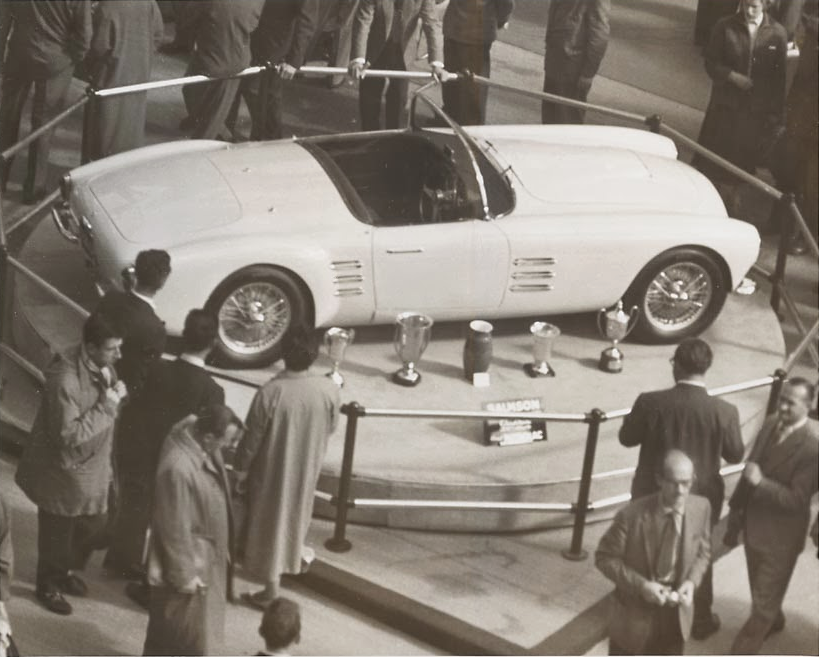
In 1955, Phillipe Charbonneaux styled a fiberglass-bodied barquette for the Paris dealership.  It remained a one-off like the Motto Le Mans spider, but has survived along with that car…

These cars were rendered extinct by mass-produced performance machinery, first from Jaguar and then Alfa-Romeo.  Today, however, they might seem a bargain compared with the last Delahayes and Talbots from the same era.  Just finding one of the Salmson Grand Sports or the long-lost supercharged coupe would be a reward for any car detective…


Footnote:  Historian Fabien Sabates gives a total production figure of 234 units for the 2300s.  Of this total, 217 were the 4-passenger coupe first bodied by Esclasson and then in larger numbers by Chapron.  The remaining 17 cars include 5 Chapron cabriolets, 3 Motto-bodied cars, and the rally cars and Grand Sports bodied by Pichon & Parat.


Photo Credits from top:
1954-57 Chapron Cabriolet:  Henri Chapron, reprinted in patrimoineautomobile.com 
2nd & 3rd:  1955 supercharged coupe for RenĂ© Cotton, from Amicale-Salmson.org
Red 1955 Motto Le Mans spider:  Amicale-Salmson.org
5th & 6th:  Motto Le Mans spider in road trim, from liberallifestyles.com
7th:  Motto Le Mans coupe, from www.les24heures.fr
8th (on left):  Grand Sport bubble top, from rarefrenchsportscars.files.wordpress.com
9th (on right):  GS fastback, from blogdoctissimo.com
10th: GS fastback:  Pichon et Parat, from coachbuild.com forum
Bottom:  2300s Barquette Nadaud, from largus.fr


Monday, June 13, 2016

The Jetsons at Home in Boulder, Colorado (Part One)

Possibly the first national media attention ever to land on Boulder, home of the University of Colorado and also of aging hippies increasingly outnumbered by tech zillionaires, happened because TV directors picked a Queen Anne house on Pine street as the televised home of Mork and Mindy in 1978.  But Robin Williams' Mork character, a space alien from the planet Ork, might have felt more at home in one of the futuristic concrete shells designed by local modernist Charles Haertling beginning in the 1950s. Haertling (1928-84) is often described in terms of philosophical parallels to Frank Lloyd Wright and Bruce Goff.  But before the decade of the 60s was over, he had developed a distinctive visual language of his  own.  A few Haertlng-designed houses, like the Menkick house (1970) on Boulder's western edge, reflect the horizontality and rectilinear massing of some of Wright's Usonian houses.  The crisply defined spaces and forms of the house are clustered around a huge rock outcropping which was left intact by the surrounding construction. The '59 Plymouth Suburban pictured would have fit nicely at the height of Haertling's career, but it actually lives at the Menkick house now.  


Other Haertling works, like the Brenton House from 1969, take a more uninhibitedly futurist approach to the idea of organic architecture, so that the result recalls science fiction of the era.  In a way, the Brenton house anticipated one work of science fiction, as it was featured four years after its completion in Woody Allen's Sleeper ...

To the best of my knowledge, all the Haertling-designed houses in Boulder are occupied, and are not normally open for tours.  But local historians sometimes organize tours of Midcentury Modern homes in town, and there's always the hope that one of these will be featured.


Photo credits:  the author

Roadside Attraction: Car Arch in Palo Alto, CA

You're wandering along a downtown Palo Alto street when you notice something odd about the two-story arched entry to a brick, Post Modernish law office headquarters.  The decorations on the arch are not carved stone faces, or animal or plant motifs...they're cars.  A kind of history of the automobile, in fact, told with castings of different models.  You identify a Chevy Impala from 1990 or so, a Ford Taurus, an early 80s Pontiac GP, a '73 Buick Century, a '59 Chevy, and on up to the top of the arch, where 1930s streamliners with helmeted fenders give way to stately creations from the Roaring Twenties and thence to horseless carriages.  Each series of 3 cars is separated from the series above it by sculptured tires (a deft touch) and these get narrower and rounder (reflecting a reverse march of technology) the higher (and thus earlier) your eyes travel along the sides.  Just above the base on each side there's a Car of the Future, and below each one, the sculptor has crafted a quizzical egg, which implies some unanticipated idea technology may hatch for us.  As the date on this piece is 1990, perhaps Emeryville artist Scott Donahue hadn't expected the autonomous, driverless cars now being incubated in the nearby labs of Google and Tesla.

The Car Arch is located at 390 Lytton Street in Palo Alto, CA. 

Photo credits:  the author


Monday, June 6, 2016

Pininfarina Abarth Scorpione 2000: It Looked Like Rocket Science

Giorgetto Giugiaro of Ital Design* was the original proponent, and widely considered a master, of the wedge form for cars.  His Maserati Boomerang from the early 70s (featured in our 9-7-15 essay "One of One: A Brief History of Unique Cars") was a pure expression of the tapered, unified form the French call "monospace."  But one of the most persuasive uses of the wedge theme appeared in 1969 from the older and usually more conservative design house of Pininfarina.  This was the Abarth 2000 Scorpione show car.
Unlike the Boomerang, or Marcello Gandini's Alfa Romeo Carabo for Bertone, the PF Scorpione was not a monospace or a single sculptural form.  Instead, the separate forms of the front fenders, glass canopy roof, and the louvered rear engine hood were integrated into a unified composition with a wedge profile.  At the front, the sharp slope of the fenders matches that of the hood, which is edged with a band of retractable rectangular lighting units.  The windshield slope matches that of the hood, but a subtle break is introduced into this plane for the big single wiper, and this scooped-out surface continues around the rear of the front fenders to form a wide ledge at the window sill. Just aft of the cabin, the leading edge of the engine hood projects beyond the sides of the inward-sloping glass canopy in a master stroke of visual form serving mechanical function: in this case, engine air intakes.  That engine is articulated as a distinct element, as is the Abarth free-flow exhaust system.  The latter item provided good publicity for Abarth's high-volume accessory business, with the added benefit of making the Scorpione look like some kind of rocket car...
Pininfarina built only one Abarth Scorpione, and it was based on Abarth's 2000 SE sports racer. And though mid-engined race cars had taken over the tracks by 1969 (the year this car appeared), and mid-engined show cars were a popular draw at auto shows, the Scorpione mounts its engine at the rear, in the traditional (for Abarth) position. This makes it more visible as a design element. The upward-pivoting entry canopy recalls jet fighter practice (as well as a couple of earlier show cars; see "Getting Over the Corvair: Part 2" from 3-18-16). While the lift-up canopy design was no more practical here than it was on the Corvair Testudo or Monza GT, it did reinforce the Space Age visual theme that runs through all the other details: rocket science for the road.

*Footnote:  Giugiaro had earlier laid the foundations for the wedge movement while at Ghia.
And Filippo Sapino, who designed this car for Pininfarina, also spent some creative time at Ghia.

Photo credits:
Top:  Pininfarina Studios
Middle:  Pininfarina Studios, featured at autoevolution.com
Bottom:  autoconcept-reviews.com

Wednesday, May 25, 2016

Jet Cars Part 3: Chrysler Turbine Epilogue

After releasing 50 examples of its Turbine Car to selected drivers and offering rides at the 1964 New York World's Fair (photo below), Chrysler continued Turbine development through the 1970s, endeavoring to improve the engine's performance in key areas like throttle lag, high fuel consumption at idle, and compensating for lack of the engine braking effect which is familiar to drivers who lift off the accelerator on a piston engine.


They managed to do quite well, improving EPA-tested mpg to the mid-20s for the 7th generation turbines which arrived in 1977.  While this figure in itself was not impressive when compared with the imports, especially Japanese ones, which were then taking greater market share in post-Fuel Crisis America, the figure becomes more interesting when one considers that the turbine could run on cheaper, non-fossil fuel, such as vegetable oil.  Engineers even learned how to curb the engine's nitrous oxide emissions, which had been a weak point of the turbines compared to piston engines.  By the use of improved regenerators, which extracted heat from the exhaust for re-use in compression and combustion, engineers reduced the exhaust temperature at the tail pipe to less than that of a piston engine car.  Throughout this period, it seemed a worthwhile effort because of the inherent advantages of the gas turbines, which are their high power-to-weight and power-to-size ratios, and the reduction in the number of moving parts…the turbine having 80% fewer than a comparably-performing V8.  And then there was the fact that the turbine had no radiator, no cooling system in the conventional sense, a single spark plug, and no need for oil changes…


Despite these advantages, Chrysler discontinued the automotive turbine program in the 1980s. Three factors spelled the end of the road for the gas turbine car.  One was the tightening EPA emissions regulations.  Gas turbines and jets are happiest running at a constant speed,  and are less efficient in stop-and-go driving.  So it was harder for turbines to deliver clean emissions in urban cycle testing. Another factor was the manufacturing cost of the engines; because of their high operating speeds and temperatures, the engines required exotic and expensive metals.  If the 1964 Turbine Car had been offered for sale that year, the price would have been around $13,500…around twice the cost of a Chrysler Imperial.  And the third, most compelling reason was economic as well.  A condition of the Federal Chrysler Loan Guarantee Act which bailed out the company when Jimmy Carter signed it into law in early 1980 was the abandonment of the turbine program.  Chrysler turbine engines did go into the Abrams tank, however.  Those tanks would get attention from specially trained jet mechanics unavailable at the average Chrysler dealer, and that was one reason Chrysler decided to keep only 9 of the original 50 Turbine Cars from the 1963-66 test program, and scrapped the rest.  Of those, 2 cars are in private collections and the rest are in Chrysler's museum or on loan to other museums.  For a drive in Jay Leno's Chrysler Turbine, along with a look at turbine engine basics as well as rare footage of the cars being assembled, you should Google "1963 Chrysler Turbine:   Ultimate Edition-Jay Leno's Garage-You Tube".

Photo credits:  wikimedia


Saturday, May 21, 2016

Jet Cars Part 2: Chrysler Turbine Car

Adolfo Lopez Mateos ran his Chrysler Turbine Car (a loaner; they all were) on tequila for awhile. He did this because:
1.)  Chrysler had claimed the turbine would run happily on it, as well as peanut oil, vegetable oil, jet fuel, or even Chanel No. 5.  
2.)  As President of Mexico, he could afford to run his car on tequila.  Chanel No. 5 would have been affordable, but possibly a little showy…


You didn't need to be a president to get your hands on one of Chrysler's 50 loaners, however. During the heady days of their public test program (1963-66) Chrysler asked licensed drivers to send in letters describing their driving patterns, and why they would like to try the new turbine. Chrysler, which had been building and testing turbines since 1954, built 5 prototypes of the new Turbine Car prior to commissioning Italian coach builder Ghia* to build 50 bodies for the "production" version in 1963-64. Chrysler then chose 203 American motorists (23 were women), and gave each of them a new Turbine Car for 3 months. The public test program (we'd call it crowd-sourced research today) logged 1.1 million miles, with only 4% of the test logs reporting any mechanical repairs, a low number for such a new machine.  It is not recorded how many problems may have been caused by the one fuel Chrysler engineers advised against using: gasoline, all of which was leaded then. 


Elwood Engel had come over from Ford (see "When the Sixties Really Began" in these pages for Nov. 15, 2015) just in time to design the new '64 Imperial and work on the Turbine Car.  He delivered a design which reflected his experience at Ford, something we could call conservatively futuristic. There are shades of the '61-'63 Thunderbird in the windshield and roof line, in the chrome outlining the unbroken top fender line from front to rear, and also in the format of the car…it's a four-seater sports coupe of about the same size. The big circular headlight housings have decorative grilles evoking turbine blades, while at the rear what look like jet exhausts are really just the backup lights.  The theme is repeated in the leather-lined interior, with more circles and blade motifs to remind you of the smooth, busy turbine in front, which would spin happily up to 44,500 rpm.  Power was transmitted through a Torqueflite automatic transmission to the rear wheels; what looks like a Buck Rogers housing for the drive shaft is just a poetic evocation of it; the console mounts the shifter and auxiliary controls close to the driver's right hand, and divides the back seats as well. You couldn't buy a Chrysler Turbine Car (though many would-be buyers sent in blank checks which Chrysler returned), but if you were lucky Chrysler would lend you one in any color you liked, as long as that color was Turbine Bronze.  In Part 3, we'll see how the Turbine Cars worked, what we learned from them, and what happened to the jet car in yesterday's future.


*Ghia also built the Imperial limousines from 1957-66 and is featured on our posts for March 14, 2016 (the Chrysler-powered Ghia 450SS) and August 29, 2015 (the Dodge Fire Arrow and the Dual Ghia).

Photo credits:
Chrysler Turbine Car #27 exteriors:  wikimedia
Turbine Car interior:  carstyling.ru


Jet Cars, Part 1: Real & Not So Real

Our last feature on the Pinin Farina Cadillacs referred to the jet-themed PF200 designs built on six Lancia (and one Cadillac) chassis.   Below we see a coupe from 1953 on the long-wheelbase Aurelia B-52 chassis, and (in color) a coupe on a B55 chassis from 1955.

Note the same jet-like air intake as on the Cadillac, the wraparound glass cabin on the coupe, and a raised and tapered center section of the trunk which breaks up what would otherwise be a rather long, flat panel.  As on PF's 1953-4 Cadillac, this feature may also be a reference to the boat tails on PF designs from the 1930s, like the Caddy V16 featured in the last post.  In 1951, GM released its Le Sabre concept car which was replete with jet references, like an oval air intake at the front, prominent fins, and a giant circular (and completely fake) jet exhaust at the rear...
But none of these cars were powered by turbine engines; they all had conventional internal combustion piston engines.  That said, the Lancias had very advanced light-alloy V6s in front, with rear-mounted transmissions for balanced weight distribution, and the glitzy Le Sabre had a high compression V8*. Early experiments with real jet cars were made first by Rover in England, which built Jet One in 1949 and made steady improvements in turbine technology, running a turbine racer at LeMans in the 1960s. Below is Jet One...
The next research car comes from Fiat in 1954, which tested a car with prominent fins, jet intake and exhaust hinting at the real turbine power, doors that curved into the roof, and the hand-formed light alloy compound curves by then associated with Italian road racers.
And in 1956, Renault's Etoile Filante (Shooting Star) appeared.  While the faux jet cars had all adapted styling cues from aircraft, the Shooting Star looked for all the world like the speed record streamliners that showed up every year at the Bonneville Salt Flats, and the French factory sent it there for tests.
But of all the manufacturers who looked at gas turbine power plants for road cars, it was Chrysler Corporation which came closest to a production car, and which actually delivered test cars into the eager hands of a jet-loving public.  That story will be told in Part 2 of Jet Cars.

*Footnote:  The Le Sabre featured a supercharged aluminum V8 of 215 cubic inches, and paralleled the Lancia in featuring a transaxle.  In this case, though, it was a Dynaflow (nobody's favorite transmission) which was later traded for a Hydramatic unit by the engineers at GM.  Under the skin, then, the car was a precursor of the 1961 Pontiac Tempest (at least the V8 version), except for that supercharger.

Photo Credits:
Lancia PF 200 coupe, top black & white shots:  Pinin Farina 
Lancia PF 200, 2nd from top:  the author
GM Le Sabre:  oldconceptcars.com
Rover Jet One:  bbc.co.uk
Fiat Turbino:  autoconcept-reviews.com
Renault Etoile Filante:  group.renault.com