Featured Post

Friday, June 2, 2017

Timing is Everything: Reventlow Scarab Saga

In our continuing series on ways to lose money in the car business, we present the Scarab Saga. If the Briggs Cunningham story could be titled "A Moment Too Soon" (see our post for 4/15/17), then the story of Lance Reventlow and his Scarab was about arriving just a bit late for international success. While Cunningham paved the way for American efforts at Le Mans with his Chrysler-engined road racers, he was too early for lightweight V8s, disc brakes, and big investments in racing by manufacturers like Chrysler, Ford and GM.  Reventlow arrived a couple of years after Cunningham gave up racing his eponymous cars to sell and race Jaguars, and was just in time to identify and exploit the potential of the then-new Chevrolet 283 as the basis for a sports racer.  Like Cunningham, Reventlow wanted to field an all-American product in international endurance races, and he was willing to spend a fortune on the effort.  But unlike Cunningham, the young Californian never planned to sell customer cars to help defray racing expenses, or to qualify the Scarab as a production car. He recruited a team of talented engineers and car builders from Los Angeles hot rod and sports car culture.

The team included Dick Troutman and Tom Barnes, designers and builders of the tubular chassis, Jim Travers and Frank Coons (later of Traco Racing Engines fame) who built and tuned the bored-out, Hilborn-injected Chevy, and Emil Diedt, who hammered out the alloy body panels over the wooden buck shown above. The harmonious contours of that body were designed by Chuck Pelly, an 18 year-old student at the Art Center College of Design in Pasadena.  Reventlow wanted to race the car in Europe, but was too late owing to a change mandating a maximum engine size of 3 liters.  The Scarab was legal in the SCCA, though, and American road racing fans were stunned when Chuck Daigh drove it to victory over the Ferraris of Dan Gurney and Phil Hill at the Riverside Grand Prix for Sports Cars in 1958. Chassis design reflected mid-Fifties race car engineering fashion, with its lightweight space frame and coil-sprung De Dion tube rear suspension with inboard brakes.  As with the Mercedes 300 SLR and Lancia D Series racers (except the D25), those brakes were finned aluminum drums. Like Cunningham before him, Reventlow failed to source any American-built disc brakes for his racer.  Despite the use of drums, the three front-engined Scarab two-seaters built were a runaway success on their home turf. But this success may have encouraged Reventlow to build a front-engined F1 car, and this proved to be Scarab's undoing.  He failed to read the success of the mid-engined Cooper* as a portent of things to come, and prepared an expensive, largely obsolescent front-engine car for battle in 1960. Worse yet, he commissioned a dedicated engine for this car from engineer Leo Goossen.  The 2.5 liter, twin cam four, designed loosely along the lines of the Meyer Drake Indy engines, featured desmodromic (mechanically opened and closed) valves which underperformed and proved fragile.  Even if the engine had proved competitive, it would have been money down the river, as Formula 1 was changed to 1.5 liter engines for 1961.  So Reventlow's timing was wrong.  Perhaps it would have been wiser to relax the Made in USA requirement a bit, buy some disc brakes from the British, and make some more two-seaters for the American privateers eager to race them... 


The Scarab team finally got around to building a single mid-engined, disc-braked two seater with an aluminum Buick V8 in 1962, and Reventlow drove the car pictured below to a solid 2nd place behind a Birdcage Maserati at Santa Barbara that year.  Reventlow sold the car after closing the Scarab shop, and A.J. Foyt won several races with it after it was re-engined with a more powerful Olds V8.  Still, the few vintage race fans (and fans of a certain vintage) who remember Scarabs at all, probably think of the graceful, perfectly proportioned front-engined brutes that Chuck Pelly sketched as his first design job, six decades ago.


*Footnote:  Mid-engined Coopers won the Formula 2 Championship in 1958, and Formula 1 Championships in 1959 and 1960.  The story of Stirling Moss and the Cooper-Borgward Formula 2 figures in our post for 3/3/17, "Forgotten Classic: When Borgward Went Racing."

Photo Credits:
Top 5 photos:  the author (car #5 at Laguna Seca Historic Races, wooden body buck & righthand drive car #50 from the Revs Institute Collier collection). 
Bottom photo of Scarab mid-engine:  slotblog.net

Tuesday, May 30, 2017

Chasing the Streamline: Delahaye 135 MS by Figoni et Falaschi

Joseph Figoni, the designer of the Paris coach building duo that was Figoni and Falaschi, liked to trace sine waves in the air while telling customers, "I like the streamline."  He did indeed, and after the mid-1930s his custom coachwork on bespoke chassis (often Delahaye and Talbot Lago) displayed an enthusiasm for the teardrop shapes which were then equated with aerodynamic efficiency.  A series of roadsters and coupes showed the influence of auto racing fan and commercial illustrator Geo Ham, who often drew cars with fenders fully enveloping the front as well as rear wheels.  Figoni's business partner Ovidio Falaschi brought in celebrity clients like Aly Kahn, who bought a Delahaye roadster in 1936.  The wheel spats and sensuous curves were applied to our example car, a Delahaye Type 135 MS belonging to the Collier Collection at the Revs Institute, in 1937...  


In keeping with Delahaye's Competition Special designation, the short chassis car (116 inch wheelbase) was bodied in aluminum, and weighed only 2,840 pounds.  Compared with the engine designs at competitor Bugatti, and advanced chassis as well as engine designs at Alfa Romeo, the Delahaye* was fairly conservative.  Unlike the twin overhead cam eights of these two competitors, the 135 MS featured a conventional, inline pushrod six with a cast iron block.  It had independent front suspension, but a rigid rear axle.  And unlike their sister cars in the combine that now included Delage, Delahayes delayed adoption of hydraulic brakes, favoring mechanical actuation until near the end, in the early 1950s.  In the transmission department, Delahayes departed from convention with the Cotal electromagnetic transmission, a preselector unit not unlike that featured around the same time in the American Cord 810.  As a result, the 135 MS offered four forward speeds, as well as four speeds in reverse…

The extravagant, voluptuous curves conceal time-honored, traditional construction methods. Metal bodies were hand-formed over wooden bucks, and wood framing was concealed below the bright metal surfaces. The visual sophistication easily outshone the engineering conservatism. Patented features of Joseph Figoni's invention included the folding top concealed under a metal cover, lightweight tubular seat frames, windshields which retracted into the cowl, and the famous compound curved fenders with spats concealing the wheels. These fenders must have been a real chore to form in alloy or steel, especially as Figoni was fond of adjusting lines and contours by a trial and error method, with the same casual attitude that a tailor might apply to altering a jacket. Note the way the designer superimposes the traditional clamshell fender form repeating the more open designs of the early 1930s over the fully enclosed teardrop around the front wheel, creating a complex concavity above the convex wheel spat, which is decorated with a bright chrome wave form repeated on the hood vents.


Unlike some designers who based their futurist arguments on the inevitable triumph of new technology (those at Lancia and Tatra come to mind), Joseph Figoni fashioned his exuberant visual statements over whatever engineering was readily (though expensively) available.  His optimistic, four-wheeled metal poems still form a vivid contrast to the optimized, logical prose pieces built by contemporary engineers.

*Footnote:  For additional notes on Delahaye cars, see our Archives for the 12-31-16 post entitled "Roadside Attraction: Rolling Sculpture at the North Carolina Museum of Art" and also our 11-22-15 post entitled "Dreyfus and the Million-Franc Delahaye vs. the Third Reich."

Photo Credits:  
First 4 photos:  Ian Avery-DeWitt
Bottom:   the author

Sunday, May 21, 2017

Architect-Designed Cars: Part 2


The number of architect car enthusiasts greatly outnumbers the number of architect car designers, and vastly outnumbers the number of cars designed by practicing architects which made it into production. The latter number, unless you accept the Citroen 2CV, which was produced by a team quarterbacked by an unlicensed architect, is zero.  Still, there were some intriguing cars modified by architects, and some design proposals which never made it past the model stage. Frank Lloyd Wright modified a 1940 Lincoln Continental after his daughter rolled it, chopping the top and making it into a sort of coupe de ville (sorry, Cadillac) with odd (but oddly predictive) lunette opera windows.  Following their curve, the steel roof actually dips downward towards the two front seats, thus insuring that even with the front roof panel in place, the occupants might experience the water intrusion characteristic of Wright's Usonian homes. Even more unusual is the fact that there was no rear-facing window whatsoever.  Perhaps Wright, ever the futurist, was determined to focus only on the road ahead...


Wright did sketch out a car for use on the avenues of his 1930s Broadacre City proposal with the idea of predicting automotive forms of 1960, but none was ever built.  Too bad, as Wright's car might have challenged Fuller's Dymaxion in the category of completely unexpected handling response.  The wheels were arranged in a diamond pattern in plan, with gigantic driving wheels the size of steamboat paddle wheels flanking the passenger compartment.  The telephone dial pattern of those wheels was a few decades ahead of lower-profile units that showed up in the 1970s on Alfas and Porsches...

By the time 1960 actually rolled around, another designer had a go at the diamond plan wheel layout, and this time it was Battista Pininfarina, one of the masters of automotive form.  Here the goal was to minimize the air resistance, and PF enlisted aerodynamicist Alberto Morelli in design of the Pininfarina X.  The tail fins were intended to enhance stability, and the car had a remarkably low drag coefficient of 0.23.  Space utilization was good, and the snub nose anticipated minivans.

It is not recorded if the PF team had seen Wright's diamond plan car, but the casual way the Fiat 1100 engine has been tossed over the designer's shoulder, landing at an odd angle to the single driven rear wheel (thus saving the expense of a differential) at least suggests the presence of an architect.  Just think for a minute about the Ford V8 trapped forlornly in back of Bucky Fuller's Dymaxion, struggling to send power uphill to the front driving wheels (see "Architect-Designed Cars: Part 1 of 2").  Then again, neither of these  examples is nearly as offhand as what Ferdinand Porsche envisioned.  One day, he predicted, engines would be so efficient and compact we could throw them in the glove compartment...


Six years before the X made its debut, Italian architect Gio Ponti proposed a space-efficient car, the Diamante, based upon an Alfa Romeo 1900 sedan chassis.  Ponti reacted against the heavy, chrome-laden excess of American-influenced design by proposing an angular profile predictive of the 1970s, but with an even lower belt line and a glassier greenhouse.


Ponti's design studies progressed beyond rough sketches to a section drawing with a more relaxed windshield angle, but no cars were actually built, though Mitsubishi took the name Diamante for a 1990 sedan.


Some cross-pollination still occurred between the worlds of architecture and industrial design, however, and one of the most vivid examples during the 50s and 60s was the popularity of the tubular space frame.  When engineer Giulio Alfieri suggested the complex nest of small-diameter tubes which formed the frame of the Tipo 60 Maserati (soon to be nicknamed "Birdcage") in 1959, he was echoing a theme which was beginning to appear all over on high-profile architectural projects...


Like the Lindheimer Observatory (now sadly demolished) at Northwestern University, designed by Walter Netsch and built in 1966.  This building happened after the Birdcage Maserati, and makes one wonder what Mr Netsch had hidden away in his garage.


Since the turn of the century, production-ready cars by high-profile architects have made few appearances.  A re-imagined London bus designed by Norman Foster with collaboration of the Aston Martin people doesn't qualify as a car, but it was a pretty practical idea for a bus.  That practicality, however, made sure it pretty much resembled a bus. 


The late Zaha Hadid was apparently unconstrained by practical concerns when she dreamed up her Z Car, a proposal for a 3-wheeled hydrogen-powered two seater.  As with some of Hadid's architectural works, form dominates, to the degree that fenders, bumpers, and even windshield wipers have been excluded (or suppressed, depending upon your viewpoint).  As with Wright's Broadacre car, nobody has yet stepped forward to produce this urban space capsule.

Photo credits:
Wright Lincoln at Taliesin:  pinterest.com
Wright Broadacre car:  thenewswheel.com
Pininfarina X (all photos):  cardesignnews.com
Ponti Diamante:  archimagazine.com
Birdcage Maserati:  the author (from the Revs Institute)
Lindheimer Observatory:  lindheimer physics.arizona.edu
Zaha Hadid Z Car:  designboom.com


Sunday, May 7, 2017

Architect-Designed Cars: Part 1

Early in the 20th century, modern architects established an affinity for automobiles. For the Italian Futurists in the days before WWI revealed the darkest potential of the Machine Age, cars and planes symbolized dynamism. Others saw the emergence of the mass-produced car as a force which would reshape the form and space of cities and the pace of life lived within them.  It's impossible to imagine Frank Lloyd Wright's 1932 idea for Broadacre City (which was really a giant suburb) without the automobile.*  As early as the mid-1920s, Le Corbusier suggested demolishing central Paris and replacing it with a grid of essentially identical 60-story towers, as this would provide the speed and ease of movement allowed (indeed, demanded) by the new technology.  He never explained how anyone would find their way home in such an environment, especially after enjoying a couple of drinks at a bistro…perhaps the bistros and cafés would disappear as "new solutions", in the words of the architect, "imposed themselves". In the photo below, Corbu proudly leans against his late-20s Voisin Lumineuse, parked before his Pavillon Suisse, completed in Paris in 1931.  Artists and engineers adopted the Voisin because of its aviation-derived lightness and mechanical elegance, but Corbu actually had nothing to do with the design of this vehicle.  Perhaps this is why it already looked dated in 1931, while the Swiss Pavilion still has a certain freshness even today, helped along by the fact that it announced the themes of mid-century modern design (now fashionable again) about two decades early. It's hard for modern eyes to ignore how much Corbu's beloved sleeve-valve Voisin looks like a clunky anachronism in front of his bright new building.

Around the same time as Corbu was rethinking the modern city and completing his project in the Cité Universitaire, Bauhaus architect Walter Gropius was designing a couple of prototype automobiles for the German Adler firm, and at least one of these was exhibited at the Paris Auto Show in October 1930.  Beyond 3 Karmann-bodied cabriolets like the one below and 3 sedans built by Neuss, the Gropius-designed cars failed to find an audience.  Like the Voisin, they seem an assemblage of distinctly separate, albeit tastefully-trimmed components (reflecting perhaps the "elements of architecture" which were a part of formal education) rather than an attempt to form a unified, aerodynamic or sculptural response to the fact that cars slice through the air as they transport their cargo.  At Adler, that approach would wait a few years for the arrival of aerodynamicist Paul Jaray.  In Paris, it would be the province of designers like Joseph Figoni, another non-architect. 


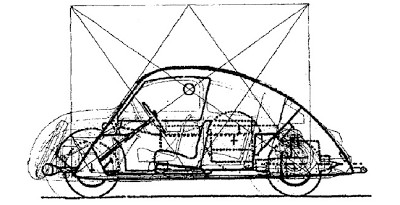
Meanwhile, back in Paris, Corbu was rethinking the car as a minimum-cost transport module.  He placed a small engine and transaxle unit between the rear wheels, with a wide front seat accommodating three modern but necessarily friendly people, with a side-facing seat in the rear. The architect's longitudinal section sketch below is shown superimposed over  the Golden Section diagram which formed limits for its Cubist radii and angles, and which also reflects Corbu's obsession with proportional systems. In the background, someone has lightly sketched in an early prototype VW
Corbu claimed that his design influenced both the VW Beetle and the later Citroen 2CV.  As La Voiture Minimum first appeared in 1936, when VW had already appropriated Hans Ledwinka's 1933 Tatra 570 as a template for the Volkswagen Type 1*, the first possibility is unlikely.  It should be noted that some features of the Minimum Car were more advanced than the Beetle, including its basic physics.  Note that the engine sits betwixt the rear wheels, somewhat like 1970s Tatras, rather than behind them as on the Beetle.  La Voiture Minimum might have been a sleepy performer like the 2CV, but probably would have handled better than the Beetle...
It's easy to see how this 1936 design may have influenced the Deux Chevaux, a project which CItroen began in 1937.  The flat planes of the sides are joined by a singly-curved arc of roof, which like the later 2CV features a sliding fabric sunroof above the rear window.  Glass area is even larger than on the Citroen, and compound curves are reserved for the fenders…here the front ones only, where they cheekily punch through the slanting plane of the cabin (shades of future minivans).  The spare tire compartment is expressed by the flat circular door, the horizontal handle of which parallels the front door handle as well as the tubular bumpers which surround the entire car. The spare tire door and those bumpers are necessary elements which are here used as a substitute for applied decoration. Note how much space separates the front bumper from the body. The ample bumpers show that Corbu was well-acquainted with the driving habits of Parisians.  It is not recorded that the architect approached Citroen with his design. Voisin, already suffering from Depression-induced financial troubles, declined it, but after WWII, Gabriel Voisin sold his own design for an even simpler, smaller rear-engined micro-car to Auto Nacional in Spain, which built about 10,000 Biscuters. The project chief for the 2CV, Citroen Vice President Pierre-Jules Boulanger, may well have been receptive to another architect's ideas on car design, as he had worked as a draftsman in a Seattle architecture firm before forming his own design and construction firm in Canada.  Like Voisin, his experience included aviation, but as a captain in the French Army air corps during WWI.  He famously described his concept for his own minimum car project as "an umbrella on four wheels."  It was produced from 1948 to 1990 in nearly 3,900,000 examples.
In the United States, engineer and building designer R. Buckminster Fuller proposed his Dymaxion living units and automobile during the same era; the car was displayed at the 1933-'34 Chicago World's Fair.  While the form of the Dymaxion was more obviously aircraft-derived than that of Voiture Mimimum, with curved windows and a central fin, the chassis design was an unlikely assemblage.  Dymaxion was a rare example of a rear-engined, front-wheel drive car.  A Ford V8 sat ahead of the single rear wheel, which provided the steering function.  The driver sat ahead of the front wheels, and while interior space utilization was predictive of the minivans half a century away, the handling characteristics were so odd that Fuller decided the car should only be driven by those who'd had an instructional course in its operation. As with the Gropius Adler and Corbu's minimum car, the Dymaxion missed commercial production. The three prototypes were produced at the old Locomobile factory during 1933-'34 under the direction of naval architect Starling Burgess.  By funding this project with his own money, Fuller provided temporary jobs for a crew of 27 during the Depression's darkest days; 1,000 applicants showed up for those jobs. One original Dymaxion survives; two near-replicas have been built.  One of these is shown below the hovering spacecraft image of the Dymaxion House.


It's easy to forget that as late as the mid-1970s, the basic architecture of the automobile was by no means settled. In the mid-1950s rear-engined cars were increasing in popularity, joining a great mass of front-engined rear-drive cars, a few front-wheel drive cars like Citroen, a small flock of four-wheel drive utility vehicles, and a barely perceptible trickle of mid-engined racers. Chassis structure included separate frames of various types, unit and semi-unit construction, and stressed-skin experiments like Jaguar's D.  To this profusion of competing types we now add architect Carlo Mollino's 1955 Nardi 750 Bisiluro (Italian for "twin torpedo"). Collaborating with engineer Mario Dalmonte and builder Enrico Nardi, Mollino suggested minimizing air resistance by reducing the car's central mass.  Reasoning that the wheels and their enclosures would be the biggest contributors to air penetration, he suggested placing the driver and fuel tank in one two-wheeled pod, and the engine and transmission across the way in the other one.  A bit like two motorcycles linked by an airfoil…or a land-bound catamaran.  The tubular chassis was designed following Mollino's body design, which also featured the radiator's cooling tubes running across the central airfoil as well as a rear-mounted air brake which was replaced by a jump seat at the insistence of Le Mans scrutineers.  Mollino's design was fabricated in light alloy by Carrozzeria Motto...


…while the twin-cam, inline 735 cc four cylinder engine, mounted between the wheels in the left pod, was provided by Giannini.  In the tragedy-haunted 1955 Le Mans race, the tiny, lightweight Nardi reached speeds up to 137 mph, but proved sensitive to side winds and tricky to handle, even in a straight line.  After the first hour, before it could be affected by the horrific accident which nearly ended automobile racing in Europe, the Nardi was blown off course in the wake of a passing Jaguar.  It ended its racing career in the grass, with lucky driver uninjured, and today lives in a museum.


*Footnotes:  Frank Lloyd Wright's design for Max Hoffman's NYC automobile showroom is featured in our post "Max Hoffman: An Eye for Cars" from May 1, 2016.  The sources for the VW Type 1 design are discussed in "Cars and Ethics:  A Word or Two on VW" from November 27, 2015.


Bibliography:      Automobiles by Architects, by Ivan Margolius, published by Wiley-Academy, Great Britain, 2000.

Photo credits:
Top: hebdo.ch (featured in Automobiles by Architects)
2nd: autobild.de (featured in Automobiles by Architects)
3rd:  lautomobileancienne.com
4th:  archpaper.com (model by Antonio Amado)
5th thru 7th:  wikimedia
8th:  museoscienza.org
9th:  slotforum.com


Saturday, April 22, 2017

The Etceterini Files, Part Eleven----Cisitalia: Fiats as Fine Art

I'm looking at an exhibit catalog from 1951; it's from the Museum of Modern Art in New York, and depicts 8 automobiles from what may have been the first exhibition focused on automobile design by an art museum.  It was almost certainly the first one featuring actual cars. 


Perhaps the most modern and predictive of those cars was the Cisitalia 202 Gran Sport. Designed largely by Giovanni Savonuzzi and introduced in 1947, it was industrialist Piero Dusio's first attempt  to market a road car.  His initial foray into car production had been the single-seat racing model D46, which despite the humble Fiat origins of its 1100 cc engine, had achieved competition success in the hands of drivers like Nuvolari.  Ex-Fiat designer Dante Giacosa had come up with a lightweight, nimble chassis which made up for the modest power. The 202 coupe used the same engine and similar multi-tubular chassis, but the body design, executed in light alloy panels by Pinin Farina, seemed to announce a revolution in automotive form, as innovative and fresh as designs by Felice Anderloni's Superleggera Touring (initially on Alfa Romeo chassis), and those by Raymond Loewy's group for Studebaker.

Curator Arthur Drexler noted the way the car's hood and grille sat below the peaks of the fenders, very unusual in 1947, and also the way the grille seemed a section through the ovoid shape of the fuselage.  Perhaps more significantly, it echoed the shape of air intakes which had already appeared on race cars.  Today, of course, we notice the seamless integration of fenders and center section into one piece of very expensive handwork.  And expensive the Cisitalia was, with a U.S. list price of $6,800, which would have easily bought two Cadillacs in 1949...


…the year the Museum's catalog car was built.  The catalog text also takes note of the way the rear fender arc relieves the unadorned flanks, and the way the bottom edges of front and rearmost fender extensions lift a bit from the horizontal base line established between the wheels.  This gives the impression of the bodywork as a tight skin which just barely fits over the car's structural and mechanical elements.


It was a theme to be repeated on many subsequent postwar designs, especially Italian ones.


Savonuzzi took the opportunity to refine some of these themes almost immediately, as Dusio requested competition versions of the 202.  In the 1947 Mille Miglia, Tazio Nuvolari held the lead over much more powerful cars in an aerodynamic spider featuring pronounced tail fins. After a rainstorm he finished in 2nd place and first in class, ahead of many cars with engines two and three times the size.  This success led to numerous orders for the SMM, or Spider Nuvolari, as it was then called. 


Overall, about 20 of this design were produced, and at least two CMM coupes featuring even more startling tail fins (remember, it's1947), and a greater inset between the upper and lower bodywork than on the Gran Sport to minimize air resistance.  Also notable on the CMM is the boundary layer air control, an airfoil device which appears just above the rear window on the car below.  Raymond Loewy would adopt a similar device on his design for a special Lancia Flaminia a dozen years later (see "Avanti Antecedents" in our archives for Feb. 18, 2016).


1947 was a busy year for the Cisitalia crew, which included future stars of the car building firmament like Carlo Abarth.  In addition to launching groundbreaking road and racing sports cars, Piero Dusio commissioned Ferdinand Porsche to design a Grand Prix single-seater for the race series that would become Formula 1. The resulting Cisitalia Porsche 360 featured driver-selectable four-wheel drive and a supercharged, 1.5 liter flat 12 cylinder engine which had been intended for Auto Union before the war.  The car first appeared in 1949, and only one example was built. Development  costs for the 360, which included money Dusio paid to obtain Porsche's release from a French prison, bankrupted Cisitalia, and by 1950 the company was in receivership.


Dusio moved to Argentina and later built some Fiat-based cars there, most of them styled in Italy, where production of the 202 ended in 1952 after 170 cars had been built to the original Gran Sport design, including 60 cabriolets.  After the bankruptcy reorganization, other cars appeared sporadically in Italy under the Cisitalia name into the 60s, but none had the impact of the original Gran Sport Pinin Farina coupe.  It was the first car acquired for MOMA's car collection, which also includes a Willys Jeep, a Volkswagen Beetle, a Series 1 E-type Jaguar, a Smart Car, and a Ferrari Formula 1 racing car from 1990...

Photo Credits:

Top + 3rd thru 5th from top:  Alexandre Georges for Museum of Modern Art
2nd:  Automobili Cisitalia
6th:  cisitalia.com
7th:  wikimedia
8th:  Von Reinhard Kaiser, reprinted in Fotocommunity
9th:  wikimedia
10th: the author
Bottom:  Linda La Fond

Saturday, April 15, 2017

A Moment Too Soon: The Cars of Briggs Swift Cunningham

Four years before Briggs Swift Cunningham II captained the winning yacht in the 1958 Americas Cup, his efforts to win the biggest prize in road racing landed him and his namesake cars on the cover of Time.  By 1950 American cars had been absent from the 24 Hours of Le Mans for an age; a Duesenberg J entered by a Romanian prince had lasted 38 laps in 1935. For the 1950 event, Cunningham entered a largely stock Cadillac coupe he nicknamed Le Petit Pataud ("clumsy puppy") as well as a Caddy roadster with a slab-sided, boat-like body which reporters quickly named Le Monstre.  Le Mans regulars criticized the size and weight of the American entries but admired Cunningham's sense of humor. Clumsy Puppy finished in 10th place, with Le Monstre in 11th, having lost some time while Briggs dug it out of a sand bank with a borrowed shovel.  The next year he would be back with a team of purpose-built cars.  The prototype C-1 set a pattern with its Ford-based independent coil-sprung wishbone front suspension, De Dion rear end, and Cadillac drum brakes. Wheelbase was 105 inches and overall weight 4,000 pounds. This was pudgy compared to the Jaguars, Ferraris and Mercedes contesting Le Mans, where the new C-2s raced with the latest Chrysler hemi V8s replacing the Cadillac unit in the externally similar C-1….

                                C-1

Of three C2s entered, one car finished 18th after running in 2nd place as late as the 20th hour; the 250 hp engine, suffering from valve problems, needed to be nursed along in the final hours.  So Team Cunningham went back to the drawing board in their West Palm Beach workshops, and came up with the C-4R, with similar tubular chassis with a live rear axle replacing the De Dion, and shaving 5 inches off wheelbase,  4 inches off width, and a whopping thousand pounds off overall weight.  Body design was by George Weaver.  At 3,000 pounds it wasn't a lightweight, but for perspective one is reminded that's about 400 pounds less than a modern VW Passat, and the modified Chrysler 331 hemi was now up to around 300 horsepower...

    C-4R


Cunningham sent the two C4-R roadsters and C-4RK coupe to Le Mans in 1952, and Briggs and co-driver Bill Spear took 4th place.  The team did even better at home, where the C4 cars won a high percentages of races entered, including the 1953 Sebring 12 Hours...


                                C-4RK
                               
The fierce-looking coupe was the product of a design collaboration with German aerodynamicist Wunibald Kamm, a proponent of managed air flow and the source of the "K" in the name.


Dr. Kamm was also the source of the abrupt tail surfaces on the coupe, which featured the then-novel division of the rear window into two surfaces by a metal arc.  The lower window surface is nearly vertical, and the transversing arc  presages the tail spoilers of the 1960s...


Cunningham entered a C-4RR roadster and coupe again for the 1953 running of the 24 Hours, and also brought the new C-5R, lighter than the previous roadster by over 400 pounds, and making 310 to 325 hp.  The new car was swiftly dubbed the "smiling shark" by spectators at practice, where the new radar guns introduced that year showed the car to be faster on the Mulsanne straight than the rival Jaguars. The Cunningham team had been extremely careful during pre-race preparation, so they were confident the cars could last the distance.  What they hadn't reckoned was that Jaguar would introduce Dunlop disc brakes at this race, and Cunningham driver Phil Walters noted that this allowed them to brake later for the corners. The result was that the Jaguar C-types finished 1st, 2nd and 4th, with the Cunninghams in 3rd, 7th and 10th places.  It was a tribute to their preparation and reliability of their cars that among the teams in real contention only Jaguar and Cunningham saw all their cars finish.  This distinction was also shared with the French Panhard team, whose two-cylinder cars were never in contention for the overall win.

    C-5R

The torsion-bar suspended C5-R, the only one built, was piloted by John Fitch and Phil Walters to 3rd place in the '53 Le Mans race; the C4-R roadster finished 7th and the coupe 10th. Along with the intrepid Fitch, the C-5R survived flipping end over end at the subsequent Reims 12 Hour race. The car was rebuilt in the US with this original body design in aluminum.  As with the Jaguar racers of the era, the front fenders and hood is an impressive piece of hand-formed alloy that tilts forward to allow easy access to the engine. Unlike the Jaguars, the Cunninghams returned to Le Mans in 1954 with drum brakes, because Jaguar exercised its veto option when Briggs approached Dunlop about supplying them.  Still, they finished well, with the C-4R of Spear and Johnston in 3rd behind a Ferrari and D-type Jag, and the other C-4R in 5th.  It was driven by J.G. Bennet and a guy named Cunningham...


     C-3

During this period there were Cunningham road cars too, and one was chosen by the Museum of Modern Art for its design exhibit, called "Ten Automobiles", in 1953*.  The C-3 coupe and convertible were based on the C-2 chassis, and the bodies were produced by Vignale to a design by Giovanni Michelotti..  The C-3 was offered to the public because Le Mans race regulations would only count the C-2 as a production car if 25 examples of the same chassis were offered to the public.  Cunningham's original plan was to build 25 cars in '52 and another 50 cars the next year.  But sales were limited by prices in the $9k to $10k range, and ultimately only 27 were sold*. Even at these prices, Cunningham lost money on every C-3, the result of sending the chassis on an Italian vacation for treatment by craftsmen who took 2 months to complete each body.

Cunningham made one last attempt at Le Mans in 1955 with this C-6R, a new chassis design with drastically reduced weight at 1,900 pounds, a return to coil springs with independent front suspension, and a De Dion rear suspension with inboard drum brakes.  Most interesting was a special version of the Offenhauser twin-cam, sixteen-valve four of Indy 500 fame, reduced to 3 liters and reconfigured to run on the mandated French pump gas rather than methanol.  Chassis and alloy body were designed by Herbert Unger, and the car ran Le Mans in the open-headlight, flat-grille form shown in the photo on the wall.  In the event, pilots Cunningham and Johnston went 196 laps before the engine burned a valve; the Offy had consistently run hot after the switch to gasoline.  But at least they had run safely, and in a race overshadowed and then defined by an appalling accident which killed 84, mostly spectators, and prompted the retirement of the Mercedes team from all racing before it ended. At Cunningham, Phil Walters and Sherwood Johnston retired from racing, and Briggs indicated he could not blame them.  Back in the States, Briggs finally got his disc brakes, but only attached to Jaguars after signing on as a Jaguar distributor and running the firm's US racing program, where he had plenty of success. The nose on the lone C-6R was changed to a D-type Jaguar profile with enclosed headlights, and it received a Jaguar engine transplant after blowing another Offy at Sebring.  Tax laws would have classified the money-losing Cunningham manufacturing operation as a hobby after 1955, and so perhaps a change was inevitable.  Still, it is tempting to wonder what might have been…If Cunningham had persuaded Dunlop to sell him disc brakes, or Goodyear-Hawley to make bigger ones (they had made the discs on the tiny 1949-50 Crosleys), or if Chrysler had spent the kind of money on racing that Ford spent in the 1960s.  In the interview for the Time cover story in April 1954, the reporter noted that it appeared that Cunningham had made a small fortune in the specialized business of building and racing sports cars.  Briggs replied that this was only true because he'd started with a large fortune...

                                C-6R Offenhauser engine

*Footnotes:  Other American cars in the "Ten Automobiles" exhibit included a Loewy-designed 1953 Studebaker Starliner and a Nash-Healey coupe from the same year.  The latter car had an English chassis to go with its Italian body, however.  The Cunningham Registry indicates that 25 of the C-3 model were bodied by Vignale, and 2 "pre-production" prototypes were bodied by Cunningham.  The $15,000 cost of these convinced the team to outsource bodywork to Vignale. Counting the single C-1 and 8 race cars, total Cunningham production amounted to 36.  All photos were taken at the Collier Collection of the Revs Institute, which houses the most complete collection of Cunningham cars anywhere.

Photo credits:
Top:  Paul Anderson
2nd:  the author
3rd:  Ian Avery-DeWitt
4th:  Paul Anderson
5th:  Ian Avery-DeWitt
6th:  Paul Anderson
7th & 8th:  the author