Featured Post

Wednesday, May 6, 2020

Body by Zagato Part 2: Five Decades of Alfa Romeos

Ugo Zagato founded his Milanese carrozzeria the year after the First World War ended, and produced this body on Alfa Romeo's 6C 1500 Sport less than a decade later. The 1928 example shown was one of Zagato's first efforts on this then-new model, the first road-going Alfa Romeo with the firm's trademark double overhead cams.  Note the vertical radiator, the bright metal trim strips on the rear fenders, and the asymmetrical doors, with a straight top on the passenger door...
…and a curved cutout on the driver's door, a jaunty touch.  Ugo Zagato, however, denied designing cars for mere attractiveness, focusing instead on light weight and fitness of purpose.  In the case of many of his Alfa Romeo designs, that purpose was road racing.
By the time Zagato bodied the  6C 1750 Gran Sport below in 1932, aerodynamic concerns prompted an angled radiator, and a lower stance.  Note the pointed prow at the base of the radiator, a feature not seen on most of this series.
Just 3 years later, concerns about weight, wind resistance and handling prompted Zagato to lower the stance still further, integrate the radiator and headlights into the streamlined overall form, eliminate running boards and trim, and connect teardrop fenders to the central torpedo shape for smoother air flow.  This is advanced stuff for 1934, the year this unique 8C 2300 spider was produced.
Another one-off Zagato body went onto this 8C 2900B Spider Aerodinamica from 1937. Note the similar treatment of fenders, the lack of decorative trim, and the narrow air intake for the twin-cam, 2.9 liter supercharged inline 8 derived from Vittorio Jano's GP racing engines.  This is a short-chassis model intended for competition.  Ten 8C 2900A models were produced, along with 32 of the 2900 B version, with one car assembled out of spare parts in 1941, after production was suspended by the arrival of war.
After the war, Zagato would experiment with new forms integrating the fenders into unified envelope bodies, and with new lightweight materials like Plexiglas, which suited those new forms. This 1949 Alfa Romeo  6C 2500SS Panoramica coupe features the Plexiglas side windows of curved section extending well into the roof also  shown on the contemporary Maserati and Ferrari Panoramicas pictured in our "Body by Zagato Part 1" post*. The proportions and details of the Alfa are different, however, with a longer hood, less front overhang, and arcs formed into the alloy panels calling attention to the wheels and reducing the visual height of the car.
At the rear, we see one of the first examples of a hatch applied to something other than a station wagon. This vented hatch was not a feature of Zagato's Maserati and Ferrari Panoramicas, which lacked external deck lids. While the Panoramica coupes were controversial designs at the time, they accurately predicted design themes of the Sixties and even Seventies, including the low belt lines, glassy greenhouses and curved side windows.
As the Italian economic boom progressed and road racing became more popular, Zagato produced bodies for dual purpose road / race versions of production cars like the Alfa 1900. The 1954 Alfa 1900SS coupe shown below features body and roof forms much like the Fiat 8V* raced by Ugo's son Elio in the same 2 liter class during the Fifties.  Only the grille shape and air intakes on the hood separate the Alfa visually from the Fiat. 
There were many variations in Zagato bodywork on these 1900s, which were based upon the first moderately-priced, series production Alfas ever.  Note that the green car above lacks the twin-hump roof shown on the 1956 example below, and has a single arc connecting front and rear fenders, while the silver car below has haunches over the rear wheels.  The grille angles forward on the silver car, and the hood scoops are closer to the prow... 
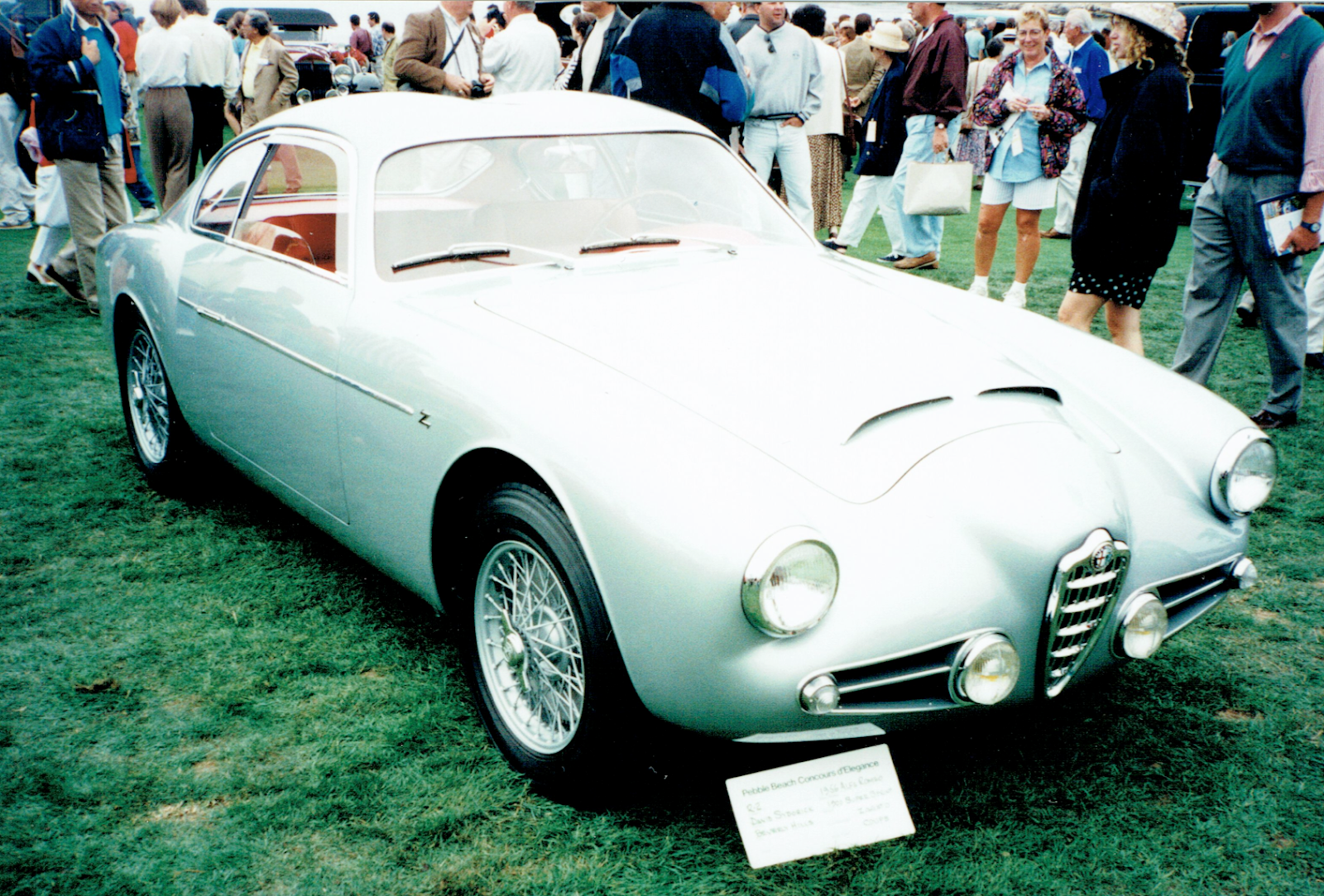
The rear view of a 1900SS similar to the silver car shows off the smooth fender contours, the complex contours of those roof bubbles, and the clean, undecorated form of the tail. Note also that the side glass is curved in section though not as much as on the Panoramicas, a feature that would not appear on most cars until the 1960s.  A standard Alfa Romeo 1900 is parked to the left of our red example, showing how much difference there was between the mass-produced sedan and the Zagato coupes.  
Alfa introduced a smaller, less expensive car in 1954, around the same time as the first Zagato coupes appeared on the 1900.  The Giulietta 1300, with its new aluminum engine block (the 1900 was cast iron) and trademark Alfa twin-cam design, became hugely popular as a sedan, a Bertone-bodied Sprint coupe, and then as a Pinin Farina spider.  Zagato soon got into the act, producing at least four of the "double bubble" lightweight coupes shown below starting in 1957. 
As the Sixties dawned, it dawned on Alfa Romeo management to offer lightweight Zagato bodies through Alfa dealers, rather than force customers to commission them independently.  The delightful silver SZ from 1961 displays designer Ercole Spada's* mastery of simple rounded form, with just enough detail to make that form distinctive. 
Among those details are oval tail lights flush with the bodywork, and an indented surface connecting the wheel arches, reducing the visual height of the car.  Designer Spada was apparently unconcerned about protecting the delicate alloy nose and tail from parking mishaps; the car looks better without bumpers.
For 1962 the designer sketched a sleeker version of the SZ with a lower penetration nose and a flat tail with raised center section and larger, wrap-around backlight.  This became known as the Coda Tronca for the truncated tail.
But nothing in the world of racing, and thus in the worlds of Alfa or Zagato, remained static, and so for the 1963 season the two firms collaborated to introduce the legendary Giulia TZ, the "T" standing for tubolare, denoting the lightweight tubular space frame chassis. Designer Ercole Spada managed to come up with an even more aerodynamic form.  Engines were now 1.6 liters, and in twin spark form the cars could show their tall, flat Kamm-inspired tails to competition like the Abarth Simca 2000 lurking behind our example car.
The Zagato-bodied TZ became the most popular factory racer yet fielded by the team of Alfa and Zagato, with over 100 produced.  The engine was installed at an angle to keep the hood low. This was also the last Zagato Alfa of the era with aluminum bodywork...
During the same era, Zagato produced a steel-bodied GT coupe on the relatively new 2600 model to Spada's design, with an aluminum block inline twin cam six. The glassy greenhouse, oblong headlights and flat tail were predictive features; 105 examples were produced.
When it came time to update the TZ with a lighter, lower and even more aerodymanic body, Zagato chose fiberglass for the shell covering the tubular chassis of the TZ2. These appeared at the Turin show in 1964, for the 1965 racing season, with a dry-sump version of the twin spark 1.6 liter engine making around 170 horsepower.  As with the original TZ, operable flaps in the nose could adjust air intake.
These views confirm Ugo Zagato's theory that fitness for purpose would yield harmony of form. Only a dozen examples of the  TZ2 would be produced, as Autodelta, Alfa's racing arm, needed capacity for the GTA production racers.  There were still Zagato versions of the Giulia in the planning stages, however...
These appeared in the form of the glassy, steel-bodied Junior Z in 1969, the first Zagato Alfas to adopt the wedge theme then being popularized by Giorgetto Giugiaro.                   
In 1970 Alfa released the production 1300 cc version of the Junior Z with short rear overhangs at first, and a 1600-engined version in 1972.  Both had the distinctive Plexiglas headlight covers with triangular cutout for the Alfa grille, and asymmetrical air intake slots (above), as well as an opening rear hatch with remote driver-controlled device to allow for flow-through ventilation (below).  The 1600 version shown below also had a bit more rear overhang.
When production ended in 1975, 1,108 of the 1300 model had been built, and 402 of the 1600.  Those are much higher numbers than any that apply to Zagato's alloy-bodied dual purpose Alfa sports cars.  Later on, from 1989-'94, Zagato produced Alfa's ES-30* two-seaters in noticeable numbers, but these were designed at Fiat by Robert Opron. During the boutique revivals that followed the extinction of Italian design studios as actual car producers in this century, Zagato released the Alfa TZ3. This was produced in only 10 examples in 2011, and 9 of these were the Stradale version with 8 liter V10 engines sourced from the Dodge Viper. That hardly fits Zagato's original philosophy, or Alfa Romeo's frequent approach, of getting big performance out of small engine displacements by weight reduction and clever aerodynamics, and has to be seen instead as a clever but mostly empty branding exercise...  
*Footnote:
The Fiat 8V Zagatos are pictured in our Archives in "The Etceterini Files Part 10" (11-13-16) while the design of Alfa's ES-30 is analyzed in "Worst Car Designs Ever, Part 4" (8-11-16) and Ercole Spada's designs for Alfa Romeo and Lancia are surveyed in the "Swiss Museum of Transportation" piece (7/4/19).  Finally, the Zagato Panoramicas and other designs for Ferrari and Maserati are profiled in "Body by Zagato Part 1" (3/31/20).

Photo Credits
Top & 2nd:  the author
3rd thru 5th:   wikimedia
6th & 9th:  pinterest.com
7th & 8th:  Carrozzeria Zagato on carstyling.ru
10th & 11th:  the author
12th:  pinterest.com
13th:  Lt. Jonathan Asbury, USN
14th:  youtube.com
15th:  en.wheelsage.org
16th & 17th: Ian Avery-DeWitt
18th thru 20th: wikimedia
21st, 22nd & bottom:  the author


Thursday, April 30, 2020

Architect-Designed Cars Part 4: Tom Tjaarda----Life Before and After the Pantera


American Tom Tjaarda, son of John Tjaarda, designer of the 1936 Lincoln Zephyr, was perhaps the most successful of architects ever to design a car.  If success is measured in the number of cars which made it from renderings and clay models to series production, this is certainly true. Unlike most car designers with architectural training, Tjaarda actually obtained his architectural degree from the University of Michigan in 1958, and took 2nd prize in the GM Craftsman's Guild car design competition that year with his design for the Turbine Wagon shown above. He was a design consultant on the Westinghouse Time Capsule Pavilion at the 1964-'65 New York World's Fair.  His car designs for Pininfarina and Ghia in Italy, however, brought him fame (at least among other car designers) in his home country.  The first of these was his design for Ghia Studios for the Innocenti 950 Spider, produced by OSI using Austin Healey Sprite drivetrains from 1961 through 1970.  Careful control of proportions masks the small size; the Honda S600 roadsters which appeared 3 years later have similar forms and proportions.                        
Tjaarda's first project for Pinin Farina (it would become one name in 1961) was the Corvair show car below.  GM was interested in selling Corvairs in Europe, and the idea of a GT car had some appeal, as Corvairs were fairly large cars by European standards. The first PF Corvair* shown in 1960 had a tight, GT style cabin and curving rear fenders recalling Corvettes of 1956-'60.
The second of three PF Corvairs appeared in 1962.  Here Tjaarda gives the car a stronger horizontal character line wrapping around the tail (a bit more like the production car), and proportions the greenhouse in a way that suggests a 2+2 rather than a 2 passenger car. The proportions, if not the form, prove to be predictive of the second-generation 1965 Corvairs.
Tjaarda's design for the Ferrari 330 GT 2+2 appeared in January 1964.  The restrained design was aimed at the luxury grand touring car market. The car's one controversial feature was the quad lighting scheme at the front, with large headlights outboard of smaller lights set in wide, bright metal openings which Tjaarda seems to have adapted from his Corvair show cars of 1962 and '63... 
                            
For the Series II version of the car which appeared in 1965, Pininfarina produced bodies with a simplified single headlight scheme, and this version seems more popular with collectors, as is the 5 speed transmission in the Series II cars.

Tjaarda's design for the Lancia Flaminia Coupe Speciale was built in only one copy as a show car in 1963.  Like the Corvair show cars, it featured a low belt line and glassy greenhouse with thin pillars.  As with the '62 and '63 PF Corvairs, a strong fold in the flanks above the wheels reduced the visual height and any need for surface decoration.  The trapezoidal tail lights and canted rear fender tops would show up on other Tjaarda designs, and soon.              
At the front, Tjaarda deployed quad headlights well above the plane of the hood, which created a more bluff impression than the single headlight design on Zagato's Flaminia Sport then in production.
                            
In 1963 Pininfarina obtained a new Corvette Sting Ray chassis from GM and gave Tom Tjaarda the challenge of formulating an alternative vision of this car. The Corvette Rondine* appeared in two forms, one with a reverse-slant rear window and the final version below, with a smooth, glassy roof form meeting the deck surface.  While the minions of General Motors decided the show car didn't look enough like a Corvette, Pininfarina encouraged Tjaarda to use several of his formal ideas on a Fiat a couple years later...
The Fiat 124 Spider went into production in 1966 with the same horizontal fold merging with a vertical fender surface, kicking up over the rear wheels, and creating fender forms which slope down to the deck surface.  The hardtop prototype shown below, which did not make production, is even more like the Rondine as it has the anodized "B"-pillars and wraparound rear window. Though Tjaarda didn't feel Fiat was serious enough about the 124 Spider, it had a more enduring presence in the US than any other Fiat model, ending production in 1985 as the Pininfarina Azzurra...
Pininfarina showed real confidence in their young designer by giving him a plum assignment at the same time as the Fiat; this was to design the Ferrari 365 California Spider produced in 1966-'67...
The scoop recessed into the door surface has a bright metal strake echoing the air intakes of the Dino 206 prototypes then being designed at Pininfarina. On the front-engined California, however, it merely provides a concealed door handle and an opening that may have channeled air to the rear brakes, or not.  Only 14 of these cars were produced...
After Tjaarda returned to Ghia, one of his first projects was to design a potential series production GT car for Serenissima*, the renegade specialist car company started by Count Volpi after a disagreement with Ferrari. The mid-engined Serenissima Ghia reflected some themes explored first by Giorgetto Giugiaro on his De Tomaso Mangusta, like the sharp fold connecting the wheels, and the steep windshield. The "drilled for lightness" roll bar, an echo of Tjaarda's 1958 Turbine Wagon, was a distinctive feature, along with the prototype 4-cam, 24 valve V8.  This GT car for Count Volpi remained a one off...


As did the De Tomaso Mustela below, which appeared on the show circuit in 1969.  Based on a Ford V6 drivetrain, the hatchback Mustela would have made a very attractive alternative to the Capri Ford introduced in Germany and England that same year...
The Lancia Fulvia 1600 Competizione appeared at car shows in 1969, the same year Fiat took over Lancia, and explored the same themes as the Mustela, but there is less trim around the windows and an absence of bumpers, all reflecting, like the high tail with retractable air foil, the car's road rally purpose.  The drilled rollover bar appears again, an example of an architect working structure into visual form...
1969 turned out to be a busy year for Tjaarda.  Ghia also showed off his design for the Marica, a GT coupe based upon the decade-old Flaminia chassis.  The tapered contours, crisp edges and restrained decoration would've brought the big Lancia well into the Seventies without any further updating, as the engineering was still pretty fresh. All Lancia really needed besides designs like these was money, so it could avoid the Fiat takeover.  It was not to be...
What was to be was another 2 seater built by Ghia to a design by Tom Tjaarda. This was the 1971 De Tomaso Pantera, a mid-engined successor to Giugiaro's Mangusta, and overlapping it on De Tomaso's production lines. Organized around Ford's 351 Cleveland V8 and sold through Mercury dealers in the US, the car offered Maserati charisma at a Mercedes price. Along with the 124 Spider, the Pantera made the biggest and most enduring impact of Tjaarda's designs on American roads.

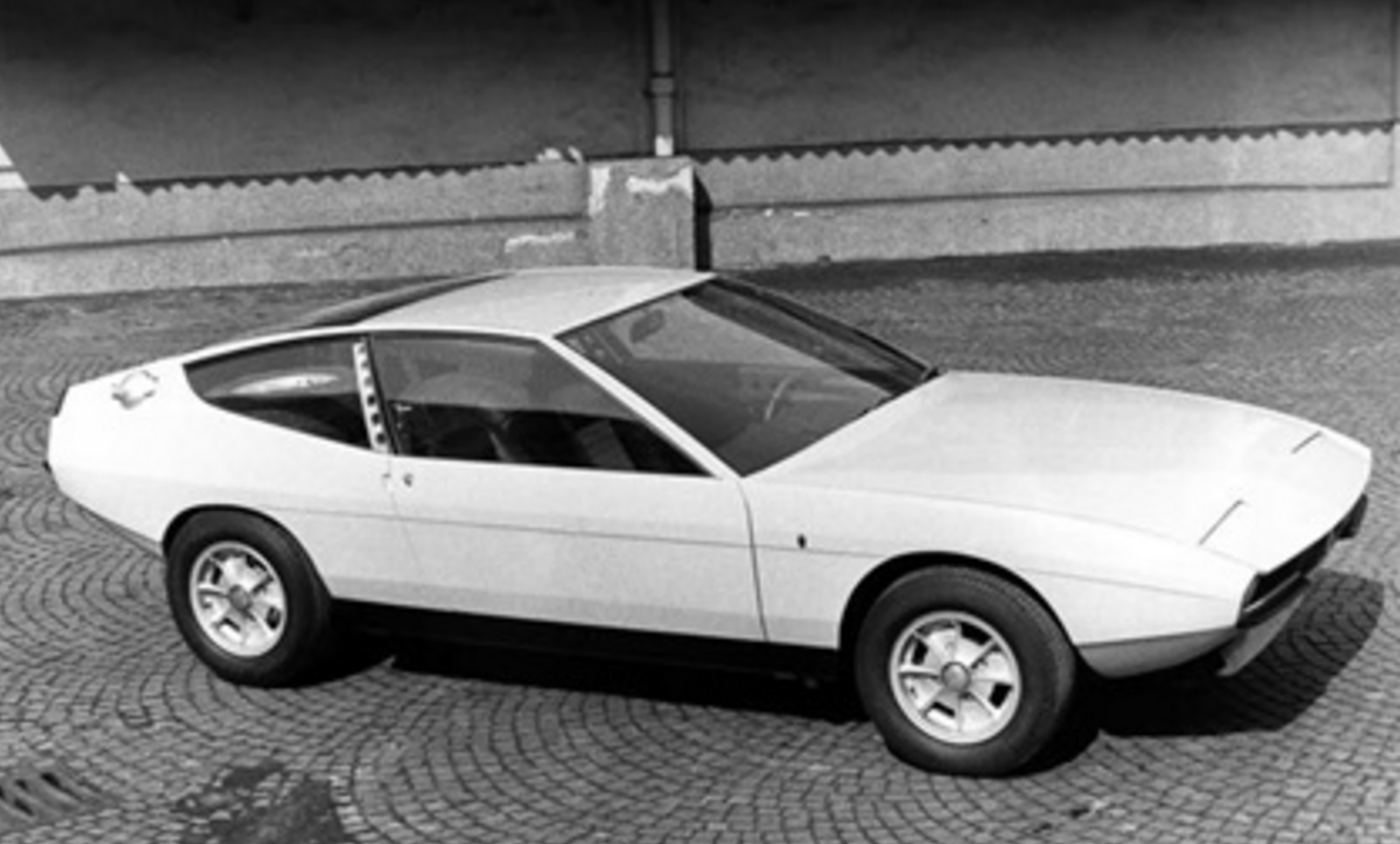
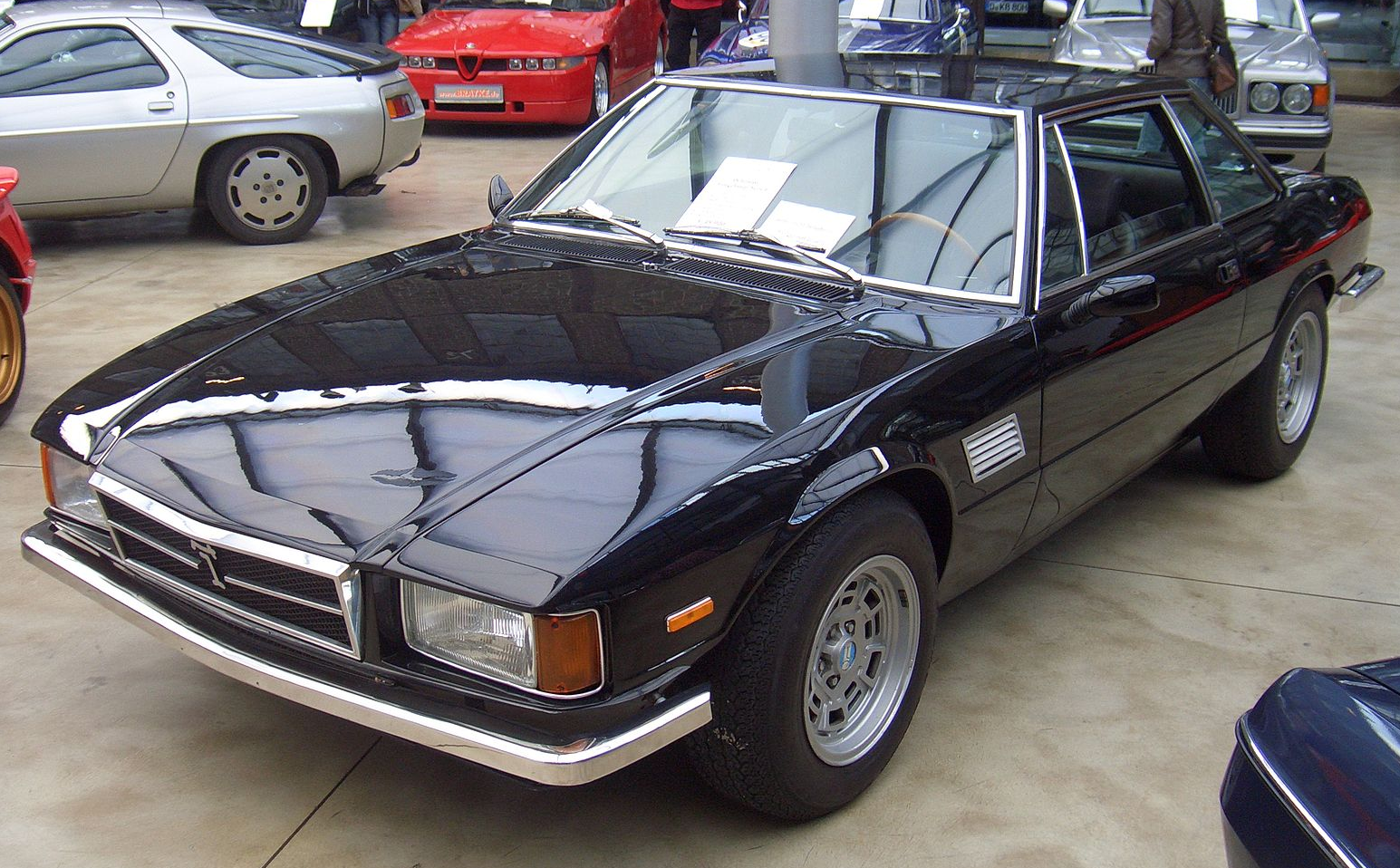
If Tjaarda's De Tomaso's Longchamp (above), in production 1972-'89, was an answer to the Mercedes SL and was stylistically derived from it, the Deauville sedan which appeared at the Turin Show in 1970 was derivative of Jaguar's XJ.  But Tjaarda's Deauville (below) was so carefully contoured, proportioned and detailed that it did a better job of looking like a Jaguar than the XJ40 series which appeared in 1986, the year after the Deauville exited production after 244 examples were built.  Ford Motor Company bought Ghia and Vignale to launch the Pantera project, and acquired a great designer of Italian cars in the process. Ironically, that designer hailed from Detroit. Tom Tjaarda went on to guide the design of several production cars, including the Ford Fiesta, and ran a successful industrial design consulting firm after leaving Ford.  He died in 2017.


*Footnote: The PF Corvairs (3/18/16), Corvette Rondine (3/10/16), Lancia Fulvia GT show car (10/3/16) and Serenissima Ghia (3/20/19 & 9/7/15) are featured in previous posts in the Archives; dates posted are in parentheses. The other posts on Architect-Designed Cars were Part 1 on 5-7-17, Part 2 on 5-21-17, and Part 3 on 4-26-20.

Photo Credits
Top:  invaluable.com
2nd & 5th:  wikimedia
3rd & 4th:  Pininfarina
6th & 7th:  Lt. Jonathan Asbury, USN
8th:  pinterest.com
9th, 11th & 12th:  Pininfarina
10th:  cartype.com
13th:  Tom Tjaarda in Auto & Design Magazine
14th:  wikimedia
15th thru 18th:  Ghia Studios
19th & 20th:  wikimedia
21st:  Honest John Classics
Bottom:  Ford Motor Company (1976 Fiesta)

Sunday, April 26, 2020

Architect-Designed Cars Part 3: Avions Voisin----Dreams From the Sky


In Part 2 of this series, we commented that no cars designed by architects other than the Citroen 2CV had ever been mass-produced, and later corrected that to read "practicing architects" after a bit more research on the subject.  Yeah, we know, that's cheating.  But it seems there were several designers and engineers trained as architects who decided to give designing cars a try. One of them managed to get a couple thousand cars built, a notable achievement considering they were mostly built by hand. His name was Gabriel Voisin, and he studied to be an architect but was distracted by the new world of aviation, became the first commercial airplane builder with his brother Charles in 1907, and built Voisin III and V planes for use in World War I, a time when he volunteered as a combat pilot in the nascent French Air Corps.  Metal-framed Voisins were more advanced than the wood-framed planes of that war, and a Voisin shot down a German plane in the first aerial fight of the conflict.
Demoralized by the destruction of war, Voisin turned to car manufacture in 1919 when it became clear that people did not share his futurist's enthusiasm for commercial aviation. Half a decade after its founding, the firm, still called Avions Voisins, produced the 1924 C5 above. The "C" preceding all Voisin model numbers was Gabriel's tribute to younger brother Charles, killed in an automobile accident in 1912. Note the sharp creases atop the fenders; most coachwork for Voisins was designed by Voisin and design engineer André Noel Telmont and built in the company workshops, an unusual arrangement at a time when most expensive cars were offered only as chassis for bespoke coachwork. The C11 shown below was built in 1927 and has wicker surfaces around the cockpit and on the doors.  Emphasis on light weight and balancing masses was derived from aircraft experience.  All Voisins used light alloy extensively and were powered by Voisin-built engines of 4, 6, 8 (a V8 prototype) and 12 cylinders (60 degree V12s but with one inline prototype) using Knight sleeve-valve patents.  An advantage of sleeve valves was that there were no valve springs, and the engines could sustain higher speeds in relative silence, an aspect Voisin valued.  A disadvantage was higher oil consumption owing to the reciprocating sleeves.  Voisin was also a pioneer in the adoption of hydraulic brakes and clutches, and devised a silent electric starting system.

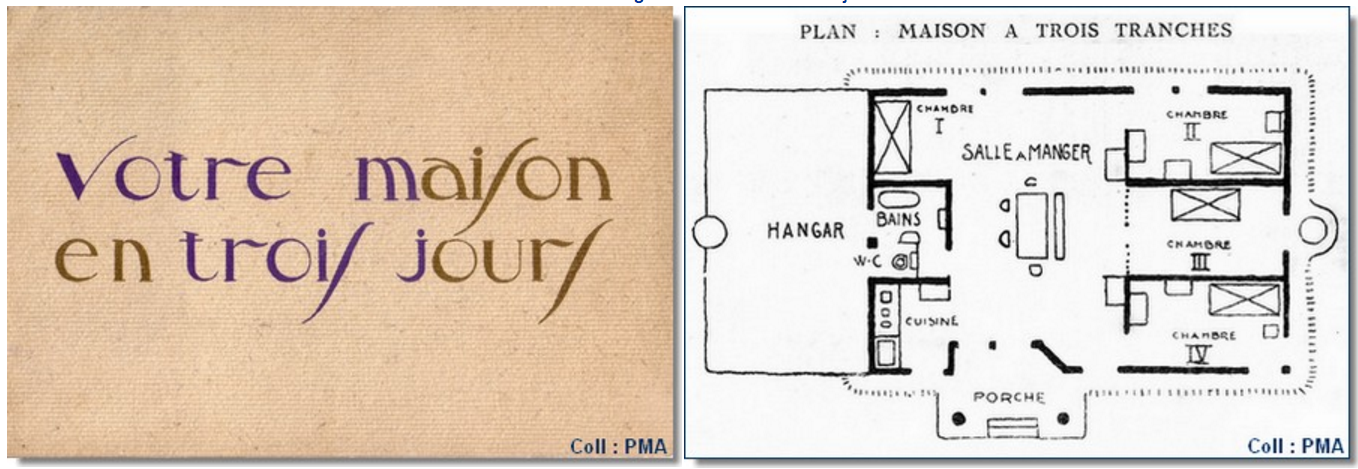
During the Twenties, Voisin's architectural training met with his futurism in his plans for "Your House in 3 Days", a house built of engineered, prefabricated* components which could be assembled in short order.  In Voisin's view, the prefabricated system would be ideal to meet the housing needs of soldiers returning to civilian life, often in towns badly damaged by war. While several houses were built, the scheme met with opposition from France's construction trades as well as skepticism from the public, something that would greet other architects who proposed this idea in the US in the period after yet another great war.

It turned out that the Twenties was the golden era for Avions Voisins. The six-cylinder C14 model accounted for the majority of sales, nearly 1,800 cars. The Voisins parked in front of Voisin's prefabricated house were designed at a time of optimism and innovation. Voisin and Telmont had released their Laboratoire Grand Prix car in 1923, an early example of monocoque chassis design driven by engineer André Lefebvre to 5th place in the Tours GP. As the decade progressed they also aimed at lowering the center of gravity on their cars. Along with engineer Lefebvre (of future Citroen fame), they conceived of the C18 and C20 powered by 3.9 and 4.9 liter V12 engines, with low-slung chassis and angular coachwork reflecting Telmont's ideas. The close-coupled Scirocco 4 door Berline below was shown at Paris in 1931, and combines modernist chassis principles with traditional ideas of horseless carriage design, and echoes of the separate "elements of architecture" from Voisin's architectural training. Gabriel's friend and client, architect Le Corbusier* reputedly designed the hardware for these cars. Even the lightweight winged hood ornament shown in the top photo was riveted together from light alloy plates...
There was also a two-door coupé in the same style called the C20 Mylord Demi-Berline. This car survives, and was recently auctioned for an eye-watering price.  Back in the early Thirties, however, these complex, expensive extravagances were not in demand, and sales were so low that Voisin had to furlough his drafting staff, along with engineer Lefebvre.
An earlier V12 model, the C18 below, was re-bodied in handsome but conventional style by an unknown coachbuilder. The steeply-angled windshield recalls Jean Bugatti's T50 Profilée coachwork, while the hood and fenders would look at home on a Bentley.  Of the handful of V12 Voisins built, only two survive. The Bucciali TAV8-32*, a front-wheel drive low-chassis car by Voisin's fellow aviator Paul-Albert Bucciali which appeared the year after the Voisin C20, used the same 4.9 liter sleeve-valve V12 as that car.  
Voisin soon decided to introduce a smaller, lighter car with a new chassis design incorporating double wishbone front suspension and 3-liter 6 cylinder engine, a bit more in tune with the reality of the Great Depression. The C25 looked fairly sedate in side elevation, but the version below was equipped with a sliding metal sunroof with its own circular skylights, the rearmost of which would allow rearward vision when the sunroof was open...
The similar C26 below also features the encircling  bright metal running board / fender ledge, with more conventional bumpers above it for added protection.
The rear of the C26 shows the bright metal rails for the retracting, surface-mounted sunroof. Despite the new chassis and body innovations, sales of the C25 and C26 combined was less than a tenth of the C14 from the Twenties.
When other coachbuilders got a chance to work on Voisin chassis, the results were often spectacular, as on this yellow and black C27 roadster, bodied by Joseph Figoni in 1934. Figoni would be joined by Ovidio Falaschi the next year, and would soon be identified with swoopy teardrop bodies on Delahaye and Talbot Lago chassis, but many of the identifying marks are already here on this 6 cylinder, 3 liter Voisin, including the sweeping trim lines dividing contrasting colors...
...and the tapered tail with ridge running down the circular deck lid.  Sadly, this was the only Figoni Voisin, and one of only two C27s the factory built before moving on to the C28. 
The other C27 was a coupe bodied by Voisin. Note the bright, scalloped metal ledge encircling the base of the fenders, as on the C25 and 26 sedans.  This became a feature on all factory-bodied Voisins, along with the winged hood ornament flanked by diagonal braces running to the fender tops.
The V-shaped side window sills were an innovation, perhaps a place to rest your arm.  The cubist-influenced, Art Deco upholstery has the visual effect of de-materializing the interior surfaces. Sunroofs were one of Gabriel Voisin's favorite details...
After the departure of André Telmont and facing dire finances, Gabriel Voisin took over body design, and introduced the C28 in 1935, with the six-cylinder engine expanded to 3.3 liters and more aerodynamic bodywork of his own design. On Lane Motor Museum's 1936 C28 Ambassade sedan below, Voisin's unique detail for the metal sunroof is visible. The windshield has no header; this enhances the open-air feeling for the driver and passengers, but makes it more difficult to form a weathertight seal between glass and metal. This insensitivity to water intrusion issues may possibly be taken as proof that Gabriel Voisin was, at heart, an architect... 
                 
To introduce the C28 series, Voisin designed every detail of a luxurious grand touring coupé called the Aerosport.  Like the Czech Tatra it featured a futurist pontoon body style with flush sides sweeping from curved prow to tapered tail.  The headerless windshield and open metal sunroof can also be seen below.
By contrast with contemporary designs like the C27 Figoni roadster, the Aerosport has a heavy presence, as if it were machined from from a solid billet of steel. But appearances are deceiving. The body panels, like those on all Voisin-bodied cars of this period, are entirely aluminum, and the detailing reflects Voisin's structural concerns as well as concerns about the construction process. Only 3 or 4 Aerosports were built. One prototype with similar body design on a longer wheelbase was exhibited with tandem 6 cylinder engines, apparently owing to unavailability of funds for a new V12. 

The cockpit has a seriousness born of aircraft practice, and a timelessness born of a design philosophy that could be called "sense of machine."  Here the open feeling created by the headerless windshield and open sliding roof can be observed, along with the detail of the floating windshield wipers. Like Delahayes of the period, the Aerosport used a Cotal preselector transmission.
The rear seating area was cozy and cosseting, an impression enhanced by the high window sills and low roof. The cylinder forward of the rear window houses the motor for the electrically-controlled sliding roof. 
At least one C28 was bodied by an outside coachbuilder. The 1938 cabriolet below is credited to Saliot, a garage that specialized in repairing and maintaining Voisins but did not have its own body fabrication facility. Possibly subcontracted in the late prewar or early postwar period to a specialist, the body resembles Delahayes from Pourtout or Faget-Varnet more than the rigorously geometric Aerosport. It's one of the few Voisins not to feature the traditional radiator shape, but the winged mascot is there, and the designers have deftly concealed hinges and even handles; the push button forward of the door opening is a nice touch.
Considering the price, which exceeded that of Bugatti's Type 57, Voisin probably did well to sell sixty-one C28s, all body styles included. By the time a receiver took over Voisin's factory and issued a half-hearted C30 with side-valve American Continental six and Dubos coachwork, the clouds of war were again darkening the skies over Avions Voisin... 

In the period after World War 2, Gabriel Voisin returned to his interest in designing a car that would  serve as minimum basic transport, echoing a theme that had been explored before the war by his friend and client, Le Corbusier*. Voisin called the result the Biscooter, and powered it with a Gnome & Rhone single cylinder engine driving the front wheels.  Gnome & Rhone took over the Voisin firm by 1950, when the Biscooter was first shown under the Voisin-Gnome & Rhone banner.  Around a dozen prototypes were built.
                           
Then Gnome & Rhone licensed the design to a Spanish company, which built around 12,000 of the renamed Biscuters in car-starved post-civil war Spain.  By 1957, the Spanish Biscuter had substituted steel for the aluminum used in Voisin's design and added an electric starter, but kept the essential simplicity. The design was Voisin's last impact on the car industry.  After a lifetime of effecting change in the air and on the ground, Gabriel Voisin died on Christmas 1973; he was 93 years old. 
*Footnote:  For a look at the Voisin V12-powered Bucciali TAV8-32, see our post "The French Line Part 4: Jacques Saoutchik" from March 8, 2020.  The Lumineuse coupe Voisin built for fellow-architect Le Corbusier is shown in "Architect-Designed Cars Part I", posted on May 7, 2017, along with Corbu's design for a Minimum Car. "Architect-Designed Cars Part 2" appeared on May 21, 2017. Finally, we explored some ideas on prefabricated housing in the August 3, 2017 post entitled "Mobile vs. Prefab:  It It Can't Go Anywhere, Can It At Least Look Like Home?"

Photo Credits:  
Top & 2nd:  wikimedia 
3nd & 4th:  youtube.com
5th & 6th:   automobiles-voisin.fr
7th:  auta5p.eu (V12 Scirocco)
8th:  goodingco.com (V12 Mylord)
9th:  automobiles-voisin.fr   (C18)
10th:  topspeed.com (C25)
11th & 12th:  wikimedia (C26 sedan)
13th & 14th:  the author (C27 roadster by Figoni)
15th:  wikimedia (C27 coupé)
16th:  artfixdaily.com (C27 coupé interior)
17th:  lanemotormusuem.org (C28 sedan)
18th & 20th:  wikimedia (C28 Aerosport)
19th:  en.wheelsage.org (Aerosport)
21st:  patrimoineautomobile.com (Aerosport dash)
22nd:  en.wheelsage.org (Aerosport interior)
23rd & 24th:  automobiles-voisin.fr   (C28 Saliot cabriolet)
25th & Bottom:  wikimedia (Biscooter prototype & Biscuter wagon)