Featured Post

Sunday, June 7, 2020

The French Line Part 5: Figoni & Falaschi----Curving Forms for Winding Roads

Joseph Figoni would wave his hand in the air, tracing a curve, and say, "We like the streamline."  An Italian whose family moves to Paris when he is 14, he fights in World War I and survives to find himself running a coachbuilding firm in his adopted city.  By 1925 he is building special bodies for a variety of makes, including Alfa Romeo and Delage, under his own name. The 1933 Alfa Romeo 6C 1750 coupe shown below highlights some Figoni themes.  A curved roof flows seamlessly into the deck with its round lid covering the spare. Subtle indented lines follow the arc of the roof, framing the rear window before they converge at the base of the deck.  Contrasting color arcs across the hood and draws attention to the rear wheels.  Just looking at the car makes you want to point it down a winding road...
The next year Figoni designs and builds the body for the only Voisin C27 roadster.  Here the black swage line separates the cockpit and hood from the flanks, creating a sense of movement... 

At the rear, the circular deck lid repeats from the Alfa coupe, and a subtle ridge is formed into it.  This will become a fin on later Figoni designs.  In 1935, Figoni forms a partnership with Ovidio Falaschi, who runs the business end while Joseph handles design.  The Delahaye* 135 cabriolet below shows the flowing fender forms which begin to appear around this time, enclosed at the front, rather than open as on the Alfa and Voisin.

                             
The year after the partnership is formed, Figoni produces the first of three coupes on the short-wheelbase Delahaye 135 Competition chassis.  He is still following the streamline, fully enclosing front as well as rear wheels. Note the concave teardrop front fender forms that allow space for steering angles, and also the way the dark blue roof and medium blue fenders are separated by a bright molding of light blue, emphasizing the fender lines.  Figoni is on his way to a masterwork...

On the 4 liter Talbot Lago* T150 chassis, he produces a couple notchback coupes resembling Touring-bodied Alfa Romeos, and also the fastback design below, still with straight side window sills, but with separate teardrop fenders and a fin formed into the rear deck. 

In the same year, 1937, Figoni takes another step toward integrating all the elements into an ideal streamlined form.  This is the definitive Teardrop (Goutte d'Eau) on the Talbot Lago chassis.  The car shown is on the most powerful T150SS short-wheelbase chassis. There were also a couple of cars on the less powerful T23.  Note the way the fenders seamlessly join the metal shroud around the central air intake, and the headlights hidden behind grilles which echo the air intake.  The bumper is reduced to a single aerodynamic blade...

The leading edge of the fenders is more like an ellipse than a circle, and the teardrop shapes of the front fenders taper until they meet the teardrop rear fender forms.  There are no running boards...

The side windows are elliptical.  Door handles are flush, as are the "trafficator" flags inset behind the doors, and chrome sills at the lower fenders underline the curves.  The rear window is a simple kidney shape, and the shape of the rear deck, with chrome topping the fin formed into it, repeats the ovoid theme.  The rear bumper, like the front, is a single airfoil shape, here with a slight "V" along the car's center line...
The exhaust is centered on the car as well.  It seems that no detail has been ignored...


Vents along the side of the hood are outlined by chrome arrows which lead the eye forward.
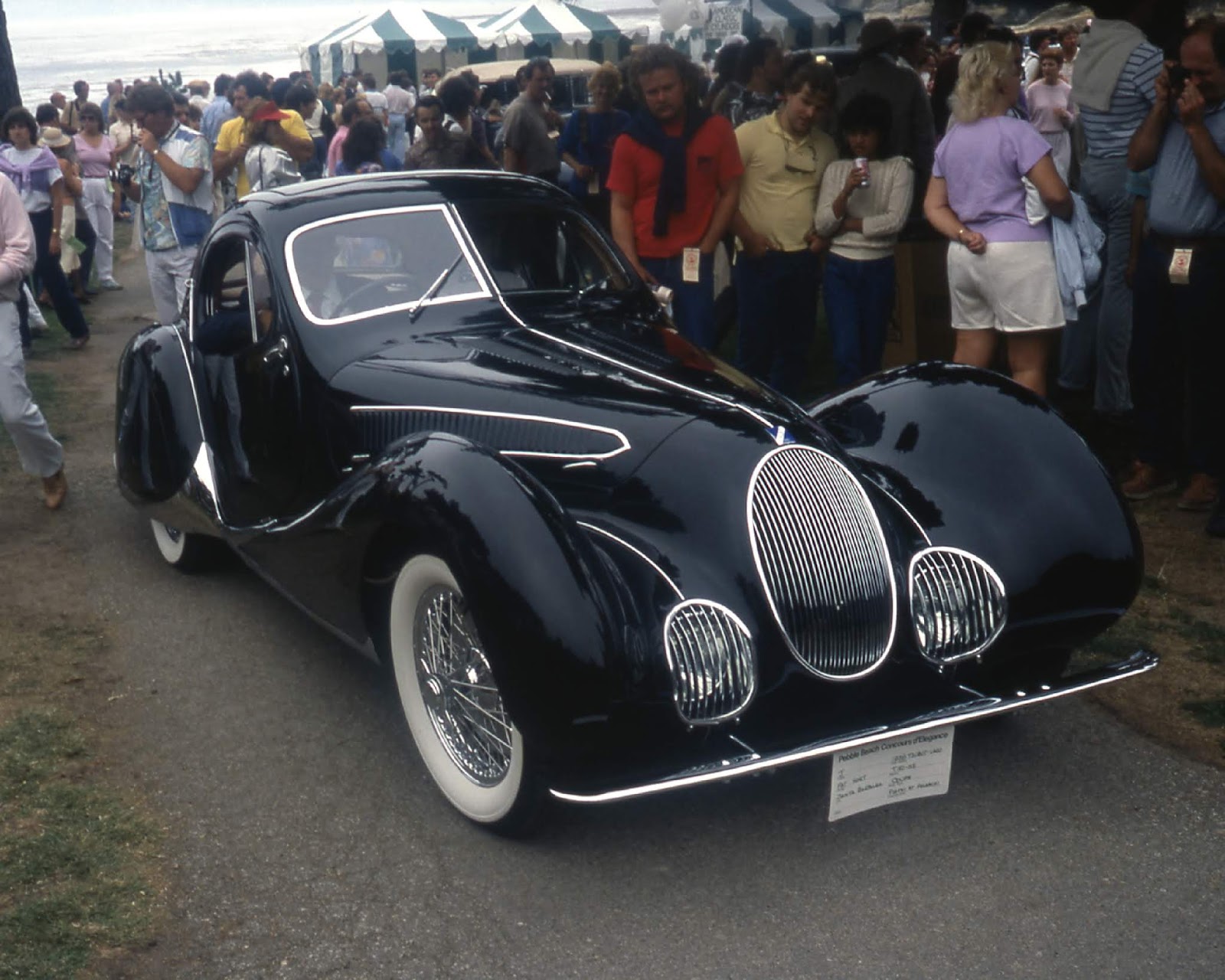
While the fenders, roof, deck and nose are all hand-formed compound curves, the hood tricks the eye.  It's really a simple, singly-curved surface...
The engine on all these cars is an overhead-valve inline six of just under 4 liters. Transmission was a four-speed pre-selector. A fastback Teardrop coupe like the one above took 2nd place in the 1938 running of the Le Mans 24 Hours.  Around two dozen Talbot Lagos would leave F & F shops with these design themes, including fastback Teardrops, semi-fastbacks and cabriolets.  Then war would halt all progress.
Early examples of what came to be called the Teardrop coupe were built in a semi-fastback design like the one shown above and below.  Named "Jeancart" after the first client, the semi-fastback had a divided rear window, as well as kidney-shaped side windows to differentiate it from the true Teardrops.  Most of the coupes were built with removable metal sunroofs, like this car.  All five Jeancart coupes differed in trim details.  

The close-coupled, 4 passenger (well, 2+2) T23 coupe shown above and below ran with a detuned version of the same 4 liter six that powered the T150SS. This 1938 specimen features a glassier profile than the Teardrop coupes, but shares the subtle chrome accents on the deck fin and fenders.  
Details like trim and lighting differed from car to car. This coupe has tail lights that are especially well-integrated with the fender forms and trim... 
The Figoni & Falaschi badge, however, never lost the stepped, upside-down ziggurat form that came from the Art Deco Twenties...
Along with the coupes, Figoni built  competition roadsters and a handful of cabriolets.  The car below is one of those, on the 1937 Delahaye 135 MS short chassis, with aluminum bodywork, patented retractable windshield and tubular seat frames, and a patented design for enclosed front wheels.  Front fenders flow into the rear as on the Teardrop coupes.  At least one of the Talbot Teardrops is also built with fully enclosed front wheels.
A handful of Delahayes and Talbots were also built with separate teardrop fenders and simplified wheel spats, front and rear.  These reflected ideas by illustrator Geo Ham, who produced posters for road races during this period, often with idealized streamliners hurtling through curves.  The example below is a 1938 Talbot Lago T150C SS.
The much larger Delahaye Type 165 was intended as a luxury cruiser for well-heeled car enthusiasts.  One feature its body design shared with the smaller Figoni-designed Lago and Delahaye 135 cabriolets was the provision of fully-skirted wheels front and rear...

At the front fenders, subtle indentations were hand-formed above the convex teardrops that allow steering clearance for the wheels.
Figoni & Falaschi completed the first of two 165 cabriolets in time for the 1938 Paris Auto Show.  A second car was sent to New York for the 1939 World's Fair, but without crankshaft, connecting rods or pistons.  The second car was completed after World War II.  Both shared a patented windshield that cranked down into the cowl. The deck-mounted dorsal fin derives from previous Figoni designs; the car seems to float on shadows, with barely visible wheels...

Though this essay is mostly about visual form, it would be bad informational form not to point out that the aluminum-block, three-cam V12 engine that powered the Type 165 was derived from the magnesium-block, three-cam V12 that powered the Type 145 Grand Prix single-seater to an upset victory over the German Mercedes team at the 1938 Pau Grand Prix.*  Both engines were 4.5 liters, but the racer got 2 spark plugs per cylinder...
Chrome trim in a wave form decorates the front fender skirts;  the 165 shared its traditional Delahaye grille with lesser models.
One Type 165 cabriolet was stranded, along with a Delage and other exhibits, at the French Pavilion of the New York World's Fair in 1940 when Nazi troops invaded France.  After the Second World War, French government plans to reorganize the automobile industry, along with higher taxes on luxury cars and a waning aristocracy, contracted the market for custom, coachbuilt cars.
Figoni showed the above coupe with removable roof panel on the Delahaye 175 chassis at the Paris Salon in 1947. The 4.5 liter car was a new model for Delahaye, and the flowing, full-width fully-enveloping bodywork was Figoni's first attempt to produce a new form for the postwar car. The widest point of the cabin is across the seating area, with nearly flush sides at that point, but this is concealed by the downward flow of the front fender forms across the doors, avoiding the slab-sided look of early envelope bodies. F & F built at least one cabriolet to a similar design during this period...
...and one of the rare postwar coupes was converted to a convertible decades later. 


The unique body on the new 4.5 liter Talbot Lago Grand Sport, from 1949, is an even braver attempt to predict the future.  The sides are flush, with visual interest created by the window shapes, proportions and contours.  A busy grille and over-decorated nose misses the purity of the pre-war Teardrops, but the car is startling when compared to most postwar designs...
The design is more successful at the rear, where the elliptical fins of the rear fenders extend into the roof.  Elliptical side windows echo the prewar Teardrop coupes, as do the wave form trims at the body sills.  This is perhaps the first postwar design where the body sides are completely flush, predicting themes that would be explored in a couple of decades by designers like Giorgetto Giugiaro.  Only one of these Talbot Lago coupes would be built in this style by Figoni.  More conventional Figoni bodies were were built on Delahaye, Citroen, and even Simca chassis in this period, but Figoni could not compete with the more cost-effective series production of competitors like Facel Metallon. Faced with declining orders and a disappearing French luxury car industry, Figoni suspended operations in 1955.

*Footnote:
Talbot Lagos with special bodies were presented in our posts "The French Line Part 1" (bodies by Marcel Pourtout, 1-17-20) and "The French Line Part 4" (bodies by Jacques Saoutchik, 3-8-20). Designs by Henri Chapron for Delahaye and Delage were reviewed in "The French Line Part 3" (2-12-20). Delahayes were featured in "Golden Days of Delahayes" from 6-30-18, and also in "Dreyfus and the Million-Franc Delahaye vs. the Third Reich" from 11-22-15.  

Photo Credits
Top thru 4th from top:  the author                     
5th thru 8th:  George Havelka 
9th thru 12th:   the author
13th thru 15th:  Linda La Fond
16th & 17th:  George Havelka
18th:  Ian Avery-DeWitt
19th:  wikimedia (photo by Zinc)
20th thru 22nd:  the author
23rd thru 25th:  George Havelka 
26th:  classiccarcatalogue.com
27th:  Carven, reproduced on coachbuildforum.com
28th:  enwheelsage.com
29th & bottom:  flickr.com

Sunday, May 31, 2020

Lost Roadside Attraction: Chicago's Century of Progress, 1933

Their century was already old enough to have seen a world war, a pandemic and a worldwide depression, but young enough to foster hopes of a brighter future through democracy, industry and technology.  So, in the worst year of the worst depression in living memory, the people of Chicago put on a World's Fair called the Century of Progress. Celebrating the first 100 years of their metropolis, the Fair ran from May 27 to November 12, 1933 and May 26 to October 31, 1934.  The original plan had been to run the Fair for only a year, but its great popularity prompted the organizers to extend the run for another year. The NAACP and African American legislators won rules prohibiting racial discrimination at the Fair, in return for extending the run. The promise of the Fair was that despite the privations of the Great Depression, science and technology would build a bright future that was just around the corner...

The era of streamlined trains began with the Chicago Fair, including a record run from Denver to Chicago by the Burlington Zephyr and the exhibit of the Union Pacific's aerodynamic M-10000. The Travel and Transport Building shown beyond the trains was designed by Bennet, Burnham and Holabird, and featured the first catenary, cable-supported roof structure in the United States. Airborne visitors included a two-hour appearance over Lake Michigan by the Graf Zeppelin, and a trans-Atlantic airplane flight from Italy by Italo Balbo which stopped on the east coast and continued to the Century of Progress.
Inventor and visionary R. Buckminster Fuller demonstrated his Dymaxion* car.  One of the few cars ever designed with a rear engine and front-wheel drive, it exhibited strange handling characteristics resulting from the extreme rearward weight bias, the driven front wheels and the single rear wheel, the only wheel that steered.  An accident on Lake Shore Drive prompted Fuller to require special instruction for anyone seeking to drive the Dymaxions.
Completed for the second year of the exhibit, architect George Fred Keck's Crystal House was perhaps the most visionary building at the Century of Progress.  Anticipating the exoskeletons of buildings like the Pompidou Center in Paris which appeared 4 decades later, the steel-structured, transparent cube posited a house made largely of prefabricated components.  In this night-time shot, a Dymaxion prototype slumbers in the translucent garage...
The year before, Keck had stunned the crowds with his House of Tomorrow, a largely transparent 12-sided polygon with two stories of living space atop a garage and utility level that offered power-operated garage doors.  The passive solar house featured the first General Electric dishwasher. 
Sitting in the drive of the House of Tomorrow in these two photos is the Pierce Silver Arrow, which must have seemed like a visitor from another time to fairgoers.  Designed by Phil Wright and built in record time for the New York Auto Show,  the V12-powered sedan explored themes that wouldn't show up on any American production cars until the second half of the next decade. These themes included front fenders flowing into the passenger cabin, allowing more seating width and eliminating running boards. Windshield and backlight are  "V"-shaped in plan, echoing the plan shape of the radiator, one of the few traditional references on this car.  The spare tire is concealed behind a panel in the front fender, while the headlights, which Pierce Arrow had integrated with fenders on its earlier cars, here are housed in a streamlined tube that runs all the way to the contrasting color molding that surrounds the windows.  Five of these SIlver Arrow concept cars would be built, and offered to the public at $10,000 apiece.
Henry Ford was initially opposed to building an exhibit when planning for the Century of Progress began in 1928.  He may have had other things on his mind, having launched the Model A the previous year.  Positive publicity attracted by General Motors plans to exhibit an automobile assembly line eventually caused him to grudgingly endorse an exhibit.  Architect Albert Kahn, creator of modern Detroit manufacturing plants, designed the giant Ford exhibit hall with its main rotunda echoing the theme of a gear wheel.  Two dozen 5000 watt projectors hurled pillars of light into the night sky.  Inside the rotunda, 67 vehicles summarized the history of wheeled vehicles, beginning with an Egyptian chariot.  Contrary to Henry's predictions, Ford's exhibit was the most popular of the two dozen companies represented at the Fair. Building exteriors were colorful, in contrast to the White City of the 1893 Chicago Fair, and led to the Century of Progress being called the Rainbow City.
John Tjaarda, designer of the 1936 Lincoln Zephyr and father of Tom Tjaarda*, designer of the Fiat 124 Spider and Ford Fiesta, produced a radical design for the Briggs Body Company's Dream Car. Featuring unitized body construction, a rear-mounted Ford V8, and an automatic transmission, the car paralleled the Czech Tatra*, a rear-engined V8 developed around the same time.  Ford applied early use of consumer surveys when it exhibited this car as a possible future Lincoln at the Fair, and concluded that American drivers wanted streamlining, but not rear engines, and not the steeply sloping nose of the Dream Car.  What they got in 1936 was Tjaarda's design for the Lincoln Zephyr, which kept the streamlining but moved the engine, now a V12, to the front.
General Motors took a more conservative approach with their Cadillac V16 coupe, which nevertheless predicted GM's design direction for the second half of the decade.  Fleetwood would build six more of these close-coupled coupes on the V16 chassis.
Nash Kelvinator, headquartered in Kenosha, Wisconsin, sent a fleet of its newest cars to outfit a display of a new idea for crowded cities, the elevator-equipped garage.  The glass-walled elevator tower could bring up new vehicles for display from subterranean storage...


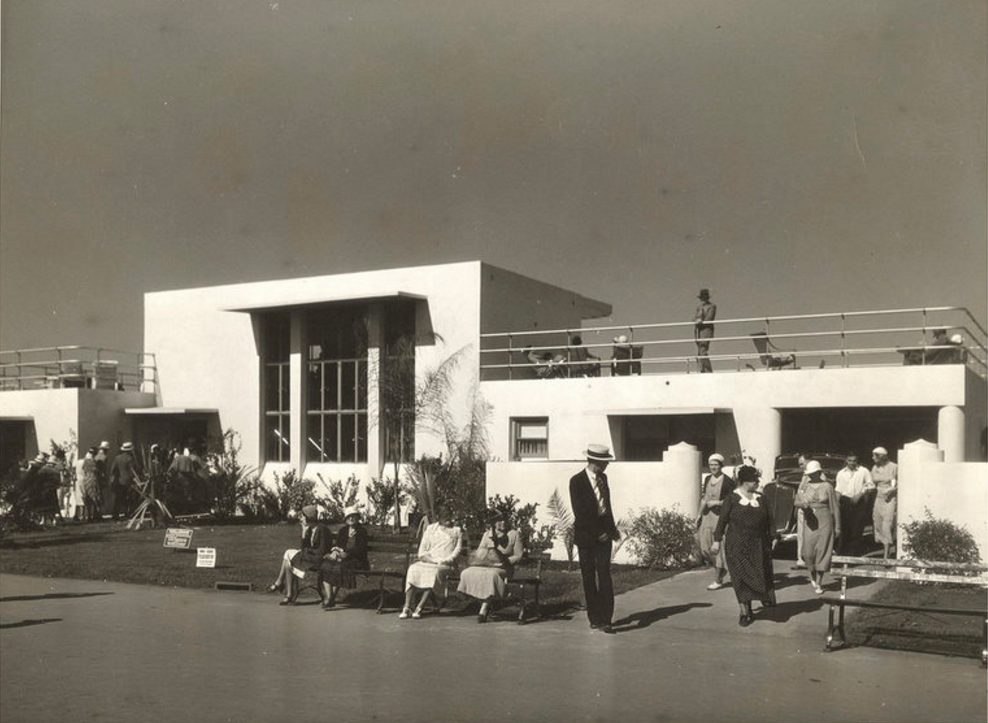
Real estate development had begun to change the environment of what had been quiet wilderness in Florida during the boom of the Twenties, so the Florida House was one of the dozen modern prototype houses on display.  The design, by architect Robert Law Weed, featured generous glazing, flat roofs and broad terraces, and undoubtedly encouraged dreams of tropical escape by Chicagoans familiar with icy, snowbound winters...

Another kind of escapism was sponsored by the Indiana firm of Auburn-Cord-Duesenberg. The Duesenberg SJ Twenty Grand Torpedo Sedan was designed by Gordon Buehrig and built by Rollston specially for the fair.  It was named after its price, which would have bought nearly four dozen of the base model Ford V8s introduced the previous year.  Buehrig's design for the bid Duesy looks back to the Roaring Twenties with emphasis on separate elements like the sweeping, open fenders, external exhausts, side-mounted spare tires, and free-standing headlights.  These elements make a striking contrast with the Pierce Silver Arrow, where the front fenders flow directly into the doors, enclosing the headlights and hiding the side-mounted spares. Only the Twenty Grand's low-roofed cabin, with its sloping "V" windshield and notchback rear, seems to belong to the Thirties.  Buehrig would issue his answer, and A-C-D's, to the fair's concept cars with his groundbreaking design for the Cord 810*, which appeared in November 1935 and went into series production the next year.
Architect Walter Schuler designed the Wieboldt-Rostone House to showcase a new building material called Rostone, composed of limestone waste, shale and alkaline earth. The resulting precast panels were bolted to a steel frame.  The massing, sheer surfaces, and reliance on window shapes for decoration reflects Art Moderne influence*.  The exterior panels deteriorated by the 1950s, and the house was re-surfaced in another precast material.  A dozen buildings, including the Wieboldt-Rostone House, the House of Tomorrow and three others from the Homes of Tomorrow exhibit, were purchased by a developer  and moved to Beverly Shores in Indiana after the exhibit closed.  
This move wasn't possible for the house designed by Chicago architect Andrew Nicholas Rebori for the Brick Manufacturers Association. The forms Rebori created were compact, full of spatial intrigue, and more suited to an urban environment than the sprawling Florida house.  Rebori exploited the potential of brick in the articulated surface treatments at the base, the porthole window and around the cantilevered balconies, and used sharply delineated mass to cast sharp shadows, as at the stairway which passed under a square arch on its way to a rooftop terrace...
Packard's Model 1106 Sport Coupe was voted Best of Show among the new car designs.  It was one of two designs created on Packard's short-wheelbase V12-powered chassis by Le Baron. The open Runabout Speedster model, which shared the pontoon fenders connected by curved running boards (these were deleted on at least one), was actually built by Le Baron, while the teardrop-windowed coupe shown was built at the Packard factory in Detroit.  No more than four Sport Coupes were made, joining no more than half a dozen Speedsters.

By contrast, assembly-line production techniques were envisioned by architect Robert Smith Jr. of Cleveland for the Armco-Ferro house, the only surviving Homes of Tomorrow exhibit which actually met the criteria established by the Fair Committee, which were for a design which could be mass-produced and sold at a price affordable to families of modest means. Seen against the backdrop of our current housing shortage, the Armco-Ferro is intriguing. It was bolted together from enameled, insulated steel panels with corrugations to add stiffness, forming structure and enclosure at once. The Armco-Ferro might have provided a new product for idled automobile factories during the depths of the Great Depression, and thus put enough people to work that they could afford to buy one.  Instead, it inspired the Lustron homes for a short period during the housing shortage after World War II.  These houses, along with a series of gas stations built by Sunoco, also featured enameled steel panels...
In addition to all the serious efforts to advance innovation in design and engineering at the Century of Progress, there was also plenty of show business.  Studebaker's team traveled from South Bend, Indiana to assemble this giant model of the 1934 Studebaker* Land Cruiser for the fair, despite the fact that the company had gone bankrupt a mere two months before it opened. Concealed in the base of the Land Cruiser display was an 80-seat auditorium. The company was reorganized by a new management team, which discontinued the entry-level Rockne line and sold Pierce-Arrow, which had merged with Studebaker in 1928.  While this move erased Studebaker's bragging rights to the Pierce Silver Arrow at the House of Tomorrow, it allowed the company to move into the late Thirties with new designs by Raymond Loewy. By the end of the that decade, war dashed the hope of universal progress through democracy and technology expressed at the Century of Progress, and the ingenuity and resourcefulness that built the fair (and the New York World's Fair* in 1939-40) was called upon to build thousands of tanks, planes and ships instead of affordable cars and  houses.  Studebaker, Packard, GM and Ford would all suspend car production for more urgent business of the war that, instead of the brighter world promised by the Fair, was around the corner and just down the road from the Rainbow City...
*Footnote:  Fuller's Dymaxion is detailed in these posts in "Architect-Designed Cars Part 1" from 5-7-17. We presented a survey of prefabricated house designs exhibited at New York's Museum of Modern Art in our post entitled "Mobile vs. Prefab" on 8/3/17.  Tom Tjaarda's designs were given a retrospective in "Architect-Designed Cars Part 4" on 5/11/20. Tatra automobiles have been featured once in "A Word About VW" (11/27/15) and pictured on two other occasions: "When Mobile Homes Were Really Mobile" (7/30/17) and "Roadside Attraction: Rolling Sculpture" (12/31/16).  A Cadillac V16 bodied by Pinin Farina is featured with later Caddies in "Jets vs. Sharks: Pinin Farina Cadillacs" in the Archives for 5/15/16.  The Cord 810, Studebakers and other cars built in Indiana are surveyed in "Looking Back: When Indy Was Indie" from 9/1/15.  And we featured the Phantom Corsair, a car based on that Cord 's drivetrain and exhibited at the New York World's Fair in 1939, in "Phantom Corsair: Shadows Over Tomorrowland", posted July 17, 2016.

*Postscript:  One reader e-mailed to say the Wieboldt-Rostone House looked like a mausoleum, and this made a connection with a subconscious impression that I hadn't been able to name.  The style of the house, with its sparse decoration, geometric windows, and absence of humor, could easily have served as a template for many of the mausoleums that were built in the Chicago suburbs after World War II.  

Photo Credits
Top:  architecture.org
2nd:  Encyclopedia of Chicago
3rd & 4th:   Hedrich Blessing Collection, from Chicago History Museum
5th:  pinterest.com
6th:  chicagology.com
7th:  motorcities.org
8th:  General Motors
9th:  Kaufmann-Fabry Agency, from Chicago History Museum
10th:  Nash Kelvinator, from theoldmotor.com
11th:  archiveofaffinities.tumblr.com
12th:  customcarchronicle.com
13th:  visitindiana.com
14th:  Packard Motor Company, from theoldmotor.com
15th:  indianalandmarks.org
Bottom:  motorcities.org