Featured Post

Wednesday, August 25, 2021

Monterey Auctions 2021: Notes on Value, and Whether It Matters

It's been awhile since we started this run of essays with a look at the Monterey Car Weekend auction results in 2015*. For our 6th anniversary we're having another look. There have, after all, been some changes in the state of the world in the last six years. Indeed, the very weekend that the auctions were held, a powerful earthquake racked Haiti, the Taliban moved on Kabul, and the largest single fire in California history continued to threaten wild lands and firefighters. You could be forgiven for failing to notice that somebody paid $20.4 million for a car on that weekend, or if you noticed, for forgetting about it almost immediately…

The pricey car in question was a 1995 McLaren F1 with just over 240 miles on the clock. Built from 1992 into 1998, Gordon Murray's concept for the F1 was a tidy package, with the central driver position ahead of the BMW V12 flanked by two passenger seats. Stylist Peter Stevens put the driver's seat a bit ahead of the passengers, and provided access through dihedral doors with indented air extractors. McLaren built 65 road-going F1s and another 41 racers, including the car that won Le Mans in 1995.  Structured with a carbon-fiber monocoque and weighing only a couple hundred pounds more than the original Mazda Miata, the F1 was famed for a kind of minimalism, eschewing trendy features like anti-lock brakes, traction control, and all-wheel drive. Sticker price (a cool million bucks) and power (5.5 times that early Miata) were non-minimal, though. It was a car designed to be driven…too bad, then, that the auction car almost never was. 242 miles in 26 years places it in the category of rolling sculpture, not car. The auction F1 was metallic brown, but we're showing you a green one because it's prettier.  For twenty million you should get whatever color you like…

Back in 2015 we selected 4 cars that said something about this trend toward valuing production cars as rolling art.  These included a late Series 1 E-Type Jaguar coupe from 1967 in excellent condition that sold for $80,000; this prompted a comment that this price might seem like a bargain in a few years.  The wait wasn't that long, but the $318,500 bid that took home this pristine '64 coupe (3.8 liter engine, upgrade from grumpy Moss 4-speed to 5 speed Tremec) nearly doubled Gooding's top estimate of $160,000, and was a surprise.  Rarity cannot be the explanation; Jaguar built 7,669 of the 3.8 liter coupes.


Another car of interest was a 1973 BMW 3.0 CS; collectors were just beginning to notice these six years ago.  Our 2015 auction example sold for $32,500; we wondered if the non-original 3.5 liter engine and 5 speed transmission helped or hurt.  For this year's auction CS the 3.8 liter engine upgrade and 5 speed cannot have hurt; the Karmann-bodied Bimmer crossed RM Sotheby's auction block for $201,600. The catalog helpfully notes that a tool kit went with it.  One hopes the new owner won't need it anytime soon...

We move on to land yachts.  The '48 Chrysler Town & Country convertible came close to defining the term, and its well-varnished condition made it seem a decent purchase, if not a surprising bargain, at $95,200.  Back in 2015 the '64 Imperial convertible below seemed a deal at $42K, a rarity in fine condition.  We couldn't find one listed this year, however, and recent auction prices show a price slide, while the similar Continental 4-door convertibles, also styled by Elwood Engel, are finally attracting some interest; 2 examples went for around $50k. By the way, if you guessed the old wood-panelled ragtop rarer than the blue Imperial, you were wrong.  Chrysler built 3,309 of the '48 T & C convertibles, and only 922 Imperial convertibles for 1964.
After the 2015 Monterey auctions one big surprise was that a 1937 Cord 812*, a sedan cousin to the open Sportsman below, sold for $42,000, a lot less than one of the old Toyota Land Cruisers on offer. If there was a bargain at the 2015 Monterey weekend, the Cord was it. It may be that though there are even fewer people around now that remember these cars when new, collectors are doing a reappraisal of Gordon Buehrig's design for these front-drive V8s...
Mecum's red Sportsman is still the subject of post-auction negotiations with the price now at $250k, while someone took home their black '37 Westchester sedan for $71,500.  It's one of 125 unsold '36 model 810s renumbered as 812s.  For some reason, Mecum chose to photograph the car only with the retractable headlights (a unique feature in 1936) in the up position.  The car looks much cleaner with the lights retracted, as on the Sportsman above.

The Westchester sedan with the fastback design was the most popular of the Cords and one of the cleanest. Lacking the external chromed exhausts of the supercharged cars and bustle trunk of some Cord Beverly sedans, it has a simplicity that appealed to designers, and curator Arthur Drexler selected one for MOMA's groundbreaking Eight Automobiles show in 1951. This show was the first time series-produced cars were displayed as art.  But even Arthur Drexler might be surprised at the prospect of a twenty-million dollar, perhaps never-to-be-driven car...
No tour of a Buehrig Cord would be complete without a view of the interior.  The dash design, with its full complement of instruments in an engine-turned stainless panel, remains one of the most memorable of any car.  The cranks at each end of the dash operate the retractable headlights, and the tiny chromed levers on the stalk extending from the wheel operates the 4-speed Bendix pre-selector transmission.
Another car built by one of the Indiana independents*, the 1931 Stutz MB at Gooding seemed like a good deal at $78.4K.  All Stutz* cars are rare enough to be special, and the condition of this specimen was convincing.  Most convincing, though, was the comparison with Gooding's other Stutz, a '31 SV-16 that was essentially a bare chassis with engine, gearbox, radiator and wheels. This went for $134.4K... 
But the best deal at these auctions was likely this 1949 Salmson S4-61.  Fully restored in a cheery egg yolk yellow over cream, and with a bright red interior, it's a reminder that French car makers are unafraid of color, and unafraid of expensive engineering...
The view under the hood offers a surprise to the uninitiated; twin overhead cams operate inclined valves in hemispherical combustion chambers on the inline four.  This is a 1.7 liter engine, but Salmson also built the same design in a 2.3 liter for S4-E sedans and their 2300S* GT car, a contemporary of the Alfa 1900.  Salmson pioneered dual overhead cam engines in the upper medium price class in 1932, over a decade and a half earlier than that four-cylinder Alfa Romeo, or the Jaguar XK120.  Shifting was by a 4-speed manual on the column; many Salmsons featured the Cotal pre-selector transmission, optional from 1934 on.  Like Delage and unlike Bugatti, Salmson was an early adopter of independent front suspension and hydraulic brakes. There was briefly a six-cylinder twin cam, and one was also offered by Salmson's British affiliate, but the Depression killed these off.
Like British cars in this class, including the Salmsons built by a British offshoot before the war, French Salmson interiors were lined with leather, elegant fabrics and wood. And most upper-class French cars retained right-hand drive into the Fifties, when all the old-line French luxury makes disappeared. For racers, RHD made sense on clockwise courses. On chauffeur-driven cars, the idea was that the chauffeur could exit at the curb to serve the passengers. But this compact Salmson wasn't intended for racers of chauffeurs.  It was just part of a tradition...
Compared with a nice '60 VW Beetle auctioned at Monterey, then, this little Salmson was a stunning deal. That Beetle featured a tidy repaint and fresh-looking vinyl interior.  But for $9,900 it was like the millions (21 million, really) of other Beetles that once chugged down the world's roads. For $7,700 the savvy buyer of this yellow Salmson got a fully restored, handmade car (one of around 2,000 built) with a Deco lounge interior, and powered by a jewel of a twin-cam engine. For comparison, a non-drivable, rusty 4-cylinder Talbot Lago from this era sold for just under $40K. For the price difference, the Salmson's new owner can afford a color change if yellow on red isn't soothing enough. If this little gem ever shows up at a Cars & Coffee in Silicon Valley or Beverly Hills, it's just about guaranteed to be the only one there. That's not a certainty that even the winning bidder on the McLaren F1 can take to the bank... 

*Footnote:  Our first post covered "A Review of the Monterey Auction Weekend, August 14-16, 2015" and appeared on Aug. 25, 2015.  Gordon Buehrig's pioneering design for Cord's 810 & 812 was featured in these posts in "The First Modern Car? Round Up the Usual Suspects…" from Sept. 26, 2020, and in  "Looking Back: When Indy Was Indie", a profile of Indiana's independent car makers, from Sept. 1, 2015.  Stutz was featured in the same post, and got a retrospective in "Stutz: The Car that Made Good in a Day", from Dec. 30, 2019.  Sports cars from the undeservedly obscure Salmson concern received a profile in "Forgotten Classic: Salmson 2300S", posted June 18, 2016.

Photo Credits:
Top:  the author 
2nd:  Gooding & Company
3rd:  bringatrailer.com
11th (Stutz):  Gooding & Company 
All other photos: Mecum Auctions

Friday, August 13, 2021

Forgotten Classics: Designed by John Tojeiro


To Blog Subscribers:  This is our first post under a new system, after a brief summer break. Our blog host has notified us that after July, subscribers will not be automatically notified of new posts, so we have managed to obtain a list of e-mail addresses for just over 3/4 of you. If you are not getting notices of what's new and would like to stay informed, please post in the Comments section, or e-mail to robert@poeschlarchitecture.com. If you'd like to unsubscribe, you can take the same approach.  
The car pictured above may look vaguely familiar to a vintage road racing fan…or a road racing fan of a certain vintage.  The low nose, covered headlights, and elliptical air intake remind you of a D-Type Jaguar, don't they?  The high, rounded tail reminds you of the Lotus Eleven. The knock-off, slotted disc wheels look British, but the body is painted in Scottish racing colors.  When you find out that it's really a Tojeiro, you wonder if that's some kind of etceterini...
But the '58 Tojeiro Jaguar at the top, like the first Tojeiro ever (powered by MG, above) was built in the Mother Country.  John Tojeiro was born in Portugal of Portuguese and English parents in 1923, and moved to England soon after.  Serving as an engineer in the Fleet Air Arm during World War 2, he began to engineer special chassis for racers not long afterwards, beginning with an MG-based car.  Soon there would be a Bristol-engined car for car dealer Cliff Davis as well...
The Bristol-engined special is #76 above; the MG is #62.  They both share an alloy-paneled body design clearly based upon the Ferrari 166 Barchetta by Superleggera Touring.  The use of cast alloy wheels is predictive.  The cars also share a simple tube chassis with independent suspension by transverse leaf springs, front and rear...
When management at AC Cars saw Tojeiro's chassis, they thought it might form the basis for a modern follow-up to their prewar Ace* using their overhead cam, long-stroke 2 liter six. They showed a prototype at the London Motor Show in 1953, and put the car into production in 1954, with body refinements by stylist Alan Turner including raised headlights over a now-famous "mustache" grille, a slightly taller deck and rear fenders, and most important, the option of the more powerful Bristol six in 1956.  The result was among the most graceful production cars of the era, and possibly ever...
The car soon became a favorite with weekend racers in England and in the US... 
And in 1962, when American Carroll Shelby replaced the Bristol and AC engines with a Ford V8 to make the first Cobra*, the car retained its Tojeiro chassis design, with 4 wheel independent suspension by transverse leaf springs, but now with disc brakes on all 4 wheels. The first Cobra completed by Shelby is shown below...
After licensing his original design to AC Cars, Tojeiro continued to refine it, supplying privateers with cars focused on club racing, like the 1954 Tojeiro Bristol below.  Built on a lightweight tubular chassis with De Dion rear suspension, it sits on an 87 inch wheelbase, 3 inches shorter than Tojeiro's Ace design.   The tall, long-stroke Bristol six hides under the hood blister, well back in the chassis.
In search of more power and lower profiles, Tojeiro eventually adopted Jaguar engines, and designed a space-frame chassis to handle the greater power. The alloy-bodied example below was built in 1957.  Note that it has a lower tail, wire wheels, and a more conventional profile than the blue 1958 car in the top photo.  By this time other specialists like HWM* and Lister had adopted Jaguar power, and the race was on to extract maximum advantage from aerodynamics, weight reductions...
…and adoption of the dry-sump D-Type engine with its wide-angle head, which Jaguar sold to outside specialists after closing down its factory-sponsored racing program in 1957.  The car below was built a year later.
Meanwhile, AC Cars had called on Tojeiro to design a more focused road racer than their production Ace Bristol, and the result was the LM 5000 which took 8th place at Le Mans in 1958, and competed that fall at Goodwood.  While the tall Bristol 100 / D2 engine forced body designer Cavendish Morton and builder Maurice Gomm to deploy a hood blister, the low nose, covered headlights and high tail recall contemporary designs like the Lotus 11.

In the same year, Maurice Gomm produced the even sleeker alloy body for the Tojeiro Climax Mk. 2 below.  The 1,100 cc Mark 2 featured a new lightweight tubular chassis and a leaned-over Climax FWA engine to create the low-profile nose and uninterrupted hood line.  
Despite real success on the track (one car scored 4 wins and 5 podiums in 1959), the Tojeiro Mk. 2 only sold in 4 copies, far fewer than the competition from Lotus, Lola and Elva.  Too bad, as it may be one of the most elegant front-engined racers ever...
Like the 1958 car in the top photo, the 1959 Jaguar E-E was commissioned by the Scottish Racing Team, Ecurie Ecosse.  It also features a De Dion rear axle, and while a hood blister was not required for the original 3 liter "short block" engine based upon the Jaguar 2.4, that engine failed in competition, and the hood bulge was added to accommodate a tall-block based on the 3.8 liter unit, with displacement reduced to 3 liters to meet the 1959 rules.  Note the low wheel arches, also a feature of the Tojeiro Mk. 2, Lotus 15 & 17, and of the last Lister Jags. 
With the Climax Mk II and the '59 Ecurie Ecosse Jag, Tojeiro had perhaps taken the front-engined format to its lowest-profile conclusion. After Formula Junior, another attempt at low-cost racing for Everyman, began to enjoy popularity in the early 60s, Tojeiro produced a mid-engined Formula Junior chassis in the Cooper and Lotus mold, along with some Formula 2 chassis...
The Formula 2 chassis was the basis for a mid-engined GT racer that appeared about a year before the better-known Lola GT* and 2 years before the wildly famous Ford GT40. Initially Tojeiro built 2 cars for Ecurie Ecosse with Climax 2.5 liter fours and the same transmissions used in the Cooper Monaco.  Gearbox and engine woes prevented success at the '62 Le Mans and Monza, and in the search for durability, the Climax fours were switched for the 3.5 liter aluminum Buick V8s, originally with modified Corvair transmissions.  Eventually Jackie Stewart won a race at Charterhall in 1963 with a Tojeiro Buick, and one of the cars was re-engined with a Ford V8.  One coupe was converted to a better-looking roadster, but after a disastrous crash it's been returned to coupe form, and has hit the show circuit with its sister coupe.  Along with the single seaters and all the postwar AC 2-seaters from Ace through 289 Cobra, they are a testament to the resourcefulness and persistence of John Tojeiro.
*Footnote:  We told the history of Tojeiro's design for the postwar AC Ace in "Happy Accidents with Bristol Power", the first of a 4-part series on AC Cars, posted Dec. 24, 2016. We visited the AC Cobras in "Roadside Attraction—Shelby American Collection Part 1: AC and Cobra", on Dec. 28, 2017.  HWM cars received a retrospective in "Forgotten Classic—HWM: Racing into Obscurity" from Nov. 23, 2020.  And we profiled the Lola GT in "1st Impressions at the Monterey Historics: Whatever Lola Wants" on Aug. 28, 2018.

Photo Credits:
Top:  news.cision.com
2nd:  Bonhams
3rd:  laluneta.com.ar
4th:  aceac.weebly.com
5th thru 7th:  the author
8th: wall.alphacoders.com
9th:  flickr.com
10th & 11th: Wikimedia 
12th:  autopuzzles.com
13th & 14th:  Wikimedia
15th:  DK Engineering (dkeng.co.uk)
16th:  flickr.com
17th:  twitter.com


Saturday, July 31, 2021

Classic Cars Go Electric

Yes, that is a Jaguar XK120* from the early 1950s up there.  You may have been expecting an essay on modern electric cars that could turn out to be collector's items (the original Tesla Roadster from 2008-12 for example), but then our title would be "Electric Cars Go Classic." Here we're focusing on older cars that have been retrofitted with fully electric powertrains...
The Lunaz Group, headquarted in a research park near England's storied Silverstone race track, has engineered electric conversions for Jaguar's XK120, 140 and 150 series, an interesting choice because the swoopy curves of the body design never left much space for luggage, let alone battery packs, and the longish engine bay has a narrow bonnet for access.  On this XK120 fixed-head coupe, they fitted an 80 kWh battery pack, and twin electric motors offer the equivalent of 375 hp. The zero to 60 run comes up in 5 seconds, and Lunaz quotes a range of 250 miles.  Lunaz also quotes a price of $435,000...
Perhaps inspired by these privateer examples, Jaguar Land Rover Classic announced a Jaguar E-Type* Zero in autumn of 2017, and hinted that cars similar to these development prototypes might eventually be supplied to customers.  The blue car above is based on a Series 1.5 model from 1968, with electric power unit including battery filling the space and using the mounting points of the original gasoline engine. The idea was that the electric conversion could be easily reversed, as the car's chassis, suspension and brakes remain as in the original.  External clues of the conversion are limited to absence of exhausts, and fitting of LED headlights under the glass covers (which anyway weren't a feature of the Series 1.5 in US form). The car's instrument panel, however, was completely reconfigured to suit the digital age, and the original four-speed gearbox is traded for a simple choice of Forward or Reverse. Range on the blue car was about 170 miles at full load, with 0 to 100 kmh (62 mph) coming up in 5.5 seconds. Intriguingly, weight was about 100 lb. less than before conversion. Despite enthusiastic reviews from the press and from test consumers the Duke and Duchess of Sussex, Jaguar suspended this project in late 2019. It's not clear whether there was an insufficient supply of Series 1 and 1.5 chassis, or whether updating the original design to meet applicable crash and safety standards so the Zero could be offered as a new car, rather than as a retrofitted old one, presented the biggest hurdle...
Meanwhile, Lunaz also has performed all-electric conversions on the original 70s Range Rover as well as the vast Rolls-Royce Phantom and more svelte Bentley Continental Flying Spur, both from the early Sixties. The Bentley with its close-coupled four-door Mulliner coachwork is particularly fetching.  Price?  If you have to ask...
Also in the UK, Richard Morgan's Electric Classic Cars offers electric conversions on a smaller scale, beginning with the Fiat 500 (a '65 model) shown below.  The 11 kWh battery pack combines with an electric motor 47 hp and 70 ft.-lb. of torque, and the little car has a range of 50 to 75 miles "depending on driving style and conditions", not all that much less than that of the larger, new-style 500e offered until last year by Fiat Chrysler in the United States.  ECC upgrades the brakes to discs, and their electric heater may improve on the one in the original air-cooled two-cylinder...
Electric Classic Cars has also applied its talents to a 1979 Porsche 911 SC Targa that arrived at its workshop in needy condition. The car uses a 54kWh battery mounted at the front, with two electric motors at the rear.  Zero to 60 takes under 6 seconds, and range is around 200 miles. Because there's more weight on the front wheels than in the original car, ECC has installed speed-sensitive power steering.  Unusual for an electric, the ECC 911 keeps its 5-speed gearbox, though as with all electrics, there's so much instantly-available torque that use of the gears is optional.  Modern touches include the LED headlights, while retro ones include bright metal trim around those lights, and 1960s style bright metal door mirrors.  Also, in place of the 911SC badge, there's a 911E badge on the engine lid...
         
Meanwhile, in Southern California, Zelectric has converted a couple of 1968 Porsche 912 coupes to electric power.  This green one uses a Tesla Model S P85 motor.  Weight is only 2,505 pounds. Zelectric quotes range at 120 to 145 miles, "depending upon speed."  And apparently speed is available, because Jay Leno pronounced the Zelectric 912 the most enjoyable electric car he'd driven.  The vented plexiglass rear quarter windows may save a bit of weight and add some style, like the wheels, which are Walker Outlaws.  Zelectric has also converted Type 1 VW Beetles, as well as a Microbus.  Starting with your donor car, Zelectric conversions on 912, 911 and 914 Porsches start at around $88,000.
Because its original mid-engined configuration with large storage below front and rear decks makes for generous battery storage areas, and because its somewhat un-Porsche-like rectangular styling resulted in modest resale value until recently, Porsche's 914* has turned out to be a popular chassis for electric conversions.  Massachusetts Institute of Technology was possibly the pioneer in electric 914 rest-mods, engineering this fully-electric conversion on  a 1974 chassis donated by a professor in 2006, two years before Tesla introduced its Roadster model.  Many 914 conversions have been completed by others since then, and I encountered one of these in Colorado a couple years ago.

Another approach to electric retrofits would be to seek out a car with a well-established, terrible reputation for engine reliability. There would, after all, be fewer twinges of guilt or nostalgia in taking a really bad engine to the metal recycler. Chevrolet's Vega, introduced for the 1971 model year, never recovered from troubles with its OHC four which pioneered (prematurely as it turned out) etched silicon-hardened cylinder bores in its aluminum block, and combined that block with a cast iron head. Troubles included valve guide failures, high oil consumption, overheating, and engine fires. There was a twin-cam Cosworth version, and it has been mostly forgotten along with the base car, as all suffered from early rust problems too. Still, the guaranteed low resale value would mean low initial cost for your starter chassis, and there was a Kammback wagon model which would leave plenty of storage space once you installed the battery pack and motor or motors.  At least one electric Vega has been completed.
Perhaps GM should've realized that cars named "Vega" might suffer from mechanical ennui. Just over a decade earlier, Jean Daninos, chief of the Facel Vega marque, had forsaken the Chrysler V8s in its large GTs for a 1.6 liter DOHC inline four in his new Facellia, a sort of French anti-Alfa. The new power plant, engineered and built by Pont-a-Mousson, which also built Facel's manual transmissions, soon established a record for mechanical suicide, with holes in pistons, inadequate cam bearings, and overheating problems, eventually leading to the company's bankruptcy in 1964. By 1963, Facel Vega had given up on the Post-a-Mousson four and replaced it with the Volvo B18 on its new Facellias.  You could replace it with an electric power unit, though, if you found a rusty Facellia project car in need of rejuvenation. This approach would, like those Chevy Vegas reconfigured with battery packs and electric motors, be an optimistic response to those who believe that whatever trouble starts in Vegas stays in Vegas...
*Footnote:  We posted a brief history of Jaguar's groundbreaking XK120 in "Game Changer: Jaguar X120" on July 16, 2017, and reviewed the E-Type's early evolution in "Racing Improves the Breed", posted Aug. 13, 2017.  Divergent designs for the Porsche 914 received attention in "Porsche 914:  Alternative Visions", posted March 13, 2016.

Photo Credits:
Top & 2 from top:  Lunaz Group 
3rd:  pinterest.com
4th:  Jaguar Land Rover
5th:  Lunaz Group
6th & 7th:  Electric Classic Cars (electricclassiccars.co.uk)
8th:  zelectricmotors.com
9th & 10th:  Massachusetts Institute of Technology
11th:  Chevrolet Division of General Motors
12th:  Wikimedia


Tuesday, July 27, 2021

Classics and Coffee in Downtown Boulder:


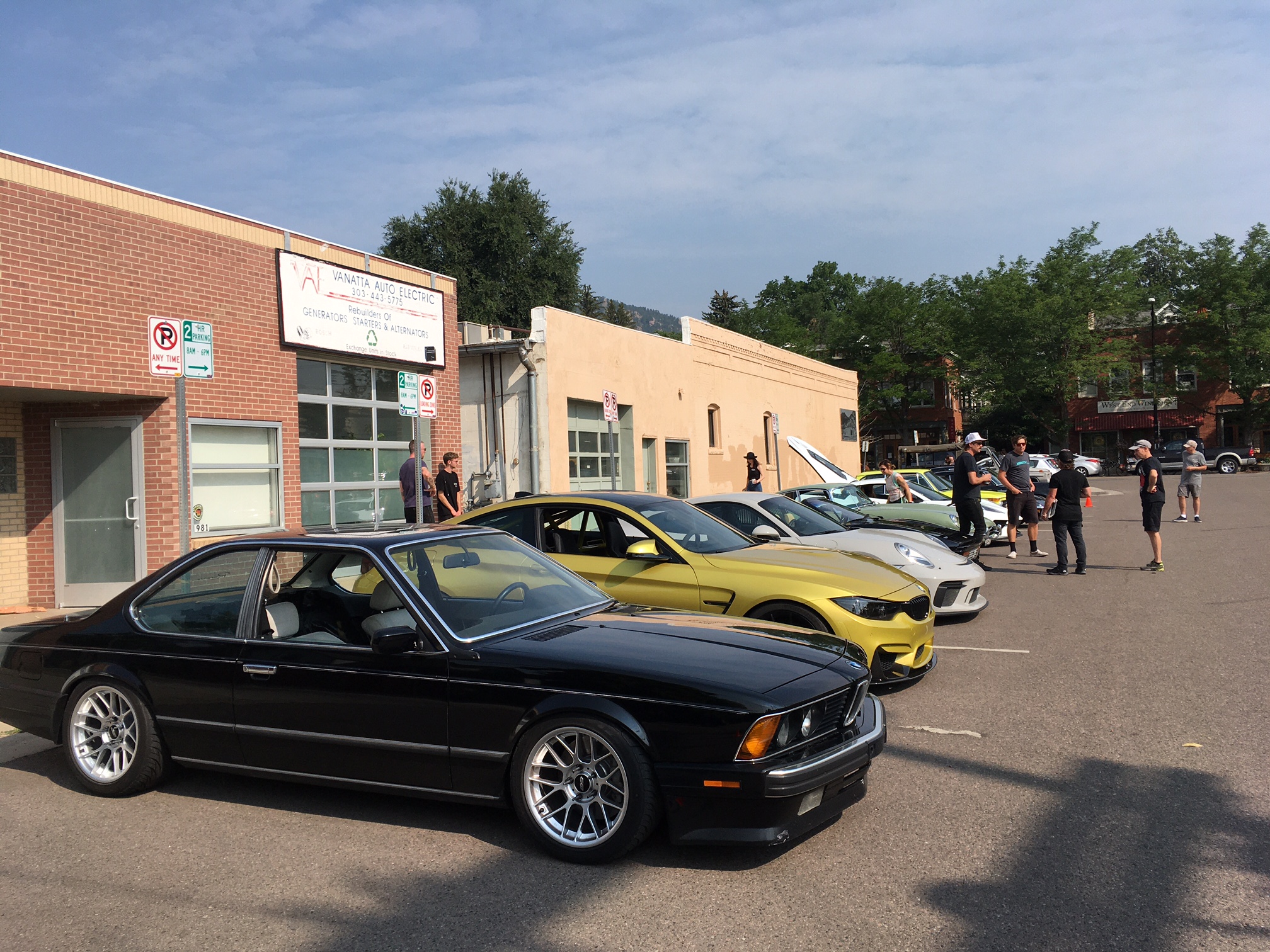
We showed up for our second Classics & Coffee on Sunday, July 25. The event attracted roughly twice as many cars as the June event (we'd missed the May show), but the supply of coffee may have been tighter because of the long line that soon formed outside of Spruce Confections, perhaps drawn by the jazz outfit that took over the Confections courtyard.  Even though the show is focused on European classics, the idea of "classic" gets stretched to include modern cars like that metallic yellow BMW M4 and modified ones like its ancestor E24 coupe in the foreground…
…as welll as Detroit iron (well, fiberglass) like organizer Mike Burroughs' 1970 Corvette with the small block expanded to 383 cubic inches.  A lineal descendant of the SBC powers the new mid-engined Corvette parked down the line; more on that later. 

The lineup included a 991 Series Porsche GT3 in yellow, a more recent 911 in gray, a Ferrari 328 GTS, a late Series 1 E-Type Jaguar, a hot rod Dodge Aspen from the late Seventies, a first-series modified Camaro, and (not pictured) a Puch.  We covered Puchs awhile ago, but we haven't talked about Ferrari V8s.  The 328s are especially appealing...
Ferrari produced the 328 GTB and GTS from 1985-'89 as a refinement of the 308 series, with a transverse mid-mounted aluminum four-cam V8 and 5-speed gearbox behind this cockpit.  Note the gated shift lever, a Ferrari trademark. The 328 was known to be an especially reliable and user-friendly Ferrari, with many engine maintenance functions possible without dropping the power unit.  In that way it is utterly unlike modern mid-engined cars (insert your example here; they all have designed-in access problems).  The owner told me he's done a lot of work on the car himself; it has 70,000 miles on the clock...
Also shiny, black and Italian, this modern Abarth 124 Spider made the trip to Boulder from California when its owner moved here.  Chassis and suspension design on the new Fiat and Abarth 124, introduced in 2017, is shared with the Mazda Miata, while the engine is the Fiat MultiAir turbo inline 4.  
In stock form the 1.4 liter engine made 168 hp; this car has been modified to produce more.  These 124 Spiders, especially the Abarth versions, are fairly rare in the US, and fated to stay that way now that Fiat has dropped out of the American market…again.
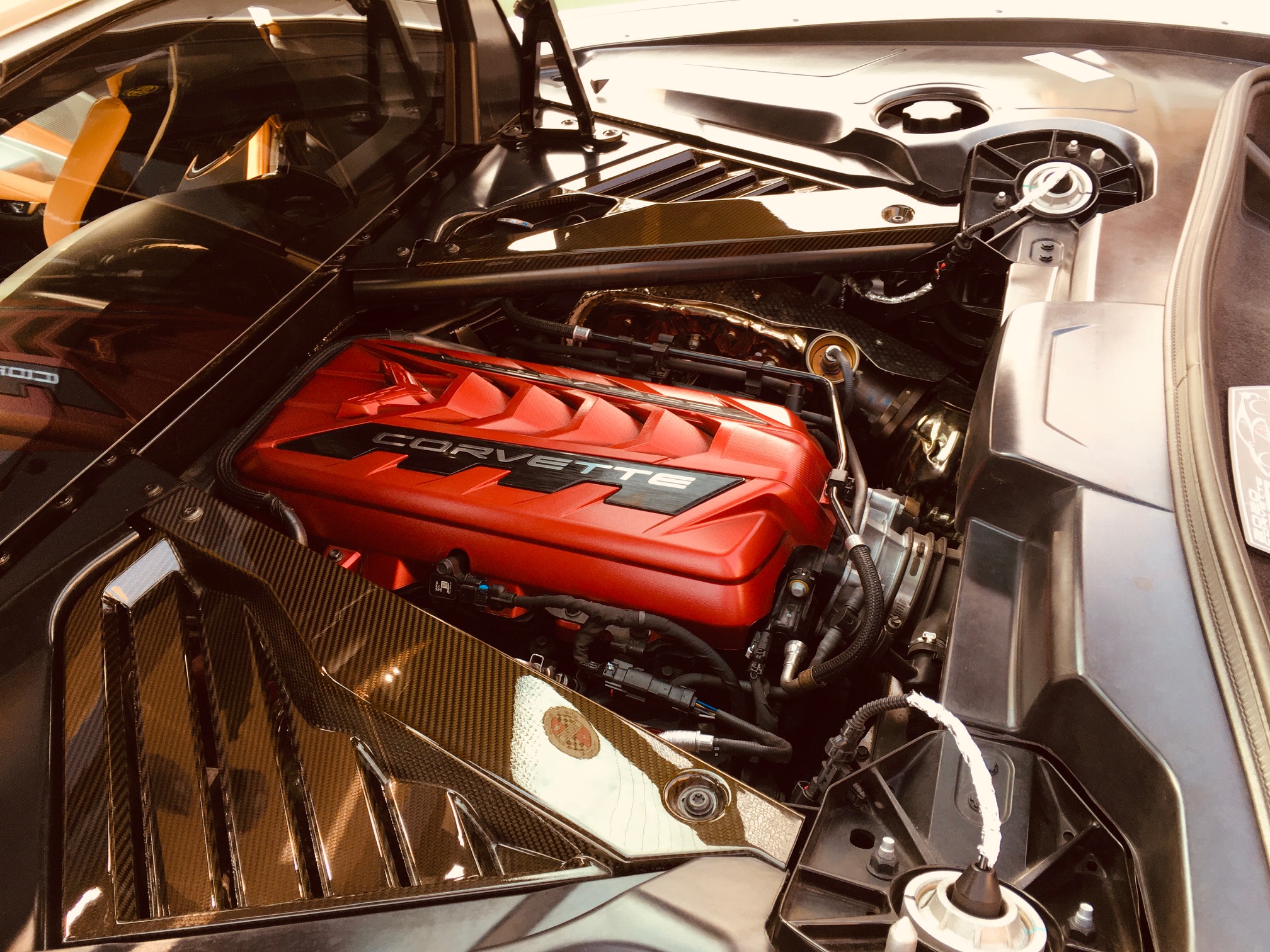
The new mid-engined Corvette C8 created lots of interest, especially when the owner opened the engine lid.  Production of the new car, available in coupe and convertible form, began in February 2020, just before a pandemic distracted human civilization from cars…apparently temporarily. The chassis design features aluminum structure; this keeps weight under 3,400 lb.  The engine placement moves the cockpit forward about 16.5 inches compared with the C7. Like the first Corvette from 1953, which had a 2-speed Powerglide, this one's only available with an automatic, but it's a dual-clutch 8-speed.  Designer Tom Peters has said the transmission choice was made to fit within the structure, which relies on a central tunnel for stiffness.  The owner, however, told me he thinks that tunnel is sized to fit batteries which may be slated to appear in C8 Version 2.0...
The C8 features a small luggage bin behind the engine, and another one ahead of the cabin. Oddly, the displacement of the 495 hp Chevy LT2, at 6.2 liters, is almost the same as the hot-rodder's favorite, the bored and stroked 383 small block sitting in the 1970 Corvette nearby.  In the modern mode, though, engine access is tight, and the attentions of amateur mechanics are deflected by lots of shiny plastic and carbon fiber... 

Engine access was never a problem on the E-Type Jaguar.  This 4.2 liter Series 1 example from 1967 was designed in a period when easy access to the mechanicals was a selling point for weekend racers as well as DIY mechanics.  And the car's biggest target market, Southern California, had plenty of both kinds of buyers. The Series 1 was the first production sports car with 4-wheel disc brakes (inboard at the rear) and 4-wheel independent suspension.  The first E-Type appeared in April 1961, and the twin-cam, aluminum-head inline XK six was replaced in the Series 3 by an aluminum, SOHC V12 exactly ten years later.
Like the Ferrari 328, the body on this Series 4 Alfa Romeo Spider was designed by Pininfarina. It's descended from the Series 1 Duetto on the Giulia chassis which appeared in 1966. The Series 4 went into production in 1990 with 1.6 liter and 2.0 liter versions of the legendary Alfa aluminum twin cam; the US just got the 2.0 liter.  On-board engine diagnostics and Bosch Motronic fuel injectiion were added to familiar Alfa features like 4-wheel disc brakes and a 5-speed gearbox, and an automatic option was added.  The redesigned nose, tail and interior boosted sales, and this essentially 1966 design stayed in production through 1993, with a couple hundred "CE" cars produced for the US and sold as 1994 models.  That's almost as long a production run as the original Porsche 911...
Despite its resemblance to previous models in the 911 Series, the 964 version Porsche introduced in 1989 was claimed by that company to be over 80% new in terms of mechanical content.  The 964 was the first 911 available with all-wheel drive and also the first available with the Tiptronic gearbox. Suspension design was changed as well, with coils replacing torsion bars.  Production gave way to the even smoother-looking 993 version after 1993.  This car, though, is a rare Ruf conversion with special wheels and other mods...
The BMW 2002, launched in 1968, put the struggling manufacturer on the map in the US car market, where it was mostly known for motorcycles. In '71 the 2002tii (Touring International Injection) appeared; 130 hp doesn't sound like much today but it made the 2,300 lb. car a bit of a hot rod.  This recently-restored example came from Montana; the owner noted that only about 10% of the sedans had this car's sunroof option.  Production ended after 1975, and a  Touring hatchback version was offered through 1974, which was also the year the sedans got clunky 5 mph US bumpers and rectangular tail lights...
Perhaps to provide a color-coordinated comparison, an industrial designer brought this modern BMW M4*, an F82 (there's also an F83 convertible). In the tradition of previous BMW coupes, it has an inline six, 3.0 liters like my old '73 CS.  The twin-turbo M4, however, makes over 440 hp. It would make an interesting track-day comparison with the adjacent Porsche and that C8 Corvette. To compete with the noise of all these engines, we recommend that organizers move the jazz from the Spruce courtyard into the garage space at Vanatta Auto Electric.  Then it may be possible to actually hear the music, and get closer to a coffee at Spruce Confections.  The next Classics & Coffee is August 29, from 8 to 10 AM at 8th & Pearl.

*Footnote:  The June edition of Boulder Classics & Coffee was pictured in our post for 7/16/21, along with a session of the Lafayette Cars & Coffee from the pre-pandemic era. "Cars and Coffee in New Canaan" showed up on 10/28/19, and we tried to shed some light on the cultural forebears of the Cars and Coffee movement in "Lost Roadside Attraction:  Before Cars & Coffee There Was Zumbach's", posted 4/11/18.  On the BMW M4, we reviewed the controversial 2021 redesign of the M4 in our post for 6/20/21, entitled "Worst Car Designs Revisited."  

Photo Credits:
All photos are by the author.