Featured Post

Thursday, October 27, 2022

Twilight of the Independents: America's "Small Five" Car Makers in the 50s


In 1954, if you'd wandered into a Kaiser showroom, you might have encountered a fiberglass-bodied 2-seater like the one above. It's a Kaiser Darrin*, a product of the 1953 merger that made Kaiser-Frazer into Kaiser-Willys. A 161 cubic inch Willys* F-head six mounted in Kaiser's compact Henry J chassis provided 95 horsepower, not enough to catch the Corvette from that year, or the Nash-Healey*, or the Jaguar XK120 that sold for a bit less than the Darrin's $3,700 and led this price class.  Styling by namesake designer "Dutch" Darrin, with odd sliding doors, was the main attraction here.  In '54, you could also walk into your Nash showroom and order a Pinin Farina-bodied coupe like the one below; it followed a PF-styled roadster that appeared in '52 to replace the British-styled effort from '51.
Why were America's independent car makers displaying so much interest in 2-seaters?  Well, they'd noticed there was a sports car boomlet going on, ignited by returning GIs who'd seen small roadsters in England, and by postwar prosperity, which allowed more people to purchase a 2nd car for weekend fun, which sometimes extended to amateur road races organized by the Sports Car Club of America.  Crosley had tried an answer to the MG TC with its Hotshot in '49 and Super Sports a year later.  They offered about half the power and the same sketchy weather protection as the MG, but weighed and cost lots less, and so Crosley sold a couple thousand before stopping car production in '52. In the meantime, Jaguar had caught Detroit's attention by offering the XK-120, which took over the market for high performance cars by offering the most speed and style for the dollar.  Enough were sold to prompt Nash to release the Healey in '51, and GM to release Chevy's Corvette in '53.  Both cars originally appeared with the same 102 inch wheelbase as the XK120.  Nash had released its compact Rambler in 1950, and hired designer Pinin Farina to give its 1952 big car line some European flair...
He applied his talents to the Nash-Healey in the same year. The new sports cars generated showroom traffic but not great sales; Nash sold 162 Nash-Healeys in 1953, and mighty GM sold only 300 Corvettes. But the smaller independents needed some way of attracting attention to any offerings with higher profit potential in this period, when a price war between Chevy and Ford was taking sales from entry-level cars from the independents.  The success of the low-priced but nicely-equipped Nash Rambler, about the same size as the expensive Nash-Healey, also suggested their might be an untapped market for smaller cars.
These included Hudson's Jet, introduced for 1953 as an effort to compete with that Rambler, which had sold 160,000 copies in the previous 3 years.  Hudson was best known for the "step-down" fastback sedans and the coupes that were then dominating NASCAR with their low center of gravity and torquey flathead six.  But that design (one is parked next to the blue Jet below) had originally appeared for 1948 and carried into 1954, the year Hudson was absorbed by Nash.  Hudson offered a stripped base model, but prices were not competitive with the Rambler, which offered more standard equipment, or with the "standard size" Chevy and Ford.  Jet sales were not helped by clunky, tall bodywork; Hudson chief A.E. Barit had insisted on headroom for tall men in hats, which gave the 105-inch wheelbase Jet awkward proportions. 
Hudson stylist Frank Spring, father of the "step-down" design, had a different demographic in mind than men in hats when he designed the Hudson Italia* in 1953. The name referred to bodywork built in Italy by Carrozzeria Touring, using their Superleggera system of aluminum panels carried on steel tubing.  The "production" version shared the Jet's 105 inch wheelbase and 114 hp, 202 cubic inch flathead six, which offered only adequate performance considering the car's $4,800 price.  So the Italia didn't appeal to the same crowd as the Jaguar or the Nash-Healey, which could boast of racing success.

Styling included a wraparound windshield, doors wrapping into the roof (at 54 inches tall, the Italia was 7 inches lower than the Jet), a concave deck lid, odd rocket-tube tail lights, and inside, contoured bucket seats facing standard Jet instruments and an inappropriate column shift.  "Production" is in quotation marks because only 25 Italias were offered to the public after Nash took over struggling Hudson in 1954; there was also a lone prototype on a shorter 100 inch wheelbase (which might have helped body flex issues) and one 4-door prototype called X-161.
The 2-seaters from Kaiser, Nash and Hudson were never intended as mass-production showroom draws, but Studebaker's 1953 Starliner* and Starlight coupes were.  The low, sleek, Italian-influenced coupes offered seating for 5 on a 120.5 inch wheelbase, and unlike those others, a modern V8.  Design for the landmark coupes was by Bob Bourke at Raymond Loewy's studios; Loewy stands with the car below.
Unfortunately, Studebaker management tooled up for more of the taller 2 and 4-door sedans than the sexy coupes, and could likely have sold at least twice as many of these as they did.  Still, 106,259 sporty coupes (pillarless Starliner and B-pillar Starlight, Commander V8 and Champion 6 included) is impressive for the two years it was offered.  Any of the other independents likely would've been thrilled by those numbers...


Packard, long associated with solidly built, conservatively engineered and styled cars, tried for a more youthful look on their Caribbean convertible, launched the same year at the Loewy Studebakers. Like Hudson, Packard had stayed with inline, side valve engines in the postwar era, and would only have their V8 ready for 1955. In the meantime, there was this jazzy convertible, a restyle of the new-for-1951 body shell by Richard Teague. No Caribbean hardtops would be offered until 1956, final year of the big Packards. Though they were  among the priciest Packards ($5,400-$6,100), the '53 and '54 Caribbeans were on the 122" Clipper wheelbase, and the '53 version got 180 hp from its 327 cubic inch straight 8 with 7 main bearings.  For '54, the last year for the inline 8, there were 9 main bearings, displacement rose to 359, and horsepower to 212.  Choosing a wheelbase 5" shorter than the big Patrician's was a wise design move, along with the restrained (for the Fifties) use of chrome, which nicely outlined the wheel arches, emphasizing the wire wheels.  The full rear wheel arch was unique to the Caribbean, as was the hood scoop.  
Along with the medium-priced Clipper, Packard offered the Patrician at the top of the line, including the $6,500 Derham-modified Formal Sedan below, one of the old coach builder's last special Packard styles, which featured a retractable divider window between the front and back cabins. Only 25 were built that year; Derham modified similar numbers each year from 1951-54.  Packard also offered a few limousines bodied by Henney.
Packard did better with the Caribbean, selling 750 of the '53 model, and 400 of the '54 shown below.  The '54 version was less effective visually than the '53, losing the full rear wheel arch, and gaining two-toning and chrome that ignored the fender forms.  Packard merged with Studebaker in October 1954; Packard would release its last major design effort, the big Packard with the long-awaited V8 and electric self-leveling suspension, in January 1955.  The merger was an unsuccessful move, as outside of an expanded dealer network, there weren't many cases where the either of the 2 companies could exchange elements the other needed.  And they both had something neither needed: lots of red ink.  It might have made more sense for Packard to merge with Nash, as the latter did not have a production-ready V8, and in fact Nash offered one of Packard's new V8s (the 327) in its 1955 Nashes and Hudsons.  And it would likely have benefitted both Studebaker and Willys to merge, but we'll get to that... 
Another independent that became more unprofitable as the Fifties wore on was Kaiser-Frazer, a company formed after World War II to challenge the Big Three.  Instead of a promised front-drive car, what Henry Kaiser and Joseph Frazer delivered in 1947 was a slab-sided, rear-drive sedan with an already outmoded side-valve six from Continental Motors, which sold the same engine to Checker for their cabs.  Kaiser had gained fame and credibility creating a production line for ships during the war, and Frazer had held top posts at Chrysler, Willys-Overland and Graham-Paige; this led some people to expect great things from the company.  In 1950, there was a spurt in interest (and in sales) when Kaiser-Frazer released the new 1951 Kaiser with body designed by Howard Darrin, who'd done some classic Packards in the 30s and 40s.  The new car was lower than most of the competition, with a low belt line and glassy greenhouse, and was offered in more styles than previous Kaisers. There were now two-door coupes (shown below) as well as two and four-door sedans. For a couple of years, Kaiser also offered a Traveler version, a sedan with a pioneering hatchback feature, because there was no station wagon.  There were no convertible or pillarless hardtop versions either; perhaps some of the money spent on tooling up the close-coupled (and rare) coupe below would have been better spent on those.
Instead, in order to secure a government loan, Kaiser entered the low-priced field with the Henry J. also for 1951. The separate-chassis fastback matched the 100" wheelbase of the unit-body Rambler, and though over 80,000 sales made for an encouraging first year, sales decreased greatly each year until the finale in 1954, when only 800 were sold, and when the chassis was used for the Kaiser Darrin 2-seater.  The Henry J was only offered as a fastback 2-door, with the Willys 161 cubic inch 6 in the DeLuxe, and the Jeep inline 4 (134 cubes) in the Standard.  This highlights a recurring Kaiser problem, the lack of its own engine...
                   
So you're probably wondering if the rumored Kaiser V8 finally arrived with the tasteful restyle of the Darrin body on the '52 Manhattan below, with its curved one-piece windshield above a padded dash, and restyled tail lights and bumpers nicely complimenting the curves. There is, for example, the "V" that's affixed to the deck lid.  But it doesn't stand for anything, because Kaiser couldn't afford to get their V8 engine design into production. Because of high production costs, Kaisers (and Frazers, discontinued after 1951), especially this top line Manhattan model, were forced to compete with makes like Oldsmobile and Dodge (and in '53, Buick), which offered modern V8s with more power than the old flathead 6 in the Kaiser. This wasn't "the world's most advanced new car", just a deft restyling effort.                                  
Kaiser management responded belatedly in 1953, spending $70 million to purchase Willys, which as we will see, gave it a more modern compact car to sell, as well as access to government contracts for Willys Jeeps and trucks.  It also readied a restyle of their big sedans for 1954, with a front end inspired by a Buick show car, a big, wraparound rear window, and a 140 hp supercharger option for the old inline 6.  The restyle made for a dandy future collector's item, but sales continued a downward spiral: 4,110 cars in 1954, and 1,291 in the final year, 1955.  

The Willys finally gave Kaiser dealers a modern competitor for the Rambler. The tidy, compact Willys Aero* below first appeared in 1952 and offered a unitized body on a 108" wheelbase (matched later by Chevy's Corvair, Studebaker's 109" Lark and even the Rambler), and a clever redesign of the Willys 161 cubic inch 6 with an F-head (inlet over exhaust) similar to designs then produced by Rover and Rolls-Royce. The Aero was relatively light and fuel- efficient, and before the small-block Chevy V8 appeared, offered one of the best power-to-weight ratios of a low-priced car.

Unlike Kaiser, Willys offered a pillarless hardtop by 1953.  The Bermuda shown below is from 1954, and shows the bigger tail lights and one-piece rear window added after the Kaiser takeover, which also prompted offering the 226 cubic inch flathead six from the Kaiser (not an improvement).  Studebaker might have chosen Willys for a merger, had they taken a good look.  They'd have gotten access to the Willys government contracts, both companies would have benefitted from a bigger dealer network (especially Willys), and Willys could have used Studebaker's V8 in its pickups and wagons (or in a hotter Aero), while Studebaker would have had a modern compact car to sell, 6 years before the Lark.  One of the Willys Aero models had already been named the Aero Lark.  So no problems with copyrights either...
While the Kaiser car line disappeared in the US after 1955 along with the Willys Aero line, Jeep sales provided profits for Kaiser-Willys, Kaiser Motors, and after 1963, Kaiser-Jeep.  The only other surviving independent of the Not So Big Five, American Motors, bought Jeep from Kaiser in 1970.  Jeep sales, including sales of the pioneering SUV, the Wagoneer introduced by Kaiser Jeep in 1963, generated income for AMC when their conventional cars struggled, and when Chrysler bought AMC in 1987, it was solely to get rights to the Jeep line, which survived under Daimler Chrysler ownership (1998-2007) and continued after Fiat purchased a stake in Chrysler (2009).  The Jeep line has continued to generate US sales for Stellantis since Fiat Chrysler and the French PSA group merged in 2021. The Willys name currently appears on special versions of the Jeep Wrangler and Gladiator pickup. It's the only surviving nameplate that was originally offered by an independent from our twilight era, and evidence that maybe Henry J. Kaiser wasn't so crazy to buy Willys when his own car company was losing money.

*Footnote:  
The Kaiser Darrin was featured here in "Kaiser Darrin:  It Could've Been a Contender", posted September 24, 2019. We told the Nash-Healey and Hudson Italia stories in "Italian Jobs from the Heartland, Part 1: Italian Bodies for Nash and Hudson", posted November 17, 2016. We recounted the history of the 1953-'54 Studebaker Starliners and Starlight Coupes in "Forgotten Classic: Sleeping Beauty from South Bend", posted Feb. 20, 2021.  The Willys Aero history appeared in "Willys Aero Saga:  An Afterlife in Rio", posted Aug. 29, 2019. 

Photo Credits:  
Top:  the author
2nd & 4th:  LCDR Jonathan Asbury, USN
3rd:  Nash-Kelvinator Corporation
5th:  Wikimedia
6th:  Hudson Motor Company
7th:  macsmotorcitygarage.com
8th:  the author
9th:  Raymond Loewy Associates
10th:  topclassiccarsforsale.com
11th:  Mecum Auctions
12th:  classiccardb.com
13th:  flickr.com
14th:  Hemmings Motor News
15th & 16th (Adjacent Henry J shots):  Wikimedia
17th:  Kaiser-Frazer Corporation
18th & 19th:  Barrett-Jackson Auctions
20th & 22nd:  the author
Bottom:  Wikimedia


Monday, October 17, 2022

Forgotten Classic: Healey, Before and After Austin

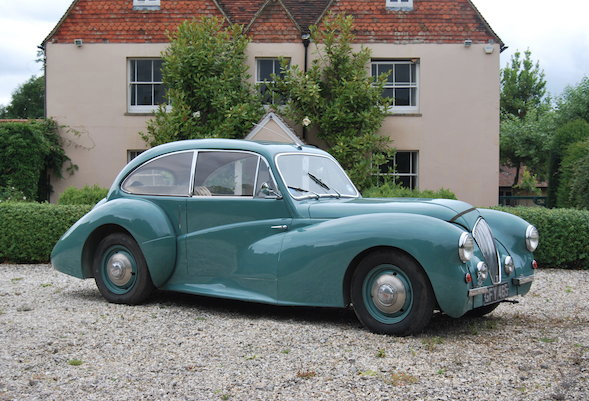
Mentioning "Healey" to Americans of a certain age (or level of car obsession) usually summons up recollections of the Austin-Healey, either the Big Healey that was a fairly common sight on our roads from the mid-Fifties through the late Sixties, or the tiny Sprite Bugeye that appeared in the late Fifties.  But there were other Healeys before and after those cars, and they may not ring as many bells in the dusty attic of memory. After World War 2 Donald Healey founded a specialist car building firm in Warwick.  He had been shot down while flying for the Royal Flying Corps in the First World War, and raced cars after it, winning the 1931 Monte Carlo Rally in an Invicta.  By the mid-Thirties (and his own late 30s) he was technical director of Triumph Cars.  The 1947 Elliott coupe above was atypically elegant (its body was by Beutler in Switzerland), but its chassis was typical of early Healey designs: a ladder frame with independent front suspension with coil springs and trailing arms, a live axle rear, and hydraulic drum brakes during a time when mechanical brakes equipped (or afflicted) many British cars. The engine was a 2,440 cc Riley that made 104 hp when equipped with twin SU carbs.  This was a twin-cam inline four, but with high cams and pushrods, not unlike the Lea Francis engine of the same period.  Most of the 101 Elliott coupes looked like the green car below, rather than the white one above.  Sincere and even friendly looking, but not what you'd call sleek...
Just over 100 of the Elliott coupes were built between 1946 and 1950; there was also a Westland open tourer that managed to sell 70 copies.  
In '49 and '50, Healey also offered the Sportsmobile (below); only 23 were sold.  This may have been the result of the clunky styling; the Sportsmobile looks like it was designed as transport for Wallace and Gromit.  Another drawback was a short-lived steering system with a triangular aluminum pivot plate; even minor wear in the pivot bearing resulted in sloppy steering.  Mobile, maybe, but not very sporting... 
Healey's Silverstone was a more sporting proposition. The name was a clue; it was named after a race track.  Appearing in July 1949, the Silverstone was designed to avoid a recently doubled purchase tax on cars priced over a thousand pounds; it sold for 975 GBP.  Bodied in cycle-fendered style (think Allard or Frazer Nash) by Abbey Panels, it featured the twin-carb, "underhead cam" Riley four, but was the first Healey with bodywork supported on a tubular steel frame, rather than the wood framing of previous models.  Despite success in racing, only 51 D Types, and 54 of the wider, more comfy E, were made before production ended in Sept. 1950.  The E Type had a wider cabin, bigger windshield and hood scoop, but traded bucket seats for a bench.  The green car below is a D Type.
The black car below is a coupe bodied by Tickford (who also bodied Alvis and Aston Martin chassis); the last one appeared in '54.  The red drophead coupe below it was bodied by Abbott in the same period.  Both shared the Riley engine featured in the Silverstone.  Many Healeys, like the Elliott, Westland and Abbott, were named after the coach builders who bodied them...

Around the dawn of the Fifties, as a result of Donald Healey meeting Nash president George Mason on an ocean liner, a plan was hatched to outfit Healey chassis with Nash six-cylinder engines.  Bodywork was nearly identical to the Panelcraft-bodied, Alvis-powered Healey 3 liter, which managed to sell only 25 copies.  But the new Nash-Healey, fronted by a Nash grille and released in summer of 1950, sold 104 copies Stateside, and a Nash-powered Healey finished 3rd at Le Mans in 1952, behind two Mercedes 300SLs but ahead of the Ferraris...
Those were good sales numbers for Healey, but probably seemed small to Mason at Nash. The American company had already hired Pinin Farina as a design consultant, so the alloy Panelcraft body was replaced by the more stylish Farina-styled steel roadster body shown below for 1952.  Size of the OHV six with special aluminum head stayed at 3.8 liters for '52, but increased to 4.1 liters for '53, when Nash added a coupe to the range.  Nash-Healeys kept the Healey front suspension design, but substituted a Nash Ambassador torque tube and rear axle.
The side-curtained roadster on the 102" wheelbase was joined by a coupe (108" WB) in 1953, and only a lightly reslyled coupe with reverse-slant C-pillar (below) was offered in 1954. The revised cars sold 402 copies over 3 years, not bad considering that the roadster, priced at $4,700, was over a third more than a Jaguar, while the $5,900 coupe was in Aston Martin territory...
1952 was a big year for Healey.  Not only was Nash-Healey production ramping up, but in answer to a need for a less expensive roadster that could be produced at Healey's factory, designer Gerry Coker sketched out the Healey Hundred, with its curvy contours tightly fitted over a 90" wheelbase Healey chassis powered by a 2.6 liter Austin OHV four.  As luck would have it, Austin and Morris had merged early in 1952 to form the British Motor Corporation, and when the minions of BMC saw the new car at that year's Earls Court show, they quickly made a deal with Donald Healey to mass-produce the car as the Austin-Healey 100.  That's Leonard Lord from BMC on the left next to Donald Healey...
Production began in 1953. The new Healey had plenty to recommend it to sports car fans in the USA: swoopy lines, sturdy mechanicals, and a friendly price around $2,900.  The 2.6 liter inline four's 90+ hp made it competitive in increasingly popular road races, especially after the 3-speed gearbox in the BN1 version was replaced by the 4-speed in the BN2. Our example Austin-Healey 100, in blue below, is parked next to a red Jensen-Healey from the early 70s; more on that later...
Note how designer Coker had finally found the fan-shaped Healey grille a happy home, and how the curve of the door sills mirrors the fender curves above.  Also note the curved uprights of the folding windshield and how they work with the curves.  The windshield glass was flat, and the curved sides probably made the side curtains an odd fit, but most observers thought it was a great-looking car.  This blue example has been owned by the same Colorado family for decades...
In 1955 Healey introduced the 100S, a factory racer made in only 50 examples and only that year; there were another 5 factory test cars. It looked like an Austin-Healey 100 with an oval grille, but it was more.  Alloy body panels replaced steel, four Dunlop disc brakes replaced drums, and a special aluminum cylinder head and twin carbs offered 132 hp. A 1955 Road & Track test gives a 7.8 second time for the 0 to 60 run, and a top speed of 120 mph, fast for the era. The photo below shows how the windscreen looks in folded-down position.  Healey selected their purchasers from a list of successful amateur racers; most of the 100S models seem to have been delivered with the white and blue paint scheme shown...
You'd be forgiven for thinking the green car below is a 100S model.  Actually it's a Healey rebuilt by Cape Motors in England, with a new alloy body like the 100S, a new chassis, an engine with the rare aluminum cylinder head, and 4 disc brakes.  
There were other attempts to increase power on the Austin-Healey 100, and some of these involved American V8s, and some of those involved power bulges on the hood.  Not sure what's going on with the cow-catcher bumper on the orange car, but the owner had a good sense of humor...
BMC had its own plans for more power, though, and in 1956, after 3 years of the four-cylinder 100, introduced the Austin-Healey 100-6. Still at 2.6 liters (actually 2639 cc to the Hundred's 2,660), it offered the smoothness of 6 cylinders with 102 hp; after a new cylinder head design from late 1957 the power increased to 117. The wheelbase increased to 92 inches; more power provided the excuse to offer alleged 2+2 seating in the BN4 offered from '56 on, while the BN6 offered in '58-'59 kept the two-seater's lines, all behind a new hood with scoop and a somewhat fussier oval grille than on the 100S.  The example below is from 1959...

In 1958, the year the BN6 appeared, BMC released the Austin-Healey Sprite, with 948 cc inline OHV four accessed by a hood in unit with front fenders including the famous Bugeye headlights, steel body designed again by Gerry Coker on an 80-inch wheelbase chassis, and everything pared down to a 1,460 pound weight and $1,795 price.  As with the AH 100-4 and 100-6, they sold thousands.  Ads highlighted the Sprite-powered speed record car, as well as the kinship to the Big Healey...
When the Sprite was released in the USA, designer Coker had gone on to work at Ford in Detroit, and was disappointed to see that his planned retractable headlights had been ditched by BMC for cost reasons.  But the Bugeye's trademark feature gave it an identity and a name, and some owners cannot resist pointing out that the car is, well, cute...
Bodies for the Sprite were built by BMC, while those for what soon became known as the Big Healeys were built by Jensen Motors...
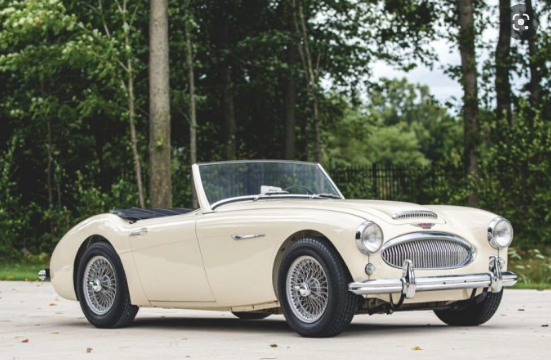
Late in 1959 the Austin-Healey 3000 appeared, with 2.9 liter inline OHV six, still based on Austin's Westminster. At first, in Mark I and Mark II versions, these were offered as two-seater or 2+2 roadsters, all with side curtains and sketchy tops (above). In summer 1962 the Mark II convertible appeared with curved windshield and roll-down side windows. The 3000 substituted disc brakes at the front wheels; while drums remained at the rear.  Grille shape went to the simpler vertical bar design on the Mark II, and power went from 124 to 148 over the life of the 3000, which ended after the 1967 model year. The Convertible model below replaced the roadsters, and acquired a wood dash in the Mark III version which appeared in spring of 1964, around the same time as Ford's Mustang.  All Convertibles feature 2+2 seating.
New US safety regulations spelled trouble for the future of the Big Healey, and the father and son team of Donald and Geoff scrambled to save the car, and their manufacturing contract, by widening the 3000 model by half a foot and plunking a 4-liter Rolls-Royce inline six (inlet over exhaust valve) as supplied for the slow-selling Austin Princess into the 4000 prototype, of which a couple were built around 1966-7.  But this adaptation of a 15-year old design was doomed by the 1968 merger of Austin, Rover, Triumph and Jaguar into British Leyland, an unwieldly mess of competing design teams with a surplus of competing engines, including the 3.5 liter Rover V8 and Jaguar's 4.2 liter six.
Meanwhile, in 1962, the 23 year-old Italian designer Pio Manzu won the design competition sponsored by Swiss publication Automobile Year by designing a new body for the Big Healey, which was built by Pininfarina to Manzu's specifications.  As a sign that it might have pointed to a more modern future for the Austin-Healey, features of the Manzu design*, with its tall greenhouse, curved side glass and angular roof, appeared 3 years later on the MGB-GT, which was actually designed by Pininfarina.  PF improved on the concept a bit by substituting a large hatch for the conventional trunk lid on the Manzu design.
When the Healey concern found a new manufacturing deal to replace the BMC contract, it was with American importer Kjell Qvale and Jensen Motors, and the car they hatched was the Jensen-Healey. Appearing in 1972, it was a conventional two-seat roadster with live rear axle and disc brakes at the front only, like the Big Healey it sought to replace.  Chassis design was more rigid than that car, but testers found it was not rigid enough to avoid the cowl shake of the Big Healey. The one modern, cutting-edge feature was the twin-cam 2 liter inline four sourced, oddly enough, from Lotus.  The engine looked great on paper, making 140 hp from 2 liters with 4 valves per cylinder.  The new engine had not yet appeared in any Lotus product, so in a way the Lotus engineering team was using the Jensen-Healey team to do trouble-shooting on their new engine. And there was plenty of trouble on the Mk. 1 cars' engines, including water pump failures, oil leaks, gasket failures, low oil pressure, and fuel line leaks.  By the time the J-H team sorted out the Mk. 2 cars, their project was losing money.  Perhaps a better route to success would have been to use a proven production engine, like the Ford V6 in the Reliant GTE.  The Jensen-Healeys we see today have been mostly sorted out and offer plenty of fun; this red example has a Toyota 5-speed transmission...
By the time Jensen offered a 2+2 sports wagon version in 1975, Healey had withdrawn from the project, so the new model was offered as the Jensen GT.  With more development and some advertising, it might have filled the gap left by the Volvo 1800 ES. But the effort collapsed in 1977 for lack of funding, and Jensen was so invested in the Jensen-Healey that it collapsed too.   

*Footnote:  
The Nash-Healey saga was detailed in "Italian Jobs from the Heartland, Part 1: Italian Bodies for Nash and Hudson", posted November 17, 2016.  And we detailed Pio Manzu's award-winning redesign of the Big Healey in "Forgotten Classic: Austin-Healey 3000 by Pio Manzu Out of Pininfarina", posted October 31, 2016.

Photo Credits:  
Top, 2nd & 5th:  classicdriver.com
3rd:  Wikimedia
4th:  classic-trader.com
6th &: 8th:  Wikimedia
7th:  bonhams.com
9th:  U.S. Postal Service
10th (Nash-Healey coupe):  LCDR Jonathan Asbury, USN
11th:  The Nuffield Group, featured on solarnavigator.com
12th & 13th:  The author
14th:  Wikimedia
15th (Cape Healey):  Mike Fuchs
16th thru 18th:  The author
19th:  British Motor Company
20th (Bugeye Sprite in toy box):  The author
21st:  Unique Car Auctions
22nd:  bringatrailer.com
23rd:  mossmotoring.com
24th:  Automobile Year
25th & bottom:  The author


Friday, September 30, 2022

The Jetsons in Boulder Part 7: Charles Haertling's Boulder Valley Eye Clinic----Futurism Hiding in Plain Sight


In 1969, the third and final year that new Star Trek episodes aired on TV, and the year after Stanley Kubrick's "2001: A Space Odyssey" mesmerized audiences in movie theaters, Charles Haertling* produced his exuberantly futuristic design for the Boulder Valley Eye Clinic, just north of Boulder's downtown on Broadway.  It was also the year that NASA first landed men on the moon.  So there was plenty of science in the air, to go along with the science fiction...
But, as anyone who's been following the "Jetsons in Boulder" series knows, Charles Haertling already had plenty of futurism in his thinking. The year he designed the eye clinic, he had seen construction completed of the Brenton House*, with its mushroom-like roof forms becoming walls and curving under floors.  The Brenton would be featured in Woody Allen's "Sleeper" in 1973.  Here in the eye clinic, Haertling found another reason to employ  curves, with the "open eye" of the waiting area inviting the visitor back to the examining rooms, with their cantilevered pods containing the eye charts.  These are visible as the four projecting forms with sloping bases in the first photo, and on the right (east) side of the plan below. These pods shade our view across Broadway in the above photo.  Two pods repeat the same function on the west.  Note the way the architect has provided landscaped spaces with trees and shrubs, partly enclosed by curving landscape walls, to shield offices and lounge from views of the parking. 
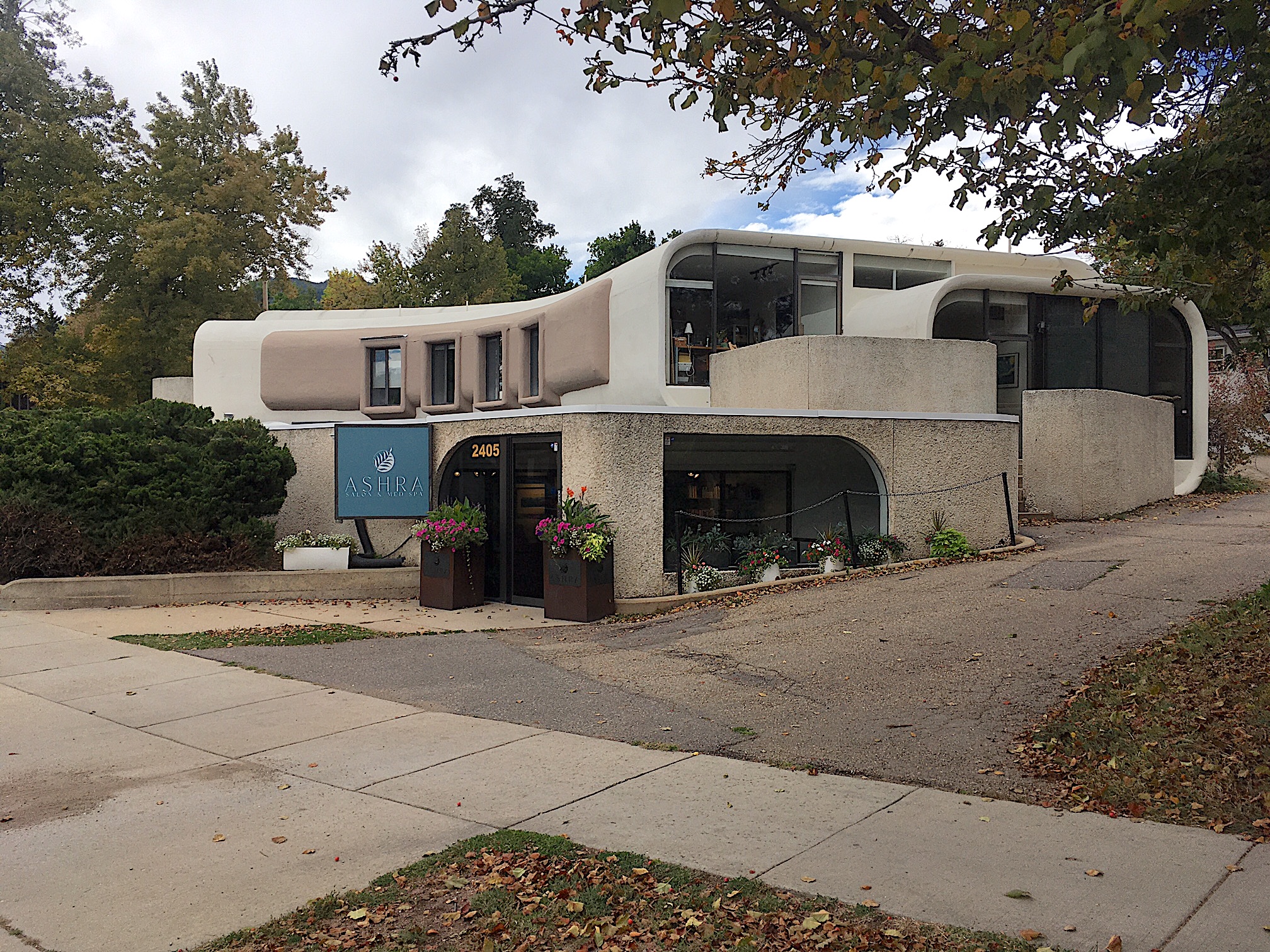
Sadly, when the building changed function to office space, someone decided the cantilevered eye chart pods needed to be removed and replaced with windows outlined in a darker color. It's too bad the building couldn't remain an eye clinic; the plan and forms were so specifically tailored to that purpose...
Here we see the Broadway side of the building as it appears today...
Below, at the south-facing, public entry of the clinic, the portion that looks like an opening eye in plan, we note what might have seemed a reassuring, regular pattern to the clinic's first customers: a series of regularly-spaced, circular concrete columns supporting the roof, and framing glass walls and the entry doors, which are marked "2401 Broadway". This may have been the only conventional message anywhere in the scheme, other than a parking lot sized to fit the vast "standard size" cars common in 1969... 
Moving around what would be the southwest corner, if the building had anything like corners, we note the sculptural way roof and walls are joined by cascading curves, and the way these curves are repeated in plan and elevation. 
As a look at the plan at the top shows, there were originally two cantilevered modules on the west side of the building that mirrored the shape and function of those on the east. Moving around to the west side, we see that like those on the front elevation, these modules have now been sheared off, and replaced by an arrangement of windows that looks like an afterthought.  The building has served a number of different functions after its years of service as an eye clinic; these have included an architect's office and a fitness center.  In its original form it could still function effectively as an eye clinic; when I visited the eye doc recently I noticed despite all the digital connectivity he still uses the same old system of charts to assess vision, but without any elegant cantilevered pods...
Moving around to the north driveway that connects back to Broadway, we can see how the roof forms roll down into the walls, and how the walls curve inward at the ground plane.  This view is enough to make anyone wish that all utility lines could be submerged below that ground plane...
Despite being detoured from the original function that helped to generate its purposeful forms, and despite being saddled with some ill-considered signage and a two-tone color scheme, Haertling's building still works its sculptural magic on anyone who will spend a few moments walking around it.  Like those works of science fiction produced in the same era, its form and content still have something to offer to a changing, troubled world.

*Footnote: For earlier photo essays devoted to Charles Haertling's architecture, see "The Jetsons at Home in Boulder, Colorado", posted on June 13, 2016, and "The Jetsons in Boulder Part 2: Charles Haertling Masterworks", from July 2, 2016.  "The Jetsons in Boulder Part 3:  Charles Haertling at Mid-Century and Beyond" appeared on June 30, 2020, and we had a look at Haertling's futuristic mountain work in "The Jetsons in Boulder Part 5: Hidden Gems in the Foothills", posted December 8, 2020.  Part 4 of the Jetsons series was devoted to a building which is now a dental clinic, but was originally an architect's studio; please see "The Jetsons in Boulder Part 4:  Roger Easton's Modest Masterpiece---Lightness and Facts on the Ground", posted October 12, 2020.

Photo Credits
All color photos are by the author.  All monochrome photos are from the Boulder Carnegie Library for Local History Collection.  The building plan by Charles Haertling was reproduced at pinterest.com.