Featured Post

Saturday, October 28, 2023

Roadside Attraction + Forgotten Classic: The Moto Guzzi Museum and the Moto Guzzi V8


Lucky visitors to the Moto Guzzi Museum in Mandello del Lario (on Lake Como, in case you need another enticement) are greeted by a marble sculpture and side elevation of a motorcycle headed for the checkered flag in Plaza Leonardo da Vinci. Engineer Carlo Guzzi had built a motorcycle shortly after World War I, and founded the oldest surviving European motorcycle maker in continuous production, Moto Guzzi, with partners Giorgio and Angelo Parodi early in 1921. Racing was important from the beginning; Moto Guzzi won its first European title at Monza in 1924. Back to that racer headed for the checkered flag up there; that looks like an engine with four overhead cams, doesn't it?
Well, it's a water-cooled 500cc V8 designed for GP racing by Giulio Carcano, and it was raced by the Moto Guzzi team from 1955 to 1957.  One way to think about this engine with its 4 overhead cams is that it resembles the Maserati Ghibli V8 of a decade later, except that its entire displacement would fit into one of the Maserati's cylinders, with space left over.  The Otto, as it was also called, set an official speed record of 171 mph 2 decades before that speed was again achieved in a motorcycle GP.  The engine featured a Dell'Orto carburetor for each cylinder, weighed 99 lb. in a 326 lb. bike, and made 78 hp at 12,000 rpm. The Moto Guzzi V8 below is one of 80 vehicles on display at the museum, and one of only two V8 racers built. 
About that checkered flag part of the mural, though, we have to report that while blindingly fast, the Otto never won a GP race. There were reliability problems, and because chassis design had not caught up to that advanced engine (brakes were still drums, for example), some racers declined to ride it in GP races.  Still, when it retired from decades of racing at the end of 1957, Moto Guzzi had collected over 3,300 race wins, and 14 world titles. By 1963, Stanguellini* decided that a mid-engined, four-wheeled speed record car would be a more stable format for the Guzzi V8, and Franco Scaglioni designed an aerodynamic shell over the tubular Stanguellini chassis for the Colibri (Italian for hummingbird) below. The body was built by Carrozzeria Gransport, of later Cobra Daytona fame. Somehow the Otto engine never arrived for installation, and the car made do with a 250cc Moto Guzzi single that made 29hp at 8,400 rpm.  That was enough, though, for the little streamliner with its 5-speed chain drive and front disc brakes to set half a dozen international speed records at Monza in fall of 1963. To see it, though, you'll need to visit the Stanguellini Museum...
There are plenty of other exhibits to take in at the Moto Guzzi Museum, including the landmark V7 Record below.  A V7 Record set 19 speed records at Monza back in 1969.  The V7 engine tooks its name from its displacement.  It originally appeared in 1966 as an air-cooled 700 cc V-twin with 90 degrees between cylinders and shaft drive, and starting in 1967 engineer Lino Tonti developed performance versions, with the 748cc V7 Sport capable of 125 mph.  The V-twins had a good reputation for handling, and Moto Guzzi sold ten V7 Police models to the Los Angeles Police Force in 1969; these were reputedly the first motorcycles not of American origin to go to Stateside police forces, and led to other Moto Guzzi police sales in the US.
The collection also highlights many of the models powered for over four decades by Carlo Guzzi's first engine design, with a single horizontal cylinder, single overhead cam, 4-stroke air-cooled configuration, at first in 500cc displacement.  That title-winning 1924 racer had 4 valves for its thumping single cylinder.  Until 1934, each engine carried the signature of the mechanic who had assembled it...
The museum collection includes an early, streamlined speed record bike, as well as a vast trove of scale models and miniatures... 
…along with photos, literature, and other memorabilia.
Carlo Guzzi was born in 1889, died in 1964 and lived long enough to see a Moto Guzzi be the first motorcycle to reach the Arctic Circle (1928), to become Italy's largest motorcycle maker (1934), build the first wind tunnel for motorcycle design (1954), and to see its host city call itself La Citta Della Moto Guzzi (ages ago).  The stone sculpture in our first image* came later, in 2011, and was produced by sculptor Ettore Gambioli and architect Paolo Gambelli.  Three years later, the Discovery Channel named the Moto Guzzi V8 one of the ten greatest motorcycles of all time.

*Footnote:  For a look at Stanguellini cars not powered by Moto Guzzi, see "The Etceterini Files Part 5—Chasing a Mirage: the Last Stanguellini", posted here on March 21, 2016.

*Photo Credits:
All photos were generously supplied by longtime reader and contributor Keith Carlson, except for the 2nd, 3rd & 4th from the top (Wikimedia), and the 5th & 6th (piaggiogroup.com).  For Keith's shots of Monterey Car Week, see "Monterey Car Week 2023:  Auctions, Pebble Beach Concours, and a Day at the Races", posted here on August 31, 2023.

Thursday, October 12, 2023

Lost Roadside Attraction: Racing in the Streets...of Pebble Beach

The first road racing in the Monterey Bay area* after World War 2 was launched under the auspices of the Sports Car Club of America on Nov. 5, 1950.  There were four races starting at noon, and the overall winner was Californian Phil Hill, in one of 240 alloy-bodied Jaguar XK120s. The XK120, launched in 1949, offered performance that had been available pre-war only in cars 2 to 3 times as expensive, like Alfa Romeo and Bugatti.  Hill would show up every year for the Pebble Beach races...
...which wound at first through the Del Monte Forest along a 1.9 mile route.  The organizers did not remove trees along the race route, as Pebble Beach was already an exclusive residential zone linked to a famous golf course.  Many of the ten thousand spectators stood between those trees, separated from the track by a rope and occasional hay bales, and were advised in the brochure: "The public is requested not to cross the highway and to remain at a safe distance during the trials and the running of the race..."  As the photos below show, the concept of "safe distance" turned out to be a pretty subjective one.
For the 1951 running of the Pebble Beach races, Phil Hill acquired a prewar Alfa Romeo 8C2900B, a car powered by a GP engine, and which might offer some performance advantage over the production sports cars in the field, even though they were newer. That theory was derailed when Bill Pollack, driving a crude (by comparison) British Allard J2 powered by a mass-produced Cadillac V8, passed Hill and eventually won the race, with Hill (left in photo below) finishing 4th in the Alfa, with its more temperamental supercharged, aluminum twin-cam straight eight.  

In the photo above, Pollack, in the J2 on the left, makes his move.  In 1951, the 2nd year of the Pebble Beach races, the course was extended to 2.1 miles with a tighter turn replacing a sweeping arc.  That course design remained until the end of racing in the Del Monte Forest...
Bill Pollack won again in '52, and to some people this may have presaged the rise of mass-produced engines.  Not to racer Ernie McAfee, though. By 1953 at his Sunset Boulevard dealership in LA, McAfee (shown with a Siata 208S) offered Ferraris and Alfa Romeos alongside now-forgotten mass-produced English compacts like the Hillman Minx.  The Siata, with its 70-degree Fiat V8 and 4-wheel independent suspension, was briefly popular in the 2 liter class.  Road & Track tested it that year and praised its handling, looks and 12.4 second 0-60 time, but not its $5,300 price. The Triumph TR-2 they tested a year later did 0-60 two-tenths of a second quicker, and was only 2 mph slower (104 mph) at less than half the price ($2,448).  It was the sign of another trend in amateur racing, as the British export drive offered weekend racers MGs, Austin-Healeys and Triumphs at Chevy prices.  
On the other hand, if you really wanted to clean up in the 2 liter class, McAfee could offer you a Ferrari 500 Mondial for over twice the price of that Siata, or if you wanted to go for broke (in all senses) one of the new Ferrari 250MM series, with the Columbo-designed 3-liter SOHC V12 that would eventually become an endurance racing star in the 250GT.  Phil Hill raced his 250MM on the left in the '53 Pebble Beach event, and took the overall win.  He didn't win everything, though.  The lady in the passenger seat eventually married Ernie McAfee.  The car on the right is an even rarer Ferrari 340 Mexico, one of 4 tubular-chassis cars with Lampredi-designed 4.1 liter V12s intended for the Carrera Panamericana, and the only open spider.
Sometime car builder Sterling Edwards frequently competed at Pebble Beach, and in 1954 he recovered from an early spin to take the overall win in his '53 Ferrari 340MM, one of 10 built and bodied by Vignale to a design by Michelotti, like both Ferraris above.  The Edwards Ferrari is the center car below.  Like all other winning cars in the Pebble Beach series, it still exists.
The rainy 1955 event would be won by Phil Hill, his third victory in the Del Monte Forest, in a Ferrari 750 Monza, a twin-cam 4 cylinder, 3-liter car.  During this period, Ferrari named cars after their individual cylinder displacements; thus, a 250 twelve-cylinder was a 3 liter engine, and so was a 750 four-cylinder...
Phil Hill also won Best of Show at that year's Pebble Beach Concours, the first time the event had been won by something other than a new (or almost new) car.  The winning car was the 1931 Pierce-Arrow in which he'd learned to drive.  This trophy for a Thirties car was likely a sign of a trend; maybe it was not coincidental that several books on classic cars were published around this time.
By the next year, Ernie McAfee's Sunset Boulevard dealership had become "the largest dealer in Italian cars in the United States", and offered the Maserati brothers' OSCA (trendy in the SCCA after Stirling Moss won the '54 Sebring) as well as Alfa, Siata and Ferrari.  By  1956, fins were trendy too, but not many copies of the Boano-designed Ferrari coupe body below found buyers.  More Ferraris would be sold after Enzo introduced his "production car", the 250GT, in 1957.  By then, however, McAfee would not be around to reap any profits.
One of the newcomers at the 1956 race was driven by an old hand, Bill Pollack, who'd won in 1951 and '52 with an Allard.  This time he showed up in an even more obscure British road rocket, the HWM* "Stovebolt Special", a former Formula 2 car with cycle fenders added for sports car events, and 2 significant upgrades by Tom Carsten: a new Chevy V8 replaced the 2-liter Alta four, and there were disc brakes at all four wheels.  Making use of these amenities, Pollack was able to lead a field including #276, Ernie McAfee in a Ferrari 735LM, a brute powered by a 4.4 liter inline DOHC six, Phil Hill in a Ferrari 860 Monza powered by a 3.4 liter inline DOHC four, Carroll Shelby in the Ferrari 750 Monza Hill had driven to victory in '55, Pete Woods (D-Type Jaguar) and Bob Wittke (Austin-Healey).  Eventually, differential trouble in the HWM dropped Pollack out of contention for the lead, but by that time those looming trees had intervened in a more fateful way...
Bill Pollack had dropped down to 4th when Ernie McAfee missed a shift and locked up the drum brakes on Ferrari #276, which led to his fatal collision with a tree, the only fatality in the seven years of races at Pebble Beach.  Carroll Shelby in the Ferrari Monza that Hill had piloted in '55 took a somber win after the race was restarted. McAfee's fatal accident was enough to end motor racing in the Del Monte Forest, and to prompt the SCCA and local promoters to seek a suitable location for a safer course design.  They found one at nearby Laguna Seca and started a road racing series there in 1957, but the story of how that happened is one we'll save for another day...

*History Notes:
Frequent contributor, vintage racer, and historian Keith Carlson notes that motor racing really started on Monterey Peninsula in 1903, when the owners of the Hotel Del Monte built a one-mile oval for racing.  The original 1880 hotel burned down in 1924, and was replaced by the current building, designed by Lewis Hobart and Clarence Tantau, in 1926-'27. Guests eventually included the likes of Theodore Roosevelt and Ernest Hemingway.  The Del Monte Hotel built Seventeen Mile Drive as a sightseeing route for clients, and the sights included what soon enough became Pebble Beach.  In 1942 the hotel was leased to the US Navy for training technicians, later housed the Naval Postgraduate School, and was renamed Herrmann Hall.  Seventeen Mile Drive now hosts classic car tours during Monterey Car Week, coming back full circle to its original purpose as an excursion route.

*Footnotes:
The saga of Britain's HWM was retold here in "Forgotten Classic: HWM---Racing Into Obscurity on Alta, Jaguar and Chevy Power", posted on November 23, 2020.

Photo Credits
Top:  San Francisco Chronicle 
2nd:  Pebble Beach Concours Archive
3rd:  Pebble Beach Resorts 
4th & 5th:  Dr. John Skivington, on tamsoldracecarsite.net
6th:  North American Motortsports Pages
7th:  Bart Jonkers on pinterest.com
8th:  Collection of Phil Hill 
9th:  Del Monte Trophy Race Group
10th:  K500.com
11th:  Pebble Beach Concours Archive
12th:  Ernie McAfee Importer & Distributor
13th:  Don Meacham, on tamsoldracecarsite.net
14th:  Don Palmer, on tamsoldracecarsite.net
 

Saturday, September 30, 2023

Roadside Attraction: Louwman Automobile Museum in the Hague (Part 2)

We noted in Part 1 that the Louwman Museum had an near-overflowing collection of cars, and we covered only a small portion.  We'd gotten as far as the 1970s, and so we'll start Part 2 there and then go back in time to provide a semblance of organization.  Above, we see a trio of Alfa Romeo Type 33 artifacts.  In the foreground, a 3 liter, 12-cylinder boxer Type 33/3 engine sits in front of a car it powered, the first of 4 Type 33/3 SC12 racers built with integral chassis structure (scatolato) rather than the previous tubular one. These last Type 33 cars were very successful, winning the World Sportscar Championships in 1975 & '77.  Parked just behind the Type 33/3 is a Type 33/2 Daytona coupe from 1968.  As is often true with Alfas, the name needs explaining. Though the engine is a 2-liter, 4-cam V8 designed by ex-ATS* and Ferrari engineer Carlo Chiti, the "/2" in the name refers not to the engine size, but tells us this is the uprated version of the 1967 Type 33 road racer.  And "Daytona" refers to the car's 2 liter class victory in the 1968 Daytona 24 Hours.  A Type 33/2 coupe co-piloted by Vaccarella and Zeccoli won the Imola 500 outright that year.  Nino Vaccarella was a part-time racer and a full-time schoolteacher; somehow we needed to tell you that...
Staying for a moment with the Italians, we note the hovering presence of the Pinin Farina X* above.  The famous coach builder enlisted aerodynamicist Alberto Morelli to come up with a fuel-efficient design minimizing aerodymanic drag, and the X, with its 4 wheels arranged in a diamond pattern in plan, emerged in 1960, the year before Pinin Farina became Pininfarina.  A 43 hp Fiat 1100 engine angled to the car's centerline provided power to the single rear wheel (thus there's no differential) and the single front wheel steers.  The drag coefficient was a low 0.23, and the fins (trendy in 1960) were there to provide directional stability.
Stability was not the main problem for Aston Martin's DB3 racer from 1951-'53, but speed was. The factory team road racers, of which this is one of 5, were routinely beaten by Jaguar's C-Type, so Aston uprated the car's engine from the 2.6 liter Lagonda 6 to a 2.9 liter before introducing the more aerodynamic DB3S with that engine in 1953.  You may have thought this was one of those, as it lacks the flat sides of the DB3, and has something resembling the scooped front wheel wells of the DB3S. That's because it was re-bodied originally by the Aston team, seeking more speed. There were also 5 customer DB3 models sold, making the DB3 three times as rare as the more successful DB3S, of which Aston made 11 team cars and 20 customer cars by the end in 1956.
The museum's 1934 Chrysler CU Airflow 8 above, like the restyled Aston, was also an example of a design team seeking aerodynamic advantage, and resulted in increased speed as well as better fuel economy than the previous model.  The wide body created more passenger space, but Carl Breer's wind-tunnel tested design encountered unexpected sales resistance while reducing wind resistance.  Some of this may have been the result of introducing a car during an economic depression, when car sales were already low and unemployment at a near-record high.  The Louwman's unrestored Airflow was one of few originally exported to Holland,and has never been repainted.  The motorcycles in the foreground are a reminder that we still need to visit the microcar collection...
But not before having a look at some really big cars. Auburn-Cord-Duesenberg introduced the supercharged Duesenberg SJ above in a depression year as well; 1932 was also a bad year for sales, but the few who could afford this Lagrande Dual-Cowl SJ Phaeton would join an exclusive club including movie stars, jazz musicians and the King of Spain. The price of admission was $8,500 for the chassis and often $12,000 for the custom bodywork by the likes of Murphy, Rollston or Lebaron; that could buy as many as 40 Fords in 1932. The style of most of these bodies was rooted in the Twenties style of separate elements, not Thirties Streamline Moderne like the Airflow or Lincoln Zephyr, but the Duesey's engine was very modern for the time. The 7 liter inline 8 featured twin overhead cams and 4 valves per cylnder, and made 320 horsepower. Lagrande indeed...
We're sliding back in time, but not down in price class, to the year before World War 1. The Renault 22/24 CV Town Car with its expensive wicker-panelled bodywork by Muhlbacher (a Parisian coach builder, despite the name) powered its pampered occupants along the streets of Paris with a 5 liter, 4-cylinder engine with its radiator located between motor and driver's compartment, which led to the shovel-snouted profile that became famous in the terrible "war to end all wars", when Renault taxis transported soldiers to the front lines...
Automotive pioneer Panhard et Levassor built its fist "systeme Panhard" car in 1891: front engine driving rear wheels through a sliding-gear transmission.  Eleven years later in 1912, coach maker Jean-Henri Labourdette built a stylish wooden skiff body on a Panhard & Levassor X19 and called it the Skiff-Torpedo. This design set a fashion for boat-tailed cars between the 2 world wars, when Labourdette would gain some fame for bodywork on Delage and Rolls-Royce chassis.  The original was lost, but when in the 1970s the Louwman Museum decided to restore a deteriorated Panhard from the pre-WWI period with a replica Labourdette skiff, Jean-Henri Labourdette was happy to advise the museum on recreating one.  It joined the Museum's collection of other pre-WWI cars and motorcycles...
At the end of Part 1 we mentioned the plethora of what are today called microcars on exhibit at the Louwman.  Luckily, each car doesn't take up too much space, because the museum has an epic collection…
This green Hanomag Kommissbrot, made from 1924-'29 by a locomotive builder in Hannover, received the kommissbrot ("army loaf") nickname from a public experiencing hyperinflation, to whom the car's rounded, flush-sided lower body resembled loaves of bread issued to the army in the recent, vividly-remembered war. Because of the terrible economy, Hannoverische Maschinenfabrik AG made a car with minimal concessions to amenities or even safety; there was a single cylinder in the 500cc, 10 hp engine, a single headlight, and only a single brake drum to stop the car from its 60 kmh (37.3 mph) top speed.  There was, however, a bit of extra ventilation afforded by the hinged windshield, which seems to lack a wiper
The Standard Superior Type 2 was designed for the German Standard company by Josef Ganz.  On a 78 inch wheelbase, it was powered by a rear mid-mounted 2-stroke inline twin just under 400cc in size, and advertised as a new "people's car" (volkswagen). In the year it appeared, 1933, more ominous developments in store for German industry were previewed when Hitler (who had his own "people's car" project in mind) forbade use of the volkswagen name in advertising by car manufacturers not long after taking power as Chancellor.  Engineer Josef Ganz, forbidden to work as a German citizen of Jewish descent, fled to Switzerland...
There, he continued to pursue ideas explored in the Standard Superior (and later by VW in their Type 1 Beetle) including a backbone chassis and swing-axle rear suspension.  By the late 30s he's built some prototypes with single-cylinder engines; by 1946 a firm called Rapid AG had built nearly 3 dozen prototypes without compensating Ganz for his ideas; the red car pictured above, next to the Standard Superior, is chassis #11.  Ganz sued, but to no avail, and died in Australia in 1967.  Czechoslovakian car builder Tatra had better luck suing VW over intellectual property theft, but that case dragged on until 1965, when VW paid Tatra one million DM.
Above we see a selection of the Louwman microcar collection, with a 1956 German Messerschmitt KR 200 cabin scooter in the foreground, featuring an aircraft-style canopy and 191cc two-stroke single cylinder powering the single rear wheel.  Production began in 1955 and was just in time for the fuel shortages caused by the Suez crisis; around 12,000 were sold.  There was no reverse gear; reverse motion was provided by reversing the engine rotation.  Just above and to the right of the KR200 is a yellow electric Peugeot from 1941 (an answer to invasion-caused shortages) and in the upper left corner, the delightfully-named Frisky Family Three, a fiberglass-bodied 3-wheeler from 1960 styled by Michelotti and powered by a Villiers 2-stroke single-cylinder motorcycle engine. "Three" refers to 3 wheel, while "Family" optimistically suggests room for 2 adults and 2 children. No such claims were made for the red car that just squeezes into the bottom right above and is fully exposed below.  Robert de Rovin had made motorcycles before Hitler's invasion of France in 1940; after war's end he introduced a series of microcars powered by single-cylinder and then twin-cylinder 4-stroke engines, with the envelope-bodied 2-cylinder D3 offering decent weather protection and power to match that of the Citroen 2CV. The line culminated with this 16 hp, 425cc D4, which despite offering more power than the 2CV in the same modern body as the D3, could not compete on price with the bigger, 4-passenger Citroen.  
Rovin had introduced a single-cylinder D1 at the 1946 Paris Auto Salon, but that car was never produced in many examples.  It was replaced by the D2 in autumn 1947 with 4-stroke twin replacing the D1 single cylinder, twin headlights instead of a single one, but the same charming, curvy styling.  Sophisticated touches included an electric starter and rack & pinion steering.  200 specimens left the old Delaunay-Bellville factory before production gave way to the D3 with envelope body and actual doors in late 1948. Rovin exited the car business a decade later...
The egg-like three-wheeled Bambino below was produced under license to Germany's Fuldamobil, but despite the Italian name it was produced by Alweco in Veghel, Holland.  With a 200cc, single-cylinder 2-stroke engine, it was not known for speed, but this 1955 model was in time for the Suez fuel shortage in '56...
By 1957, when a 4-wheeled Bambino Sport version was introduced, the public had moved on to other automotive offerings.  A year later, Holland's DAF would introduce the DAF 600, the first production car with an infinitely variable automatic transmission using belt drives. The Variomatic was used by DAF and Volvo into the 1980s, but that's a story for another day...

Photo Credits:
All photos were generously supplied by longtime reader and contributor George Havelka. The monochrome shot of the Rovin D2 is from Wikimedia.

*Footnotes:
The story of the car that presaged many aspects of Alfa Romeo's first Type 33, the ATS, was told in our post "Forgotten Classic Revival Show: ATS 2500GT and GTS", from Nov. 11, 2018. More details of the Pininfarina X, including its diamond wheel plan with zany angled engine, are shown in "Architect-Designed Cars: Part 2", posted May 21, 2017.


Sunday, September 24, 2023

Roadside Attraction: Georgia's Automobile Museum (No, Not That Georgia)


Sharp-eyed readers would have already guessed from the Soviet Era Volga sedans shown above that we're not visiting a car collection in, say, Atlanta, even without the "Tbilisi Automuseum" lettering on the building, not to mention the illegible (to most of us) lettering above it.  And indeed, this car collection is housed in the Republic of Georgia, a democratically-governed nation facing West (in a couple of senses) across the Black Sea, and with a high scenic view to area ratio...
It's a country traversed by picture-postcard mountain ranges with lakes nestling in green valleys.  Our count on the mountain ranges is 10, but if you count the Greater and Lesser Caucasus separately from the Caucasus we're at a dozen...
Mountains provide a backdrop for this GAZ-20 Pobeda (Russian for "victory") four-door cabrio. The Pobeda was the first post-WWII Russian car design that was not a copy of a foreign design. After a couple dozen handbuilt prototypes appeared in 1946 and early production cars suffered problems with body integrity in 1948, the Gorky Automobile Works (GAZ) revised the 2.1 liter, side-valve 4-cylinder car, the first Soviet car with 4-wheel hydraulic brakes, and one of the first anywhere with flush-sided pontoon bodywork, and it stayed in production into 1958. Most Pobedas were sedans; about 14,000 cabrios were produced from 1949 to '53 owing to short supply of steel roof stampings.
The Pobeda cabrio appears to have delighted our volunteer photography crew*, but we're not sure if they were permitted to drive it off the premises...
The successor to the Pobeda, the GAZ-21 Volga, was introduced in 1956 and overlapped Pobeda production.  In the same size category, it was designed with a 2.4 liter OHV inline 4, but the first thousand cars feathred the flathead Pobeda.  Another independent design, the Volga reflected a bit of Ford influence in its styling, and an automatic transmission based on the Ford-O-Matic was offered.  Its 106" wheelbase was 4" more than the Volvo Amazon (Type 122) that appeared  the same year.
The Volga enjoyed a similar reputation for sturdy durability as that Volvo model, and was one of the first Russian cars to be exported in significant numbers...
For those reasons the GAZ-21 Volga had a long production life, and wasn't replaced by the 2.45 liter, aluminum-block 4-cylinder GAZ-24 Volga until 1970; a wagon appeared in 1971. Wheelbase increased to 110", the new car was shorter, lower and more space efficient, with room for 6.  This design was successful enough that Belgian-assembled models were sold as the Scaldia Volga M24, with the final facelifted Volga M2410 available from 1985 to 1992, the year after the Soviet Union officially dissolved...
Before these original designs appeared, however, Russian car manufacturing depended upon foreign designs.  If the GAZ 4 pickup below reminds you of a Ford Model A, there's a good reason. A 1932 agreement between the Soviet goverment and Ford Motor Company licensed use of Ford's designs.  The Tbiiisi museum's restored GAZ 4 is one of less than half a dozen that remain.  The museum also has a Ford Model A wagon as a reference car.
This GAZ M-1 went into production in 1936, and was based on the design of the Ford Model B from 1932, the transitional 4-cylinder model between the Model A and the more famous '32 Ford V8.  The first version of the M-1 ("M" standing for a factory named for Molotov, of cocktail fame) used a side-valve V8 engine based upon drawings supplied by Ford. The second series had a more rounded grille shape, and an engine based upon the 6-cylinder Dodge D5.  This particular 1st series M-1 was the personal car for Lavrenti Beria, enforcer of Stalin's purges as head of the dreaded NKVD...
When the Moscow Small Car Plant sought a design for a smaller postwar car than the  Pobeda then in the works, it looked to GM's Opel Division in Germany, and adapted the Kadett K38 series for this Moskvitch 401 series that went into production at the end of 1946...
The Moskvitch 400 and 401 were replaced by the restyled 407 in 1956, and the new car featrured improvements like independent front suspension, a better heater and available radio. Even though private automobile ownership was not yet widespread in the Soviet Union, the Moskvitch 407 scored some success in export markets in Scandinavia and Eastern Bloc countries, competing with cars like the Fiat 1100 and Hillman Minx, which it resembled...

The restyled Moskvitch 408 prototype appeared in 1960, with the 408 and 412 series production cars running from 1964 to 1975.  Power was provided by a 1.4 liter inline 4 gasoline engine, or a 1.7 liter diesel 4.  Styling and size resembled the contemporary English Ford Cortinas, but as with the Volga designs, the Sixties Moskvitch was a homegrown effort.

The need for a more modern product led to a Soviet deal with Fiat.  In exchange for Russian steel used in its Italian plants, Fiat would license production of a modified version of its 124 sedan (new in 1966) at the new Togiatti plant in Russia's Samara region. The plant and related new town were named for Italy's Communist Party leader. The car, known as the Zhiguli in Russia and Lada in export markets, was powered by a Russian-designed OHC inline 4 of 1,200 or 1,300cc, and offered thicker sheet steel in the bodywork, along with aluminum drum rear brakes instead of the Fiat discs.  It was produced in Russia from 1970 until 2012, and was the second most-produced car model after the original VW Beetle, with over 17 million examples hitting the highways of Europe and Asia...
Special police versions included two series of Wankel-powered Zhiguli-Ladas, but these suffered the same durability problems as the NSU Wankels...
The Ukrainian Zapororzhets ZAZ-965 & 965A production spanned the Sixties, starting with a Fiat 600-influenced sedan shown below in '60.  It wasn't a Fiat copy though; the rear-mounted engine was an air-cooled V4 rather than a inline water-cooled unit, and early cars had magnesiium blocks.  Engine size went from just under 750cc to just under 900cc during this period.
The 965A was succeeded by the 1.2 liter V4 Model 966 in 1966, but production of the two models overlapped for 3 years. The new model, with its Corvair-influenced styling, had a longer production life span than the Corvair (or most cars really), with production ending in 1994, and exports going from Ukraine to Western Europe and Scandinavia, with some cars being sold with Renault power plants instead of the air-cooled V4...

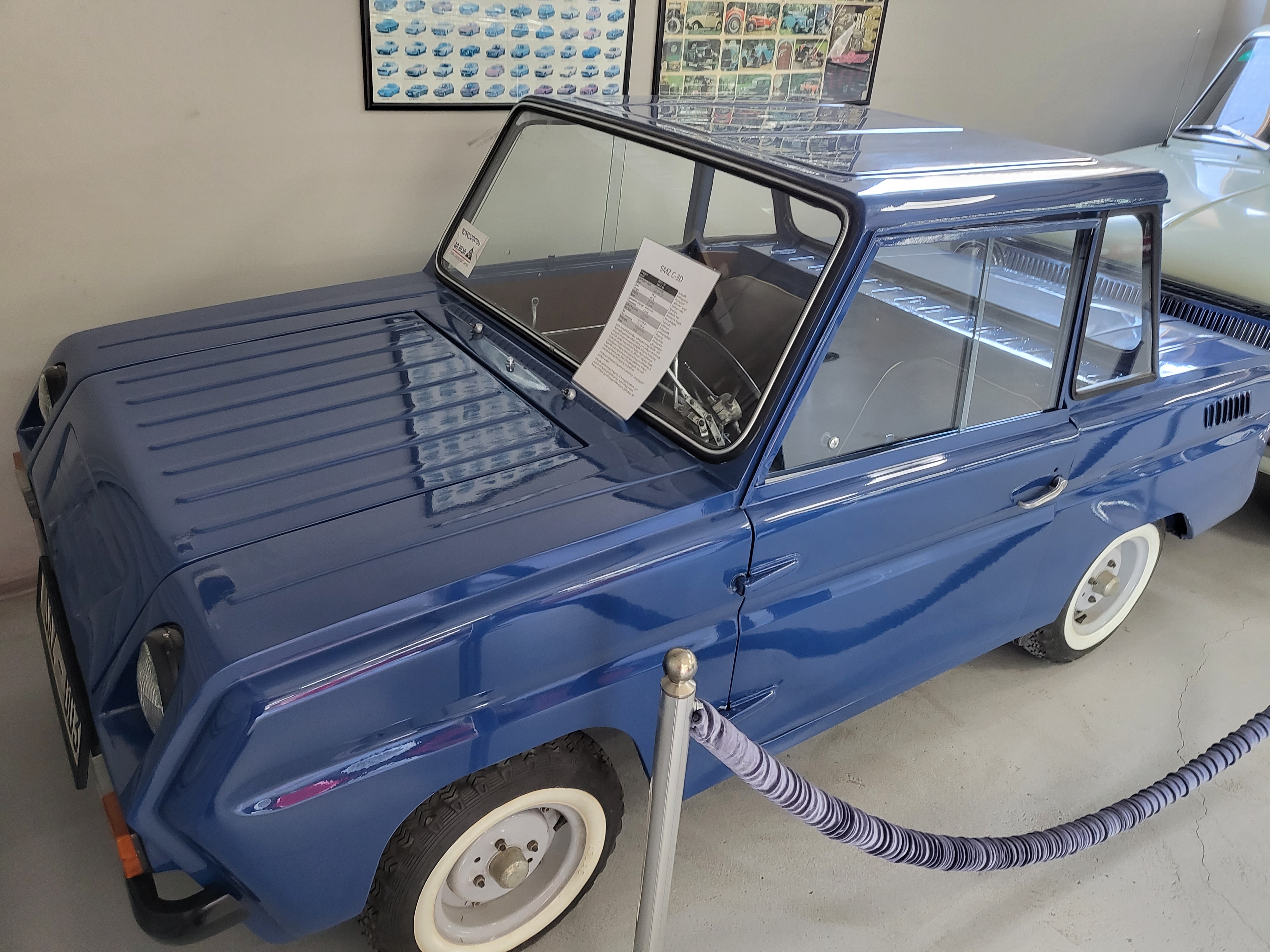
The SMZ S-3D was classed as a "cyclecar" and offered by the government only to citizens with eligible disabilities, somewhat like the "invalid cars" built by AC in England, and was in production form 1970 to 1997.  Rear-mounted power for the 2-passenger car came from a 350cc, 17 hp (DIN) two-stroke engine. Weight was just under 500 kg, but this was considered high owing to the use of steel body panels...


Meanwhile, at the opposite end of the size and ambition scale, Russian officialdom, the nomenklatura and apparatchiks that made the Soviet bureaucracy function (until somehow it stopped), moved from the Zis limousines and parade cars that were copies of early Forties Packards from Detroit, to this GAZ-12 Zim, that was in production from 1950 to 60.  Resembling a cross between a late 40s Cadillac (especially that grille) and a Checker cab from the same era, it was an original design powered by a 3.5 liter inline 6.  Also made as a 4-door cabrio like the Pobeda, it was technically available for private purchase, but the 40,000 ruble price, twice that of a Pobeda, put it out of reach.  The "M" in Zim was to honor Molotov, but after he fell out of favor with Nikita Khrushchev in 1957, the "M" disappeared, and it was just the GAZ-12...
This GAZ-13, a white Chaika, was one of the few offered in anything but black during the 1959-'81 production, or offered to anybody other than a member of the regime-affiliated nomenklatura. It was gifted by the Kremlin, though, to the first woman cosmonaut, Valentina Tereshkova.  Power came from a 5.5 liter V8, wheelbase was in the Beyond Imperial (in all senses) category at 135.8", and styling, like that on the even more exclusive and chrome-laden Zil, was derivative of the 1955 Packard.
Rear views of the official apparatchik cars reflect Detroit influence down the decades from the pudgy attempts at streamlined curves of the late Forties, to the chromed and be-finned Fifties, and the bland recdtangularity ushered in by the Seventies... 
Most Chaikas were painted black, with the exception of two-tone show cars for the 1958 Brussels World's Fair, and government cars that exceeded a mileage limit set by the State were reconditioned as "wedding cars."  Painted white like that Cosmonaut Chaika, these were popular well into the present century as ceremonial rentals...
The last Chaikas, like the GAZ-14 model below, were assembled from leftover parts in 1989 after Gorbachev ordered discontinued production the previous year as a part of his perestroika policy of reducing the privileges enjoyed by the nomenklatura. Remaining to this day in Moscow, however, are the 2-way "Zil lanes" reserved for government officials and emergency vehicles. These days, though, the nomenklatura in Putin's regime are likely to take to these lanes in chauffeur-driven German luxury makes, rather than in Chaikas or Zils...


Photo Credits:  All color photos were generously provided by longtime contributor LCDR Jonathan D. Asbury,