Featured Post

Tuesday, June 12, 2018

The Porsche Effect at the Petersen Museum


The Porsche Effect, an extensive (and expensive) exhibit currently on show at LA's Petersen Museum, is a sort of automotive Wayback Machine, to borrow a phrase from a cartoon series that gained popularity at around the same time as these cars. The introductory display recalls a time and a car that most visitors will not remember...


…and revisits the 1938-39 period, when prototypes of Ferdinand Porsche's design for a "people's car", then called KdF, were being tested and shown to the public.  As part of the publicity and fund-raising effort* designed to finance production of what became the Volkswagen, Porsche also planned a lightweight road racer on the Beetle's underpinnings.


Three examples of the resulting Type 64 (it wasn't yet called a Porsche) were built, each with thin alloy all-enveloping bodywork featuring a narrow cockpit with teardrop roof flowing smoothly into the tapered tail, and spats over all four wheels. The overall form recalled Auto Union speed record streamliners (also Porsche designs), the stillborn Type 114 road version of the Auto Union GP car, and (deliberately, it seems) the humble Beetle in the profile of its roof.


The car was often called the Berlin-Rome VW because it was intended to compete in a road race between those two cities. The air-cooled 985cc flat four was tweaked to make about 50 horsepower.  And while the design is now claimed by Porsche to have been "the shape of things to come", it both was and was not.  The lines are slimmer, more elongated and more fluid than the first Porsche road cars, partly because of the fully enclosed fenders, but also due to this coupe's retention of the Beetle's 94 inch wheelbase, a full foot longer than the later Porsche 356. The graceful taper of the rear fenders helps, too...


The other part of the future that the Berlin-Rome prototype failed to anticipate was that there would be no Berlin-Rome road race because Germany launched a war instead; in that regard, Rome went right along with Berlin...

The Type 64 cockpit would have been a perhaps excessively cozy place for pilot and co-pilot.  It was so narrow that the navigator's seat was staggered in order to allow a bit of shoulder room, and the steering wheel was close to the center.  This is the only Type 64 known to survive; it was raced in the postwar period, and later restored by the Pininfarina coach building house, no less.  After the war, and after Ferdinand Porsche was released from prison in France*, the idea of the Berlin-Rome car was resurrected in a series of cars built at first in Gmund, Austria.  Among the things carried over were the VW-based engine and transmission, and while the Porsche team shortened the wheelbase, they also simplified the bodywork to involve a tub shape rather than a series of teardrops.

    
Signs that this is one of the roughly 50 cars made in Gmund include the Porsche lettering  above the hood opening rather than below it, and the 4 chrome strips around the license plate frame. Engine size had been increased about 10%, too.


The side view shows other telltale signs, with the non-opening "vent" windows in the leading edge of the door curved in plan, and a correspondingly narrower windshield than later cars like the one below.  This windshield was in two flat pieces. In addition to the Gmund coupes, there were 8 cabriolets, half a dozen of which were bodied by Beutler in Switzerland.  Any of  these would be a holy grail for Porschephiles today.


This restored convertible is not one of those cars; instead it's an example of a production model cabriolet from 1955, bodied by Reutter.


It's an example of the kind of car that Max Hoffman* sold at his Frank Lloyd Wright-designed showroom in New York, and despite its simple mechanicals and modest power, the solid craftsmanship and fine level of finish impressed Americans in the first flush of postwar sports car fever.  That name, "Continental" was, like the stripped-down Speedster sold alongside it, Hoffman's idea.  He wanted model names instead of numbers...


But Ford Motor Company, a few months away from launching its expensive new Continental Mark II, protested, and this name came off the Porsche in 1956. Somehow Studebaker never minded "Speedster" (perhaps because Porsche had gotten there first), and so that name stayed on the entry-level ragtop Porsche. 


Spyder is a name that has appeared on other cars, but none so famous as the original Porsche Spyder, Type 550.  Originally appearing in 1953 with the pushrod, VW-derived engine, it soon was released in racing trim with a 4-cam, roller-bearing crankshaft racing engine that would win its class in road races in Europe and the USA. 


Around ninety of the Type 550 would be made before production ended in 1957.  The car gained notoriety with the American public when James Dean died on the way to the races in central California driving a Spyder*.  That was in 1955, the year of the blue-striped car in the above photos.


This 1956 example of the Spyder is claimed to be the most original specimen in existence...


The California license plate refers to Porsche's biggest individual market (more were sold there by 1960 than in Germany) as well as to two other landmark personalities of that era, an era which marked a turning point with the introduction of the Type 901, a six-cylinder car with dry-sump, single overhead cam engine offering the fruits of Porsche's years of racing experience to suburban commuters...


Soon after release, Peugeot would complain that it had a monopoly on triple digit designations with center zeroes, and Porsche complied by calling the car 911; soon those numbers would soon be associated with the most successful dual-purpose GT car ever. But that epic is quite another story, one which has been told by more obsessive and probably better historians, in other places...


*Footnotes:  The VW Beetle design saga is summarized, along with a related lawsuit concerning intellectual property theft, in "Cars & Ethics: A Word or Two on VW" in these posts for 11/27/15, while the Revs Institute's Collier Collection of classic Porsche racing cars is surveyed in "Pantheon of Paranormal Porsches" from 3/19/17 and "Porsches by Another Name" from 3/25/17.  The Cisitalia PorscheType 360 racing car project which got Dr. Porsche out of jail is reviewed in "The Etceterini Files, Part Eleven—Cisitalia" in these posts for 4/22/17.  And for the tale of Max Hoffman and his launching of Porsche in the USA, see "Max Hoffman: An Eye for Cars, and the Studebaker Porsche" from 5/1/16.  The James Dean story is revisited in "On a Lonesome Highway in California" in the archives for 1/18/16. The Wayback Machine is, of course, from the "Rocky and Bullwinkle Show", and is also spelled "WABAC", which stood for Wavelength Acceleration Bidirectional Asynchronous Controller. It was allegedly even more complex than the notorious Porsche roller-bearing crankshaft...

Photo Credits:  All photos were taken by Porsche enthusiast Dr. Marcus Nashelsky on his long-awaited first visit to the Petersen, which is at 6060 Wilshire Boulevard in Los Angeles.  The Porsche Effect will be on show until January 2019.  You may want to tell your own doctor about experiencing classic symptoms of Porsche obsession, and ask him (or her) if heading down life's highways and byways in a dry sump, air-cooled, turbocharged projectile is right for you...

Sunday, June 10, 2018

Immigrants Make Good in America: Maserati 8CTF


Modern consumers may be unaware that before Maserati became an upmarket lifestyle accessory, it was a line of successful racing cars engineered and built on a meager budget. During the period that stretched between the 20th century's two biggest wars, the five Maserati brothers* experimented with such abandon that there were almost as many types of Maserati as there were actual Maserati cars.  Among the many engines, there were inline  twin-cam fours, sixes and eights, as well as a 4-liter V16 confusingly named the V4.  The brothers' long experience finally paid off with something like fame in America when the same Maserati, a sister to the 8CTF below, but owned by the racing team of Mike Boyle, won back-to-back victories at the Indianapolis 500 in 1939 and '40 with American Wilbur Shaw behind the wheel.  The background to this achievement also involves an American living in Europe...


A confluence of tides resulted in the Maserati wave that landed at Indy. The GP racing formula was changed from a no-holds-barred 750 kg maximum weight affair to an 850 kg minimum weight after 1937, the same year the Orsi family of successful industrialists bought the Maserati factory and name from the eponymous brothers, signing three of them (Ernesto, Ettore and Bindo) to a ten-year contract under which they provided design and engineering services exclusively to the new firm. Ernesto laid out a new GP car to challenge the Germans in 1938, the same year that former race driver Lucy O'Reilly Schell financed a successful challenge to the German juggernaut at the French GP with Rene Dreyfus leading her semi-official Ecurie Bleue team of Delahaye V12s across the finish line in 1st and 2nd places*. Mrs. Schell soon noticed that the new Maserati was even more powerful than her Delahayes, and bought two of them...


The 8CTF engine design was essentially based upon tandem blocks of the 1.5 liter 4CM Maserati had produced for voiturette racing. The new engine featured a head in unit with the block, or testa fissa (the TF in the model designation), and two valves per cylinder operated by dual overhead cams.  Two Roots-type superchargers boosted horsepower to 350 in the first versions, and when this was raised to 365 in final form it was still over 100 hp less than rival Mercedes got with their supercharged V12.  Also, the volatile fuels then used in European GPs exposed some fragility in the design...


It would be an understatement to say that the Maserati engine was happier running on the alcohol-based fuel used at Indy.  The third 8CTF built, serial number 3032, became the most successful specimen of any car ever to race at the Brickyard.  Wilbur Shaw won in 1939 and 1940, and the same car finished 3rd twice and 4th once, running its last race at Indy in 1953. A sister car, the one in these pictures and one of two owned by Schell's team, finished 10th at Indy in the hands of Rene Le Becque and Rene Dreyfus. Dreyfus had  been spirited out of France by Schell's Ecurie Blue before the invading Germans could get their hands on him; they were still upset that he had beaten their best at that '38 French GP*.


This car, chassis #3030, the first of only three 8CTF models built, is likely the one in a state closest to its original form. Only one spare engine was originally produced by the factory.  Despite that, chassis #3032, the Wilbur Shaw car, enjoyed a 15-year career, an eternity in racing, even in a time of slower technological change.  That car is now on display at the Indianapolis Motor Speedway Hall of Fame Museum.  


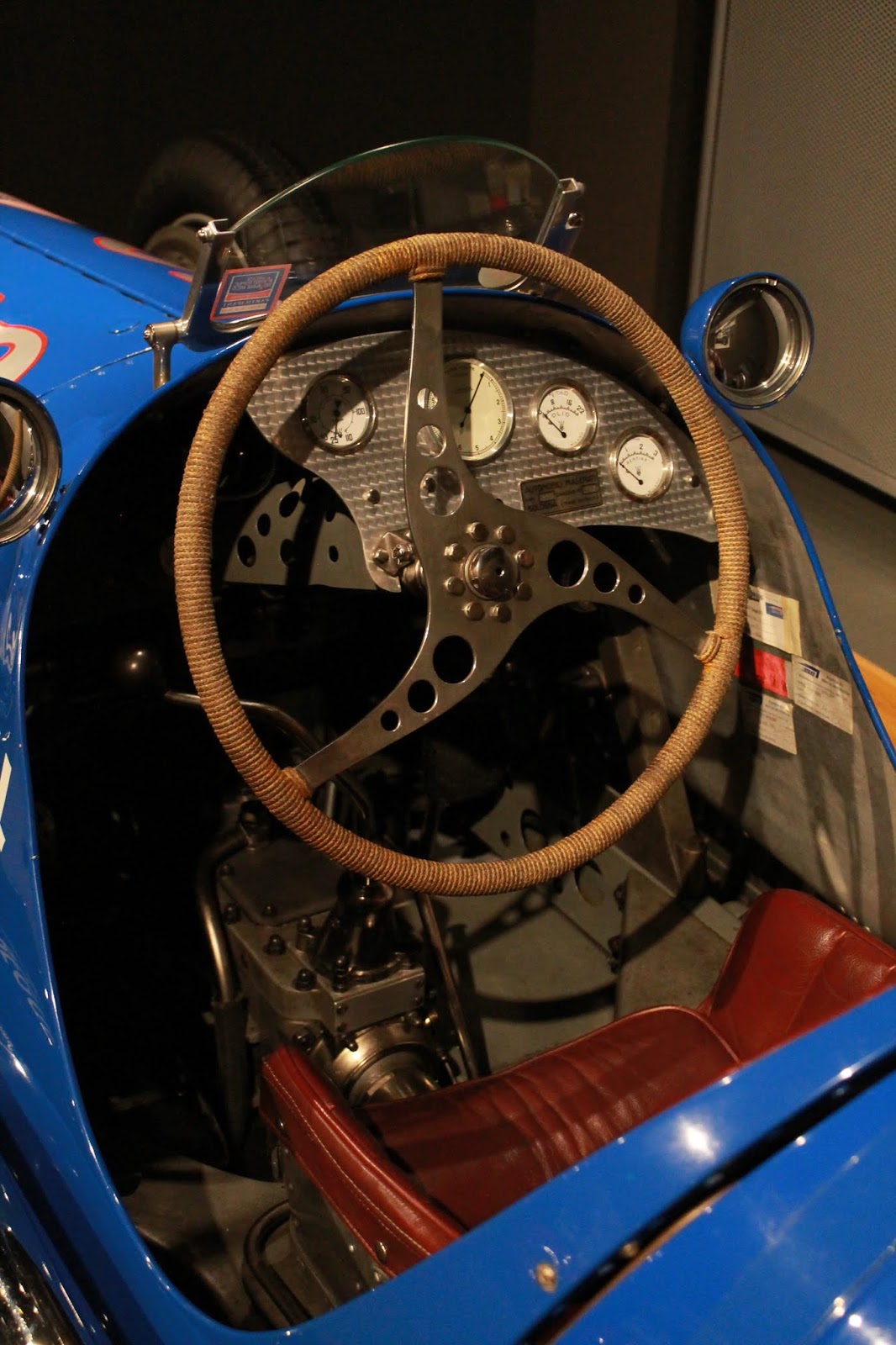
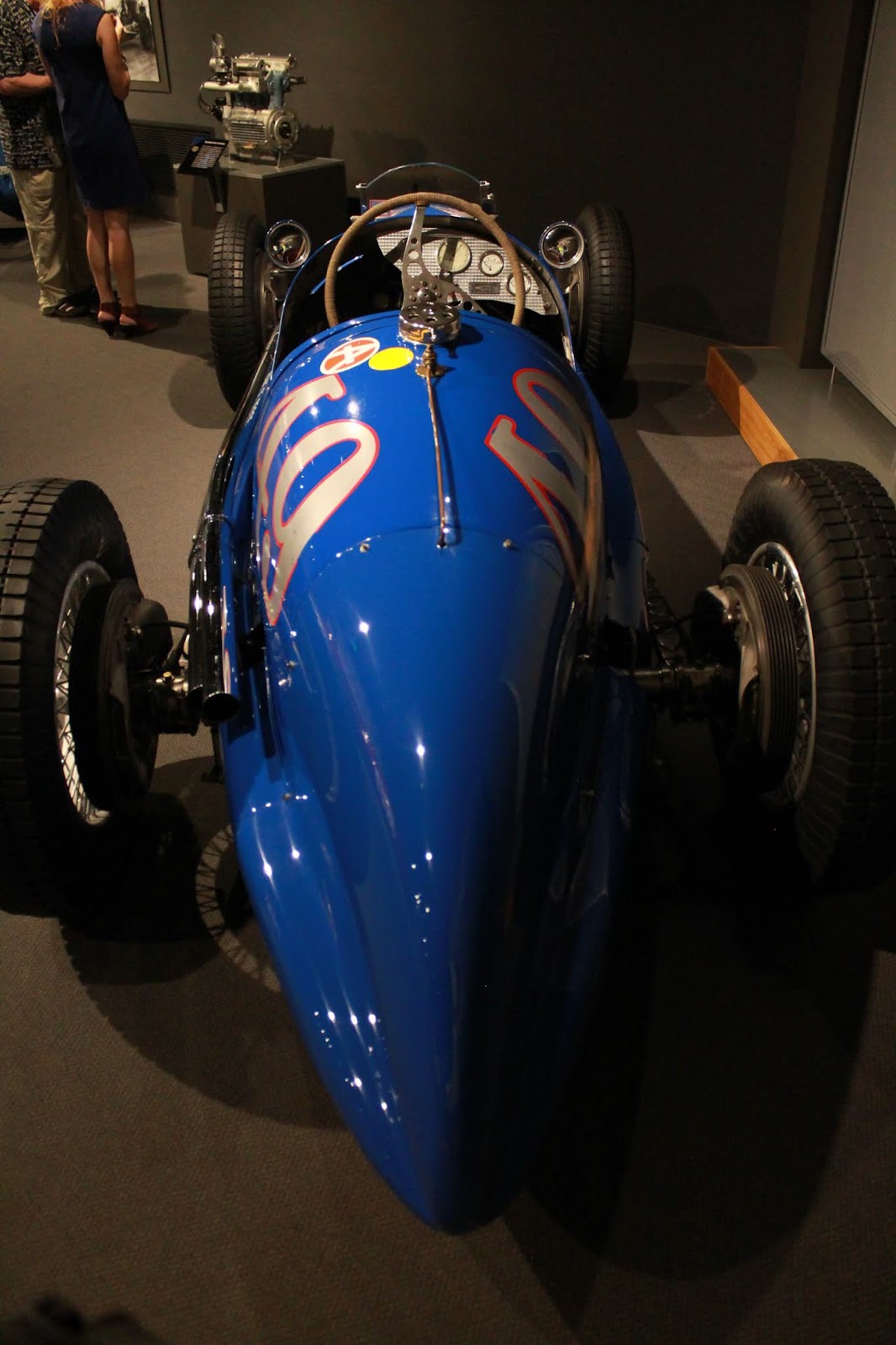
And at the Revs Institute in Naples, Florida, you can get close enough to the first 8CTF to  gather some idea of how it might have been to sit in the narrow, form-fitting seat behind the wheel with its distinctive curving spokes drilled for lightness, and face the new challenge of racing on a bumpy, banked oval for 500 miles on your first job assignment as a new immigrant to America.  After finishing 10th at Indy, Rene Dreyfus joined the US Army and served in Italy, opening a restaurant called Le Chanteclair in New York City after the war.  His bistro was known to provide good food and a congenial environment to talk about cars.


*Footnotes:  The Maserati brothers' saga was summarized in "Almost Famous", a post in the archives for 4/20/16, and a story on 4-cylinder 1950s Maserati sports racers appeared in "Before the Birdcage" from 9/30/17.  Earlier we recounted the story of Lucy O'Reilly-Schell's racing efforts with Rene Dreyfus in "Dreyfus and the Million-Franc Delahaye" on 11/22/15.  

Photo credits:  

Top:  the author
2nd from top:  Ian Avery DeWitt
3rd from top:   psychoontyres.co.uk
Balance of photos:  Ian Avery-DeWitt

Tuesday, May 29, 2018

Mille Miglia 2018 Part 2: Fiats, Lancias, MG and Mercedes


We begin our second post on Mille Miglia 2018 with the car that many historians and engineers credit with beginning the modern era.  The Lancia Lambda, introduced in 1922, was made in 9 slightly different series through 1931.  Among its innovations, it introduced load-bearing unit body construction, independent front suspension (the famous sliding pillar type which lasted until the Aurelia of the 50s), and a single overhead cam V4 engine.  It also had four-wheel brakes, another uncommon feature at this time, and was beyond doubt the first car to put all these cutting-edge features under one roof.  On closed cars, though, that roof was not yet a part of the stressed unit structure.  The Lambda wasn't a case of offering just a few hand-built specimens to get into the record books. Vincenzo Lancia's company built over 11,000 Lambdas during the 9-year production span. Engines were built in 2.1, 2.4 and 2.6 liter sizes, with power ranging from about 50 to 70 hp.  The later example below is fetching in red, though the Lancia family's official racing entries were often painted blue...  


The Fiat Balilla appeared in 1932 with a side-valve inline 4 of just under a liter.  It produced 22 hp, and was designed for simplicity of manufacture and ease of maintenance.  Soon enough, there were sports versions like the 508S spider below.


By 1934, the year the the pretty 508S Aerodynamica coupe shown below appeared, the sports Balilla offered an overhead valve version of the 995cc engine making 36 hp.  The gearbox gained a speed that year with 4 speeds, the top two featuring synchromesh.  This moment was likely the beginning of an era when Fiats formed the basis of countless racers built on a budget in privateer's garages, which after WWII became the etceterini movement. The Balilla roadster, based as it was on humble mass-produced parts, has often been compared to cars from Morris Garages...


Mentioning MG is our cue to introduce the sweet little boat-tailed C-Type Supercharged MG below.  It's from 1932, and we can note that MG beat Jaguar to running at Le Mans with something called a C-Type competition car by almost 2 decades.  The MG was a whole lot smaller than that Jag.  With only 750cc, the example shown below used its supercharger and a single overhead cam inline 4 to win its class at the 24 hour race, and finished 6th overall in 1933.


We've slipped out of alphabetical order here, but at least it's in the midst of a trio of Brits, and anyway it's my blog and I can do what I want, so here's an Aston Martin from the early 1930s. This was in the era when Aston Martins were spindly 4-cylinder lightweights of 1.5 to 2 liters, only a bit more beefy than the Frazer Nash.  In fact, Frazer Nash briefly owned Aston Martin in the 1930s. David Brown made the move to bigger engines after WWII with the W.O. Bentley-designed Lagonda twin-cam six, and a few decades later Ford ownership ushered in the era of V12-engined Aston supercars.  There were several 1930s Astons in the MM this year.  This one is not the boat-tailed Ulster model (the holy grail of interwar Astons), but any of the similar-looking Internationals or Le Mans roadsters would be welcome in an enthusiast's garage.


The fan-shaped grille is a clue that this white coupe is a Healey, in this case one of the 2.4 liter cars powered by a Riley inline 4 that appeared a few years before the Austin Healey 100-4 (with a flattened version of the fan grille) succeeded in making Healey famous in the USA, something even the Nash Healey had missed doing.  This particular Healey is unusual in that it was bodied in Switzerland by Beutler coach works, which also built a couple of Bristols with similar flowing lines. The engine was interesting in that it was a twin-cam design, but not with overhead cams. Instead it featured gear-driven cams mounted high on the block and operating overhead valves in a cross-flow head through short pushrods*. This allowed hemispherical combustion chambers. This "underhead cam" engine was featured in Rileys from 1926 and also in ERA race cars, until BMC put an end to the party in 1957.


As Mercedes Benz was one of the sponsors of this year's events, it seems fitting to close with a shot of one of the 3 Mercedes SSK roadsters entered. This is probably over 10% of the world's supply of these 7.1 liter road rockets, as fewer than 40 were built in the first place, and one has to allow for attrition from race accidents, war, and the abandoned car syndrome (Briggs Cunningham used the body of a crashed SSK on his Buick-engined Bu-Merc). Ferdinand Porsche designed these before leaving Daimler Benz to head off in a different direction, actually several different directions involving mid-engined multicylinder racers, air-cooled people's cars and tanks.  In the case of this SSK made from 1928 to 1932, he plugged a vast, single overhead cam six into a short chassis (116 in. wheelbase; the K is for kurz).  The supercharged engine was lightly stressed, making only around 225 hp from over 7 liters.  


*Footnote:  The English Lea Francis also featured a similar "underhead cam" engine design, as did the post-WWII Talbot-Lago.  The Lea Francis engine found its way into Connaught sports and racing cars, featured in our archives for 7/24/2016, entitled "Celtic Rainmaker."

Photo Credit:

All photos were provided by LT Jonathan D. Asbury USN.  

Sunday, May 27, 2018

Mille Miglia 2018 From A to B: Alfa Romeo to Bugatti

Oh, to be in Rome on a spring evening when the Mille Miglia roars down the tree-shaded avenues and through the narrow, echoing lanes. That's what happened to a good friend of mine who was on a work assignment and, as luck would have it, witnessed the arrival of the cars on Thursday evening, May 17, when the 2018 running of the Mille Miglia threaded through the city, roughly halfway through its thousand mile loop around Italy, starting and ending in Brescia. The modern event is run as a road rally, making it safer and more manageable than the thousand-mile endurance race around Italy on public roads from 1927 to 1957. Cars which would have been available during that period, as well as any that actually participated, are eligible. The result is that many apply, but hundreds don't make the cut; this year the organizers accepted 450 cars out of a whopping 725 applicants. Still, there's an eclectic and democratic sampling of cars to watch. Beyond the expected exotic Alfa Romeos, Bugattis, Lancias, Mercedes and Ferraris, there were tiny MGs, spindly Fiats, a 1929 Chrysler like one that raced at Le Mans, and a cushy 1956 Thunderbird brought by an Italian team.  My friend Jonathan was lucky to be there when some of the great classics from motor racing's heroic age hit the streets.  Because there were so many, we're only going to make it through the letter B in today's post...
Alfa Romeo 6C 1750
There was a flotilla of Alfa Romeos from the late 1920s through the 1930s, the first golden era of Alfa's racing sports cars, and an astonishing thirteen of these were the immortal 6C 1750 model like the one above, and with varieties of bodywork by the likes of Zagato and Castagna.
Alfa Romeo 8C 2300, 1931
The Superleggera Touring-bodied spider above was one of a quartet of the 8C 2300 series which ran this year's event.  This English team entry appears to be the long wheelbase model. Like the 6C 1750, the 8C featured twin overhead camshafts and a supercharger.  On the 8C, there were twin tandem four-cylinder blocks with the gear drive for the camshafts between the blocks. Alfa was a pioneer in engineering these features, as well as in using light alloy in cylinder heads, and later in engine blocks. Our photographer was riveted by the aircraft sound of these Alfa engines, overlaid as it was with the whine of their Roots-type superchargers...
Alfa Romeo 6C 1750

 Alfa Romeo 6C 1750

Sunday, May 20, 2018

Delage: A Car for the Ages

Louis Delage left Peugeot and went into the horseless carriage business in 1905; the first automobile appeared under the Delage name in 1906, and the last would not roll out of the Delage works until 1953. Between those dates, plenty happened, including two world wars, and the Delage saga roughly coincided with the peak years of the machine age as well as the golden age of classic cars.  Solidly built and engineered by open and innovative minds, the Delage was a car for the ages.  It's even in the name; "de l'age" is French for "of the age"…
My copy of Griff Borgeson's Sports and Classic Cars points out that Delage was one of the few car makers during the classic era (roughly 1925-50) to gain fame for small,  lightweight   racing cars as well as luxurious road yachts.  And unlike Bugatti, which succeeded at selling racers and failed with big tourers, the engineering of Delage racers diverged from the touring models, reflecting different concerns. One unifying concern throughout, however, was a concern for stopping power. Delage offered the first production cars with four wheel brakes and was among the first to offer servo-assisted brakes.  Even after the bankruptcy-motivated takeover of Delage manufacture by Delahaye in 1935, Louis Delage insisted that his cars feature hydraulic brakes, while Delahaye mostly stayed with mechanical brakes until the postwar era.


The 1.5 liter Delage Grand Prix racer pictured above is a good example of engineering to win road races. Low and light, it features a supercharged inline eight cylinder engine; this Model 15 S 8 was characterized by elegance of form and obsessive attention to detail, from the nickel chromium crankshaft to the provision of roller and ball bearings for the crankshaft and twin overhead cams…over 200 bearings according to the Revs Institute, which owns this car.  One detail which was new for the 1927 car pictured is that the exhaust was rerouted to the left side, owing to excessive heat under the driver's feet.  Rather than move the righthand steering leftward, violating GP convention, or continue with suffering drivers cooling their feet post-race in buckets of water, Delage re-engineered the whole engine, swapping sides for the intake and exhaust valves.  This paid off, as Delage racers won every single race on the GP schedule in 1927, capturing the manufacturer's championship, with Robert Benoist winning the driver's title.  Even the outside of the engine reflects the Swiss-watch perfectionism of its innards.  Of the six GP cars built for that epic 1927 GP season; half reside in the USA.
Having established its name as a maker of unbeatable race cars, Delage focused on luxury tourers during the late 1920s and early 1930s. The D8S model from 1932 pictured below uses pushrods to actuate the valves in the much larger (up to 4 liters) inline eight under that long hood; the bodywork was by Letourneur & Marchand, and the car was featured in the film Prends la Route ("Let's Take to the Highway")  from 1936.  
By this time the name Delage had become as strongly connected in the public mind to elegant upper crust carriages as to winning racers, a neat trick.  The 1934 D8S shown below was typical of Delage offerings from this time.  The sweeping lines are by Fernandez and Darrin (the same Darrin who designed custom Packards a few years later). These positive associations, and the stylistic attentions of designers like Dutch Darrin, might have insured Delage's survival in boom times.  But the Great Depression had steadily eroded sales, even in this rarefied class, and by 1934 Delage was nearing the end of the road as an independent manufacturer.
Delahaye*, maker of trucks and more mainstream cars until it took a more upmarket direction in the early 1930s, took over manufacture of Delage cars in 1935, but allowed Louis Delage a degree of independence. To their credit, Delahaye management declined to simply slap Delage labels on the junior line of Delahayes.  In fact, the new Delages appearing in 1936 weren't really junior versions of anything, featuring Delahaye chassis with independent front suspension.  Below the 3.5 liter Delahaye 135, there was a new Delage D6/70 with a 3 liter version of the 135 engine.  Above the 135, a new Delage D8-120 appeared.  This had a new inline eight based on adding 2 cylinders to the Delahaye 135 for a smooth luxury cruiser.  Neither engine appeared in any Delahaye.  The D8-120 below was bodied by Henri Chapron in 1937.


External exhausts added a dashing touch of style.  These were usually featured on the D8-120, rather than on the smaller D6/70.
Delage, like most French luxury makers, would stay with right-hand drive until the 1950s. Another common feature on French luxury cars was the pre-selector transmission, in this case a Cotal electromagnetic unit with four speeds forward (and also, oddly, in reverse) which was adopted from Delahaye.  The selectors for this gearbox are to the right of the steering wheel... 

The car shown below is a measure of the degree of independence Delahaye granted to Louis Delage, and also of their budget for new race cars.  It was designed and built in 1936, the first year of the new combine, as a streamlined GP car at a time when competitors, including the Auto Union and Mercedes, were experimenting with fully-enclosed as well as open-wheel racers.  The radical, light alloy bodywork by Labourdette featured a "Vutotal" wraparound windshield and side windows with no "A" or "B" pillars to interrupt the view.  The slim center windshield pillar offered little visual interruption…and no roof support.  
Even more startling than the streamlined teardrop bodywork was the completely new, light alloy 4.5 liter V12 engine under the hood. The otherworldly effect was reinforced by the dorsal fin centered on the car's tail, an item that had recently appeared on the rear-engined Tatra streamliners from Czechoslovakia…The innovative racer crashed at the Tourist Trophy GP in England. Delahaye used the engine design as the basis for its successful Type 145 GP racer, but that car had open wheels and bodywork.*
The Vutotal side windows, along with a more subdued dorsal fin, were also featured on a series of aerodynamic D8-120 coupes built by Letourneur & Marchand starting in 1937.  A dozen of these coupes were finished before the German invasion of France, and one was shown at the New York World's Fair in 1939 and 1940...
At least one D8-120 was bodied in 1939 by Figoni & Falaschi in a similar style to their cabriolets on Delahaye chassis. A similar Delahaye 165* roadster, with the V12 engine, was sent to the World's Fair.  

Also in 1936, Delahaye sponsored the construction of a streamlined, short wheelbase coupe on the 6 cylinder D6/70 chassis.  Louis Delage selected Figoni & Falaschi to design and build the body.  This car, especially when compared with the D8 boulevard cruiser shown above, shows how Delage addressed two different kinds of client.  This light, purposeful coupe took 4th place at the Le Mans 24 hours in 1937.  A Delage D6 took 2nd place at the 1939 race, the last before the war.
The coupe repeated at the first postwar Le Mans in 1949, taking 2nd place and winning its class. Emphasizing more compact, lighter, high performance cars might have been the right direction for Delage (it worked for Jaguar).  But that would have required making the cars in larger numbers and exporting them to North America, as French tax laws and an emphasis on economy cars made them unsaleable at home.  
A high percentage of the Delage race and road cars have survived, a tribute to their sturdiness as well as their star quality as art objects.
*Footnote: Delahaye 135 roadsters with exotic bodywork by Figoni & Falaschi are featured in our post entitled "Chasing the Streamline: Delahaye 135 MS" in the archives from 5/30/17, and also in "Roadside Attraction: Rolling Sculpture at the North Carolina Museum of Art", from 12/31/16. The Delahaye 145 GP car and its 165 road car relatives are shown in "Dreyfus and the Million-Franc Delahaye" from 11/22/15.


Photo credits:  

Top thru 4th: Paul Anderson
5th: wikimedia
6th:  imcdb.org
7th:  rmsothebys.com
8th thru 12th from top:  the author
13th & 14th:  patrimoineautomobile.com
15th:  vintagemotorssarasota.com
16th & 17th:  24 heures du Mans-Banque d'images
18th (bottom):  1938 D8-120 Super Sport bodied by De Villars, photographed by the 
author.


Sunday, May 6, 2018

Lost Roadside Attraction: Luigi Chinetti Motors

Our recent brief history of Zumbach's Motor Service* alluded to a neighbor that arrived midway through the famous shop's residency in Manhattan, that being Luigi Chinetti's Ferrari showroom and service garage.  It arrived in the early 50s, after Zumbach's had gained national fame for its work on automotive exotica like Bugattis, Alfa Romeos and Duesenbergs.  Perhaps Chinetti thought Zumbach's might offer a deep pool of master mechanics who might be enticed to move next door as his fledgling business expanded; more likely, he knew that the kind of people who drove Bugattis and Lagondas might be interested in Ferraris, and could afford them...


That was certainly true of Briggs Cunningham*, who bought the very first Ferrari sold in the United States from Luigi Chinetti in 1949. This Tipo 166* Spyder Corsa pictured above, built the year after Ferrari's 1947 production start, features cycle fenders which could be removed for open-wheel races.  Before selling this car to Cunningham, Chinetti won the Spa 12 Hours race in September 1948 with it.  
Cunningham's spider has a style which preceded the famous 166 Superleggera Touring barchetta (little boat), with which Luigi Chinetti had won the 24 Hours of Le Mans in 1949, his third overall win there, having covered most of the miles (and over 22 hours) himself. In the photo above, he's shown at this race, where he beat several cars with engines much larger than the 2 liter V12 in his little red "boat".
The Cunningham sale preceded the establishment of the Chinetti showroom.  By the time the showroom was up and running at 780 Eleventh Avenue in Manhattan, Chinetti was able to mount an impressive display of cars at the New York Auto Show.  His display for the 1954 World of Motor Sports in New York is shown below.  Left to right, the cars under the Ferrari banner Chinetti shared with O.S.C.A. dealer Alfred Momo include a Vignale-bodied coupe (likely a 225S), a 375 competition spider by Pinin Farina, a 250 Europa by Vignale, a Squalo (shark) single-seat racer which ran in F2 races for 1953 and would be eligible in F1 for 1954, and a dark colored OSCA* with white hood and trunk lids.  The car right of the OSCA looks like a Stanguellini, perhaps a part of Alfred Momo's Maserati and etceterini display. Maseratis and Siata V8s* can be glimpsed in the distance... 
By the late 1950s, the modestly-sized showroom space at 780 Eleventh Avenue was well-furnished (one hesitates to say "littered") with road-going and racing Ferraris, new and used. In the photo below, we can detect a Pinin Farina coupe (looking very much like a 410 Superamerica Series 2 from 1957) to the left of a Pinin Farina 250GT cabriolet in back, while the foreground harbors a 250GT California spider and a barely visible single-seater. Photographer Mark Jaffe took this shot in 1962, and it's one of the rare views inside Chinetti's showroom, as the maestro disliked having his customers photographed. The wistful, nostalgic racing red glow is perhaps due to the photographer's reflection on the five figures Chinetti would've asked him for any of these cars in '62, and the (minimum) seven figures any of them would fetch now…
Two years later, early in 1964, a resourceful photographer snapped these Ferrari road racers being unloaded for a season's duty with Luigi Chinetti's North American Racing Team. Founded in 1958 to promote Ferrari sales through racing success, NART received the latest competition cars from the factory in Maranello. In what looks like a successful case of industrial espionage below, it seems like a hidden spy camera has recorded the delivery of a mid-engined 275P that will compete in that year's Sebring 12 Hours.  
Another reason I wondered about industrial espionage is that these photos surfaced in the Henry Ford Museum (now simply called The Henry Ford) collection, and 1964 was the beginning of the legendary battles between the Ferraris and the just-developed Ford GT40.* In the photo below, however, the lucky pilot seems to be looking right at the camera, so my suspicion of secret sleuthing by Ford was dismissed. Ford might indeed have done some advance sleuthing, just not on this Manhattan street...

The cars look appealingly fresh, displaying taped lids and their Italian "on test" plates. And there was a front-engined Ferrari delivered that day too; the GTO64 below shows the fresh new body design featuring a steeply contoured windshield contrasting with the abrupt chop of the flat-windowed "tunnel roof" at the rear.  The car crouches behind the transporter framework like a caged beast.  Once released, this car (or one of its sisters) would win the Daytona 2000 Kilometers in February 1964, in the hands of Phil Hill and Pedro Rodriguez. And the 275P? In March, 275Ps would finish 1st and 2nd at the Sebring 12 Hours, with a similar 330P in third, followed by three Ford-powered Shelby AC Cobras.  Chinetti's (and Ferrari's) deep and wide racing experience, however, would hold off the mid-engined Ford juggernaut, especially at Le Mans, for a couple years longer.  Maybe Ford really did need somebody with a spy camera...

*Footnotes:  Zumbach's is described in this essay series in "Before Cars and Coffee There Was Zumbach's" from 4/11/18. Ferrari model numbers in this period reflected the displacement of individual cylinders. Thus a 12 cylinder 166 was a 2 liter car.  But as Ferrari soon branched out into building inline 4 and 6 cylinders, you had to know that a 750 Monza was a 4 cylinder car to realize it was a 3 liter, just like the 250GT V12.  A brief history of Briggs Cunningham's namesake cars is featured in "A Moment Too Soon" from 4/15/17.  His later success with the Jaguar E-Type is reviewed in "Racing Improves the Breed" in the archives from 8/13/17.  The OSCA saga is featured in "Etceterini Files Part 7: Almost Famous" from 4/20/16;  there are notes on the Siata 208S and related Fiat 8V in "Etceterini Files Part 10" from 11/13/16.  Finally, the design and history of Ford's GT40 are surveyed in "Roadside Attraction---Shelby American Collection Part 2" from 12/31/17.

Photo Credits:
Top:  the author
2nd & 3rd:  Ian Avery-DeWitt
4th:  les24heures.fr
5th:  unknown photographer, posted on pinterest.com
6th:  Marcel Massini, featured at rmsothebys.com
7th:  Mark Jaffe
8th through 11th:  The Henry Ford collection (photographer unknown)